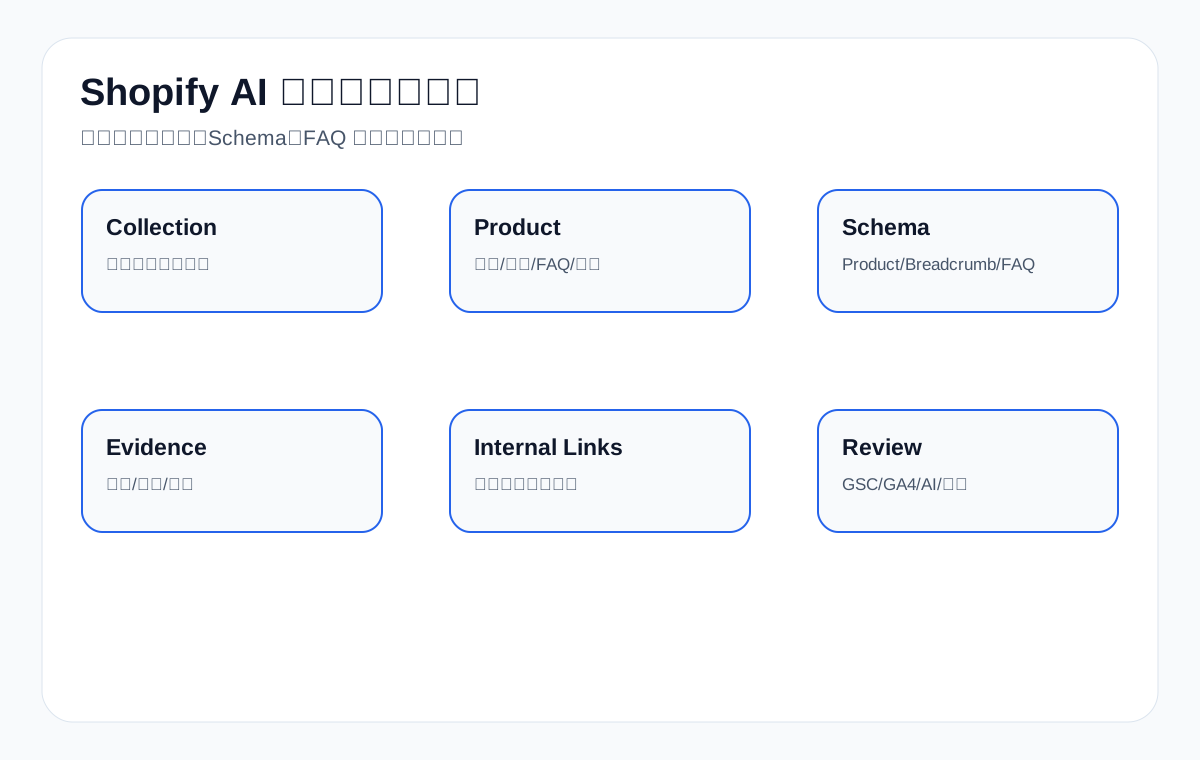
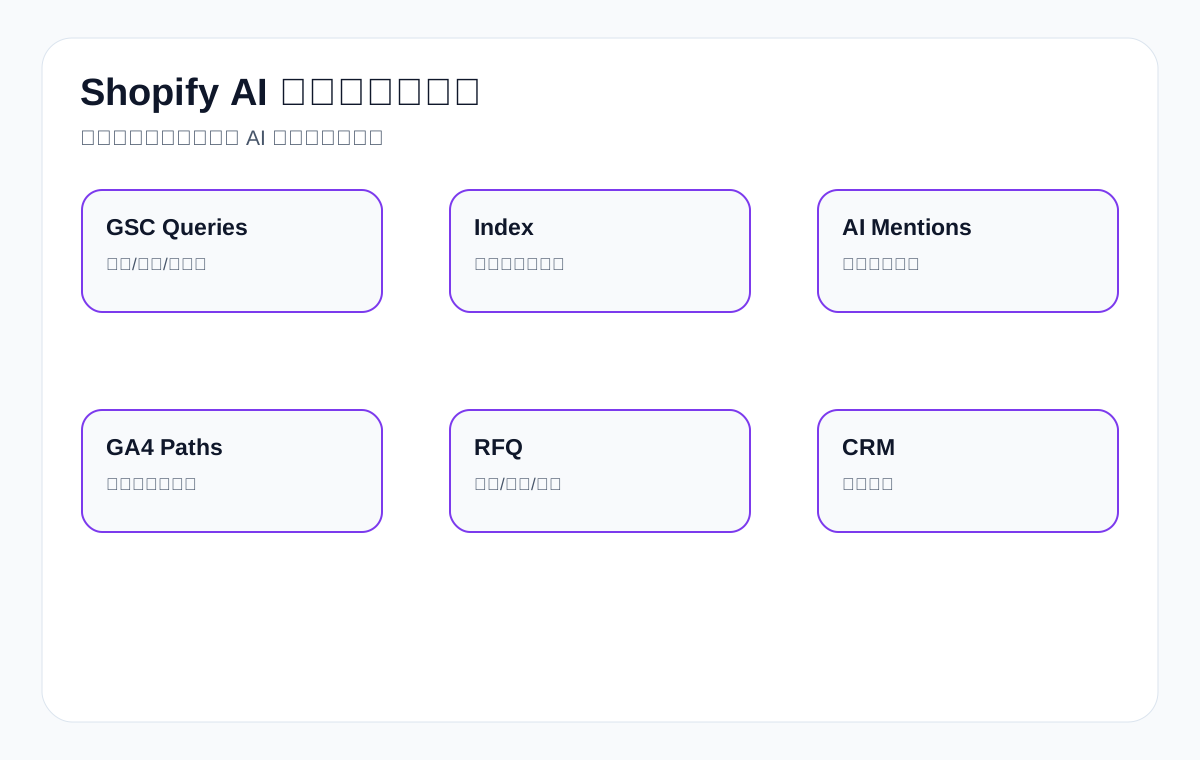
At the core of Shopify AI search visibility is not getting AI to recommend one store on a fixed basis, but making your collection pages, product pages, application pages, blog, and inquiry pages clear, credible, and structured enough for systems such as Google, AI Overviews, ChatGPT, and Perplexity to understand product entities, application scenarios, parameter evidence, and purchasing paths.
This article is written for export factories and trading companies, using English product terms such as custom metal parts, LED flood light, packaging machine, medical probe, cnc machining parts, ceramic dinnerware, waterproof connector, industrial valve supplier, and private label activewear manufacturer to explain how Shopify collection and product pages should be written, which content is easier for search and AI systems to understand, and how to observe and review results with GSC, GA4, inquiry sources, CRM, and AI citations.
Top1 Benchmark Conclusion: Shopify Official Fundamentals + AI Visibility in Practice
This page uses Shopify’s official documentation on product SEO, collections, meta fields, and structured data/searchability, along with current practical guides on AI search visibility, ecommerce SEO, and GEO, as its authoritative benchmark. The benchmark material explains Shopify pages, titles, descriptions, URLs, images, structured data, and sitemaps, but it does not go into enough detail on collection pages, product parameters, RFQs, samples, MOQ, certifications, and AI citation reviews for export B2B scenarios.
This article fills that gap for export Shopify sites with a collection page matrix, product page fact tables, application pages, FAQs, Schema, image captions, internal links, and a 90-day review, and it stresses that no fixed AI placement is promised — only official-site fact assets that can be understood and cited.
Shopify AI Visibility Priority Table
| Priority | Page | What to Add | Review Metrics |
|---|---|---|---|
| P0 | Core collection pages | Product family descriptions, selection tables, FAQs, internal links | GSC impressions and indexing |
| P1 | Core product pages | Parameters, images, certifications, delivery, FAQs | Product term clicks and inquiries |
| P2 | Application pages | Scenario questions, recommended products, evidence | Application term impressions |
| P3 | Blog pages | Questions, comparisons, selection, links | Question terms and paths |
| P4 | Structured data | Product, Breadcrumb, FAQ | Rich results and understanding |
| P5 | Review | AI citations, GA4, CRM | Description accuracy and lead quality |
Boundaries of Official Evidence: What to Look at for Shopify Collection Pages, Product Pages, and AI Visibility
For an export Shopify site working on AI search visibility, you cannot just ask whether there is an AI plugin.
The more practical questions are: does the collection page clearly explain the product family, does the product page clearly state the facts about each item, is the structured data consistent with the visible page content, and can Search Console and GA4 be used to verify page performance and on-site behavior?
If these fundamentals are unclear, there is no stable material for AI scenarios to work with.
Mapping Table: Official Documentation and Shopify Page Verification Fields
| Official Documentation | Corresponding Page | What It Verifies |
|---|---|---|
| Shopify.dev: Collection object | Collection pages | A collection page should have readable basic information such as title, description, products, seo, and image. |
| Shopify.dev: Product object | Product pages | A product page should have product fact fields such as title, description, vendor, variants, options, metafields, and seo. |
| Shopify.dev: Liquid structured_data filter | Product pages and article pages | A Shopify theme can output structured data, but the page facts themselves still have to be clear; markup cannot replace content. |
| Shopify.dev: Unlisted product status | Product visibility | Unpublished or unlisted products may be noindex/nofollow, removed from the sitemap, or absent from collection paths, so their status needs to be checked. |
| Google Search Central: Product structured data | Product pages | Product structured data must match the visible page content, and fields such as price, availability, and reviews must be verifiable. |
| Google Search Central: Merchant listing structured data | Product listings | Product visibility involves more complete merchant fields such as price, availability, shipping, and returns. |
| Search Console Help: Performance report | Collection and product page performance | Clicks, impressions, CTR, average position, queries, and page dimensions should be reviewed separately. |
| Google Analytics Help: Recommended events for online sales | Purchase paths and inquiry paths | Events such as view_item, select_item, add_to_cart, and purchase can help you observe product paths. |
| OpenAI Platform: Bots | Crawler access | robots and logs need to be checked so that key collection pages and product pages are not accidentally restricted. |
| Bing Webmaster Blog: AI Performance | AI search monitoring | If it is visible in your account, you can observe the impressions, citations, and clicks reported by Bing AI Performance. |
AI Visibility Verification Checklist for Collection and Product Pages
| Page Type | Acceptable Approach | Warning Signs |
|---|---|---|
| Collection pages | Explain the product family, uses, materials, specification ranges, target industries, and purchasing considerations, and link to core product pages. | Only product cards, with no collection description and no criteria for purchasing decisions. |
| Product pages | State the model, specifications, materials, certifications, MOQ, lead time, packaging, application scenarios, customizable options, and common questions. | Copying supplier material only, with very short titles and descriptions and specifications scattered inside images. |
| Variants | Name colors, sizes, capacities, interfaces, and wattages clearly, and make variant differences readable in the body text or a table. | Variants labeled only A/B/C, so neither AI nor buyers can tell the difference. |
| Images | alt text and captions describe the product, angle, use, or key specifications. | Random image file names, with alt text that only says product image. |
| Structured data | Fields such as Product, Offer, and Review match the information visible on the page. | Information that is not visible on the page is written into Schema, or multiple plugins output conflicting markup. |
| Internal link paths | Blog pages explain the question, collection pages cover the product family, and product pages handle the specific inquiry. | Articles and product pages are not linked to each other, and collection pages sit like isolated islands. |
How to Write Shopify AI Visibility Conclusions When There Is No GSC Signal
A new export Shopify site often has no Search Console row data yet.
At this stage you can verify page facts, structured data, index status, GA4 events, and a baseline sample of AI answers. You cannot write that keyword rankings have already improved, or that a given AI platform now consistently cites the official site.
| Current Evidence | Conclusions You Can Write | Conclusions You Cannot Write |
|---|---|---|
| Collection and product pages now have fact tables | The product family, per-item parameters, and purchasing path on the pages are clearer. | AI will definitely show these pages first. |
| Product and Merchant listing structured data has been checked | Consistency between product fields and visible page content has improved. | Structured data directly produces AI citations. |
| GSC has no query/page row data yet | There is not yet an analyzable sample of search performance; keep monitoring. | A certain keyword’s ranking has already improved. |
| GA4 product events have been configured | You can later observe view_item, select_item, add_to_cart, purchase, or inquiry events. | Current inquiries definitely come from AI search. |
| AI answer sampling has been set up | You can record answer changes against a fixed query set. | A single sample represents long-term performance. |
So the first step in Shopify AI search visibility is not chasing trending keywords. It is making collection pages work like entry points to a product family and product pages work like fact sheets. That way traditional search has content to crawl, and AI answers have facts to use.
Step 1: Define Shopify AI Search Visibility First
Shopify AI search visibility is not about getting AI to recommend one store on a fixed basis; it is about making collection pages, product pages, application pages, and resource pages clear, structured, and credible enough for search engines and AI answer systems to understand the product, scenarios, parameters, and purchasing path.
For an export Shopify site, the point is not showing off technical tricks, but making the official site a clear, credible source of information when overseas buyers search for a product, specifications, an application, supplier, manufacturer, sample, or MOQ.
For products such as custom metal parts, LED flood light, packaging machine, medical probe, cnc machining parts, ceramic dinnerware, waterproof connector, industrial valve supplier, and private label activewear manufacturer, the test is not how many features a page carries, but whether buyers and AI systems can understand what the product is, who it suits, what evidence supports it, and how to inquire next.
Step 2: Collection Pages Are the Entry Point for AI to Understand a Product Family
Shopify collection pages usually capture product-family and category terms. They cannot be just a product grid; they need to explain series differences, application scenarios, filtering logic, parameter ranges, certifications, FAQs, and the next step for inquiries.
For example, an LED flood light collection page should cover wattage, luminous efficacy, IP rating, beam angle, mounting height, and scenarios, rather than merely listing 20 product cards.
For products such as custom metal parts, LED flood light, packaging machine, medical probe, cnc machining parts, ceramic dinnerware, waterproof connector, industrial valve supplier, and private label activewear manufacturer, the test is not how many features a page carries, but whether buyers and AI systems can understand what the product is, who it suits, what evidence supports it, and how to inquire next.
Step 3: Product Pages Should Become Entity Fact Pages
For AI to understand a product, it needs stable facts: product name, model, material, specifications, images, use, certifications, packaging, delivery, samples, and common questions.
If a waterproof connector product page only says “high quality connector,” it is hard to understand accurately; if it clearly states IP rating, pin count, cable range, application, and data sheet, it is far more worth citing.
For products such as custom metal parts, LED flood light, packaging machine, medical probe, cnc machining parts, ceramic dinnerware, waterproof connector, industrial valve supplier, and private label activewear manufacturer, the test is not how many features a page carries, but whether buyers and AI systems can understand what the product is, who it suits, what evidence supports it, and how to inquire next.
Collection Page Content Module Table
| Module | Weak Approach | Strong Approach | Example |
|---|---|---|---|
| Above the fold | Product name only | Explain the product family, scenarios, and selection entry point | LED flood light for warehouse/outdoor |
| Filtering | Tags only | Explain wattage, material, certifications, and applications | IP65/IP66, wattage, beam angle |
| Table | No parameter comparison | Series/specification/application matrix | waterproof connector pin count |
| FAQ | No questions | Answer MOQ, samples, certifications, and lead time | private label activewear manufacturer |
| Internal links | Products only | Link to applications, blog, resources, and inquiries | packaging machine guide |
| Evidence | Slogans | Certifications, testing, resources, packaging | medical probe compatibility |
Step 4: Blog Pages Should Connect to Commercial Pages
A Shopify blog is well suited to capturing question terms such as how to, vs, guide, and checklist, but articles must link to the relevant collection, product, application, and RFQ pages.
If an article discusses packaging machine selection but does not link to the corresponding series and inquiry entry point, it is hard to form a commercial loop.
For products such as custom metal parts, LED flood light, packaging machine, medical probe, cnc machining parts, ceramic dinnerware, waterproof connector, industrial valve supplier, and private label activewear manufacturer, the test is not how many features a page carries, but whether buyers and AI systems can understand what the product is, who it suits, what evidence supports it, and how to inquire next.
Step 5: Application Pages Cover Industry Scenarios
Many B2B export products are searched by application rather than by product name. Shopify can use pages or blog posts to build application pages.
For example, waterproof connector for solar cable, LED flood light for warehouse, and packaging machine for frozen food each need their own explanation of the scenario, parameters, and recommended products.
For products such as custom metal parts, LED flood light, packaging machine, medical probe, cnc machining parts, ceramic dinnerware, waterproof connector, industrial valve supplier, and private label activewear manufacturer, the test is not how many features a page carries, but whether buyers and AI systems can understand what the product is, who it suits, what evidence supports it, and how to inquire next.
Step 6: Schema Cannot Replace Real Content
Structured data such as Product, Breadcrumb, FAQ, Review, and Organization helps machines understand, but it must be consistent with what the page actually displays.
Do not put prices, inventory, reviews, or promises into structured data that the page does not display.
For products such as custom metal parts, LED flood light, packaging machine, medical probe, cnc machining parts, ceramic dinnerware, waterproof connector, industrial valve supplier, and private label activewear manufacturer, the test is not how many features a page carries, but whether buyers and AI systems can understand what the product is, who it suits, what evidence supports it, and how to inquire next.
Product Page AI Comprehension Checklist
| Check Item | Why It Matters | Shopify Action | Export Example |
|---|---|---|---|
| Title | Entity and model recognition | Clear product title | M12 waterproof connector |
| Description | Explain use and differences | Put application and parameters above the fold | outdoor lighting cable |
| Images | Support multimodal understanding | alt + captions + detail shots | LED beam angle |
| Variants | Avoid confusion | Clear naming of specification variants | size/color/material |
| Schema | Strengthen structural understanding | Product/Offer/FAQ | cnc machining tolerance |
| Inquiry | Commercial conversion | RFQ form fields | drawing upload, MOQ |
Step 7: Image alt Text and Captions Should Support Purchasing Decisions
Shopify product images are often numerous, but if file names and alt text are messy, AI and search systems struggle to understand the details.
Images should describe the angle, structure, material, installation, packaging, application, and specifications, not just say product image.
For products such as custom metal parts, LED flood light, packaging machine, medical probe, cnc machining parts, ceramic dinnerware, waterproof connector, industrial valve supplier, and private label activewear manufacturer, the test is not how many features a page carries, but whether buyers and AI systems can understand what the product is, who it suits, what evidence supports it, and how to inquire next.
Step 8: Variant Naming Should Be Clear
If Shopify variants are labeled only option 1 and option 2, neither buyers nor systems can understand them. Variants should be named by real attributes such as material, size, color, wattage, interface, and packaging.
A private label activewear manufacturer can name variants by fabric, size range, color, and printing method.
For products such as custom metal parts, LED flood light, packaging machine, medical probe, cnc machining parts, ceramic dinnerware, waterproof connector, industrial valve supplier, and private label activewear manufacturer, the test is not how many features a page carries, but whether buyers and AI systems can understand what the product is, who it suits, what evidence supports it, and how to inquire next.
Step 9: Control Indexing of Collection Page Filters
Tags, filters, sorting, and parameter combinations generate a large number of URLs. Only filter combinations with search and commercial value are suitable for stable indexing.
For cnc machining parts, you can build stable pages for material and surface finish, but do not let every combination generate a thin page.
For products such as custom metal parts, LED flood light, packaging machine, medical probe, cnc machining parts, ceramic dinnerware, waterproof connector, industrial valve supplier, and private label activewear manufacturer, the test is not how many features a page carries, but whether buyers and AI systems can understand what the product is, who it suits, what evidence supports it, and how to inquire next.
AI-Citable Information Table
| Information Type | Page Location | How to Write It | Cautions |
|---|---|---|---|
| Definition | Above the fold/FAQ | Describe the product family in one sentence | Do not exaggerate |
| Parameters | Product page table | Range, units, conditions | Keep accurate |
| Certifications | Evidence module | Certificate type and applicable markets | Do not fake |
| Applications | Collection/application pages | Industry, environment, pain points | Link to products |
| Delivery | Product/inquiry pages | Samples, MOQ, packaging, lead time | Do not promise fixed results |
| Comparisons | Blog/collection pages | Suitable/unsuitable scenarios | Avoid absolutes |
Step 10: FAQs Should Come from Real Purchasing Questions
FAQs should not be generic. They should come from sales emails, forms, customer service, GSC queries, and competitor pages.
A medical probe page FAQ can answer compatibility, sterilization, material safety, sample testing, and documentation.
For products such as custom metal parts, LED flood light, packaging machine, medical probe, cnc machining parts, ceramic dinnerware, waterproof connector, industrial valve supplier, and private label activewear manufacturer, the test is not how many features a page carries, but whether buyers and AI systems can understand what the product is, who it suits, what evidence supports it, and how to inquire next.
Step 11: Reviews and Evidence Must Be Verifiable
AI visibility depends on credible facts. Certifications, testing, downloadable documents, packaging photos, factory capability, after-sales scope, and customer industries are all more valuable than vague slogans.
If there are no public case studies, do not fabricate them; you can describe your capability scope, quality process, and document list.
For products such as custom metal parts, LED flood light, packaging machine, medical probe, cnc machining parts, ceramic dinnerware, waterproof connector, industrial valve supplier, and private label activewear manufacturer, the test is not how many features a page carries, but whether buyers and AI systems can understand what the product is, who it suits, what evidence supports it, and how to inquire next.
Step 12: Internal Links Should Form Topic Paths
Collection pages link to products, applications, blog posts, and resources; blog posts link back to collections and products; product pages link to FAQs, resources, and inquiry pages.
This makes it easier for search and AI systems to understand the relationships between pages, and easier for buyers to complete their evaluation.
For products such as custom metal parts, LED flood light, packaging machine, medical probe, cnc machining parts, ceramic dinnerware, waterproof connector, industrial valve supplier, and private label activewear manufacturer, the test is not how many features a page carries, but whether buyers and AI systems can understand what the product is, who it suits, what evidence supports it, and how to inquire next.
90-Day Review Table
| Timeframe | Search Signals | AI Signals | Business Signals |
|---|---|---|---|
| 7 days | Indexing and accessibility | No AI judgment yet | Page paths working normally |
| 30 days | Product/collection queries appear | Sample checks for brand/page mentions | Complete inquiry form fields |
| 60 days | CTR and page match | Whether descriptions are accurate | Product inquiry quality |
| 90 days | Growth in application and question terms | Whether official-site facts are cited | CRM lead stage |
| Ongoing | Content decay and competitor changes | Changes in AI answers | Add FAQs from sales feedback |
Step 13: Start with Collection and Product Pages in GSC
Shopify AI visibility still starts with search data. GSC shows which queries surface collection pages and product pages.
If a collection page only appears for brand terms and not product-family terms, the content and internal links are not yet sufficient.
For products such as custom metal parts, LED flood light, packaging machine, medical probe, cnc machining parts, ceramic dinnerware, waterproof connector, industrial valve supplier, and private label activewear manufacturer, the test is not how many features a page carries, but whether buyers and AI systems can understand what the product is, who it suits, what evidence supports it, and how to inquire next.
Step 14: Use GA4 to Look at Paths, Not Just Traffic
After organic traffic lands on a collection page, does it continue to products? After landing on the blog, does it click through to products? Does the product page lead to an RFQ? These matter more than raw visit counts.
GA4 events and paths help you judge whether a page supports inquiries.
For products such as custom metal parts, LED flood light, packaging machine, medical probe, cnc machining parts, ceramic dinnerware, waterproof connector, industrial valve supplier, and private label activewear manufacturer, the test is not how many features a page carries, but whether buyers and AI systems can understand what the product is, who it suits, what evidence supports it, and how to inquire next.
Step 15: AI Citations Need Manual Sampling
You can regularly sample answers from ChatGPT, AI Overviews, Perplexity, and others using target product terms, application terms, and comparison terms to see whether they mention the official site or describe the brand/product accurately.
Do not treat a single mention as a fixed result; look at long-term trends and description accuracy.
For products such as custom metal parts, LED flood light, packaging machine, medical probe, cnc machining parts, ceramic dinnerware, waterproof connector, industrial valve supplier, and private label activewear manufacturer, the test is not how many features a page carries, but whether buyers and AI systems can understand what the product is, who it suits, what evidence supports it, and how to inquire next.
Shopify AI Visibility Priority Table
| Priority | Page | What to Add | Review Metrics |
|---|---|---|---|
| P0 | Core collection pages | Product family descriptions, selection tables, FAQs, internal links | GSC impressions and indexing |
| P1 | Core product pages | Parameters, images, certifications, delivery, FAQs | Product term clicks and inquiries |
| P2 | Application pages | Scenario questions, recommended products, evidence | Application term impressions |
| P3 | Blog pages | Questions, comparisons, selection, links | Question terms and paths |
| P4 | Structured data | Product, Breadcrumb, FAQ | Rich results and understanding |
| P5 | Review | AI citations, GA4, CRM | Description accuracy and lead quality |
Step 16: Do Not Write Empty Talk for AI
AI needs clear facts, not vague marketing. Parameters, tables, definitions, FAQs, image captions, downloadable material, and page relationships are more useful.
Writing content for buyers to read also makes it easier for AI to understand correctly.
For products such as custom metal parts, LED flood light, packaging machine, medical probe, cnc machining parts, ceramic dinnerware, waterproof connector, industrial valve supplier, and private label activewear manufacturer, the test is not how many features a page carries, but whether buyers and AI systems can understand what the product is, who it suits, what evidence supports it, and how to inquire next.
Step 17: Do Not Ignore Shopify Technical Fundamentals
Theme speed, mobile experience, image loading, canonical, collection URLs, product URLs, sitemap, robots, and structured data all affect crawling and understanding.
If product descriptions are loaded asynchronously by an app or key FAQs are not in the HTML, visibility may suffer.
For products such as custom metal parts, LED flood light, packaging machine, medical probe, cnc machining parts, ceramic dinnerware, waterproof connector, industrial valve supplier, and private label activewear manufacturer, the test is not how many features a page carries, but whether buyers and AI systems can understand what the product is, who it suits, what evidence supports it, and how to inquire next.
Step 18: Multilingual Shopify Sites Must Avoid Confusion
If you run a multilingual/multi-market Shopify store, you need to handle hreflang, market, currency, canonical, and localized content.
Pages for different markets cannot just switch currency; they also need local search terms, certifications, logistics, and FAQs.
For products such as custom metal parts, LED flood light, packaging machine, medical probe, cnc machining parts, ceramic dinnerware, waterproof connector, industrial valve supplier, and private label activewear manufacturer, the test is not how many features a page carries, but whether buyers and AI systems can understand what the product is, who it suits, what evidence supports it, and how to inquire next.
Collection Page Content Module Table
| Module | Weak Approach | Strong Approach | Example |
|---|---|---|---|
| Above the fold | Product name only | Explain the product family, scenarios, and selection entry point | LED flood light for warehouse/outdoor |
| Filtering | Tags only | Explain wattage, material, certifications, and applications | IP65/IP66, wattage, beam angle |
| Table | No parameter comparison | Series/specification/application matrix | waterproof connector pin count |
| FAQ | No questions | Answer MOQ, samples, certifications, and lead time | private label activewear manufacturer |
| Internal links | Products only | Link to applications, blog, resources, and inquiries | packaging machine guide |
| Evidence | Slogans | Certifications, testing, resources, packaging | medical probe compatibility |
Step 19: Common Mistake One: Installing an AI Plugin and Nothing Else
Tools cannot automatically build page facts. Without clear product pages, collection pages, FAQs, Schema, and internal links, a plugin’s help is limited.
Get the page content right first, then consider tools.
For products such as custom metal parts, LED flood light, packaging machine, medical probe, cnc machining parts, ceramic dinnerware, waterproof connector, industrial valve supplier, and private label activewear manufacturer, the test is not how many features a page carries, but whether buyers and AI systems can understand what the product is, who it suits, what evidence supports it, and how to inquire next.
Step 20: Common Mistake Two: Copying Supplier Material onto Product Pages
Duplicated material rarely creates differentiation. Add your own selection experience, packaging, samples, delivery, quality control, and inquiry information.
This is where an export Shopify site can go beyond an ordinary product list.
For products such as custom metal parts, LED flood light, packaging machine, medical probe, cnc machining parts, ceramic dinnerware, waterproof connector, industrial valve supplier, and private label activewear manufacturer, the test is not how many features a page carries, but whether buyers and AI systems can understand what the product is, who it suits, what evidence supports it, and how to inquire next.
Shopify AI Search Visibility Execution Checklist
- List core collection and product pages
- Add product family descriptions, selection tables, and FAQs to collection pages
- Add parameters, image captions, certifications, delivery details, and RFQ information to product pages
- Use the blog to capture question terms and link to collections/products
- Build application pages to capture industry scenario terms
- Check whether Product/Breadcrumb/FAQ Schema is truly consistent
- Optimize image file names, alt text, captions, and nearby text
- Control indexing of filter and tag pages
- Use GSC to see whether product/application/question terms appear
- Use GA4 to review the path from collection pages to product pages and RFQs
- Use CRM to assess inquiry country, product, quantity, and quality
- Regularly sample AI answers to check whether they describe official-site content accurately
Shopify AI Visibility Priority Table
| Priority | Page | What to Add | Review Metrics |
|---|---|---|---|
| P0 | Core collection pages | Product family descriptions, selection tables, FAQs, internal links | GSC impressions and indexing |
| P1 | Core product pages | Parameters, images, certifications, delivery, FAQs | Product term clicks and inquiries |
| P2 | Application pages | Scenario questions, recommended products, evidence | Application term impressions |
| P3 | Blog pages | Questions, comparisons, selection, links | Question terms and paths |
| P4 | Structured data | Product, Breadcrumb, FAQ | Rich results and understanding |
| P5 | Review | AI citations, GA4, CRM | Description accuracy and lead quality |
Collection Page Content Module Table
| Module | Weak Approach | Strong Approach | Example |
|---|---|---|---|
| Above the fold | Product name only | Explain the product family, scenarios, and selection entry point | LED flood light for warehouse/outdoor |
| Filtering | Tags only | Explain wattage, material, certifications, and applications | IP65/IP66, wattage, beam angle |
| Table | No parameter comparison | Series/specification/application matrix | waterproof connector pin count |
| FAQ | No questions | Answer MOQ, samples, certifications, and lead time | private label activewear manufacturer |
| Internal links | Products only | Link to applications, blog, resources, and inquiries | packaging machine guide |
| Evidence | Slogans | Certifications, testing, resources, packaging | medical probe compatibility |
Product Page AI Comprehension Checklist
| Check Item | Why It Matters | Shopify Action | Export Example |
|---|---|---|---|
| Title | Entity and model recognition | Clear product title | M12 waterproof connector |
| Description | Explain use and differences | Put application and parameters above the fold | outdoor lighting cable |
| Images | Support multimodal understanding | alt + captions + detail shots | LED beam angle |
| Variants | Avoid confusion | Clear naming of specification variants | size/color/material |
| Schema | Strengthen structural understanding | Product/Offer/FAQ | cnc machining tolerance |
| Inquiry | Commercial conversion | RFQ form fields | drawing upload, MOQ |
AI-Citable Information Table
| Information Type | Page Location | How to Write It | Cautions |
|---|---|---|---|
| Definition | Above the fold/FAQ | Describe the product family in one sentence | Do not exaggerate |
| Parameters | Product page table | Range, units, conditions | Keep accurate |
| Certifications | Evidence module | Certificate type and applicable markets | Do not fake |
| Applications | Collection/application pages | Industry, environment, pain points | Link to products |
| Delivery | Product/inquiry pages | Samples, MOQ, packaging, lead time | Do not promise fixed results |
| Comparisons | Blog/collection pages | Suitable/unsuitable scenarios | Avoid absolutes |
90-Day Review Table
| Timeframe | Search Signals | AI Signals | Business Signals |
|---|---|---|---|
| 7 days | Indexing and accessibility | No AI judgment yet | Page paths working normally |
| 30 days | Product/collection queries appear | Sample checks for brand/page mentions | Complete inquiry form fields |
| 60 days | CTR and page match | Whether descriptions are accurate | Product inquiry quality |
| 90 days | Growth in application and question terms | Whether official-site facts are cited | CRM lead stage |
| Ongoing | Content decay and competitor changes | Changes in AI answers | Add FAQs from sales feedback |
Supplement: Different Business Models for Export Shopify Sites and Their Focus Areas
Shopify is not only for small retail goods; export companies also often use it to present product catalogs, receive sample inquiries, manage product documentation, and test overseas markets. The AI search visibility focus differs by business model: DTC retail cares more about price, reviews, inventory, shipping, and returns; B2B export cares more about specifications, certifications, MOQ, samples, drawings, customization, packaging, lead time, and sales follow-up; a hybrid site needs to distinguish products that can be ordered directly from products that require an inquiry.
For that reason, custom or engineering products such as custom metal parts, cnc machining parts, and industrial valve supplier should not be forced into a simple shopping cart page; instead, make the RFQ, drawing upload, materials, tolerances, applications, and quality control clear. For products that can be sampled and organized into series, such as ceramic dinnerware and private label activewear manufacturer, add series, colors, sizes, packaging, MOQ, and the sampling process. The more closely a page matches the real purchasing path, the more easily it can be understood at the same time by search systems, AI answers, and overseas buyers.
FAQ: Common Questions About Shopify AI Search Visibility
Is Shopify AI search visibility the same as GEO?
It includes GEO thinking, but it is more specific to Shopify collection pages, product pages, structured data, images, internal links, and inquiry reviews.
Can changing Schema alone improve AI citations?
Not guaranteed. Schema helps understanding, but the page’s real content, evidence, FAQs, image captions, and brand credibility matter just as much.
Do collection pages need a lot of text?
You do not necessarily need to pile on words, but you do need to explain the product family, selection logic, parameter ranges, application scenarios, FAQs, and related products clearly.
What should product page FAQs cover?
Write the questions buyers actually ask: materials, specifications, certifications, samples, MOQ, lead time, compatibility, packaging, after-sales support, and document downloads.
How should AI citations be reviewed?
Regularly sample AI answers using target product terms, application terms, and question terms to see whether they mention the official site, whether the description is accurate, and whether they cite the wrong competitors.
Are Shopify blogs still useful?
Yes, but they should serve product and application pages. The blog explains questions, comparisons, and selection, and guides readers toward collections, products, and RFQs.
Does not publishing prices on a B2B Shopify site hurt SEO?
Not necessarily. For custom products, you can clearly explain the quoting method, samples, MOQ, parameters, and inquiry fields; you do not have to fake a fixed price.
Can you guarantee that AI will consistently recommend my website?
No. AI answers are affected by sources, real-time results, the query, the model, and competition. What you can do is improve the clarity of the official site’s facts and its chances of being understood.
Conclusion: Shopify AI Visibility Comes from Clear Product Facts and Purchasing Paths
To improve AI search visibility, an export Shopify site cannot rely on plugins or slogans alone. It should turn the collection pages, product pages, application pages, blog, images, Schema, FAQs, internal links, and RFQ paths for products such as custom metal parts, LED flood light, packaging machine, medical probe, cnc machining parts, ceramic dinnerware, waterproof connector, industrial valve supplier, and private label activewear manufacturer into stable fact assets, then review them over the long term with GSC, GA4, CRM, and AI citations. That is what makes a site easier for search systems, AI answers, and real buyers to understand.
Continue Reading This GEO Series
If you are studying GEO and AI search visibility systematically, the following articles are a good next step. Start with the concepts, then move on to diagnosis, monitoring, content structure, and the boundaries of collaboration.
- How to Build B2B Export AI Search Visibility: A Guide to Getting Inquiry and Solution Terms into AI Answers
- How to Build WooCommerce AI Search Visibility: A Guide to Category Pages, Product Pages, and Schema Optimization
- What a GEO Visibility Diagnosis Includes: AI Answers, Entity Consistency, Citation Sources, and Review
- How to Read a GEO Diagnosis Report: A Guide to Judging AI Answers, Citation Sources, and Entity Consistency
- How to Monitor AI Search Visibility: A Checklist for Export Website Brand Mentions, Official-Site Citations, and Competitor Answers
- How to Choose GEO Monitoring Tools: Where to Look for Mentions, Citations, and Traffic
{
“@context”: “https://schema.org”,
“@type”: “FAQPage”,
“mainEntity”: [
{
“@type”: “Question”,
“name”: “Collection Page Content Module TableModuleWeak ApproachStrong ApproachExampleAbove the foldProduct name onlyExplain the product family, scenarios, and selection entry pointLED flood light for warehouse/outdoorFilteringTags onlyExplain wattage, material, certifications, and applicationsIP65/IP66, wattage, beam angleTableNo parameter comparisonSeries/specification/application matrixwaterproof connector pin countFAQNo questionsAnswer MOQ, samples, certifications, and lead timeprivate label activewear manufacturerInternal linksProducts onlyLink to applications, blog, resources, and inquiriespackaging machine guideEvidenceSlogansCertifications, testing, resources, packagingmedical probe compatibilitynStep 4: Blog Pages Should Connect to Commercial PagesA Shopify blog is well suited to capturing question terms such as how to, vs, guide, and checklist, but articles must link to the relevant collection, product, application, and RFQ pages. If an article discusses packaging machine selection but does not link to the corresponding series and inquiry entry point, it is hard to form a commercial loop. For products such as custom metal parts, LED flood light, packaging machine, medical probe, cnc machining parts, ceramic dinnerware, waterproof connector, industrial valve supplier, and private label activewear manufacturer, the test is not how many features a page carries, but whether buyers and AI systems can understand what the product is, who it suits, what evidence supports it, and how to inquire next.nStep 5: Application Pages Cover Industry ScenariosMany B2B export products are searched by application rather than by product name. Shopify can use pages or blog posts to build application pages. For example, waterproof connector for solar cable, LED flood light for warehouse, and packaging machine for frozen food each need their own explanation of the scenario, parameters, and recommended products. For products such as custom metal parts, LED flood light, packaging machine, medical probe, cnc machining parts, ceramic dinnerware, waterproof connector, industrial valve supplier, and private label activewear manufacturer, the test is not how many features a page carries, but whether buyers and AI systems can understand what the product is, who it suits, what evidence supports it, and how to inquire next.nStep 6: Schema Cannot Replace Real ContentStructured data such as Product, Breadcrumb, FAQ, Review, and Organization helps machines understand, but it must be consistent with what the page actually displays. Do not put prices, inventory, reviews, or promises into structured data that the page does not display. For products such as custom metal parts, LED flood light, packaging machine, medical probe, cnc machining parts, ceramic dinnerware, waterproof connector, industrial valve supplier, and private label activewear manufacturer, the test is not how many features a page carries, but whether buyers and AI systems can understand what the product is, who it suits, what evidence supports it, and how to inquire next.nProduct Page AI Comprehension ChecklistCheck ItemWhy It MattersShopify ActionExport ExampleTitleEntity and model recognitionClear product titleM12 waterproof connectorDescriptionExplain use and differencesPut application and parameters above the foldoutdoor lighting cableImagesSupport multimodal understandingalt + captions + detail shotsLED beam angleVariantsAvoid confusionClear naming of specification variantssize/color/materialSchemaStrengthen structural understandingProduct/Offer/FAQcnc machining toleranceInquiryCommercial conversionRFQ form fieldsdrawing upload, MOQnStep 7: Image alt Text and Captions Should Support Purchasing DecisionsShopify product images are often numerous, but if file names and alt text are messy, AI and search systems struggle to understand the details. Images should describe the angle, structure, material, installation, packaging, application, and specifications, not just say product image. For products such as custom metal parts, LED flood light, packaging machine, medical probe, cnc machining parts, ceramic dinnerware, waterproof connector, industrial valve supplier, and private label activewear manufacturer, the test is not how many features a page carries, but whether buyers and AI systems can understand what the product is, who it suits, what evidence supports it, and how to inquire next.nStep 8: Variant Naming Should Be ClearIf Shopify variants are labeled only option 1 and option 2, neither buyers nor systems can understand them. Variants should be named by real attributes such as material, size, color, wattage, interface, and packaging. A private label activewear manufacturer can name variants by fabric, size range, color, and printing method. For products such as custom metal parts, LED flood light, packaging machine, medical probe, cnc machining parts, ceramic dinnerware, waterproof connector, industrial valve supplier, and private label activewear manufacturer, the test is not how many features a page carries, but whether buyers and AI systems can understand what the product is, who it suits, what evidence supports it, and how to inquire next.nStep 9: Control Indexing of Collection Page FiltersTags, filters, sorting, and parameter combinations generate a large number of URLs. Only filter combinations with search and commercial value are suitable for stable indexing. For cnc machining parts, you can build stable pages for material and surface finish, but do not let every combination generate a thin page. For products such as custom metal parts, LED flood light, packaging machine, medical probe, cnc machining parts, ceramic dinnerware, waterproof connector, industrial valve supplier, and private label activewear manufacturer, the test is not how many features a page carries, but whether buyers and AI systems can understand what the product is, who it suits, what evidence supports it, and how to inquire next.nAI-Citable Information TableInformation TypePage LocationHow to Write ItCautionsDefinitionAbove the fold/FAQDescribe the product family in one sentenceDo not exaggerateParametersProduct page tableRange, units, conditionsKeep accurateCertificationsEvidence moduleCertificate type and applicable marketsDo not fakeApplicationsCollection/application pagesIndustry, environment, pain pointsLink to productsDeliveryProduct/inquiry pagesSamples, MOQ, packaging, lead timeDo not promise fixed resultsComparisonsBlog/collection pagesSuitable/unsuitable scenariosAvoid absolutesnStep 10: FAQs Should Come from Real Purchasing QuestionsFAQs should not be generic. They should come from sales emails, forms, customer service, GSC queries, and competitor pages. A medical probe page FAQ can answer compatibility, sterilization, material safety, sample testing, and documentation. For products such as custom metal parts, LED flood light, packaging machine, medical probe, cnc machining parts, ceramic dinnerware, waterproof connector, industrial valve supplier, and private label activewear manufacturer, the test is not how many features a page carries, but whether buyers and AI systems can understand what the product is, who it suits, what evidence supports it, and how to inquire next.nStep 11: Reviews and Evidence Must Be VerifiableAI visibility depends on credible facts. Certifications, testing, downloadable documents, packaging photos, factory capability, after-sales scope, and customer industries are all more valuable than vague slogans. If there are no public case studies, do not fabricate them; you can describe your capability scope, quality process, and document list. For products such as custom metal parts, LED flood light, packaging machine, medical probe, cnc machining parts, ceramic dinnerware, waterproof connector, industrial valve supplier, and private label activewear manufacturer, the test is not how many features a page carries, but whether buyers and AI systems can understand what the product is, who it suits, what evidence supports it, and how to inquire next.nStep 12: Internal Links Should Form Topic PathsCollection pages link to products, applications, blog posts, and resources; blog posts link back to collections and products; product pages link to FAQs, resources, and inquiry pages. This makes it easier for search and AI systems to understand the relationships between pages, and easier for buyers to complete their evaluation. For products such as custom metal parts, LED flood light, packaging machine, medical probe, cnc machining parts, ceramic dinnerware, waterproof connector, industrial valve supplier, and private label activewear manufacturer, the test is not how many features a page carries, but whether buyers and AI systems can understand what the product is, who it suits, what evidence supports it, and how to inquire next.n90-Day Review TableTimeframeSearch SignalsAI SignalsBusiness Signals7 daysIndexing and accessibilityNo AI judgment yetPage paths working normally30 daysProduct/collection queries appearSample checks for brand/page mentionsComplete inquiry form fields60 daysCTR and page matchWhether descriptions are accurateProduct inquiry quality90 daysGrowth in application and question termsWhether official-site facts are citedCRM lead stageOngoingContent decay and competitor changesChanges in AI answersAdd FAQs from sales feedbacknStep 13: Start with Collection and Product Pages in GSCShopify AI visibility still starts with search data. GSC shows which queries surface collection pages and product pages. If a collection page only appears for brand terms and not product-family terms, the content and internal links are not yet sufficient. For products such as custom metal parts, LED flood light, packaging machine, medical probe, cnc machining parts, ceramic dinnerware, waterproof connector, industrial valve supplier, and private label activewear manufacturer, the test is not how many features a page carries, but whether buyers and AI systems can understand what the product is, who it suits, what evidence supports it, and how to inquire next.nStep 14: Use GA4 to Look at Paths, Not Just TrafficAfter organic traffic lands on a collection page, does it continue to products? After landing on the blog, does it click through to products? Does the product page lead to an RFQ? These matter more than raw visit counts. GA4 events and paths help you judge whether a page supports inquiries. For products such as custom metal parts, LED flood light, packaging machine, medical probe, cnc machining parts, ceramic dinnerware, waterproof connector, industrial valve supplier, and private label activewear manufacturer, the test is not how many features a page carries, but whether buyers and AI systems can understand what the product is, who it suits, what evidence supports it, and how to inquire next.nStep 15: AI Citations Need Manual SamplingYou can regularly sample answers from ChatGPT, AI Overviews, Perplexity, and others using target product terms, application terms, and comparison terms to see whether they mention the official site or describe the brand/product accurately. Do not treat a single mention as a fixed result; look at long-term trends and description accuracy. For products such as custom metal parts, LED flood light, packaging machine, medical probe, cnc machining parts, ceramic dinnerware, waterproof connector, industrial valve supplier, and private label activewear manufacturer, the test is not how many features a page carries, but whether buyers and AI systems can understand what the product is, who it suits, what evidence supports it, and how to inquire next.nShopify AI Visibility Priority TablePriorityPageWhat to AddReview MetricsP0Core collection pagesProduct family descriptions, selection tables, FAQs, internal linksGSC impressions and indexingP1Core product pagesParameters, images, certifications, delivery, FAQsProduct term clicks and inquiriesP2Application pagesScenario questions, recommended products, evidenceApplication term impressionsP3Blog pagesQuestions, comparisons, selection, linksQuestion terms and pathsP4Structured dataProduct, Breadcrumb, FAQRich results and understandingP5ReviewAI citations, GA4, CRMDescription accuracy and lead qualitynStep 16: Do Not Write Empty Talk for AIAI needs clear facts, not vague marketing. Parameters, tables, definitions, FAQs, image captions, downloadable material, and page relationships are more useful. Writing content for buyers to read also makes it easier for AI to understand correctly. For products such as custom metal parts, LED flood light, packaging machine, medical probe, cnc machining parts, ceramic dinnerware, waterproof connector, industrial valve supplier, and private label activewear manufacturer, the test is not how many features a page carries, but whether buyers and AI systems can understand what the product is, who it suits, what evidence supports it, and how to inquire next.nStep 17: Do Not Ignore Shopify Technical FundamentalsTheme speed, mobile experience, image loading, canonical, collection URLs, product URLs, sitemap, robots, and structured data all affect crawling and understanding. If product descriptions are loaded asynchronously by an app or key FAQs are not in the HTML, visibility may suffer. For products such as custom metal parts, LED flood light, packaging machine, medical probe, cnc machining parts, ceramic dinnerware, waterproof connector, industrial valve supplier, and private label activewear manufacturer, the test is not how many features a page carries, but whether buyers and AI systems can understand what the product is, who it suits, what evidence supports it, and how to inquire next.nStep 18: Multilingual Shopify Sites Must Avoid ConfusionIf you run a multilingual/multi-market Shopify store, you need to handle hreflang, market, currency, canonical, and localized content. Pages for different markets cannot just switch currency; they also need local search terms, certifications, logistics, and FAQs. For products such as custom metal parts, LED flood light, packaging machine, medical probe, cnc machining parts, ceramic dinnerware, waterproof connector, industrial valve supplier, and private label activewear manufacturer, the test is not how many features a page carries, but whether buyers and AI systems can understand what the product is, who it suits, what evidence supports it, and how to inquire next.nCollection Page Content Module TableModuleWeak ApproachStrong ApproachExampleAbove the foldProduct name onlyExplain the product family, scenarios, and selection entry pointLED flood light for warehouse/outdoorFilteringTags onlyExplain wattage, material, certifications, and applicationsIP65/IP66, wattage, beam angleTableNo parameter comparisonSeries/specification/application matrixwaterproof connector pin countFAQNo questionsAnswer MOQ, samples, certifications, and lead timeprivate label activewear manufacturerInternal linksProducts onlyLink to applications, blog, resources, and inquiriespackaging machine guideEvidenceSlogansCertifications, testing, resources, packagingmedical probe compatibilitynStep 19: Common Mistake One: Installing an AI Plugin and Nothing ElseTools cannot automatically build page facts. Without clear product pages, collection pages, FAQs, Schema, and internal links, a plugin’s help is limited. Get the page content right first, then consider tools. For products such as custom metal parts, LED flood light, packaging machine, medical probe, cnc machining parts, ceramic dinnerware, waterproof connector, industrial valve supplier, and private label activewear manufacturer, the test is not how many features a page carries, but whether buyers and AI systems can understand what the product is, who it suits, what evidence supports it, and how to inquire next.nStep 20: Common Mistake Two: Copying Supplier Material onto Product PagesDuplicated material rarely creates differentiation. Add your own selection experience, packaging, samples, delivery, quality control, and inquiry information. This is where an export Shopify site can go beyond an ordinary product list. For products such as custom metal parts, LED flood light, packaging machine, medical probe, cnc machining parts, ceramic dinnerware, waterproof connector, industrial valve supplier, and private label activewear manufacturer, the test is not how many features a page carries, but whether buyers and AI systems can understand what the product is, who it suits, what evidence supports it, and how to inquire next.nShopify AI Search Visibility Execution ChecklistnList core collection and product pagesAdd product family descriptions, selection tables, and FAQs to collection pagesAdd parameters, image captions, certifications, delivery details, and RFQ information to product pagesUse the blog to capture question terms and link to collections/productsBuild application pages to capture industry scenario termsCheck whether Product/Breadcrumb/FAQ Schema is truly consistentOptimize image file names, alt text, captions, and nearby textControl indexing of filter and tag pagesUse GSC to see whether product/application/question terms appearUse GA4 to review the path from collection pages to product pages and RFQsUse CRM to assess inquiry country, product, quantity, and qualityRegularly sample AI answers to check whether they describe official-site content accuratelynShopify AI Visibility Priority TablePriorityPageWhat to AddReview MetricsP0Core collection pagesProduct family descriptions, selection tables, FAQs, internal linksGSC impressions and indexingP1Core product pagesParameters, images, certifications, delivery, FAQsProduct term clicks and inquiriesP2Application pagesScenario questions, recommended products, evidenceApplication term impressionsP3Blog pagesQuestions, comparisons, selection, linksQuestion terms and pathsP4Structured dataProduct, Breadcrumb, FAQRich results and understandingP5ReviewAI citations, GA4, CRMDescription accuracy and lead qualitynCollection Page Content Module TableModuleWeak ApproachStrong ApproachExampleAbove the foldProduct name onlyExplain the product family, scenarios, and selection entry pointLED flood light for warehouse/outdoorFilteringTags onlyExplain wattage, material, certifications, and applicationsIP65/IP66, wattage, beam angleTableNo parameter comparisonSeries/specification/application matrixwaterproof connector pin countFAQNo questionsAnswer MOQ, samples, certifications, and lead timeprivate label activewear manufacturerInternal linksProducts onlyLink to applications, blog, resources, and inquiriespackaging machine guideEvidenceSlogansCertifications, testing, resources, packagingmedical probe compatibilitynProduct Page AI Comprehension ChecklistCheck ItemWhy It MattersShopify ActionExport ExampleTitleEntity and model recognitionClear product titleM12 waterproof connectorDescriptionExplain use and differencesPut application and parameters above the foldoutdoor lighting cableImagesSupport multimodal understandingalt + captions + detail shotsLED beam angleVariantsAvoid confusionClear naming of specification variantssize/color/materialSchemaStrengthen structural understandingProduct/Offer/FAQcnc machining toleranceInquiryCommercial conversionRFQ form fieldsdrawing upload, MOQnAI-Citable Information TableInformation TypePage LocationHow to Write ItCautionsDefinitionAbove the fold/FAQDescribe the product family in one sentenceDo not exaggerateParametersProduct page tableRange, units, conditionsKeep accurateCertificationsEvidence moduleCertificate type and applicable marketsDo not fakeApplicationsCollection/application pagesIndustry, environment, pain pointsLink to productsDeliveryProduct/inquiry pagesSamples, MOQ, packaging, lead timeDo not promise fixed resultsComparisonsBlog/collection pagesSuitable/unsuitable scenariosAvoid absolutesn90-Day Review TableTimeframeSearch SignalsAI SignalsBusiness Signals7 daysIndexing and accessibilityNo AI judgment yetPage paths working normally30 daysProduct/collection queries appearSample checks for brand/page mentionsComplete inquiry form fields60 daysCTR and page matchWhether descriptions are accurateProduct inquiry quality90 daysGrowth in application and question termsWhether official-site facts are citedCRM lead stageOngoingContent decay and competitor changesChanges in AI answersAdd FAQs from sales feedbacknnSupplement: Different Business Models for Export Shopify Sites and Their Focus AreasnShopify is not only for small retail goods; export companies also often use it to present product catalogs, receive sample inquiries, manage product documentation, and test overseas markets. The AI search visibility focus differs by business model: DTC retail cares more about price, reviews, inventory, shipping, and returns; B2B export cares more about specifications, certifications, MOQ, samples, drawings, customization, packaging, lead time, and sales follow-up; a hybrid site needs to distinguish products that can be ordered directly from products that require an inquiry.nFor that reason, custom or engineering products such as custom metal parts, cnc machining parts, and industrial valve supplier should not be forced into a simple shopping cart page; instead, make the RFQ, drawing upload, materials, tolerances, applications, and quality control clear. For products that can be sampled and organized into series, such as ceramic dinnerware and private label activewear manufacturer, add series, colors, sizes, packaging, MOQ, and the sampling process. The more closely a page matches the real purchasing path, the more easily it can be understood at the same time by search systems, AI answers, and overseas buyers.nFAQ: Common Questions About Shopify AI Search VisibilitynIs Shopify AI search visibility the same as GEO?”,
“acceptedAnswer”: {
“@type”: “Answer”,
“text”: “It includes GEO thinking, but it is more specific to Shopify collection pages, product pages, structured data, images, internal links, and inquiry reviews.”
}
},
{
“@type”: “Question”,
“name”: “Can changing Schema alone improve AI citations?”,
“acceptedAnswer”: {
“@type”: “Answer”,
“text”: “Not guaranteed. Schema helps understanding, but the page’s real content, evidence, FAQs, image captions, and brand credibility matter just as much.”
}
},
{
“@type”: “Question”,
“name”: “Do collection pages need a lot of text?”,
“acceptedAnswer”: {
“@type”: “Answer”,
“text”: “You do not necessarily need to pile on words, but you do need to explain the product family, selection logic, parameter ranges, application scenarios, FAQs, and related products clearly.”
}
},
{
“@type”: “Question”,
“name”: “What should product page FAQs cover?”,
“acceptedAnswer”: {
“@type”: “Answer”,
“text”: “Write the questions buyers actually ask: materials, specifications, certifications, samples, MOQ, lead time, compatibility, packaging, after-sales support, and document downloads.”
}
},
{
“@type”: “Question”,
“name”: “How should AI citations be reviewed?”,
“acceptedAnswer”: {
“@type”: “Answer”,
“text”: “Regularly sample AI answers using target product terms, application terms, and question terms to see whether they mention the official site, whether the description is accurate, and whether they cite the wrong competitors.”
}
}
]
}
This page is machine-translated from the Simplified Chinese version and awaiting human review. It has not yet been proofread.