B2B export AI search visibility does not mean requiring ChatGPT, Gemini, Perplexity or Google AI Overviews to adopt a given company’s website. A more accurate goal is for AI systems, when answering overseas buyers’ questions, to correctly discover, understand, restate and cite your website content: what products you sell, which application scenarios they suit, and what specifications, certifications, lead times, MOQ, customisation capabilities and supporting documentation you have, plus how the buyer should judge the next step.
If you are a domestic export factory, foreign-trade manufacturer or trading company, genuinely valuable AI search visibility usually does not come from vague statements such as “we are very professional”. It comes from facts that machines and buyers can both read: which drawings custom metal parts can be machined to, whether an LED flood light suits a warehouse or a port, how a packaging machine matches production capacity, what material and certification requirements a medical probe has, how cnc machining parts are quoted, how ceramic dinnerware explains glaze and packaging, how to judge the IP rating of a waterproof connector, how an industrial valve supplier proves pressure resistance and material, and how a private label activewear manufacturer explains sampling, fabric, sizes and lead time.
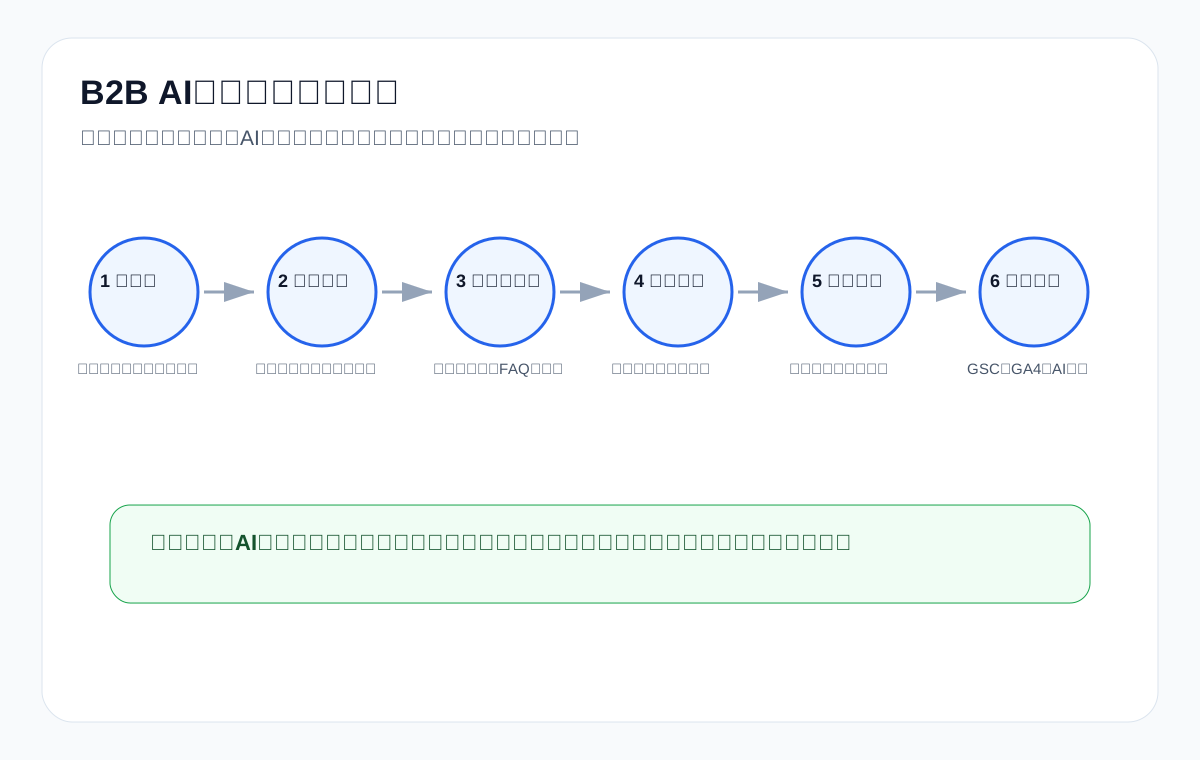
Official documentation boundaries: B2B export AI search visibility starts with page facts and data definitions
For a B2B export site working on AI search visibility, the first step is not chasing one platform’s answer but confirming whether the website has the foundation to be discovered, understood, restated and verified. For product lines such as custom metal parts, LED flood light, packaging machine, medical probe, waterproof connector, industrial valve supplier and private label activewear manufacturer, the controllable part of AI search visibility usually lies in page facts, URL discovery, crawl access, structured data, query sets, GSC, GA4, AI samples and inquiry fields.
Official documentation can help a company break “AI visibility” into verifiable fields, but it cannot turn external platform results into certainties. Whether a page can be crawled, whether it is included in the sitemap, whether the Schema matches visible content, whether query/page rows appear in GSC, whether GA4 records on-site events, and whether AI crawlers can access the site according to the rules can all be checked; when an AI answer adopts a page, whether it cites the website, and whether a buyer sends an inquiry can only be observed continuously against real data.
Mapping table: official documentation and B2B AI visibility verification fields
| Official documentation | Corresponding verification field | How a B2B export site checks it | What must not be claimed |
|---|---|---|---|
| Google Search Central: SEO Starter Guide | Basic page quality | Whether titles, body text, image captions, internal links and page purpose serve real purchasing judgement. | Must not be written as a specified search result or platform answer. |
| Google Search Central: Search Essentials | Basic search eligibility | Whether pages are accessible and indexable, and whether spammy and misleading content is avoided. | Basic compliance does not equal established search performance. |
| Google Search Central: AI features and your website | Basic boundaries of AI search | AI features still depend on accessible pages, clear content, structured data and basic search setup. | Must not promise that an AI answer will definitely adopt the website. |
| Google Search Central: Sitemaps overview | URL discovery path | Whether category pages, product pages, application pages, resource pages and key articles are included in the sitemap. | A URL appearing in the sitemap does not mean it has been adopted by search systems. |
| Google Search Central: robots.txt introduction | Crawl rules | Whether robots accidentally blocks product pages, images, PDFs, JS/CSS, search crawlers or AI-related access. | robots allowing access does not mean the page is indexed. |
| Google Search Central: Structured data general guidelines | Structured data boundaries | Whether Schema fields come from visible page content, and whether duplicate plugin output and fabricated fields are avoided. | Schema is not a display switch, nor a controller of AI answers. |
| Google Search Central: Product structured data | Product fact fields | Whether fields such as product name, image, description, brand, SKU and Offer match the facts on the export product page. | Must not fabricate price, stock, ratings, certifications or brand relationships. |
| Search Console Help: Performance report | GSC performance | Observe clicks, impressions, CTR and average position by query, page, country and device. | When there are no row data, rankings, clicks or CTR must not be invented. |
| Search Console Help: URL Inspection tool | Single URL status | Whether indexing, crawling, canonical and the version Google sees are consistent for key URLs. | A checkable single URL does not mean it will be shown. |
| Google Analytics Help: About events | On-site behaviour events | Whether actions such as forms, email, WhatsApp, downloads, RFQ and button clicks can be recorded. | GA4 events cannot replace conclusions about search or AI citations. |
| Google Analytics Help: Recommended events for online sales | Product path events | Events such as view_item, select_item, add_to_cart and purchase can help observe the product path. | A B2B inquiry site must also record RFQ, email and downloads separately. |
| OpenAI Platform: Bots | AI crawler access | The purpose and access boundaries of OAI-SearchBot, GPTBot and ChatGPT-User must be checked separately. | Allowing one bot access does not mean AI search results have changed. |
| Bing Webmaster Blog: AI Performance | Bing AI observation definitions | If visible in the account, citations, cited pages and grounding query phrases can be recorded. | A citation is not a ranking, an answer position or a business result. |
| IndexNow: Documentation | URL update notification | After adding, updating or deleting URLs, record the submission time, URL list and return status. | HTTP 200 only means the notification was received, not that indexing is complete. |
B2B export AI visibility baseline checklist: keep queries, pages, evidence and inquiries separate
Export companies often turn AI visibility into a single conceptual table: whether the brand appears, whether competitors appear, whether the answer cites anything. That table is only an observation table; it cannot replace a page baseline. A genuinely actionable baseline separates buyer questions, website URLs, page facts, technical status, AI samples, GSC/GA4 and inquiry fields.
| Baseline field | Minimum requirement | Export product example | Verification material |
|---|---|---|---|
| Query set | Group by product terms, application terms, supplier terms, solution terms, documentation terms and comparison terms. | waterproof connector for outdoor LED lighting, custom cnc machining parts with drawing. | Question ID, language, intent, corresponding URL and retest frequency. |
| Page mapping | Map each question to at least a homepage, category page, product page, application page, resource page or article page. | A warehouse lighting question about LED flood light should map to an application page, a category page and a specific product page. | URL table, page type, target question and internal link path. |
| Factual evidence | Product facts must be visible, including material, specifications, MOQ, lead time, certification, packaging, drawings and the sampling process. | A medical probe must state compatible models, materials, test documentation and sample requirements. | Specification tables, FAQ, certification notes, downloadable documents and image alt text. |
| Technical status | Status codes, index/follow, canonical, sitemap, robots, mobile tables and Schema must be reviewable. | The resource page and PDF summary for a packaging machine must not be blocked by mistake. | Source code, sitemap, robots, GSC URL inspection and mobile screenshots. |
| AI samples | Record the platform, date, question, answer summary, whether the website was cited, competitor sources and incorrect facts each time. | Pressure resistance, material and application questions for an industrial valve supplier must be recorded separately. | Sample table, screenshot IDs, cited URLs and retest dates. |
| On-site behaviour | Forms, email, WhatsApp, downloads, RFQ, product clicks and resource page visits must be separated. | A private label activewear manufacturer should look at inquiries about sampling, fabric, sizes and MOQ. | GA4 events, inquiry fields, sales feedback and page paths. |
How inquiry terms and solution terms land on pages: do not only write articles
Inquiry terms and solution terms do not have to live only in blog posts. The real questions of export buyers often need product pages, category pages, application scenario pages and resource pages to answer together. Blog posts explain the problem, category pages carry the product family, product pages carry models and specifications, and resource pages carry certificates, selection, installation, maintenance and downloads.
| Question type | Suitable host page | What the page should add | Wrong approach |
|---|---|---|---|
| Product terms | Category pages, product pages | Product family definition, representative models, specification range, certification, applications and an inquiry entry point. | Only stacking product cards with no product family explanation. |
| Inquiry terms | Product pages, RFQ page, resource pages | MOQ, lead time, drawing, sample, packing, custom options and the fields required for a quote. | Only writing Contact us without saying what information the buyer must submit. |
| Solution terms | Application pages, category pages, article pages | Scenario problems, selection criteria, applicable boundaries, risk reminders and candidate product paths. | Only writing a general industry introduction without connecting to product facts. |
| Documentation terms | Resource pages, product pages | certificate, datasheet, manual, installation, maintenance and a summary before download. | Hiding key specifications only inside images or PDFs. |
| Comparison terms | Article pages, category pages | Differences in material, process, interface, power, packaging, lead time, after-sales service and applicable scenarios. | Only writing “we are more professional” with no decision fields. |
With no GSC data, B2B AI visibility can only start with a baseline
If Search Console shows no query, page or page-query rows in the last 28 or 90 days, conclusions must be downgraded. At this stage you may say “the page baseline is established”, “the query set is established”, “the monitoring fields are established” and “the technical status has been reviewed”; you must not write that there are already rankings, clicks, CTR, AI citations or inquiry changes. Having no data is not a failure, but it requires a more restrained report.
| Current evidence | Can be written as | Must not be written as | Next review |
|---|---|---|---|
| No row data in GSC | No GSC baseline yet that allows judging search performance. | Search performance has improved. | Review query, page and page-query in 7-14 days. |
| Product facts added to pages | Page facts, structure and purchasing fields are more complete. | External platforms have adopted the page. | Check indexing status, logs, AI samples and GSC. |
| AI samples established | There is a repeatable question set and sample table for observation. | The samples represent long-term results or results in all regions. | Retest the same question set monthly and record the fluctuations. |
| GA4 events configured | Forms, email, downloads and RFQ actions can be observed going forward. | Event changes are directly equal to AI search results. | Combine with pages, sources, inquired products and sales feedback. |
| IndexNow submitted | The URL update notification has been sent. | The page has been indexed or has entered the answer environment. | Keep checking the sitemap, logs, GSC and Bing data. |
30-60-90 day review: look at GSC, GA4, AI samples and inquiry quality separately
After B2B AI visibility goes live, the biggest risk is lumping every change into one line about “how it performed”. A steadier review splits by 30-60-90 days: the first 30 days look at whether controllable actions landed, 60 days look at whether search and on-site behaviour have an observable baseline, and at 90 days AI samples, inquiry fields and sales feedback are brought together to decide the next round of priorities.
| Period | Review focus | Fields to record | What it helps judge |
|---|---|---|---|
| 0-30 days | robots, sitemap, index/follow, canonical, Schema, mobile tables, page facts and internal links. | URL, action, go-live date, review result, owner. | Whether the page baseline has landed. |
| 31-60 days | Whether query/page rows appear in GSC and whether GA4 events can be recorded. | query, page, country, device, events, downloads, forms, email clicks. | Whether observable data is starting to form. |
| 61-90 days | AI answer samples, Bing citations, inquired products, sales feedback and their relationship to page actions. | Platform, question, cited URL, competitor sources, inquiry fields, sales notes. | Which product line, page type and evidence module to fix first in the next round. |
Delivery boundaries: a page system can be delivered, platform results cannot
For an export company, credible AI search visibility delivery is not a promise about platform results but turning the website into a clearer evidence system. What can be delivered is the query set, URL mapping, page facts, technical review, structured data, monitoring tables, review cadence and data permissions; what can only be observed is search systems, AI platforms and buyer behaviour.
| Delivery scope | Can be delivered | Can only be observed | Verification evidence |
|---|---|---|---|
| Query system | A question set of product terms, application terms, supplier terms, documentation terms, comparison terms and competitor terms. | How platforms rewrite these questions over time. | Question table, categories, languages, URL mapping. |
| Page system | Strengthening fields on category pages, product pages, application pages, resource pages, article pages and inquiry pages. | Whether external platforms adopt a given page. | Before-and-after summaries, page source code, front-end screenshots. |
| Technical system | Review of robots, sitemap, index/follow, canonical, Schema and mobile tables. | When search systems crawl, index or display. | Status codes, sitemap, source code, official tests and GSC URL inspection. |
| Data system | Table definitions for GSC, GA4, Bing, AI samples, inquiry fields and sales feedback. | Trends, growth or business conclusions when there is no data. | Export files, sample tables, event lists and review dates. |
| Iteration system | 30-60-90 day reviews, the next round of URL lists, product fact completion and risk notes. | Buyer behaviour, platform changes and competitor actions. | Review reports, priority tables and to-be-verified lists. |
In current English search results and industry benchmarks, the top-ranking content mostly comes from B2B SaaS, AI visibility tools, GEO consultancies and marketing agencies. They usually discuss AI search entry points, LLM citations, brand mentions, structured content, cross-platform consistency, AI visibility monitoring and share of voice. Their value is separating AI search visibility from traditional rankings, but for Chinese export companies there is still an obvious gap: most examples revolve around SaaS or service brands and rarely explain how product pages, category pages, application scenario pages, resource pages and inquiry pages carry citable evidence.
Top1/authoritative benchmark comparison card
| Dimension | Where current Top1 or authoritative benchmarks do well | Where they still fall short for export companies | How this article fills the gap |
|---|---|---|---|
| Topic coverage | Explains AI search, GEO, LLM citations, brand mentions and monitoring | Most cases lean toward SaaS or marketing teams and lack export factory product terms | Breaks inquiry terms, solution terms, product specifications, application scenarios and RFQ paths into actionable modules |
| Content structure | Includes definitions, steps, tools and trend judgements | Page types are not split finely enough; the roles of product pages and category pages are unclear | Provides writing guidance separately for category pages, product pages, application pages, resource pages, article pages and inquiry pages |
| Evidence expression | Emphasises authority, entity consistency and citable content | Lacks B2B purchasing evidence such as MOQ, lead time, drawing and certificate | Provides specification tables, decision tables, FAQ, RFQ fields, downloadable documents and review metrics |
| Monitoring and review | Mentions AI visibility tracking and brand appearance frequency | Rarely combines GSC, GA4, inquiry sources and product line conversion | Builds four categories of metrics: GSC query terms, GA4 paths, inquiry fields, AI mentions and website citations |
Therefore this article will not write AI search visibility as an abstract concept, nor turn external platform results into certainties. The more reasonable approach is to make controllable actions solid: pages crawlable, content restatable, facts verifiable, entities consistent, internal links clear and the inquiry path smooth, then use data to observe whether they are gradually discovered and cited.
II. First, distinguish: AI search visibility and traditional ranking are not the same metric
Traditional search is easier to measure with keyword rankings, organic clicks, indexed page counts, CTR and conversion paths. AI search visibility is more complex, because an AI answer may first retrieve web pages, knowledge bases, reviews, forums, videos, news, company resource pages and structured data, then synthesise several sources into an answer. Even if a page ranks at the top of Google’s organic results, it is not necessarily cited in an AI answer; conversely, a page that is very clear in definitions, specifications, FAQ and factual evidence may be cited in some AI answers.
For an export company, the question is not only “can AI correctly understand the facts on our website”. A more professional question is: when an overseas buyer searches or asks “best waterproof connector supplier for outdoor LED lighting”, “custom cnc machining parts quote with drawing” or “private label activewear manufacturer MOQ and lead time”, can the AI answer correctly understand your product lines, capability boundaries and evidence pages? Will it cite the website? Will it guide the buyer to a product page, resource page or inquiry page?
Differences between AI search visibility and traditional SEO metrics
| Item | What traditional search optimisation usually looks at | What AI search visibility also looks at | Practical check for export companies |
|---|---|---|---|
| Entry point | Google search results and organic clicks | Answer environments such as ChatGPT, Gemini, Perplexity and AI Overviews | Whether buyers discover you through question sentences, comparison sentences and solution sentences |
| Page value | Keyword rankings and click-through rate | Whether the page is correctly summarised, cited, mentioned or used as evidence | Whether the product page has specification tables, FAQ, certificates and application notes |
| Content form | Body text, headings, internal links, external links | Definition paragraphs, lists, tables, entity consistency, verifiable facts | Whether MOQ, lead time, material, drawing and sample are stated clearly |
| Review method | GSC query terms, clicks, rankings | AI answer sampling, website citations, brand mentions, competitor co-occurrence | Build a fixed question set per product line and review monthly |
This is also why an export site cannot rely only on “keyword stacking”. AI systems need extractable information blocks: a one-sentence definition, applicable scenarios, specification boundaries, selection criteria, FAQ, evidence links and the next action. If a page only has a general introduction and no basis for purchasing judgement, it is hard for AI to treat it as a high-quality answer source.
III. Export AI query set: first list the questions buyers will ask
The first step in AI search visibility is not changing pages but building a query set. A query set is not simply a keyword list; it is the collection of questions a buyer might put to AI. It should cover product terms, inquiry terms, solution terms, comparison terms, documentation terms, risk terms and company judgement terms. Without a query set, content easily becomes a “company introduction” rather than the answers overseas buyers actually ask for.
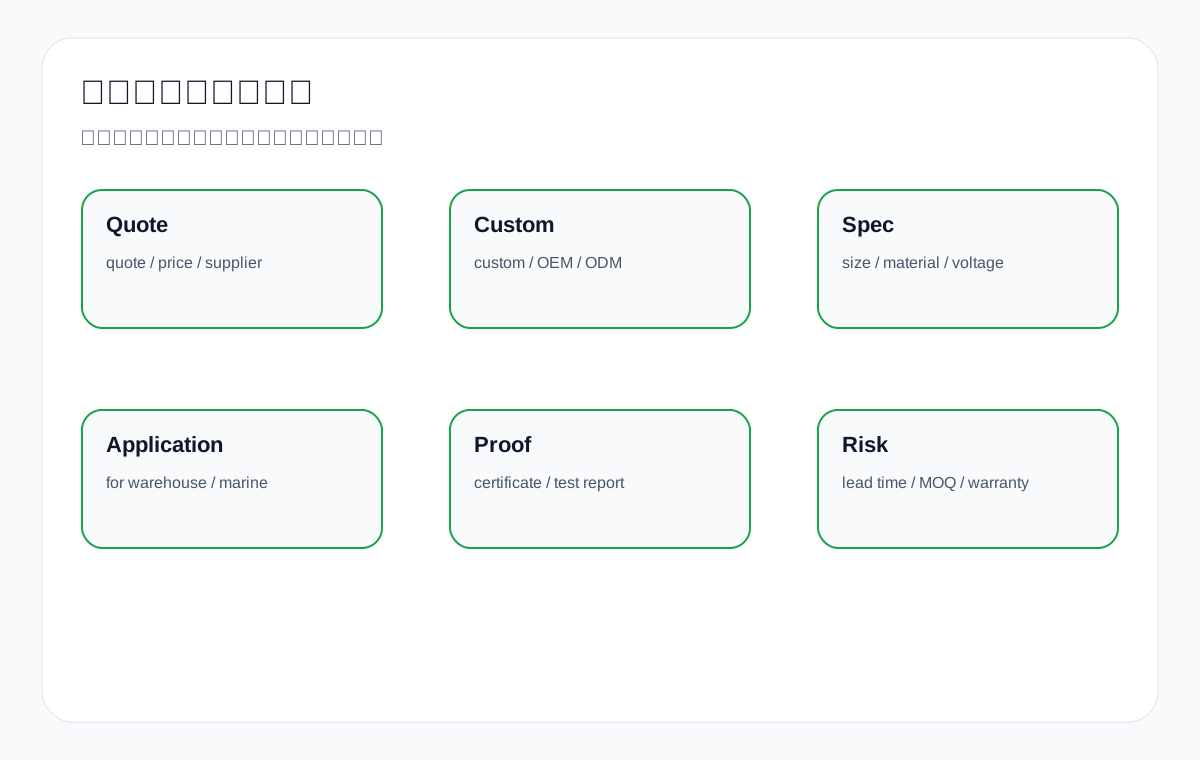
B2B export AI query type checklist
| Query type | How a buyer might ask | Suitable host page | What the content must answer |
|---|---|---|---|
| Product terms | waterproof connector for outdoor lighting | Category pages, product pages | Product type, IP rating, pin count, current, material, applicable environment |
| Inquiry terms | custom cnc machining parts quote with drawing | Product pages, inquiry pages, quoting guide | Drawing format, material, surface finish, quantity, quoting turnaround |
| Solution terms | LED flood light for warehouse high ceiling | Application pages, solution pages, category pages | Scenario problems, power selection, installation height, glare and maintenance |
| Comparison terms | ceramic dinnerware porcelain vs stoneware for wholesale | Comparison articles, category pages | Material differences, durability, packaging, minimum order quantity, target market |
| Documentation terms | industrial valve pressure test certificate | Resource pages, product pages | Test standards, certificate samples, material reports, usage boundaries |
| Risk terms | private label activewear manufacturer lead time risk | FAQ, process pages, inquiry pages | Sampling, fabric, sizes, packaging, lead time milestones and contingency plans |
The query set should be written in English, because most overseas buyers phrase their questions in English. Internal discussion in Chinese can be kept, but the examples on the page must be understandable to the team and must also make it easier for Google and AI systems to connect the page with real English purchasing demand. For example, do not just write “waterproof connector SEO terms”; write “waterproof connector for marine lighting”, “IP67 circular connector supplier” and “custom waterproof cable connector quote”.
IV. Page roles: not every page should compete for the same AI answer
A common problem with export websites is that every page says “high quality, customisation supported, inquiries welcome” but no page has a role. When an AI system sees such a site, it is hard to tell which page answers the product definition, which answers specification selection, which answers application scenarios and which answers the quoting process. The result is that pages blur into one another, hurting both traditional search and AI answer citations.
Page roles and AI visibility tasks
| Page type | Main task | Content blocks it must have | Suitable example |
|---|---|---|---|
| Category page | Explain the product family and the selection path | Type comparison, application scenarios, specification entry points, related questions | waterproof connector category split by IP rating and interface type |
| Product page | Prove that a product can solve a specific need | Specification table, material, certification, drawings, MOQ, lead time, FAQ | cnc machining parts product page explains material and tolerance range |
| Application page | Connect the purchasing scenario with the product solution | Scenario pain points, recommended products, selection criteria, installation/usage boundaries | LED flood light for warehouse recommended by height and illuminance |
| Resource page | Provide verifiable facts | datasheet, certificate, test report, installation guide | industrial valve pressure test report download notes |
| Article page | Explain the problem and the selection method | Steps, tables, misconceptions, case-style scenarios, internal links | packaging machine capacity calculation guide |
| Inquiry page | Capture the action demand that follows an AI answer | RFQ fields, file upload, samples, lead time, contact details | custom metal parts quote form requires a drawing upload |
If a page does not know what role it plays, do not rush to expand it. Ask three questions first: what kind of purchasing question does this page answer? Which next-step page should it lead to? If AI cites it, which sentence, table or FAQ passage should be cited most? If these three questions cannot be answered, the page is still at the general introduction stage.
V. How inquiry terms enter AI answers: write RFQ information as understandable modules
Inquiry terms usually carry a purchasing action, such as quote, price, supplier, manufacturer, custom, OEM, ODM, sample, drawing, MOQ, lead time, bulk order, wholesale and certificate. An export site must not only write “Contact us for quote” at the bottom of the page; it must place the information a buyer needs to judge before submitting an inquiry into the body text, tables and FAQ.
Inquiry term content modules
| Inquiry term | The buyer’s real question | Information the page should provide | Recommended wording |
|---|---|---|---|
| quote | What information is needed to quote | Material, dimensions, quantity, drawing, target market, packaging | For a custom metal parts quote, prepare drawing, material, tolerance, surface finish and order quantity. |
| sample | Can I get a sample first, and how long does it take | Sample scope, cost, turnaround, approval criteria | Sample lead time depends on mold, material and printing requirements. |
| MOQ | Whether the minimum order quantity is suitable | Varies by product, packaging, colour and degree of customisation | MOQ differs for stock ceramic dinnerware and custom logo packaging. |
| lead time | How to judge lead time risk | Milestones for sampling, approval, production, quality inspection and shipping | Lead time should be separated into sample approval and mass production. |
| drawing | Whether machining to drawings is supported | File formats, tolerances, material substitution, NDA requirements | CNC machining parts can be quoted from STEP, PDF or DWG drawings. |
This content is not only for people to read; it also gives AI systems citable purchasing facts. When AI answers “what information is needed for a custom cnc machining parts quote”, it is more likely to cite a page that clearly lists drawing, material, tolerance, finish, quantity and application than a page that only says “we provide high quality machining service”.
VI. How solution terms enter AI answers: write application scenarios into product evidence
Solution terms are closer to real purchasing demand than product terms. A buyer may not only ask “LED flood light” but “LED flood light for warehouse high ceiling”; not only “packaging machine” but “packaging machine for powder filling”; not only “industrial valve supplier” but “industrial valve supplier for chemical processing”. If the website has no application scenario pages, AI can only guess the use from generic product pages.
Solution term wording matrix
| Solution term | Decision dimensions the page must cover | Citable content blocks | Next-step link |
|---|---|---|---|
| warehouse lighting | Installation height, illuminance, glare, dust protection, maintenance | Power selection table, scenario diagram, FAQ | LED flood light category page and product page |
| powder packaging | Powder flowability, metering method, bag type, speed | Capacity calculation table, list of suitable materials | packaging machine product page and inquiry page |
| chemical processing valve | Medium, pressure, temperature, material, sealing | Material compatibility table, test certificate notes | industrial valve application page and resource page |
| private label activewear | Fabric, sizes, colours, logo, packaging | Sampling process, MOQ table, quality inspection checklist | activewear customisation process and inquiry page |
A solution term page is not a repeat of the product term; it answers “how should a buyer judge in this scenario”. For example, a waterproof connector page should explain what different scenarios such as outdoor lighting, marine equipment, solar systems and industrial control cabinets require in terms of IP rating, material, wiring method and temperature range. Only then does AI have enough information to use the page as part of a scenario answer.
VII. Citable content modules: AI more easily extracts clear structures
AI answers tend to extract content with clear structure, explicit facts and well-defined boundaries. An export site should break core information into citable modules rather than writing everything in one long paragraph. Citable modules include definition paragraphs, specification tables, selection tables, step lists, FAQ, glossary explanations, certificate notes, download document notes and inquiry field notes.
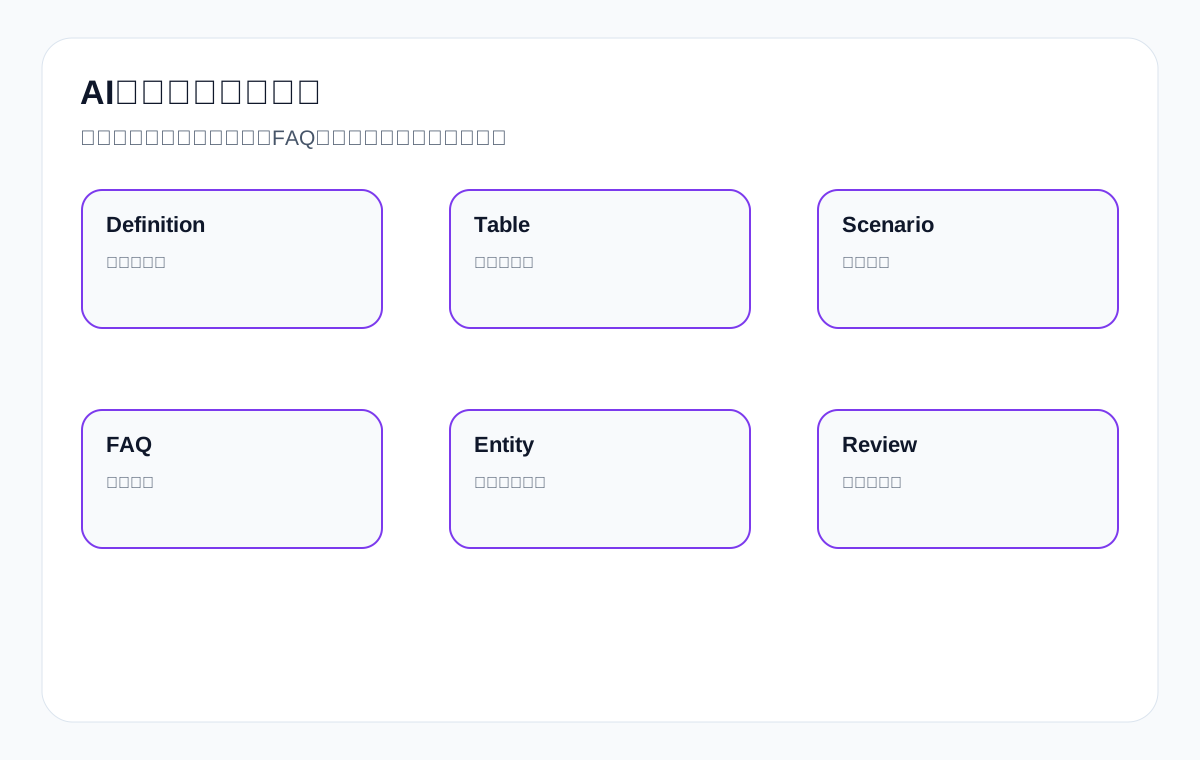
AI-citable content module checklist
| Module | Writing requirement | Export example | Wrong wording |
|---|---|---|---|
| Definition paragraph | Explain the product or concept in one or two sentences | A waterproof connector protects cable joints from water, dust and vibration in outdoor equipment. | Only writing “this product is high quality and widely used” |
| Specification table | List key specifications and applicable range | IP67/IP68, rated current, pin number, cable diameter | Hiding specifications in images with no text in the body |
| Selection table | Help buyers judge the model | Select a connector by installation environment, cable gauge, current and certification | Only giving a model list without explaining the differences |
| FAQ | Answer real purchasing questions | Can I get samples before bulk order? | Writing the FAQ as vague promotion |
| Document notes | Explain what certificates and downloadable files represent | Datasheet shows dimensions, material and electrical rating. | Only placing a download button with no explanation |
One practical principle: a page should have at least three types of content that can be excerpted and still stand on their own. For example, a product page can have a one-sentence definition, a specification table and a selection FAQ; an application page can have scenario questions, a recommended product table and risk reminders; a tutorial can have steps, a decision table and review metrics.
VIII. Entity consistency: let AI know who you are, what you sell and which markets you serve
AI systems understand a company not just from one article. They combine the website, about page, product pages, structured data, social media profiles, third-party sources, reviews and cited information. If the company name, brand description, product lines, market positioning, contact details and certification information are expressed inconsistently across pages, the stability of machine understanding decreases.
Entity consistency checklist
| Entity information | What should be unified | Export site example | How to review |
|---|---|---|---|
| Company name | English name, Chinese name, brand name spelling | Tianwen SEO Research Site is only this site’s brand; a client site must unify the manufacturer’s English name | Check the footer, about page, contact page and structured data |
| Product lines | Main products, subcategories, application areas | waterproof connectors, cable assemblies, industrial plugs | Whether category pages, product pages and article internal links are consistent |
| Market | Target countries or industries | Europe lighting distributors, North America OEM buyers | Whether pages state certification and application scenarios |
| Capability boundaries | The scope of customisation supported and not supported | Supports custom size; does not support medical implant use | Whether the FAQ and inquiry fields state this |
Entity consistency is not about packaging an image but about reducing ambiguity. If an AI answer cannot tell whether you are a manufacturer, supplier, trading company or distributor, it is hard for it to cite you accurately in supplier selection questions. An export website can state its identity honestly: a factory emphasises production, quality inspection, lead time and certification; a trading company emphasises product selection, supply chain integration, responsiveness and a multi-category portfolio, but it should not pretend to capabilities it cannot prove.
IX. Internal link paths: let both AI and buyers move from question to inquiry
AI search visibility is not about a single article. Even if an article is cited in an AI answer, if it does not lead to category pages, product pages, resource pages and inquiry pages, buyers still cannot move smoothly into judging and contacting. An export site should use internal links to turn question traffic into a path toward understanding products.
AI visibility internal link paths
| Starting page | Should link to | What the anchor text should express | Example |
|---|---|---|---|
| Tutorial article | Category pages, application pages, resource pages | The next step of judging product or scenario | View the IP67 waterproof connector selection table |
| Category page | Core product pages, application pages | Model differences and usage scenarios | Connectors for outdoor LED lighting |
| Product page | Resource pages, FAQ, inquiry pages | Download documents or submit a requirement | Download the datasheet or submit a drawing |
| Application page | Recommended products and inquiry pages | From scenario solution to product selection | Recommended models for warehouse LED flood light |
| Resource page | Product pages and inquiry pages | From evidence to purchasing action | Submit a valve requirement based on the pressure test report |
Anchor text should not mechanically repeat one word; it should describe what the user will get next. For example, “learn more” is not as good as “compare waterproof connector IP67 and IP68”; “Product Center” is not as good as “view CNC machining parts material and tolerance options”. This wording is clearer for buyers and friendlier for AI to understand page relationships.
X. Rewriting by page type: what each type of page should add
How to add AI visibility content to category pages
A category page must answer the question “which type of product should I look at”. For waterproof connectors, it can split by IP rating, interface form, current, cable gauge, installation method and application environment. For ceramic dinnerware, it can split by material, glaze, set composition, packaging and target market. A category page should not just stack product listings; it needs selection logic, common scenarios and relevant FAQ.
How to add AI visibility content to product pages
A product page must answer the question “is this model right for me”. It needs a text-based specification table, dimensions, material, certification, optional configurations, applicable scenarios, unsuitable scenarios, MOQ, samples, lead time, packaging and inquiry fields. When AI cites a product page, it usually needs stable facts, not promotional slogans.
How to add AI visibility content to application pages
An application page must answer the question “how should I choose for my scenario”. For example, LED flood light for warehouse should cover installation height, illuminance targets, power selection, glare control, dust protection, waterproofing and maintenance cost. An application page should link back to products and also link to the inquiry page.
How to add AI visibility content to resource pages
A resource page must answer the question “can I verify what you claim”. datasheets, certificates, test reports, installation guides and material compatibility charts all need explanatory text. Do not just place a download button; explain what the document contains, who should download it and how it is used for purchasing judgement afterwards.
How to add AI visibility content to inquiry pages
An inquiry page must answer the question “how do I submit a clear requirement”. RFQ fields should guide buyers to provide product type, target application, quantity, drawing, material, dimensions, certification, packaging, lead time and target market. The form copy should let customers know that the clearer the information, the more accurate the quote.
XI. Process: start with one small-scope revision
An export company does not need to revise the whole site at the start. A steadier approach is to choose one high-value product line for a small-scope validation. For example, start with waterproof connector or CNC machining parts, build the query set, select 5 to 10 key pages, add content modules and internal links, then observe changes in GSC, GA4, inquiries and AI answers.
30-day execution process
| Stage | Action | Deliverable | Acceptance criteria |
|---|---|---|---|
| Week 1 | Build the query set and page list | Product terms, inquiry terms, solution terms, page role table | Every query has a target page or a page to be created |
| Week 2 | Rewrite core category pages and product pages | Specification tables, FAQ, evidence modules, inquiry entry points | Pages are readable, crawlable and restatable |
| Week 3 | Add application pages and resource pages | Scenario decision tables, document notes, internal link paths | Articles, categories, products and documents are interconnected |
| Week 4 | Build the review question set | AI answer sampling table, GSC/GA4 metrics table | Able to record mentions, citations, competitors and inquiry changes |
If team resources are limited, the whole site can wait. Choose the product line with the highest profit, the greatest inquiry potential and the easiest evidence to explain. For example, a machinery equipment company can start with packaging machine for powder filling; an electronic components company can start with waterproof connector for outdoor lighting; a garment factory can start with private label activewear manufacturer.
XII. Quality criteria: how to know a page is suitable to be cited by AI
A page is not better the longer it is; it is better the clearer it is, the more evidence it has and the better it answers purchasing questions. Long-form content must deliver information gain: more than current benchmarks on export scenarios, purchasing judgement, product evidence and review methods. Rephrasing and padding the same sentence does not materially help AI search visibility.
Page quality scoring table
| Scoring item | Low-quality performance | Acceptable performance | Stronger performance |
|---|---|---|---|
| Query matching | Covers only one broad term | Covers product terms and inquiry terms | Covers product terms, solution terms, comparison terms and risk terms |
| Factual evidence | Only promotional language | Has specifications and FAQ | Has specifications, certificates, documents, application judgement and boundary notes |
| Page structure | Long paragraphs that are hard to extract | Clear H2/H3 | Complete definitions, tables, lists, FAQ and diagrams |
| Export scenarios | Generic examples | Uses English product terms | Built around the real purchasing process and RFQ fields |
| Review capability | No tracking after publishing | Looks at GSC and GA4 | Looks at GSC, GA4, inquiries, AI mentions and website citations together |
A page should answer at least four questions: why would a buyer search this question? What evidence does the page use to answer it? Where should the buyer click next after reading? What metric will judge effectiveness one month later? Only when all four questions are clear does the page have long-term asset value.
XIII. Monitoring and review: do not only ask whether you entered an AI answer
AI answers fluctuate; different tools, regions, login states, languages and times can all affect results. Reviews should therefore use a fixed question set, a fixed recording method and a fixed frequency, rather than drawing conclusions from a few random questions. It is advisable to build 20 to 50 English questions per product line, classified by product terms, inquiry terms, solution terms, comparison terms and risk terms.
AI search visibility review metrics
| Metric | How to record | What it shows | Cautions |
|---|---|---|---|
| GSC query terms | Look at impressions, clicks, average position and CTR | Whether traditional search is starting to cover related demand | Do not look only at brand terms; look at product terms and solution terms |
| GA4 paths | Look at organic landing pages, next pages and form events | Whether users move from content into product and inquiry paths | Distinguish article pages, category pages and product pages |
| Inquiry sources | Add source, landing page and product line fields to forms | Which pages actually bring valid inquiries | Do not count only total inquiries; look at quality |
| AI mentions | Use a fixed question set to sample and record whether the brand or product is mentioned | Whether the brand and products are understood by AI | Record the same question multiple times and with multiple tools |
| Website citations | Record whether the AI answer provides a website link or page basis | Whether the content becomes an evidence source | A single citation must not be treated as a long-term result |
| Competitor co-occurrence | Record which competitors appear at the same time | Judge content gaps and trust gaps | Do not focus only on yourself; also analyse competitor evidence |
During reviews, avoid treating an AI answer as the only goal. For an export website, what matters more is: whether impressions for product terms grow, whether solution terms start getting clicks, whether product pages gain more organic entry points, whether inquiry fields are more complete, and whether buyers make contact with a clearer product requirement. AI citations are one observation dimension, not the only acceptance standard.
XIV. Common misconceptions: these practices weaken content
Writing only concepts, not product facts
Many pages discuss AI search, GEO and visibility but have no product terms, specifications, scenarios, MOQ, lead time or FAQ. For an export company, such content can hardly support purchasing judgement.
Using your own industry terms as the main examples
If a page targets export factories but uses “a certain optimisation service” or “a certain consulting service” as most of its examples, it drifts away from the client’s real business. Examples should be replaced with English product terms such as custom metal parts, LED flood light and packaging machine.
Mistaking platform results for delivery results
AI answers are determined by multiple factors, so it is not possible to promise that a page will be consistently adopted. The safer framing is to raise the probability of being discovered, understood, cited and verified, and to review with metrics.
Changing only articles, not product pages
AI search visibility needs an evidence chain. However well an article is written, if the product page has no specifications, documents, FAQ or inquiry path, both AI and buyers lack a basis for the next step.
Writing content as internal notes
A client-facing page must not use an internal execution tone. It should start from buyer questions, decision criteria, risks and next actions, not describe how the team arranges its work.
Neglecting resource pages and certificate notes
B2B export purchasing often needs datasheets, certificates, test reports and installation guides. The clearer the resource page notes, the more easily the page becomes credible evidence.
XV. FAQ: common questions about AI search visibility for export companies
Is AI search visibility the same as traditional SEO ranking?
No. Traditional SEO ranking mainly looks at position and clicks on the search results page; AI search visibility also looks at whether AI answers correctly understand, mention, restate or cite your website. The two are related but are not the same metric.
Should an export website now create dedicated GEO or AI search content?
Yes, but do not detach it from products and purchasing scenarios. It is better to first turn existing category pages, product pages, application pages, resource pages and FAQ into content that is crawlable, verifiable and restatable, and then expand into topic articles.
How should the first batch of product lines to optimise be chosen?
Prioritise product lines with high profit, high inquiry value, clear English search demand and product evidence that is easy to explain. Examples include waterproof connector, cnc machining parts and packaging machine, which allow specifications, scenarios and inquiry fields to be written out.
If an AI answer does not cite the website, does that mean the content failed?
Do not judge by a single result. AI answers fluctuate and are affected by the tool and the time. Use a fixed question set, record brand mentions, website citations and competitor co-occurrence monthly, and also look at GSC, GA4 and inquiry quality.
How long should a product page be?
A product page does not have to be especially long, but it must carry enough information for purchasing judgement. Specification tables, application scenarios, FAQ, MOQ, lead time, documents, certificates and inquiry fields matter more than vague padding.
How should articles and product pages work together?
Articles answer questions and methods, category pages explain the product family, product pages prove specific specifications, application pages carry scenarios, resource pages provide evidence and inquiry pages collect requirements. Every page type should be connected with internal links.
Can AI be used to generate large amounts of content to cover queries?
Chasing volume alone is not advisable. Export AI search visibility values facts, evidence, page roles and consistency more. Large amounts of content without product specifications, documents and real purchasing logic easily become low-value pages.
Is structured data required?
Structured data helps, but it cannot replace facts in the body text. Structured data for products, FAQ, breadcrumbs, organisation information and so on should match the visible content of the page; markup must not be used to dress up information the page does not state clearly.
XVI. Practical checklist for export teams
- Build an English query set for each high-value product line, covering product terms, inquiry terms, solution terms, comparison terms and risk terms.
- Assign a target page to each query, so that not every page competes for the same kind of question.
- Add product family explanations, model differences, application entry points and FAQ to category pages.
- Add specification tables, material, certification, MOQ, lead time, sample, drawing and RFQ notes to product pages.
- Add scenario questions, selection criteria, recommended products and usage boundaries to application pages.
- Add datasheet, certificate, test report and installation guide notes to resource pages.
- Use internal links to connect articles, categories, products, applications, resources and inquiry pages into a purchasing path.
- Sample the AI question set on a fixed monthly basis and record brand mentions, website citations, competitor co-occurrence and answer accuracy.
- Review GSC, GA4, inquiry sources and inquiry quality at the same time, and do not treat AI citations as the only goal.
XVII. A rewrite example for one product line: from generic introduction to purchasing judgement
Take waterproof connector as an example. Many export websites originally wrote “the product is widely used in outdoor equipment, with stable quality and customisation support”. That sentence is not useful enough for either buyers or AI systems, because it does not state applicable boundaries, key specifications, certification basis or inquiry conditions. A wording better suited to AI search visibility should break it into four parts: product definition, application scenarios, specification judgement and purchasing action.
waterproof connector page rewrite example
| Module | Weak content | Stronger content | Why it is better suited to AI citation |
|---|---|---|---|
| Definition | The waterproof connector is good quality | A waterproof connector protects cable joints from water, dust and vibration in outdoor lighting, marine equipment and industrial control cabinets. | One sentence states the product, function and scenario, and can be restated on its own |
| Specifications | Multiple models available | Compare IP67/IP68 rating, pin number, rated current, cable diameter, shell material and operating temperature before choosing a model. | Lists the purchasing judgement dimensions clearly, suitable for inclusion in an answer summary |
| Application | Widely used | Outdoor LED lighting usually needs UV-resistant housing, stable locking and enough current rating for long cable runs. | Connects solution terms with real scenarios |
| Inquiry | Welcome to contact us | For a quote, provide application, cable diameter, pin layout, rated current, quantity, target market and certification requirements. | States the RFQ fields clearly and improves inquiry quality |
The same method can be transferred to other product lines. A custom metal parts page must explain drawings, material, tolerances, surface finish and quantity; a packaging machine page must explain material, packaging format, speed, metering method and cleaning requirements; a private label activewear manufacturer page must explain fabric, fit, sizes, logo techniques, packaging and the sampling process. The point is not to write more words but to complete the information buyers will ask about, AI will extract and sales will use.
The core of this method is not chasing new concepts but upgrading an export website from “company introduction content” to “purchasing judgement content”. When pages can clearly answer buyers’ questions, traditional search, AI answers and the real inquiry path share a common foundation.
{
“@context”: “https://schema.org”,
“@type”: “FAQPage”,
“mainEntity”: [
{
“@type”: “Question”,
“name”: “Is AI search visibility the same as traditional SEO ranking?”,
“acceptedAnswer”: {
“@type”: “Answer”,
“text”: “No. Traditional SEO ranking mainly looks at position and clicks on the search results page; AI search visibility also looks at whether AI answers correctly understand, mention, restate or cite your website. The two are related but are not the same metric.”
}
},
{
“@type”: “Question”,
“name”: “Should an export website now create dedicated GEO or AI search content?”,
“acceptedAnswer”: {
“@type”: “Answer”,
“text”: “Yes, but do not detach it from products and purchasing scenarios. It is better to first turn existing category pages, product pages, application pages, resource pages and FAQ into content that is crawlable, verifiable and restatable, and then expand into topic articles.”
}
},
{
“@type”: “Question”,
“name”: “How should the first batch of product lines to optimise be chosen?”,
“acceptedAnswer”: {
“@type”: “Answer”,
“text”: “Prioritise product lines with high profit, high inquiry value, clear English search demand and product evidence that is easy to explain. Examples include waterproof connector, cnc machining parts and packaging machine, which allow specifications, scenarios and inquiry fields to be written out.”
}
},
{
“@type”: “Question”,
“name”: “If an AI answer does not cite the website, does that mean the content failed?”,
“acceptedAnswer”: {
“@type”: “Answer”,
“text”: “Do not judge by a single result. AI answers fluctuate and are also affected by the tool and the time. Use a fixed question set, record brand mentions, website citations and competitor co-occurrence monthly, and also look at GSC, GA4 and inquiry quality.”
}
},
{
“@type”: “Question”,
“name”: “How long should a product page be?”,
“acceptedAnswer”: {
“@type”: “Answer”,
“text”: “A product page does not have to be especially long, but it must carry enough information for purchasing judgement. Specification tables, application scenarios, FAQ, MOQ, lead time, documents, certificates and inquiry fields matter more than vague padding.”
}
}
]
}
Continue reading this GEO series
If you are studying GEO and AI search visibility systematically, it is worth continuing with the articles below. Start with the concepts, then move on to diagnosis, monitoring, content structure and the boundaries of collaboration.
- Where to start with AI search optimisation: should an export website build the query set first or change content first?
- How to do Shopify AI search visibility: a guide to collection pages, product pages and optimising for AI understanding
- What GEO visibility diagnosis includes: AI answers, entity consistency, citation sources and review
- How to read a GEO diagnosis report: a guide to judging AI answers, citation sources and entity consistency
- How to monitor AI search visibility: a checklist of brand mentions, website citations and competitor answers for export websites
- How to choose GEO monitoring tools: where to look for mentions, citations and traffic
This page is machine-translated from the Simplified Chinese version and awaiting human review. It has not yet been proofread.