What should you look at in a Generative Engine Optimization quote? Don’t just ask “how much.” First ask exactly which diagnostics, which pages, which technical items, which monitoring samples, and which review evidence it includes, and which results fall outside the controllable range.
GEO, AI search visibility, AEO, and traditional SEO are now often quoted together in the same proposal. For B2B export businesses, that is not surprising. When you sell products like custom metal parts, LED flood light, packaging machine, medical probe, cnc machining parts, ceramic dinnerware, waterproof connector, industrial valve supplier, and private label activewear manufacturer, Google Search, AI Overviews, ChatGPT Search, Bing Copilot, Perplexity, and product page conversion were never isolated from one another.
What really needs to be compared is not the monthly fee, but the workload, evidence quality, and boundaries behind the quote. A cheap quote that only covers a few generic articles may leave behind thin pages, wrong pages, and links that cannot be reviewed. A high quote that lists no URLs and no acceptance method is not necessarily professional either. This article gives you a framework for breaking a GEO quote apart, so you do not mix concept fees, tool fees, and real page assets together.
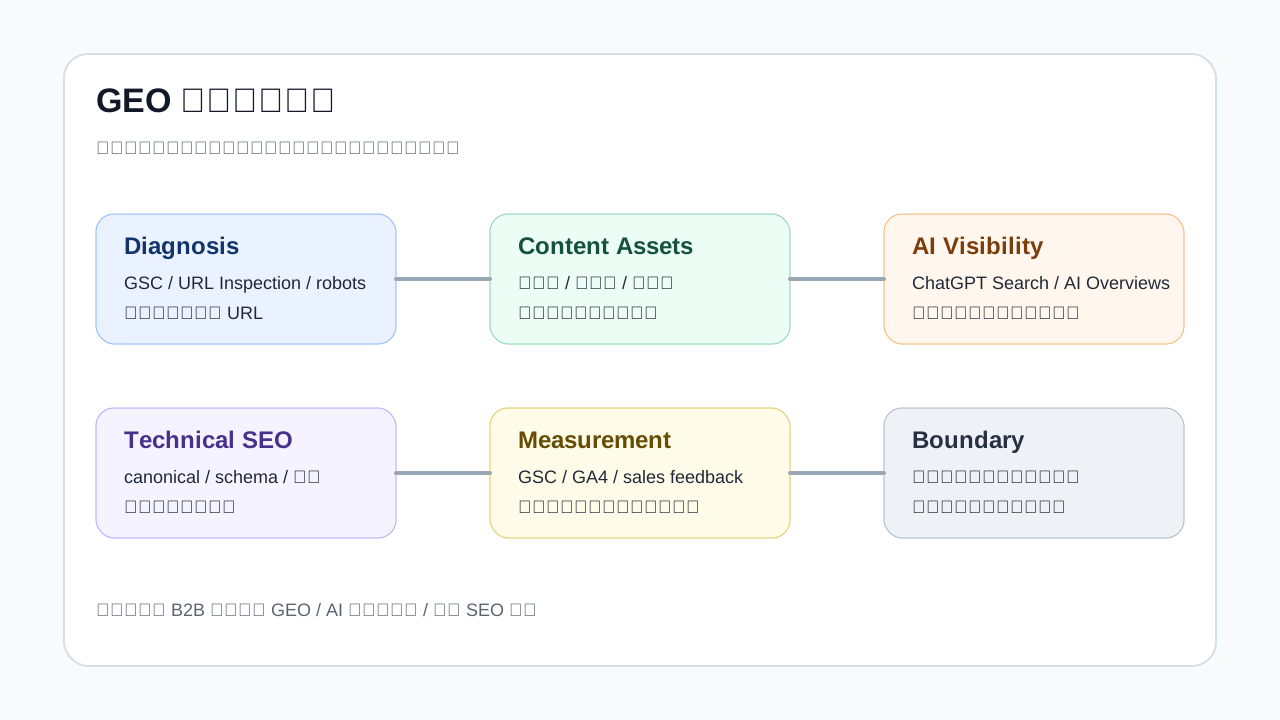
Start with the conclusion: buy reviewable work, not unverifiable promises
A qualified GEO quote should answer at least five questions: what to diagnose first, which pages to change, which official and product evidence to add, how to monitor AI and search performance, and how to determine that this month’s work is complete. It should also answer a sixth question: which results cannot be written as guaranteed deliverables.
| Quote item | Should be stated clearly | Should not be confused |
|---|---|---|
| Diagnostics | GSC, URL Inspection, robots, sitemap, canonical, weak points on pages | A single screenshot cannot be written up as a complete diagnosis |
| Content | Which URLs to change for question pages, product pages, FAQs, comparison pages, and source pages | Cannot list only the number of articles without explaining each page’s role |
| Technical | Structured data, internal links, mobile tables, images, status codes, and index signals | Cannot just say “install a plugin” |
| Monitoring | GSC, GA4, AI sample questions, cited URLs, sales feedback | Cannot write sample observations as third-party system results |
| Review | Monthly URL changes, data windows, next-round priorities, and exclusions | Cannot just hand over a pretty monthly report |
When judging a quote, first break these items apart. If they cannot be separated, it is hard to know where the money goes.
Why GEO quotes vary so much
GEO is not a single point action. It may include traditional SEO, technical diagnostics, content rewriting, product page restructuring, structured data, entity consistency, AI search sample monitoring, GSC/GA4 review, sales Q&A organization, and internal link structure. Different teams put these items into a quote in different ways, so prices naturally differ a lot.
| Source of difference | Low-effort version | High-effort version |
|---|---|---|
| Diagnostic depth | Looks at the homepage and a few articles | Breaks down URLs, indexing, content, internal links, and business paths into a table |
| Content depth | Writes generic concept articles | Rewrites pages based on product facts, purchasing questions, and official sources |
| Technical scope | Only looks at plugin scores | Reads back robots, canonical, schema, sitemap, status codes, and rendering |
| Monitoring scope | Samples only a few AI questions | Fixes sample questions, records answer sources, and compares against GSC and page changes |
| Review method | Sends screenshots at month end | Reviews by URL, action, evidence, result boundaries, and next steps |
So when asking about a quote, do not ask only for the total price. Ask “exactly which URLs, which actions, and which evidence does this price include?”
First, look at Google’s basic reminders about SEO
In Do you need an SEO?, Google reminds site owners that SEO can help improve a website, but it can also bring risks; businesses should understand what the other party will do and remain responsible for their site. Google’s Search Essentials also states that a site must meet bottom lines such as crawlability, indexability, content quality, and spam policies.
This matters a lot when judging a GEO quote. AI search visibility is not new magic that works apart from the fundamentals of web pages. Basic page crawling, indexing, content quality, structured data, and accessibility still have to pass first.
| Official source | What the quote should reflect | How to verify |
|---|---|---|
| Google SEO hiring guidance | Actions, risks, permissions, change logs, and responsibility boundaries | The quote lists specific pages and work items |
| Search Essentials | Crawling, indexing, spam content, and quality bottom lines | Check robots, status codes, page content, and index status |
| Helpful content | Content serves real users, not just keyword stacking for systems | Sales and product teams confirm the facts together |
| Structured data intro | Schema helps understanding but cannot replace page facts | Structured data and visible content match |
Diagnostic fee: check whether it really reads GSC and URL Inspection
Diagnostics is the item most easily underestimated in a GEO quote. Without diagnostics, the content and technical work that follows easily goes off track. Google’s Search Console performance reports help a site observe pages, queries, countries, devices, impressions, clicks, and average position. The URL Inspection tool can show the index status, crawl status, and canonical information of a single URL.
| Diagnostic item | What to look at | How it should be written in the quote |
|---|---|---|
| Page performance | Which URLs get impressions and which have no data at all | Lists priorities instead of just saying “site-wide optimization” |
| Query matching | Which terms trigger the page and whether they drift from the business | Groups terms into purchasing, technical, comparison, quote, and brand |
| Index status | Submitted and indexed, discovered, crawled but not indexed, and unrecognized | Sets different actions by status |
| Crawl boundaries | robots, canonical, status codes, sitemap, internal links | Every issue needs evidence and a recheck method |
If a quote has no GSC, URL Inspection, sitemap, or page list and only says “AI visibility diagnostics,” it is usually not enough.
Content fee: not writing more, but turning pages into citable material
GEO content is not about making blog posts longer. It should let both AI systems and search systems understand: who you are, what products you make, which industries you serve, where your facts come from, which questions have clear answers, and which boundaries must not be crossed. For B2B export websites, content fees should often go into product pages, category pages, application pages, question pages, and company trust pages, not only into generic articles.
| Page type | What to add | How to judge the quote |
|---|---|---|
| Product pages | Specifications, materials, certifications, MOQ, applications, packaging, testing, downloadable materials | Priced by core product line, not only by article count |
| Category pages | Product families, model differences, selection logic, related applications | Check whether it can capture supplier terms and category terms |
| Question pages | Purchasing questions, technical comparisons, causes of failure, pricing factors | Check whether it answers real buyer questions |
| Trust pages | Factory capability, quality control, certifications, export markets, contact paths | Check whether it supports entity consistency |
| Source pages | Official documentation, industry standards, company materials, FAQs | Check whether it avoids unsourced opinions |
If a content quote only says “a certain number of articles per month,” keep asking: which URLs do these articles map to, which purchasing question do they serve, and how do they link to the product pages?
Technical fee: check whether it can handle crawling, indexing, and structured understanding
Technical SEO cannot be glossed over in a GEO quote. Both AI search and traditional search need accessible web pages. If a page is blocked by robots, has a wrong canonical, loads important content through invisible scripts, or has structured data that does not match the body text, even good content that follows is easily wasted.
| Technical item | Common problem | Acceptance evidence |
|---|---|---|
| robots | Important pages or resources are blocked | Read back robots.txt, meta robots, X-Robots-Tag |
| canonical | Product pages point to the wrong URL or are diluted by duplicate pages | Compare page source with URL Inspection |
| sitemap | URLs are missing from the sitemap, or lastmod is not updated for a long time | GSC sitemap download time and XML read-back |
| schema | Structured data does not match visible content | Rich Results / schema read-back compared with page content |
| Mobile | Tables, images, and navigation overflow on mobile | Real browser screenshots and horizontal scroll checks |
A technical fee is not “installing a plugin.” It should come with inspection files, read-back evidence, and recheck records.
AI visibility monitoring fee: look at samples, not slogans
AI search visibility can be monitored, but the method has to be stated clearly. Google’s AI search optimization guide still emphasizes web page fundamentals, helpful content, structured data, and accessibility. OpenAI’s OpenAI Bots documentation explains the purpose and access boundaries of different crawlers. ChatGPT Search’s official help page also notes that search results combine web page information with source display.
| What is monitored | What can be recorded | What it cannot be written as |
|---|---|---|
| AI question samples | Question, time, region, language, answer screenshots, cited URLs | Cannot be written as if the answer is always the same |
| Official website citations | Whether the official website URL appears and in which question | Cannot be written as a guaranteed display by a third-party system |
| Entity consistency | Whether company name, product names, contact details, and resource pages are consistent | Cannot replace real product facts |
| Competitor sources | Which third-party or peer pages AI often cites | Cannot treat competitor data as your own results |
A monitoring fee is worth paying, but what it buys is sample records and diagnostic clues, not control over third-party AI answers.
Tool fees: distinguish software subscriptions from human judgment
Some quotes include tool fees. Tools can help with crawling, monitoring, exporting, and alerts, but they will not understand your product for you or confirm your page facts for you. Whether a tool fee is reasonable depends on what reviewable output it produces.
| Tool type | Possibly useful output | Still requires human judgment |
|---|---|---|
| Ranking / visibility tools | Keyword, page, region, and device trends | Whether the terms match purchasing intent |
| AI monitoring tools | Sample questions, mentions, citations, competitor sources | Whether the samples represent real buyer questions |
| Crawler tools | Status codes, titles, meta, internal links, duplicate pages | Which issues to handle first |
| Analytics tools | Visits, interactions, events, paths | Which interactions have sales value |
If a quote includes tool fees, you can ask the other party to list the tool names, purposes, export fields, and delivery files. Otherwise a tool fee easily becomes an amount you cannot understand.
GA4 and sales feedback: a quote cannot look only at the search side
GA4’s About events explains that events can record specific interactions on a website or app. If an export site looks only at impressions and clicks and ignores forms, WhatsApp, email, catalog downloads, product material downloads, on-site search, and key page views, it easily misreads “having traffic” as “having value.”
| Metric | What it can show | What it cannot show |
|---|---|---|
| GSC impressions | The page appears in search results | Cannot prove buyer quality |
| GSC clicks | Users enter the page from search | Cannot prove a business opportunity was generated |
| GA4 events | A user had some kind of interaction on the site | Cannot by itself prove deal value |
| Sales feedback | Whether the inquiry matches the product, country, quantity, and budget | Cannot replace search-side diagnostics |
A mature quote puts this data into the review instead of handing over only ranking screenshots.
How to choose between a monthly quote and a one-time diagnostic
Not every business should sign a long-term contract from the start. When the site foundation is weak, pages are messy, GSC data is scarce, and product materials are incomplete, you can start with a one-time diagnostic and a small-scale page upgrade. When the site foundation is clear, there are many product lines, and the team can keep providing materials, then consider a monthly engagement.
| Engagement type | Suitable situation | Acceptance focus |
|---|---|---|
| One-time diagnostic | You do not know where the problems are and want to understand the baseline first | Diagnostic table, URL queue, risk notes, next-step priorities |
| Small-scale validation | You want to validate the team’s method first | A set of product pages, question pages, GSC, and front-end read-back |
| Monthly engagement | There is ongoing content, product material, and sales feedback | Monthly URLs, changes, data windows, next batch plan |
| Targeted fixes | There are clear issues with indexing, crawling, migration, or structured data | Before-and-after evidence and recheck timing |
If all you know right now is “we want to do GEO,” you can buy a diagnostic first. If you already know which product lines matter most, you can buy small-scale validation. If the team has proven the method works, then scale up.
Deliverables that must appear in the quote
An acceptable GEO quote should ideally not be a single line like “site-wide optimization.” It should read like a work checklist. Every item has a corresponding file, page, or piece of evidence.
| Deliverable | Minimum requirement | More professional requirement |
|---|---|---|
| URL priority table | Lists the URLs to be handled | Sorts by GSC, business value, index status, and content gaps |
| Issue diagnostic table | Lists issue types | Gives evidence, impact, fix method, and recheck commands |
| Content revision draft | Has body text and headings | Includes official sources, product facts, tables, FAQs, internal links, and boundaries |
| Technical read-back | Explains what has been handled | Provides HTTP, robots, canonical, schema, and mobile screenshots |
| Monthly review | Has data screenshots | Has time windows, URL comparison, sales feedback, and next-round actions |
If a quote has no deliverables, it is hard to accept. When acceptance is unclear, the longer the engagement runs, the more likely disputes become.
Which quotes look cheap but may actually be expensive
Being cheap is not a problem in itself. The problem is being so cheap that there is no diagnostic, no material confirmation, no page read-back, no official sources, and no review boundaries. Such a quote may save money at first, but later costs more time fixing thin pages, wrong pages, and duplicate pages.
| Apparent saving | Possible leftover problem | Follow-up cost |
|---|---|---|
| Buying only a number of articles | Pages do not match product lines | Re-planning URLs and internal links |
| Buying only tool reports | No business judgment | Still need manual filtering and explanation |
| Buying only external links | On-site pages are weak | Adding product pages and trust pages |
| Buying only AI monitoring | You know the problems but there is no fixing action | Buying diagnostics and page upgrades again |
What export sites fear most is “looking like a lot was done, but none of it can be reviewed.” A cheap quote is not scary; the lack of an evidence chain is.
Which high-priced quotes also call for caution
A high price does not equal professionalism either. Be cautious with a high-priced quote that does not break down pages, does not explain boundaries, does not provide raw data, and does not say who confirms product facts. Professionalism is not talking in complicated terms; it is breaking complicated work into acceptable actions.
| High-price risk | How to judge | How to respond |
|---|---|---|
| Many concepts | Can they land on URLs, pages, and evidence | Ask for a first-month work list |
| Many tools | Whether tool output feeds into decisions | Ask for sample exports and an explanation method |
| A very thick report | Whether there are next-step actions | Ask for prioritization |
| Results are overpromised | Whether they admit third-party systems are uncontrollable | Ask them to state exclusions and observation items |
How B2B export businesses should prepare inquiry materials
The clearer the information you give, the more accurate the quote is likely to be. If you send only one URL and let the other party guess your industry, products, and market, the quote will usually be rough too. Before asking for a quote, prepare a one-page brief.
| Material | What to write | Purpose |
|---|---|---|
| Core product lines | The 3-5 most important product categories and their English names | Determine page priorities |
| Target markets | Main countries, industries, buyer roles | Determine language, phrasing, and content depth |
| Existing data | GSC, GA4, inquiry sources, sales feedback | Determine whether data review is possible |
| Site issues | Slow indexing, poor inquiries, thin product pages, AI not mentioning the official site, etc. | Determine the diagnostic focus |
| Internal resources | Who can provide product materials and who can confirm technical facts | Determine the content production pace |
This material does not need to be long, but it does need to be real. Real material is more useful than a pretty brief.
A 90-day quote acceptance rhythm
If you decide on a 90-day validation, you can split the quote into three stages. This gives the team enough time and prevents the scope from being too large at the start.
| Stage | Work focus | Acceptance evidence |
|---|---|---|
| Days 1-15 | Diagnostics, URL queue, data access, product material organization | Diagnostic table, GSC/URL Inspection status, priorities |
| Days 16-45 | Core page upgrades, technical fixes, content evidence reinforcement | Publish records, front-end read-back, official sources, mobile screenshots |
| Days 46-75 | AI sample monitoring, internal link reinforcement, FAQ and application page expansion | Sample table, URL change table, sitemap, and crawl status |
| Days 76-90 | GSC, GA4, sales feedback review, and next batch plan | Review table, continue/adjust/pause recommendations |
When short-term data is scarce, do not force an explanation. First check whether the page is acceptable, whether Google discovered it, whether it was crawled, and whether it entered the index; then look at impressions, clicks, and business feedback.
Quote comparison scorecard
You can compare different teams on a 100-point scale. The score is not meant to find the lowest price, but to see which quote is more executable.
| Dimension | Score | High-score performance |
|---|---|---|
| Diagnostic clarity | 20 | Lists URLs, issues, evidence, and priorities |
| Content assets | 20 | Can add product pages, question pages, source pages, and trust pages |
| Technical capability | 15 | Can read back crawling, indexing, schema, mobile, and internal links |
| AI monitoring | 15 | Has sample questions, cited URLs, time windows, and boundaries |
| Data review | 15 | Can compare GSC, GA4, and sales feedback |
| Boundary description | 15 | Clearly states controllable actions and uncontrollable results |
Below 60 points, a direct long-term engagement is not recommended. From 60 to 80 points, you can start with small-scale validation. Above 80 points, still expand in stages.
Example of breaking down a quote: the same “GEO” label can mean completely different workloads
Many businesses find GEO quotes hard to compare because different teams put different work under the same word. Some understand it as AI Q&A monitoring, some as content rewriting, some as technical SEO plus structured data, and some as a full rebuild of product pages and trust pages. The same name does not mean the same deliverables.
So when asking for a quote, do not ask only for a total price. A safer approach is to break the quote into six parts: diagnostics, pages, technical, monitoring, review, and collaboration. Each part should correspond to a read-back deliverable. That way, even if you ultimately choose a lower budget, you know which work is kept and which is deferred, instead of mashing everything into one phrase like “AI search optimization.”
| Item | What the low-end version usually includes | What the high-end version should add |
|---|---|---|
| Diagnostics | A quick look at titles, indexing, and a few tool hints | Outputs GSC, index status, content gaps, internal links, and mobile issues by URL |
| Content | Writes a few topical articles | Rewrites product pages, question pages, comparison pages, FAQs, source sections, and internal links |
| Technical | Handles titles, descriptions, and basic plugin items | Reads back robots, canonical, schema, sitemap, status codes, images, and mobile tables |
| Monitoring | Spot-checks a small number of AI questions | Fixes samples and records time, language, region, answer sources, and URL changes |
| Review | Provides summary screenshots | Reviews by page, action, data window, sales feedback, and next-step queue |
| Collaboration | The client is only responsible for payment and confirmation | The client provides product materials, technical facts, sales feedback, and market priorities |
This breakdown table can also be used in reverse to control the budget. When the budget is limited, you can keep diagnostics, core pages, and basic technical read-back first, and move long-term monitoring and expanded content to the second stage. When the budget is ample, you should still not spread too wide at once; instead, first turn the core product lines into a reviewable model.
How to write acceptance criteria so the engagement does not become a verbal agreement
The truly hard part of a GEO quote is not writing the price, but writing acceptance. Without acceptance criteria, both sides easily end up with different understandings of “completed.” The business expects to see search and AI results change immediately, while the provider may only consider that the page has been published. A professional quote needs to separate controllable actions from observation results.
Controllable actions include: whether the page has been modified, whether official sources have been added, whether images and tables display correctly, whether there is no horizontal overflow on mobile, whether the sitemap includes the URL, whether Search Console can read the page status, whether GA4 has key events, and whether the sales team can see an entry point for inquiry quality feedback. Observation results include: whether Google recrawls, whether it indexes, whether impressions and clicks occur, and whether AI answers cite the official site. These observation results matter, but they cannot be written as immediate deliverables.
| Acceptance level | Controllable item | Observation item |
|---|---|---|
| Publish acceptance | Page returns 200, index/follow, body text and meta read-back are consistent | Whether the search system has recrawled |
| Content acceptance | Product facts, FAQs, tables, official sources, and boundary notes are complete | Whether the page immediately gets impressions |
| Technical acceptance | canonical, sitemap, structured data, images, and mobile performance are normal | Whether index status changes the same day |
| Data acceptance | GSC, GA4, and sales feedback have a fixed review standard | Whether clicks, interactions, and inquiries grow in the short term |
| AI acceptance | Sample questions, answer screenshots, cited URLs, and time windows are recorded | Whether third-party AI consistently displays a certain answer |
The benefit of writing it this way is that the engagement is not driven by emotion. Page work that can be accepted can be accepted the same day, while data results that need observation are given a time window. The more complex search and AI systems become, the clearer the acceptance language must be.
Internal collaboration costs should also count in judging a quote
For a B2B export website doing GEO, you cannot rely only on an external team writing behind closed doors. Much key information sits inside the company: product specifications, material limits, certification certificates, testing processes, lead times, packaging methods, common after-sales questions, target countries, and the objections sales encounters most often. If the external team cannot get this information, it can only write generic content, and the pages can hardly become truly citable material.
So a quote is not only buying external hours; it is also buying a collaboration rhythm. Who provides product materials, who confirms technical facts, who gives feedback on inquiry quality, who decides the priority product lines, and who approves pages going live must all be made clear early. If collaboration costs are not arranged well, even an expensive quote will slow down; if collaboration is arranged clearly, even a moderate budget can produce solid assets.
| Internal role | Information to provide | GEO work affected |
|---|---|---|
| Sales | Real inquiry questions, countries, quantities, budgets, and deal obstacles | Question pages, FAQs, pricing factors, content priorities |
| Product or engineering | Specifications, materials, testing, certifications, constraints | Product pages, comparison pages, technical explanations, and fact checking |
| Marketing | Target industries, core markets, competitors, brand expression | Category pages, trust pages, entity consistency, and internal link strategy |
| Website maintenance | CMS access, template limits, plugin status, and publishing workflow | Technical fixes, front-end read-back, mobile, and structured data |
| Person in charge | Budget stages, acceptance rhythm, and pause conditions | Quote scope, milestones, and review decisions |
If a quote has no collaboration requirements at all, be extra cautious. Professional work usually tells you clearly: which materials must be confirmed by the business, which content can be organized externally, and which judgments need sales and technical staff to participate together.
When the budget is tight, which parts to do first for the best value
Not every site needs to buy a full monthly GEO service from the start. When the budget is limited, priorities should relate to risk and asset accumulation. Handle the foundational issues that block crawling, indexing, understanding, and conversion first, then handle expanded monitoring and large-scale content. That way, even if the first-stage budget is not high, money will not be spent on material that is hard to reuse.
| Budget stage | Buy first | Defer |
|---|---|---|
| Stage one | GSC diagnostics, core URL queue, indexing, and technical read-back | Large-scale generic content and complex report templates |
| Stage two | Core product pages, question pages, official sources, and mobile experience | Too many low-value long-tail topics |
| Stage three | AI sample monitoring, internal link expansion, GA4 events, and sales feedback review | Tool subscriptions whose purpose cannot be explained |
| Stage four | Replicating more product lines, topic pages, and industry pages | Blind expansion without data support |
This is also a way to judge whether a quote is professional: whether the other party can help you prioritize when the budget is not enough. A team that truly understands GEO and SEO should know which work reduces risk when done first, and which work is better scaled after the foundational pages are in good shape.
If you see these questions, the other party is more likely building long-term assets
In inquiry conversations, what the other party asks often says more about professionalism than what they show. If they only ask about budget, industry, and keywords right away, it is hard to judge their depth. If they follow up on pages, data, product facts, sales feedback, and acceptance boundaries, they are closer to long-term asset building.
| Their follow-up question | What it shows they are assessing | What you can prepare |
|---|---|---|
| Which product lines are most profitable | Content priority and page value | Product categories, profit ranges, target markets |
| Which pages already get impressions but no inquiries | Search intent and conversion breakpoints | GSC page data, GA4 interactions, sales feedback |
| Which questions buyers ask repeatedly | FAQs, question pages, and AI sample questions | Emails, chat records, and organized sales Q&A |
| Which facts must be rigorous | Content risk and technical boundaries | Specification sheets, certifications, test materials, and the engineering sign-off person |
| Which results cannot be promised | Engagement boundaries and review standards | Budget stages, time windows, and acceptance methods |
These questions will not make the quote look simpler, but they will make it more real. GEO and SEO are not one-off copy polishing; they connect company facts, page structure, and data review over the long term.
There is one more practical test: whether the other party is willing to leave behind transferable material, such as a URL list, issue list, source list, page change records, monitoring samples, and review standards. Even if you change partners in the future, this material can still be used. A quote that leaves behind only verbal explanations and scattered screenshots looks convenient in the short term, but in the long term it prevents website experience from accumulating.
The final judgment: a quote is not a price list, but a work-boundary table
What should you look at in a GEO quote? See whether it can break the work into verifiable diagnostics, pages, technical, content, monitoring, and review. See whether it can build an evidence chain from Google, OpenAI, Bing, GSC, GA4, and your own sales feedback. See whether it is willing to admit that search rankings, AI answer display, citation position, and inquiry volume cannot be directly controlled by an external team.
What is truly worth buying is the assets that accumulate in your website: clearer product pages, better-sourced question pages, more complete structured information, more reviewable data tables, and a more stable review rhythm. The quote is only the entry point. What should remain in the end is a GEO and SEO working system you can keep using later.
Related reading
- What a GEO visibility diagnostic includes: AI answers, entity consistency, cited sources, and review
- How to choose an AI search visibility service team: a capability checklist for export businesses evaluating a GEO partner
- How to choose a Google SEO company for B2B export: judging inquiry terms, technical content, and product pages
- What is the difference between an AI SEO company and a GEO company: how content optimization and answer visibility divide the work
This page is machine-translated from the Simplified Chinese version and awaiting human review. It has not yet been proofread.