How do you choose a Google SEO company for B2B export? Don’t rush to judge how polished the proposal sounds. Look at three things first: whether it can break inquiry keywords apart, whether it can write technical content that holds up, and whether it can turn product pages into pages that both buyers and search systems can understand.
SEO for exporters is not the same as ordinary traffic content. When you sell custom metal parts, LED flood light, packaging machine, medical probe, cnc machining parts, ceramic dinnerware, waterproof connector, industrial valve supplier, or private label activewear manufacturer, buyers are not interested in a one-line promise to “do Google SEO.” They ask about specifications, materials, certifications, lead times, MOQ, application scenarios, alternative models, installation conditions, export markets, and after-sales boundaries. Search systems are judging the same thing: whether the page truly answers the question, whether it can be crawled, whether it can be indexed, and whether it has clear entities and sources.
So judging an export SEO team is not about what it promises, but about how it verifies results. What it can deliver is diagnosis, page structure, technical content, product page optimization, structured data, internal links, GSC reviews, and comparison against sales feedback. What it cannot deliver is a guaranteed commitment to search rankings, AI answer visibility, or inquiry volume.
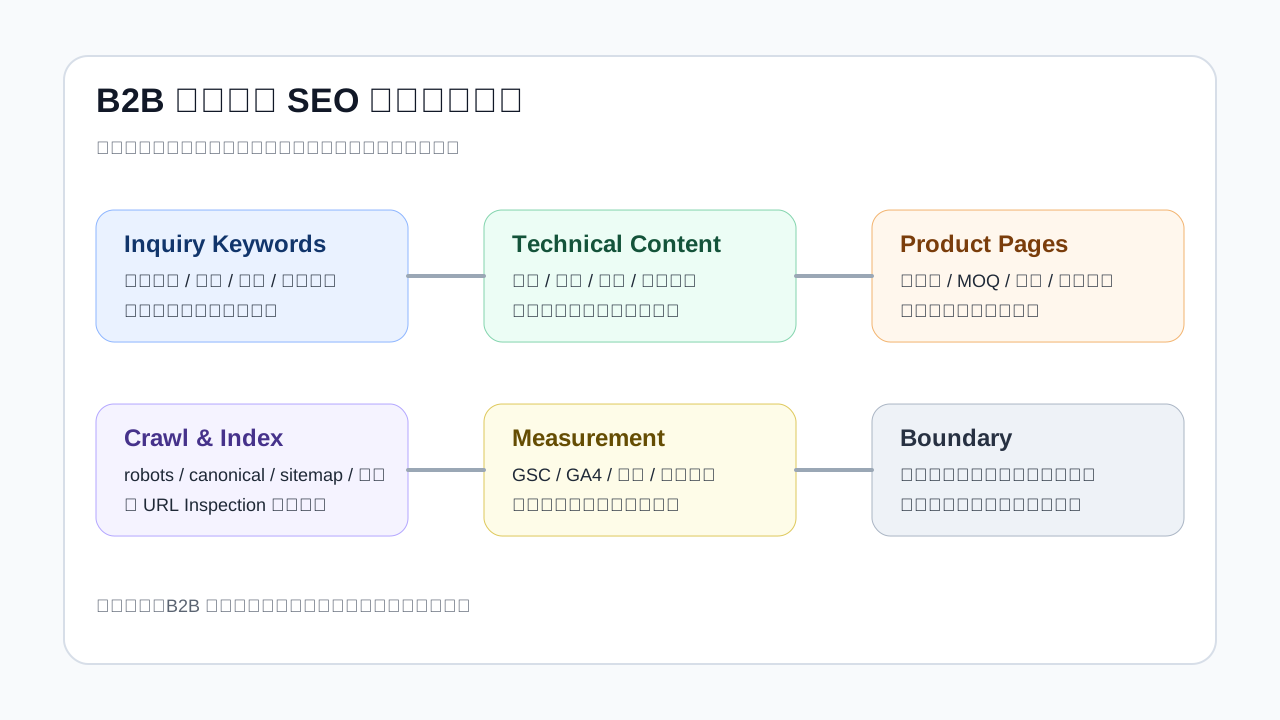
Start with the conclusion: a good team asks business questions before discussing SEO actions
If a team starts out talking only about how many articles it will publish, how many backlinks it will build, and how many keywords it will push to page one, be careful. The entry question for a B2B export website is not “is there content” but “does the content carry procurement judgment.” Many pages run to thousands of words yet contain no model numbers, specifications, materials, tolerances, certifications, industry applications, image captions, downloadable materials, inquiry entry points, or real FAQs. Even when such pages are crawled, they give buyers little reason to keep evaluating.
| Criterion | What weak teams often say | What a professional team should ask first |
|---|---|---|
| Inquiry keywords | Lists only broad terms and Chinese terms | What are the target countries, buying roles, English product names, specification terms, and application terms? |
| Technical content | Makes product descriptions longer | Which technical questions do buyers ask before selection, substitution, factory audits, and certification? |
| Product pages | Changes only titles and descriptions | Are the specification table, MOQ, materials, test standards, downloadable materials, and inquiry path complete? |
| Data review | Hands over only a ranking table | Can GSC, GA4, sales feedback, and page change logs be mapped to the same set of URLs? |
That is also why this article does not name “the one company that is definitely good.” Export businesses need a screening method. Methods can be reused. Results always depend on the industry, the product, the site’s starting point, and the execution window.
Step 1: Ask the team to explain your inquiry keywords, not just hand over a keyword list
B2B export keywords are not a spreadsheet. They are a set of procurement questions. Behind LED flood light supplier may be a contractor looking for a vendor; behind waterproof connector IP67 may be an engineer verifying an ingress protection rating; behind custom metal stamping parts tolerance may be a buyer and an engineer jointly confirming machining capability. Different keywords call for different pages.
| Keyword type | Common English forms | Page it should match | How to verify |
|---|---|---|---|
| Supplier terms | supplier, manufacturer, factory | Category pages, capability pages, company trust pages | The page explains capacity, certifications, export markets, and the inquiry entry point |
| Specification terms | IP67, 24V, stainless steel, MOQ | Product pages, specification pages, FAQ | The parameter table is clear, units are consistent, and images match the text |
| Application terms | for warehouse, marine, food grade | Industry application pages, solution pages | Explains use scenarios, limitations, and the basis for selection |
| Question terms | how to choose, why fail, difference | Technical articles, diagnostic pages | Answers specific questions instead of piling up concepts |
You can ask a prospective team to explain, in a single-page table, which terms are for acquisition, which are for education, which are for supporting sales, and which are not worth pursuing for now. That table is more useful than search volume alone.
Step 2: Check whether it understands Google’s official baseline for SEO
Export SEO can rely on experienced judgment, but its foundations must not contradict the official documentation. In Do you need an SEO?, Google reminds businesses that SEO can improve a site and can also bring risk; a business should understand what the team will do and remains responsible for its website. Google’s Search Essentials also sets out the baseline for crawlability, indexability, spam policies, and best practices.
| Official source | What it supports | What an export business should ask |
|---|---|---|
| Google: Do you need an SEO? | SEO should explain its actions and risks; a business cannot rely on verbal promises alone | Please list which pages and technical items you will change and how changes are logged |
| Google Search Essentials | Technical accessibility, content quality, and spam policies are the baseline | Does the site have noindex, canonical, status code, soft 404, or thin-page problems? |
| Helpful content guidance | Content should serve real users, not just pile up words for search systems | Do the articles answer buyer questions and contain real product facts and boundaries? |
| Introduction to structured data | Structured data helps systems understand a page’s meaning but cannot replace content | Do Product, Article, FAQ, and Organization markup match the page content? |
If a team presents “submitting a sitemap,” “installing a plugin,” or “writing schema” as guaranteed results, keep asking questions. Tools are actions. Actions are not results.
Step 3: Look at how it handles product pages, not just blog posts
Many export sites have plenty of blog posts but thin product pages. Thin product pages tend to mean poor inquiry quality. If a buyer clicks through and cannot find specifications, materials, dimensions, certifications, customization scope, packaging, shipping methods, test reports, application photos, and related models, it is hard for the conversation to continue.
| Product page module | Question it must answer | SEO value |
|---|---|---|
| Specification table | Are dimensions, materials, power, standards, colors, packaging, and so on clear? | Gives long-tail specification terms a landing point and reduces irrelevant inquiries |
| Application scenarios | Which industries suit this product, and which scenarios do not | Matches application and question terms and raises the page’s decision value |
| Certifications and testing | Are CE, RoHS, FDA, ISO, IP, and similar items explained? | Supports trust judgments and avoids empty slogans |
| Customization boundaries | What can and cannot be changed, and what are the MOQ and lead time? | Moves procurement questions up front and helps sales qualify leads |
| Related pages | Are category pages, FAQ, application pages, and download pages linked to one another? | Builds a clear internal linking path |
A good export SEO team treats product pages as the main battlefield. Blog posts explain problems, product pages carry the decision, category pages aggregate models, and company pages build trust. These four page types cannot replace one another.
Step 4: See whether technical content can be confirmed by sales and engineering together
Technical content is not about translating parameters into English. It turns the questions sales hears every day into pages that are clear, verifiable, and easy to update. For topics such as medical probe repair, industrial valve supplier, or ceramic dinnerware manufacturer, buyers want grounds for a decision, not pretty adjectives.
| Content type | Low-quality wording | Wording you can verify |
|---|---|---|
| Material description | high quality material | Lists material grades, suitable scenarios, limitations, and alternative options |
| Process description | advanced production | Explains what CNC, die casting, injection molding, welding, and surface treatment each affect |
| Quality control | strict QC | States inspection stages, sampling methods, test items, and record retention |
| Export experience | export worldwide | Describes common markets, packaging requirements, compliance documents, and communication workflow |
When reviewing, do not look at word count alone. Have a sales colleague read it to see whether it reduces repeated explanations; have an engineering colleague read it to check for errors; have an operations colleague read it to see whether the page can be crawled and indexed. Publish only after all three sign off.
Step 5: Confirm the team actually uses Search Console rather than just handing over screenshots
Google Search Console is the basic dashboard for export SEO. It cannot tell you all business outcomes, but it can tell you about pages, queries, countries, devices, clicks, impressions, CTR, average position, indexing status, and crawling signals. Google’s Search Console performance reports can help a business understand these metrics. Whether a URL has been processed by Google is shown by the crawl and index information in the URL Inspection tool.
| GSC item | What to look at | What not to misread it as |
|---|---|---|
| Performance report | Whether pages and queries show changes in impressions, clicks, countries, and devices | Do not treat short-term impressions as stable conversion capability |
| URL inspection | Whether crawling is allowed, whether the URL is indexed, which canonical is used, and the last crawl time | Do not treat a submitted request as a re-evaluation |
| Sitemap | Submission status, download time, errors, and warnings | Do not treat the number of URLs in a sitemap as a page quality score |
| Page experience and crawling | Whether there are accessibility, loading, or mobile issues | Do not judge real crawling from a plugin score alone |
You can require the team to log three things after every page change: the modification time, the sitemap submission time, and the lastCrawlTime from URL Inspection. Only when lastCrawlTime is later than the modification time does it show that Google has at least re-crawled the new version of the page. Even then, you cannot directly infer rankings, AI visibility, or inquiry growth.
Step 6: Read GA4 together with sales feedback
GA4 is not there to judge business value for you, but it can help you break down on-site behavior. Google’s About events reminds us that on-site interactions need to be recorded as events. Common events on export sites include form submissions, WhatsApp clicks, email clicks, product downloads, catalog downloads, video plays, site search, and scrolling on key pages.
| Data source | Question it can answer | How export SEO uses it for verification |
|---|---|---|
| GSC | Which queries and pages users enter from | Judging entry points and search visibility |
| GA4 | Whether there is interaction after arrival | Judging whether content leads to a next step |
| Sales feedback | Whether inquiries are valuable in terms of product, budget, country, and quantity | Revising pages and keyword groups in response |
| CRM or form records | Which type of page leads come from | Judging page combinations rather than single keywords |
A mature partner will not call every visit a good result. It distinguishes impressions, visits, meaningful interactions, follow-up-ready inquiries, and order opportunities. Each step needs its own evidence.
Step 7: AI search visibility also starts with web fundamentals
Many export businesses now ask whether ChatGPT Search, AI Overviews, Bing Copilot, and Perplexity can see their pages. That question is worth researching, but the fundamentals cannot be skipped. Google’s AI search optimization guide stresses that generative search still depends on accessible web pages, clear content, structured data, and basic SEO. OpenAI’s Bots documentation also distinguishes the purpose of different crawlers and their robots access rules. Bing’s webmaster guidelines likewise require accessible pages, valuable content, and no manipulation.
| AI visibility issue | What to check first | What can be delivered |
|---|---|---|
| AI answers do not mention the official site | Whether pages are crawled and indexed and whether the content answers specific questions | Question pages, source pages, entity consistency, and monitoring samples |
| AI answers describe the company inaccurately | Whether entity information, product facts, company pages, and contact details on the official site are consistent | An entity information table, About page, and revisions to product facts |
| AI cites a competitor’s page | Whether the competitor’s page is clearer, better sourced, and easier to cite | Gap analysis, page structure, and stronger sourcing |
| Abnormal AI crawler access | robots.txt, server logs, status codes, and important resources | A crawler access audit and remediation recommendations |
The boundary here needs to be stated clearly. A team can improve the conditions for pages to be understood, crawled, and cited; it cannot control how each AI answer is assembled, nor require a third-party system to display a particular brand consistently.
Step 8: Contracts and quotes must state delivery boundaries clearly
When choosing an export SEO team, a lower quote is not automatically better, and a higher one is not automatically more professional. Check whether the quote specifies deliverables, verification methods, data access, scope of changes, communication frequency, and review cadence.
| Contract item | What should be stated clearly | Risk signal |
|---|---|---|
| Page scope | Which product pages, category pages, article pages, and company trust pages will be changed first | Says “site-wide optimization” without listing URLs |
| Content scope | Who provides product materials, who confirms technical facts, who is responsible for the English wording | Promises a number of articles without explaining the sources |
| Technical scope | robots, sitemap, canonical, structured data, speed, and mobile checks | Installs plugins only, with no read-back verification |
| Data scope | How GSC, GA4, logs, forms, and sales feedback will be reviewed | Provides screenshots only, with no auditable files |
| Uncontrollable boundaries | No promises on search rankings, AI visibility, lead volume, or closed deals | Writes uncontrollable outcomes as guaranteed deliverables |
Stating boundaries clearly in a contract is not conservatism; it is professionalism. When boundaries are clear, both sides know what is being reviewed each month.
Step 9: A 90-day verification plan
In the first phase of export SEO, it is not advisable to go too broad at the start. Use 90 days to test the team’s capability. Pick one core product line first and run diagnosis, page rework, content reinforcement, technical re-checks, and data review. Then decide whether to expand.
| Phase | Main actions | Verification evidence |
|---|---|---|
| Days 1-15 | Diagnosis of GSC, GA4, sitemap, robots, product pages, and inquiry keywords | Diagnostic table, problem URLs, priorities, uncontrollable boundaries |
| Days 16-45 | Rework core category pages, product pages, and company trust pages, plus 2-4 technical articles | Publishing log, page read-back, official sources, internal links, and mobile checks |
| Days 46-75 | Expand FAQ, application pages, technical articles, and structured data | URL Inspection, sitemap downloads, and GSC changes at the page level |
| Days 76-90 | Review impressions, clicks, interactions, and sales feedback | Review table, next batch of URLs, and continue/pause/adjust recommendations |
If there is not enough search data within 90 days, that does not automatically mean failure. The key is whether page quality, crawling and indexing, the data loop, and sales feedback have become clearer. If none of that is in place, more spending later will easily run out of control.
Step 10: Score team capability across six dimensions
An export business can assess candidate teams on a 100-point scale. Do not judge by the presentation deck alone. It is best to give them one real product line for a small diagnostic exercise and see whether they can name specific URLs, specific problems, and specific verification methods.
| Capability | Score | What a high score looks like |
|---|---|---|
| Inquiry keyword understanding | 20 | Distinguishes supplier, specification, application, question, and country terms |
| Technical content capability | 20 | Turns product facts, engineering questions, and sales Q&A into verifiable content |
| Product page optimization | 20 | Reworks specifications, images, FAQ, internal links, downloads, and inquiry entry points |
| Technical SEO | 15 | Handles crawling, indexing, canonical, structured data, and mobile issues |
| Data review | 15 | Uses GSC, GA4, and sales feedback to explain the boundaries of change |
| Delivery boundaries | 10 | Clearly states what is controllable and what is not |
Below 60 points, do not sign a long-term contract right away. From 60 to 80, start with a small scoped test. Above 80, still scale in stages rather than handing over the whole site at once.
One more detail here. The score is not for nitpicking a team but for reducing communication gaps. An export business can also use the same table for self-assessment: is sales willing to provide Q&A, is engineering willing to confirm technical facts, can operations access GSC and GA4 data, and does management accept starting with a small scoped test? No matter how professional an outside team is, it cannot replace the business’s own product judgment.
Step 11: Different types of export businesses need different screening priorities
Even among export sites, factories, trading companies, brand owners, and custom manufacturing businesses have different SEO priorities. If a team offers the same plan for every industry, it has not yet reached the business level.
| Business type | SEO focus | What to ask the team instead |
|---|---|---|
| Manufacturing factory | Capacity, processes, certifications, quality control, customization scope | How to turn engineering capability into pages a buyer can evaluate |
| Trading company | Product selection, supply chain, bundled quotes, delivery reliability | How to keep pages from looking like generic directories and how to demonstrate sourcing judgment |
| Custom manufacturing | Drawings, materials, tolerances, samples, MOQ, lead time | How to capture long-tail specification and engineering question terms |
| Brand going global | Brand story, channels, reviews, product differentiation, and content assets | How to handle branded terms, non-branded terms, and content trust |
A good partner acknowledges industry differences. It will not write ceramic dinnerware, industrial valve, medical probe, and activewear manufacturer pages as if they were the same page.
Step 12: Red-flag list — stop when you see these
When screening teams, some signals matter more than price. The more of the following signals appear, the higher the risk of the engagement.
| Red flag | Why it is risky | What to ask instead |
|---|---|---|
| Talks only about search rankings, not URLs and pages | There is no way to verify real actions | Please list the URLs to be handled this month and the problem with each URL |
| Gives only broad terms without breaking down buying intent | Easily attracts mismatched traffic | Please break them down into supplier, specification, application, and question terms |
| Writes articles only and does not change product pages | Weak inquiry capture | Please explain which verifiable modules will be added to product pages |
| Provides screenshots only, not the raw tables | No way to audit | Please provide GSC exports, GA4 events, and URL change logs |
| Unwilling to explain uncontrollable boundaries | Leads to disputes later | Please state which outcomes can only be observed and cannot be treated as guaranteed deliverables |
A truly professional team is not afraid to define boundaries. Those who fear it are often not too busy but simply unclear about their delivery standards.
Deliverables checklist: do not accept a polished proposal alone
When an export business buys SEO, it should not receive only a monthly report. A monthly report is just a record. What lasts is a set of assets that can keep being used, audited, and iterated: a keyword grouping table, a product page change list, a technical issues table, a content source table, an internal link map, a structured data table, URL Inspection records, GSC exports, and the next round’s page queue. These files need not be fancy, but they show the business why each step was taken.
| Deliverable | What it should include | Why it matters |
|---|---|---|
| Inquiry keyword grouping table | English terms, intent, matching pages, priority, notes | Prevents every term from being crammed into one article |
| Page issue list | URL, issue type, recommended change, owner, verification status | Turns abstract optimization into specific pages |
| Product fact table | Specifications, materials, applications, certifications, MOQ, packaging, limitations | Makes content verifiable and reduces repeated explanations from sales and engineering |
| Technical read-back table | Status codes, robots, canonical, sitemap, structured data, mobile | Confirms a page is not merely fine inside the editor |
| Data review table | GSC pages, queries, countries, devices; GA4 interactions and sales feedback | Reads search entry points and business feedback side by side |
If a team delivers only a screenshot report, it is hard to judge how to continue. Screenshots can support a report but cannot replace raw exports, URL lists, and change logs.
Materials preparation checklist: the export business has to take part too
Good SEO is not something you outsource and then ignore. B2B product information sits with the business itself. A team can organize, translate, structure, publish, and review it, but it cannot magically know each product’s real process, specifications, limitations, and delivery capability. The more clearly the business takes part, the more the pages read like a real supplier rather than a generic content site.
| Material type | What the business needs to prepare | How the team uses it |
|---|---|---|
| Product materials | Specification sheets, model tables, material tables, packaging methods, images, and videos | Fills in product pages, category pages, and downloadable materials |
| Sales Q&A | The questions buyers ask most, misunderstandings, reasons for lost orders, price sensitivities | Writes FAQ, technical articles, and pre-inquiry explanations |
| Engineering materials | Process limitations, test standards, alternatives, failure causes | Writes in-depth content and avoids vague descriptions |
| Market materials | Main countries, industry customers, common certifications, trade terms | Judges country terms, application terms, and trust pages |
| Site access | The necessary read-only access to GSC, GA4, the CMS, forms, and server logs | Completes diagnosis, read-back, and review without guessing |
The business does not need to watch every detail daily, but it must confirm facts at key milestones. A product page is not a literary work. It is closer to a public procurement reference. If the facts are wrong, even smooth SEO writing will hurt inquiry quality.
Sample English page structure: help buyers decide quickly
For English pages on an export site, do not aim only for a “premium look.” Buyers usually have very little time. The page should let them quickly judge: do you make this product, can you meet their specifications, do you have export experience, are you willing to take small batches or custom work, and what information do they need to provide after inquiring. If the SEO team can answer these questions up front, sales conversations become much easier.
| Page position | Suggested content | Decision value |
|---|---|---|
| Above the fold | Product category, core specifications, application industries, main export markets | Lets the buyer confirm they are on the right page |
| Specification section | Materials, dimensions, power, tolerances, colors, packaging, certifications | Reduces vague inquiries and improves inquiry accuracy |
| Application section | Which industries it suits, which scenarios it does not, common installation conditions | Captures application terms and real selection questions |
| Customization section | Customizable items, MOQ, sample lead time, drawing formats, communication workflow | Makes custom inquiries more complete |
| FAQ section | Lead time, payment, packaging, testing, after-sales, alternative models | Captures questions sales answers repeatedly onto the page |
If a team can restructure a product page this way, and pair it with category pages, application pages, and technical articles, the site is no longer simply piling up content; it is building a path for procurement decisions.
Internal collaboration review table: turn SEO into a company asset
As export SEO matures, its value is not limited to search. It also organizes the company’s product materials, sales Q&A, and page wording. At each monthly review, have operations, sales, product, or engineering each contribute one piece of feedback. That way the SEO pages increasingly reflect the real business instead of resting on an outside writer’s understanding.
| Role | What to feed back each month | How it enters the next optimization round |
|---|---|---|
| Operations | Which pages are discovered, crawled, indexed, shown, or clicked | Adjust URL priorities and internal links |
| Sales | Which inquiries are more complete and which questions still come up repeatedly | Add FAQ, product page explanations, and inquiry prompts |
| Product | Which specifications, materials, and application descriptions need revision | Update specification tables and technical sections |
| Management | Which product lines deserve further investment | Decide the next batch of pages and the budget range |
This table looks simple but is very useful. It keeps SEO from spinning its wheels on the operations side alone, and it helps an outside team understand the business faster.
Review boundaries: what to look at when there is little short-term data
New pages, low-authority sites, and sites that have just added an HTTPS property may show very little short-term performance data. At that point you cannot fabricate results, nor stop work just because data is scarce. Review should be split into four layers: is the page acceptable, has Google discovered it, has Google crawled it, and are users taking action. These four layers are sequential; do not blur them together.
| Layer | Evidence | Next step |
|---|---|---|
| Page acceptable | HTTP 200, index/follow, no spammy terms, readable on mobile, complete official sources | First make sure the page itself is worth crawling |
| Google discovery | Appears in the sitemap; URL Inspection shows it as discovered | Strengthen internal links and keep the sitemap downloading correctly |
| Google crawl | lastCrawlTime is later than the modification time; pageFetchState succeeds | Watch whether it enters the index and keep fixing weak pages |
| User behavior | GSC impressions and clicks, GA4 interactions, forms, and sales feedback | Adjust the next batch of content based on terms, pages, and inquiry quality |
Reviewed this way, a team will not describe “sitemap submitted” as “results achieved,” nor call a page “worthless” simply because it has not appeared yet. Each stage has its own evidence and actions.
Interview questions an export business can use directly
If you are screening outside teams, send them the questions below. The more specific the answers, the more the conversation is worth continuing.
| Question | What a good answer includes | What a weak answer usually looks like |
|---|---|---|
| Look at this product page and name the three things that most need changing | Specific issues in specifications, content, crawling, internal links, or the inquiry path | Says it looks good overall and needs ongoing optimization |
| Which English terms should this product line target? | Supplier, specification, application, question, and country terms | Gives a few broad terms only |
| How do you tell that a new page version has been reprocessed by Google? | URL Inspection, lastCrawlTime, sitemap, and crawl logs | Says only that it has been submitted |
| How do you verify AI search visibility? | Sample questions, cited URLs, entity consistency, and the boundary between search samples and AI samples | Says it is certain to appear |
| How do you decide whether to continue after 90 days? | Page quality, indexing, impressions, interactions, sales feedback, and the next batch plan | Says to keep going for a few more months |
The final judgment: choose people who can explain complex problems clearly
The hard part of Google SEO for B2B export is not knowing a few tools. It is putting product, procurement, search, and data on the same table. If a team can break down inquiry keywords clearly, write technical content accurately, complete product pages, use GSC and GA4 in the right places, and explain the boundaries of AI search visibility clearly, it is worth moving into a small scoped test.
Conversely, if it offers only slogans, talks only about results, shows only screenshots, and writes only generic articles, it is hard to tell where the money went. Export SEO is work that can be logged, reviewed, and scaled step by step. Let it prove the method on one set of URLs first, and only then discuss a long-term, site-wide engagement. That is more reliable than any polished promise.
Related reading
- What a GEO visibility diagnosis includes: AI answers, entity consistency, cited sources, and review
- How to choose an AI search visibility team: a capability checklist for export businesses evaluating GEO partners
- What to look at in a Generative Engine Optimization quote: do not ask only about price
- What is the difference between an AI SEO company and a GEO company: how content optimization and answer visibility divide the work
This page is machine-translated from the Simplified Chinese version and awaiting human review. It has not yet been proofread.