What does Google foreign trade lead acquisition optimization include? If the answer is only “do keywords, publish articles, build backlinks,” that answer is no longer enough. Genuine Google SEO/GEO lead acquisition optimization that helps Chinese export manufacturers and trading companies should cover technical accessibility, English product terms and buying intent, product pages and category pages, application scenario pages, long-form resource content, internal links and conversion paths, GSC and GA4 data, visibility in AI answers such as AI Overviews/ChatGPT, and inquiry quality review. The ultimate goal is not to perform a pile of SEO activities that look busy, but to make it easier for overseas buyers to find, understand, verify, and contact your company.
This article uses English foreign trade product terms such as custom metal parts, LED flood light, packaging machine, medical probe, cnc machining parts, ceramic dinnerware, waterproof connector, industrial valve supplier, and private label activewear manufacturer to explain what Google foreign trade lead acquisition optimization actually includes, which deliverables are useful, which are only surface work, how to judge whether a service is reliable, and how to review results with GSC, GA4, AI answers, and inquiry tables.
Target queries: what does Google foreign trade lead acquisition optimization include, what does foreign trade SEO service include, B2B SEO deliverables, Google SEO deliverables checklist, B2B SEO services. Search intent: foreign trade companies want to know what SEO/GEO optimization should actually deliver, how to judge whether technical work, content, data, and inquiry review are complete, and how to avoid receiving only reports, article counts, or ranking screenshots. Top1/authority benchmarks: B2B SEO service pages and deliverables checklists from OuterBox, WebFX, SEOBrand, TheRankHQ, RuleDox, and others generally cover technical SEO, keyword mapping, content strategy, landing pages, digital PR/link building, analytics/reporting, AI visibility, and pipeline reporting; what they lack is the Chinese foreign trade factory/trading company context, English product term pages, inquiry quality fields, GSC landing review, and AI answer correction. This article fills those gaps.
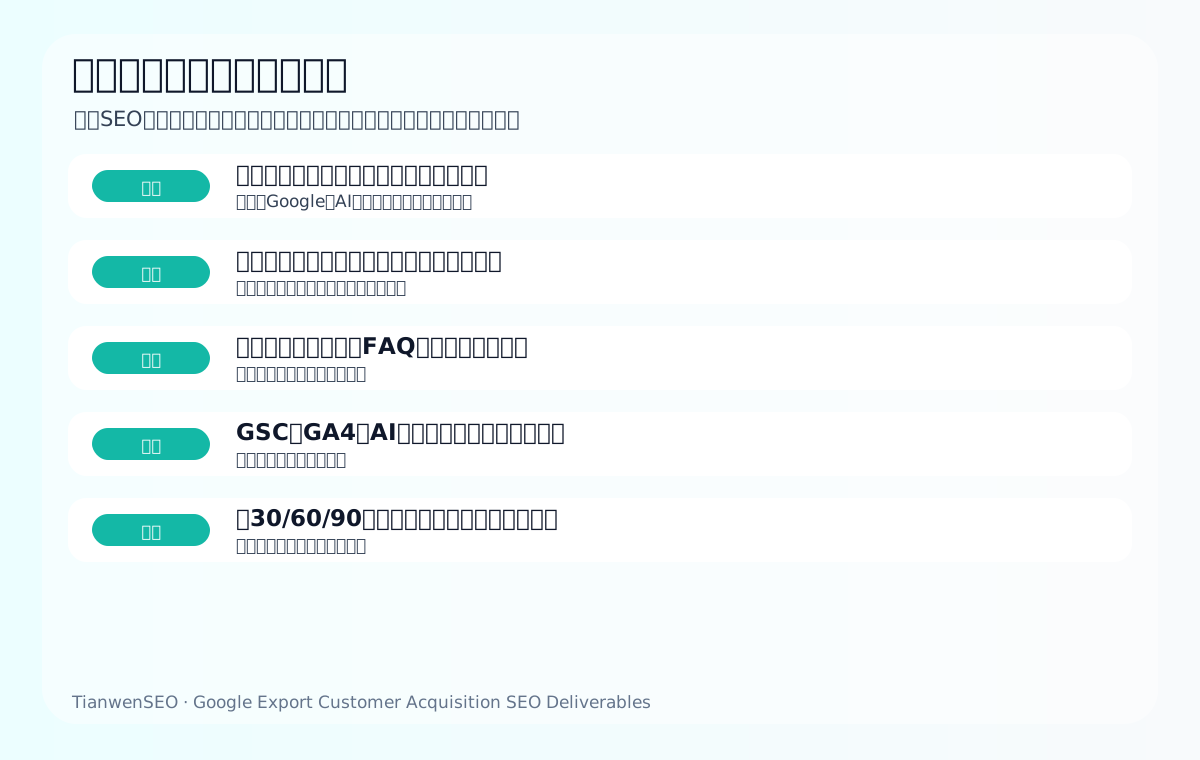
Start with the conclusion: foreign trade SEO delivery must revolve around the “lead acquisition chain,” not around task counts
The pitfall foreign trade companies fall into most easily is understanding SEO as a task list: how many articles to write this month, how many titles to change, how many links to build, one report delivered. Task counts do not equal lead acquisition results. A genuinely valuable optimization project should be able to answer four questions: What do overseas buyers search for? Which page should they land on? Is the page credible and convertible enough? Do the data and inquiries prove the direction is right?
For example, in the custom metal parts business, if you only write “how to choose supplier” articles but have no materials, tolerances, surface treatment, drawing requirements, or inquiry checklist, the lead acquisition chain is broken. In the LED flood light business, if you only optimize product terms but have no application pages for warehouse, parking lot, outdoor billboard, and so on, many buying questions cannot be served. In the packaging machine business, without material scenario pages for powder, granules, and liquids, both AI and buyers will struggle to understand equipment fit.
Core modules of foreign trade SEO lead acquisition optimization
| Module | Problem to solve | Typical deliverables | Foreign trade example |
|---|---|---|---|
| Technical SEO | Can Google crawl, index, and understand the page | Crawl diagnostics, indexing issues, speed, mobile, structured data | Whether product pages can be indexed |
| Keywords and intent | What buyers search for and what their intent is | English product term matrix, page mapping, priorities | waterproof connector vs IP67 connector |
| Page system | Which page serves which need | Product pages, category pages, application pages, resource pages, contact page | LED flood light warehouse application |
| Content upgrade | Whether pages answer buying questions | Long-form articles, tables, FAQ, graphics, inquiry checklist | CNC tolerance guide |
| Brand authority | Whether the company and products are credible | About page, certificate page, external sources, entity consistency | industrial valve supplier certifications |
| Data review | Whether optimization brings business results | GSC, GA4, AI answers, inquiry table, sales feedback | Inquiry country and product match |
What is not effective foreign trade SEO delivery
| Surface deliverable | Problem | Better deliverable |
|---|---|---|
| Only keyword ranking screenshots | Cannot explain inquiries or business value | Rankings + GSC queries + page paths + inquiry quality |
| Only article counts | May be generic content | Strong pages, tables, FAQ, graphics, and business paths |
| Only homepage optimization | Product and application needs cannot be served | Product page/category page/application page system |
| Only backlink counts | Source quality and business relevance unclear | Industry-relevant sources and a consistent brand entity |
| Only a technical report | No implementation fixes or review | Issue priorities, fix results, and front-end verification |
Technical SEO: the foundation of foreign trade lead acquisition
Technical SEO is not an internal report for technicians; it is the foundation that determines whether overseas buyers can find pages through Google.
| Check item | Why it matters | Foreign trade scenario |
|---|---|---|
| Crawling and indexing | If a page is not indexed, there is no search entry point | Whether core product pages are in the Google index |
| Mobile usability | Overseas buyers browse heavily on mobile | Whether tables and images are readable on phones |
| Speed and stability | Slow pages hurt experience and crawling | Whether image-heavy product pages load too slowly |
| Structured data | Helps understanding of products, FAQ, and articles | Readability of FAQ and product resource pages |
| Internal link structure | Helps Google and users discover pages | Product pages link to application pages and resource pages |
Keyword research: do not look only at search volume, look at buying intent
The core of foreign trade keyword research is not finding the largest search volume, but finding the terms that bring buying decisions and inquiries.
| Keyword type | Example | Page type | Review method |
|---|---|---|---|
| Product terms | custom metal parts | Product/capability page | Impressions, clicks, product inquiries |
| Specification terms | IP67 waterproof connector | Product/resource page | Specification-related inquiries |
| Application terms | LED flood light for warehouse | Application page | Project specification inquiries |
| Question terms | how to choose packaging machine | Resource page | Internal links to product pages |
| Supplier terms | industrial valve supplier | Category/company capability page | Contact page visits |
| Wholesale terms | ceramic dinnerware wholesale | Category/purchasing page | MOQ and sample inquiries |
Page system: foreign trade SEO cannot be blogs only
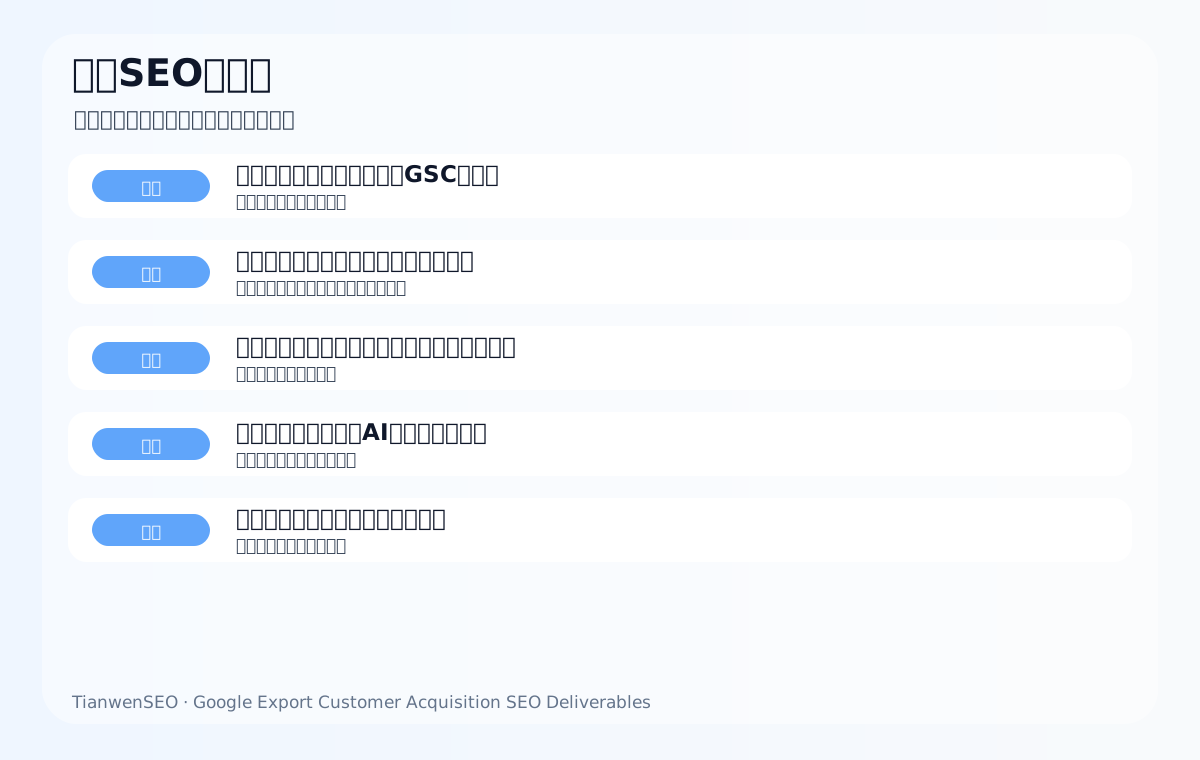
| Page | Task | Required content |
|---|---|---|
| Product page | Prove you can supply a specific product | Specifications, materials, certifications, applications, limitations, FAQ |
| Category page | Help choose a product category | Category logic, model differences, purchasing advice |
| Application page | Solve scenario problems | Environmental conditions, selection process, risks, and solutions |
| Resource page | Explain professional judgment | Tables, steps, common mistakes, inquiry checklist |
| About/certificate page | Build trust | Company entity, capabilities, certificate scope |
| Contact page | Capture action | Form fields, response time, materials to prepare |
Content optimization: from generic articles to procurement resource assets
Foreign trade SEO content should not chase article counts alone; it should build procurement resource assets.
| Generic content | Resource asset | Value |
|---|---|---|
| how to choose supplier | custom metal parts supplier evaluation checklist | Closer to buying decisions |
| LED lighting tips | warehouse LED flood light wattage and beam angle table | Serves scenario needs |
| packaging machine guide | powder packaging machine RFQ checklist | Converts into inquiries |
| ceramic dinnerware article | ceramic dinnerware wholesale material, MOQ and packaging guide | Answers wholesale purchasing questions |
GSC and GA4 review: how to read a foreign trade SEO report
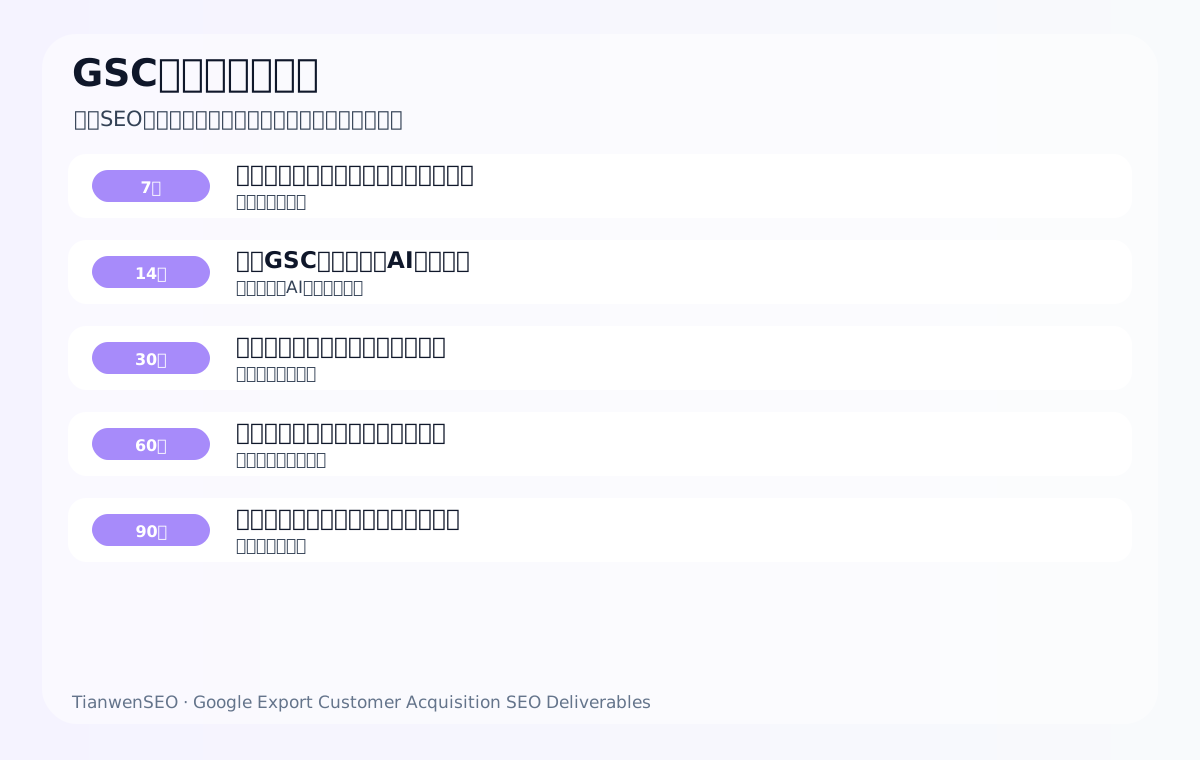
| Data | What to look at | What it explains |
|---|---|---|
| GSC query terms | Impressions, clicks, CTR, average position | Whether Google matches pages to the right needs |
| GSC pages | Which URLs get impressions and clicks | Whether the page system works |
| GA4 paths | Whether visitors view product and contact pages after the entry page | Whether traffic follows a business path |
| AI answers | Whether the brand or pages are mentioned or cited | GEO visibility and answer accuracy |
| Inquiry table | Product, country, specifications, source | Whether high-quality opportunities are generated |
90-day foreign trade SEO delivery rhythm
Weeks 1-2: Diagnosis and priorities
Complete technical, page, GSC, content, competitor, and inquiry diagnostics and output priorities, rather than immediately starting to publish articles.
Weeks 3-4: Page mapping and foundational fixes
Determine English product terms and page roles, and fix issues affecting crawling, indexing, speed, and mobile usability.
Weeks 5-8: Core page upgrades
Prioritize upgrades to product pages, category pages, application pages, and high-value resource pages, adding tables, FAQ, graphics, internal links, and inquiry checklists.
Weeks 9-12: Data review and second iteration
Review GSC, GA4, AI answers, and inquiry quality, and decide on title adjustments, content expansion, page consolidation, or new resource pages.
FAQ: common questions about Google foreign trade lead acquisition optimization
Top1 benchmark: common B2B SEO service pages lack foreign trade implementation
The B2B SEO service pages in current English search results generally talk about technical SEO, keyword research, content strategy, link building, conversion optimization, and reporting. These modules are not wrong, but for Chinese foreign trade manufacturers and trading companies they are still too generic. Foreign trade lead acquisition is not just about lead count; it is also about whether the product matches, whether the country matches, whether specifications are complete, and whether the conversation can move into a quote discussion.
Many service pages also emphasize pipeline and revenue but lack a breakdown of English foreign trade product terms and page roles. For example, how custom metal parts should build material pages and tolerance pages, how packaging machine should build material application pages, how ceramic dinnerware should build MOQ and packaging pages — these are the delivery details foreign trade companies actually need.
| Benchmark module | Common service page coverage | Foreign trade company gap | What this article adds |
|---|---|---|---|
| Technical SEO | Crawling, speed, indexing, structured data | Do not know which product pages to fix first | Prioritized by core products and inquiry value |
| Keywords | Keyword research and mapping | Lack English product terms and buying intent | Layered product, application, question, and supplier terms |
| Content | Blogs and landing pages | Lack product pages, resource pages, application pages | Page system deliverables checklist |
| Reporting | Rankings, traffic, conversions | Lack inquiry quality and sales feedback | GSC + GA4 + inquiries + AI answers |
| AI visibility | Mentions AI search | Lack an AI answer correction process | Question library, screenshots, cited sources, entity consistency |
Foreign trade SEO deliverables checklist: from diagnosis to launch
| Stage | Deliverables | Acceptance method |
|---|---|---|
| Diagnosis | Technical issues, page structure, content gaps, GSC and inquiry analysis | Can explain priorities and reasons |
| Strategy | English product term matrix, page mapping, 90-day plan | Every term has a corresponding page and action |
| Technical fixes | Indexing, crawling, speed, mobile, structured data fixes | Front-end and tool re-checks pass |
| Page upgrades | Content updates for product, category, application, and resource pages | Pages can answer buying questions |
| Content assets | Long-form articles, tables, FAQ, graphics, inquiry checklists | Not generic articles; they have a business path |
| Review | GSC, GA4, AI answers, inquiry and sales feedback report | Can explain the next actions |
What questions to ask during the diagnosis stage
Diagnosis is not about producing a beautiful report; it is about finding where the lead acquisition chain is broken.
| Question | Why ask | Output |
|---|---|---|
| What are the core products | Determines page and keyword priorities | Product line list |
| Where are the target markets | Determines language, vocabulary, and content focus | Market and language statement |
| Where do existing inquiries come from | Assesses the current lead acquisition path | Inquiry source table |
| Which pages have GSC impressions | Find pages with an existing foundation | High-potential page list |
| What does sales explain most often | Find content gaps | FAQ and resource page directions |
| Does the AI answer name the wrong brand | Assess GEO risk | AI answer baseline |
Technical delivery cannot stop at a detection report
Many SEO services deliver a technical report, but what is truly useful is: which issues affect core pages, which have been fixed, and how fixes are verified.
| Technical issue | Impact on foreign trade lead acquisition | Effective delivery |
|---|---|---|
| Core product pages not indexed | Buyers cannot find the pages | Submit/fix indexing issues and re-check |
| Important content hard to render with JS | Google and AI may not read it | Ensure body content is directly readable |
| Mobile tables unreadable | Buyers cannot view specifications | Optimize responsive tables |
| Images without descriptions | Product images cannot convey information | Add alt text and captions |
| Weak internal links | Resource pages and product pages are isolated | Build page relationships |
Keyword deliverables: you must provide page mapping, not just a term list
A term list has no value by itself; page mapping has value.
| English product term | Intent | Page | Delivery focus |
|---|---|---|---|
| custom metal parts | Custom supply capability | Product capability page | Materials, processes, tolerances, drawing checklist |
| cnc machining parts tolerance | Technical judgment | Resource page | Tolerance table, influencing factors, inspection |
| LED flood light for warehouse | Application solution | Application page | Mounting height, wattage, beam angle |
| packaging machine for powder | Equipment selection | Application/category page | Material, speed, precision, cleaning |
| ceramic dinnerware wholesale | Wholesale purchasing | Category page | MOQ, material, packaging, samples |
| industrial valve supplier | Supplier judgment | Category/capability page | Media, pressure, standards, certificates |
Content delivery: every piece of content needs a business role
| Content type | Business role | Must include |
|---|---|---|
| Pillar long-form article | Explain a complete method or topic | Top1 benchmark, graphics, tables, FAQ, review |
| Product page | Serve product terms and inquiries | Specifications, materials, certifications, applications, limitations |
| Application page | Serve scenario needs | Environmental conditions, selection, risks, solutions |
| Resource page | Serve AI and buying judgment | Standards, steps, comparisons, checklists |
| FAQ | Reduce repeated explanations by sales | Conditions, boundaries, next steps |
What a monthly foreign trade SEO report should include
| Report module | Should have | Signs it is not good enough |
|---|---|---|
| This month’s actions | Page, technical, content, internal link, and review actions | Only lists task counts |
| GSC data | Query terms, pages, CTR, ranking changes and explanations | Only screenshots of total clicks |
| GA4 paths | Entry pages, product pages, contact pages, conversion events | Only looks at total visits |
| Inquiry quality | Product, country, specification completeness, sales feedback | Only states inquiry counts |
| AI answers | Target questions, whether cited, whether accurate | Does not look at AI search at all |
| Next month’s plan | Data-based page actions | Vaguely writes “continue optimizing” |
Inquiry quality fields: foreign trade SEO must look at business results
| Field | Why it matters | Example |
|---|---|---|
| Source page | Know which page brought the inquiry | warehouse LED flood light application page |
| Product line | Judge whether it matches business priorities | waterproof connector / cable assembly |
| Country/region | Judge market quality | USA, Germany, UAE |
| Requirement specifications | Judge whether the inquiry is specific | quantity, material, drawing, voltage |
| Customer stage | Quote, sample, price comparison, technical confirmation | Determines sales follow-up |
| Sales feedback | Good/average/invalid and why | Guides content updates |
What AI visibility deliverables should include
Today’s Google foreign trade lead acquisition optimization must at least bring AI search into view.
| Deliverable | Content | Purpose |
|---|---|---|
| AI question library | Core product and buying questions | Establish reviewable targets |
| Answer screenshots | Records of answers from ChatGPT/AI Overviews/Perplexity, etc. | Judge whether mentioned and whether accurate |
| Cited sources | Official site, competitors, third-party sources | Find content and brand gaps |
| Entity consistency check | Company name, product lines, certificates, external materials | Reduce AI misreading |
| Correction actions | Add pages, FAQ, certificate pages, update external materials | Make answers more accurate |
How to judge whether a service is doing “real optimization”
| Judgment question | Real optimization | Surface optimization |
|---|---|---|
| Does it change core pages | Product, application, and resource pages actually updated | Only publishes blog posts |
| Does it explain priorities | Ranked by GSC, inquiries, and business value | Done randomly by term list |
| Does it re-check the front end | HTTP, titles, images, tables, bad-word checks | Only says “published” |
| Does it look at inquiry quality | Linked with sales feedback | Only looks at rankings |
| Is there a next step | Adjusts monthly based on data | Repeats the same report every month |
How foreign trade SEO and SEM work together
Although this article is about SEO, foreign trade lead acquisition often needs SEO and Google Ads working together. SEO is suited to long-term accumulation of product pages, resource pages, and brand authority; SEM is suited to quickly testing markets, product terms, and landing pages.
| Scenario | SEO role | SEM role |
|---|---|---|
| New product line | Build product pages and resource pages | Quickly test terms and countries |
| Highly competitive product terms | Long-term content and authority | Short-term exposure |
| Application scenario terms | Build application pages and case boundaries | Test conversion rates |
| Poor inquiry quality | Add resources and filtering content | Optimize ad terms and negative keywords |
90-day acceptance table
| Time | What you should see | What to do if not |
|---|---|---|
| Day 7 | Basic pages accessible, fixes launched | Solve technical and publishing issues first |
| Day 14 | Some pages begin to show impressions or indexing changes | Check indexing and internal links |
| Day 30 | GSC queries and page paths become clearer | Adjust titles and page intent |
| Day 60 | Inquiry fields more complete or page paths improved | Add conversion entry points and resource pages |
| Day 90 | Form the next batch of high-priority pages | Consolidate, expand, or adjust strategy |
A few more FAQ
Do foreign trade SEO services have to produce long-form articles?
Technical tutorials, resource pages, and pillar content should go deep, but contact pages, quote entry points, and pure navigation pages should not be padded with words.
Is looking only at rankings enough for an SEO report?
No. Rankings are only one aspect of visibility; you also need GSC queries, GA4 paths, AI answers, and inquiry quality.
Can we do this without GSC data?
You can start with basic diagnosis and page upgrades, but you should connect GSC as soon as possible, otherwise the review will be incomplete.
How often should foreign trade SEO be reviewed?
Monthly review is recommended; do basic checks 7-14 days after major pages go live, and look at business direction at 60-90 days.
Why look at sales feedback?
Sales knows what customers actually ask, what they misunderstand, and which inquiries are valuable, and this can guide content updates.
Does foreign trade SEO need images?
Yes. Product images, flowcharts, selection matrices, application diagrams, and review dashboards can significantly improve readability and decision value.
Delivery priorities by industry: different foreign trade products cannot use the same content
Genuine foreign trade SEO delivery must explain industry differences clearly. A site selling ceramic dinnerware and a site making industrial valves have completely different page structures and content priorities.
| Industry/product | Core pages | Content focus | Review focus |
|---|---|---|---|
| custom metal parts | Capability page, material page, tolerance page, drawing inquiry page | Materials, processes, tolerances, surface treatment, inspection | Completeness of drawing inquiries |
| LED flood light | Product page, warehouse application page, outdoor application page, certification page | Wattage, beam angle, IP rating, mounting height | Project specification inquiries |
| packaging machine | Category page, material application page, selection checklist, after-sales FAQ | Material, speed, precision, cleaning, sample testing | Equipment requirement match |
| medical probe | Quality page, material page, compliance confirmation FAQ | Material, cleanliness, inspection, certificate scope | Technical confirmation quality |
| ceramic dinnerware | Wholesale page, material page, packaging page, MOQ FAQ | Material, patterns, packaging, samples, target market | Sample and MOQ inquiries |
| industrial valve supplier | Category page, media application page, standards page, certificate page | Media, pressure, temperature, connections, spare parts | Completeness of operating parameters |
Page case one: how to deliver a custom metal parts lead acquisition page
A qualified custom metal parts lead acquisition page should not just say “we provide high quality custom parts.” It should let buyers judge whether you can make their drawing.
| Module | Content | Acceptance criteria |
|---|---|---|
| First screen | State machinable materials, processes, and suitable order types | Users know at a glance whether it matches |
| Material table | stainless steel, aluminum, brass, copper, etc. | Has applicable scenarios and limitations |
| Process table | CNC machining, turning, stamping, laser cutting | Explains what structures each suits |
| Tolerance explanation | Factors affecting tolerances and drawing requirements | Avoids generic claims of high precision |
| Inquiry checklist | Drawing, material, quantity, tolerance, surface treatment, use | Form or list is clear |
Page case two: how to deliver a packaging machine lead acquisition page
| Module | Content | Acceptance criteria |
|---|---|---|
| Material selection | Differences among powder, granules, liquids, sauces | Has a compatibility table |
| Equipment type | Semi-automatic, fully automatic, premade pouch, vertical form fill seal | Explains applicable capacity |
| Precision and speed | Influencing factors and ranges | Avoids writing only “high speed” |
| Cleaning and maintenance | Contact parts, disassembly, food-grade requirements | Can answer buyer concerns |
| RFQ fields | Material, weight, bag type, speed, voltage, budget | Can improve inquiry quality |
Page case three: how to deliver a LED flood light application page
| Module | Content | Acceptance criteria |
|---|---|---|
| Application scenarios | warehouse, parking lot, stadium, billboard | Scenarios are not listed generically |
| Parameter judgment | Wattage, beam angle, mounting height, illuminance | Has a selection table |
| Environmental requirements | IP rating, surge protection, temperature, certifications | Has applicable boundaries |
| Graphic explanations | Installation diagram or illumination range diagram | Not just product photos |
| Project inquiry | Area, height, target illuminance, quantity, market | Makes quoting easy |
Service acceptance: what you should receive each month
| Month | Should deliver | Acceptance focus |
|---|---|---|
| Month 1 | Diagnosis, term list, page mapping, technical fixes, first batch of page upgrades | Whether real bottlenecks were found |
| Month 2 | Core product/application/resource pages live, internal links and conversion paths optimized | Whether pages are readable and convertible |
| Month 3 | GSC/GA4/AI answer/inquiry review, second batch plan | Whether data can be explained and iterated on |
| Ongoing months | Page updates, content reinforcement, brand authority, external signals, and review | Whether adjustments are made based on business feedback |
Risk warning: do not believe these promises
- Claims of guaranteed rankings or guaranteed inquiries are not credible.
- Measuring SEO value only by article count is not credible.
- A monthly report that ignores GSC and inquiry quality is incomplete.
- Using the same keyword set and article structure for every industry does not suit foreign trade.
- Optimizing only the homepage without handling product and application pages makes stable lead acquisition difficult.
- Describing AI search optimization as one-click submission or guaranteed adoption does not match reality.
Questions to ask when discussing foreign trade SEO services
| Question | Good answer should include | Warning signs |
|---|---|---|
| Which data will you look at first? | GSC, GA4, pages, inquiries, competition, and technical | Only keyword tools |
| How do you choose priority pages? | Business value, search foundation, inquiry value, content gaps | Sorting by search volume |
| How is content written? | Foreign trade product terms, buying questions, tables, FAQ, graphics | Generic AI articles |
| What do you look at in the monthly report? | Search, visits, AI answers, inquiries, sales feedback | Ranking screenshots |
| Can you write results as guaranteed commitments? | Cannot promise uncontrollable outcomes, but can commit to process and review | Promises rankings and inquiries |
Reverse-engineering pages from inquiries: a practical method
Every month, classify inquiries by product and question, then work backward to pages.
| Inquiry question | What the page lacks | Content action |
|---|---|---|
| Customer does not know what specifications to send | Inquiry checklist insufficient | Add RFQ checklist |
| Customer repeatedly asks about certifications | Certificate page or product page unclear | Add certificate scope |
| Customer asks whether the product fits a scenario | Application page insufficient | Add application page and selection table |
| Customer only asks about price | Value and specification judgment insufficient | Add price influencing factors |
| Customer’s product does not match | Keyword and page intent inaccurate | Adjust page titles and filtering content |
AI answer review example
For example, if a user asks “how to choose waterproof connector for outdoor LED lighting” and the AI answer cites a competitor instead of you, you cannot just say “we need to do GEO.” You must break down the reasons.
| Check item | Possible gap | Action |
|---|---|---|
| Official site product page | Missing IP rating, cable diameter, installation instructions | Add specifications and application boundaries |
| Resource page | No IP67/IP68 selection guide | Create a resource page or a strong section |
| Brand entity | Product lines inconsistent on external platforms | Correct B2B and trade show materials |
| Internal links | Resource page does not link to product pages | Build an application page-product page-inquiry page path |
| Inquiry | Contact page has no project fields | Add a project requirement form |
Framework for writing a foreign trade SEO deliverables checklist
| Deliverable | File/page | Must explain |
|---|---|---|
| Diagnosis report | PDF/table | Issues, impact, priorities, fix recommendations |
| Keyword matrix | Table | English terms, intent, pages, priorities |
| Page plan | Table | Actions for product, application, resource, and contact pages |
| Content draft | HTML/WordPress page | Word count, tables, FAQ, graphics, bad-word check |
| Publishing record | URL and backup | Publish time, backup path, re-check results |
| Monthly review | Report/table | GSC, GA4, AI answers, inquiries, and next month’s actions |
Content quality acceptance criteria
| Criterion | Pass | Fail |
|---|---|---|
| Foreign trade perspective | Uses English product terms and buying questions | Uses SEO service terms as examples |
| Depth | Covers judgment, process, tables, FAQ, review | Vague discussion of concepts |
| Graphics | Has flowcharts, matrices, diagrams, or screenshots | Only stacked text |
| Client-readable | Solves client judgment problems | Reads like internal implementation notes |
| Safety boundaries | Does not promise uncontrollable results | Promises rankings or inquiries |
Why save backups and re-check after publishing
Foreign trade website content upgrades are not finished once the writing is done. Back up before publishing, and check whether the front end is normal after publishing.
| Re-check item | Why | Common problems |
|---|---|---|
| HTTP 200 | The page must be accessible | 404 or cache anomalies after publishing |
| Title and Meta | Affects search snippets and clicks | Title not updated or too long |
| Images | Graphic content must display | SVG or image 404 |
| Bad words | Avoid internal tone and uncontrollable promises | Internal process words appear |
| Word count and structure | Confirm long-form standards are met | Content truncated or formatting lost |
Final judgment: is a foreign trade SEO project worth continuing
| Signal | Worth continuing | Needs adjustment |
|---|---|---|
| Page quality | Core pages keep getting stronger | Only publishing low-quality articles |
| Data explanation | Can explain the relationship between GSC and inquiries | Only reports rankings |
| Business feedback | Sales finds inquiries clearer | Sales does not know what the project did |
| AI visibility | Answers are more accurate or citations begin | Does not track AI at all |
| Iteration capability | Data-based actions every month | Repeats the same task set |
Official documentation boundaries: foreign trade SEO delivery must separate technical, content, data, and inquiry acceptance
Google foreign trade lead acquisition optimization is not about putting “keywords, articles, backlinks, reports” into one package. A more solid approach is to map each deliverable to an officially verifiable standard: whether pages can be discovered, whether they meet basic search eligibility, whether sitemap, robots, canonical, and structured data are clear, whether GSC and GA4 can be reviewed, whether AI search samples can be recorded, and whether inquiry fields can return to sales feedback.
If Search Console has no query, page, or page-query rows in the last 28 or 90 days, the report can only state “no usable GSC signal at this time.” It must not add rankings, impressions, clicks, CTR, traffic growth, or inquiry changes. What an SEO team can deliver is diagnosis, page actions, technical corrections, content resources, data standards, and a review cadence; Google impressions, AI citations, buyer inquiries, and closed deals must all be continuously observed.
| Official source | What it corresponds to in delivery | Foreign trade site acceptance example | What it must not be written as |
|---|---|---|---|
| Google Search Central: SEO Starter Guide | Titles, body content, image descriptions, internal links, page purpose, and user value. | Whether the custom metal parts page answers questions about materials, tolerances, drawings, samples, and volume. | Must not be written as a specified ranking result. |
| Google Search Central: Search Essentials | Basic search eligibility, content quality, accessibility, and spam risk. | Whether the medical probe page avoids fabricated certifications, misleading compatible models, and empty copy. | Basic compliance does not mean impressions have already been generated. |
| Google Search Central: Sitemaps overview | Key URL discovery paths and URL update lists. | Whether the LED flood light category page, product page, application page, and resource page are included in the sitemap. | A sitemap containing a URL does not mean the page is indexed. |
| Google Search Central: robots.txt introduction | Crawl rules, resource access, images, PDF, JS/CSS, and troubleshooting of accidentally blocked key pages. | Whether the packaging machine catalog, installation materials, images, and inquiry page are accessible. | Allowing crawling does not mean impressions or clicks will occur. |
| Google Search Central: Consolidate duplicate URLs | Canonical strategy for parameter pages, filter pages, variant pages, multilingual pages, and duplicate URLs. | Whether private label activewear manufacturer color, size, and fabric variants dilute each other. | canonical is not a mandatory command, nor a ranking promise. |
| Google Search Central: Structured data general guidelines | Whether structured data fields come from visible page content. | Whether Product, Breadcrumb, Article, and FAQ fields match the page body. | Schema is not a rich result or AI answer controller. |
| Search Console Help: Performance report | query, page, clicks, impressions, CTR, average position, country, device. | Review pages and queries for waterproof connector and industrial valve supplier separately. | Without GSC row data, you cannot write about trends, clicks, or CTR improvements. |
| Search Console Help: URL Inspection tool | Indexing, crawling, canonical, and the version Google sees for a single URL. | Spot-check whether core category pages, resource pages, product pages, and inquiry pages are correctly recognized. | A single URL being inspectable does not mean it has gained search impressions. |
| Google Analytics Help: About events | On-site behaviors such as forms, email, WhatsApp, downloads, RFQ, and resource page clicks. | Whether cnc machining parts drawing uploads, inquiry buttons, resource downloads, and email clicks can be recorded. | On-site events cannot directly replace organic search performance. |
| Google Search Central: AI features and your website | AI search still depends on pages being discoverable, indexable, clear in content, and on basic SEO. | Whether AI samples can be mapped to product pages, resource pages, FAQ, and source pages. | Cannot promise that AI answers will definitely use the official site. |
| OpenAI Platform: Bots | Distinguish the purposes and access boundaries of OAI-SearchBot, GPTBot, and ChatGPT-User. | Check robots.txt and logs, and do not treat training crawls, search crawls, and user-triggered visits as one category. | Allowing a certain crawler does not mean ChatGPT search will display the official site. |
| Bing Webmaster Blog: AI Performance | If visible in the account, observe citations, cited pages, grounding query phrases. | Record which product questions cite the official site and which cite competitors, directories, or third-party materials. | A citation is not a ranking, answer position, or inquiry result. |
| IndexNow: Documentation | After adding, updating, or deleting URLs, record submission time, URL list, and return status. | After a major product page overhaul, write the notification record and subsequent GSC/Bing/log observations separately. | HTTP 200 only means the notification was received, not that it was crawled, indexed, or shown. |
Foreign trade SEO delivery acceptance table: every piece of work needs evidence
| Delivery layer | Qualified delivery | Acceptance materials | Unqualified signal |
|---|---|---|---|
| Technical layer | Status codes, index/follow, canonical, robots, sitemap, structured data, mobile tables. | Source code, sitemap, GSC check, screenshots, URL list. | Only tool screenshots, without listing URLs and handling actions. |
| Keyword layer | English product terms, supplier terms, application terms, certificate terms, parameter terms, inquiry terms, and page mapping. | Query set, page role map, priority explanation. | Only a Chinese term list or generic industry terms. |
| Page layer | Category pages, product pages, application pages, resource pages, article pages, and RFQ pages each have a role. | Before-and-after summaries, body content fields, internal link paths, review records. | All issues are handled with blog articles. |
| Data layer | GSC, GA4, Bing, AI samples, inquiry fields, and sales feedback reviewed in the same table. | Export files, event list, sample screenshots, review dates. | Writing trends or results when there is no data. |
| Business layer | Whether inquiries include product, specifications, drawings, MOQ, country, budget, lead time, and application scenario. | Inquiry table, sales feedback, page sources, next month’s actions. | Only looking at inquiry count, not quality. |
When there is no GSC data, what should Google foreign trade lead acquisition optimization do first
No GSC data does not mean SEO cannot be done. It only means review conclusions must be downgraded: build the page and data baseline first, then wait for real signals. At this stage the most important deliverables are the product line list, page roles, technical eligibility, event standards, AI samples, and inquiry fields, not judgments about results.
| Zero-signal stage | Can deliver | Must not be written as | Follow-up check |
|---|---|---|---|
| GSC has no query/page rows | Build query set, URL mapping, page inventory, and review dates. | Existing rankings, impressions, clicks, or CTR improvements. | Re-check GSC page/query after 7-14 days. |
| GA4 events just configured | Test form, email, WhatsApp, download, RFQ, and resource page events. | Inquiries have already increased. | Combine with source, landing page, product line, and sales feedback. |
| AI samples just established | Platform, query, date, answer summary, cited URL, and wrong facts. | The official site is already consistently used by AI. | Re-test the same question set at 30/60/90 days. |
| Pages just updated | Before-and-after summaries, page facts, internal links, and review records. | The pages have already produced business results. | Look at crawling, indexing, GSC, GA4, and inquiry paths. |
Service boundaries: what SEO can do and what it cannot promise
Foreign trade SEO can improve the chance that pages are discovered, understood, clicked, and inquired about, but it cannot replace product competitiveness, price, delivery, sales follow-up, or market demand. Clear boundaries actually make a project healthier.
| Item | What SEO can do | What it cannot promise |
|---|---|---|
| Rankings | Improve page quality, technical foundation, content match, and authority signals | Cannot promise a specified position |
| Inquiries | Improve the quality of high-intent pages and conversion paths | Cannot promise a specified number |
| AI citations | Improve content structure, entity consistency, and verifiable sources | Cannot promise that AI answers will use the official site |
| Conversion rate | Optimize page information and inquiry fields | Cannot replace price, product, or sales capability |
| Timeline | Establish a 30/60/90-day review mechanism | Cannot write short-term immediate results as a definite conclusion |
Example roadmap for core product line pages
Take a foreign trade company that makes both waterproof connector and LED flood light as an example. Within 90 days it should not work on all pages equally, but should build a roadmap around core product lines.
| Week | Page | Action | Purpose |
|---|---|---|---|
| Weeks 1-2 | Core product pages | Add specifications, materials, certifications, applications, and FAQ | Ensure product terms have a strong landing page |
| Weeks 3-4 | IP rating resource page | Write IP67/IP68, outdoor applications, and a risk table | Serve AI and long-tail questions |
| Weeks 5-6 | Warehouse lighting application page | Add wattage, mounting height, beam angle, and a project requirement table | Serve scenario terms |
| Weeks 7-8 | Inquiry checklist page | Organize project parameters and the sample process | Improve inquiry quality |
| Weeks 9-12 | GSC/GA4/AI review | Look at queries, visits, AI answers, and inquiries | Decide the next batch of pages |
Foreign trade SEO report sample: explain the business clearly with one page of data
A good monthly report does not need dozens of pages of screenshots, but it must explain the key facts clearly.
| Module | Example content | Interpretation |
|---|---|---|
| Completed this month | Published the LED warehouse application page and the IP rating resource page | Core page system is more complete |
| Search performance | warehouse LED flood light impressions grew, CTR average | Titles and first screen need further optimization |
| Visit paths | 30% of application page visitors go to product pages | Internal links are effective |
| AI answers | AI cited a competitor’s IP rating table, not the official site | Need to strengthen the IP resource page and external signals |
| Inquiries | 3 new warehouse project inquiries, 2 provided height and area | Inquiry quality improved |
| Next month’s actions | Add beam angle matrix, update inquiry fields, optimize titles | Iterate based on data |
How to handle a new site with no data
A new site with no GSC history can still do foreign trade SEO, but expectations for short-term results should be lowered. At the new site stage the focus is building basic pages and data collection.
| Stage | Action | Goal |
|---|---|---|
| Foundation setup | GSC, GA4, sitemap, indexing check | Let data start accumulating |
| Core pages | Homepage, product pages, category pages, about page, contact page | Build indexable entry points |
| Resource assets | 3-5 high-value resource pages | Cover buying judgment |
| Brand entity | Unify external platform materials | Reduce entity confusion |
| Early review | Look at indexing, impressions, brand searches, and inquiries | Judge direction |
How to handle a site with traffic but poor inquiries
Traffic but poor inquiries usually means there is a problem with search intent, page content, or the conversion path.
| Symptom | Possible cause | Action |
|---|---|---|
| Lots of blog traffic, few product page visits | Content disconnected from the business | Add product internal links and relevant CTAs |
| Many product page visits, no inquiries | Insufficient specifications, trust, or inquiry paths | Add parameters, certificates, and an inquiry checklist |
| Inquiries do not match | Keyword intent too generic | Adjust titles and page filtering information |
| Customers ask basic questions | The page does not explain in advance | Add FAQ and resource pages |
| High bounce rate | First screen mismatch or slow page | Rewrite the first screen, optimize speed and mobile |
How to handle a site with lots of content but poor results
When there is a lot of content but poor results, you cannot keep blindly adding articles. You need to do a content audit and consolidation.
| Problem | How to handle | Example |
|---|---|---|
| Multiple articles competing for the same term | Consolidate into a strong pillar page | Merge multiple packaging machine selection articles |
| Articles have no product entry points | Add internal links and conversion modules | CNC tolerance article links to the custom metal parts page |
| Content is outdated | Update standards, parameters, years, and FAQ | Update 2026 data in the AI Overviews CTR article |
| Too many low-value pages | Lower priority or consolidate | Articles with no search and no business |
| Page roles unclear | Split product, application, and resource intent | Separate LED flood light product and warehouse application |
What clients should cooperate on in a foreign trade SEO project
An SEO team cannot manufacture product facts out of thin air. Foreign trade companies need to provide real materials.
| Client material | Purpose | Example |
|---|---|---|
| Product specifications | Write product pages and tables | Dimensions, materials, voltage, wattage, model |
| Certificates and testing | Build trust and boundaries | CE, RoHS, ISO, test reports |
| Sales questions | Write FAQ and resource pages | MOQ, samples, lead time, packaging |
| Product images/application images | Combine graphics and text | Installation diagrams, structure diagrams, application scenarios |
| Inquiry feedback | Review content quality | Reasons why inquiries were valid/invalid |
Do not neglect the contact page and inquiry form
No matter how good the technical long-form articles and product pages are, if the contact page is unclear, conversion will suffer. The contact page does not need to be 10,000 words, but it must let buyers know how to get in touch, what materials to provide, and how quickly they will get a response.
| Contact page module | Suggested content | Purpose |
|---|---|---|
| Contact methods | Email, phone, WhatsApp, form | Lower the communication barrier |
| Inquiry fields | Product, quantity, specifications, target market, attachments | Improve inquiry quality |
| Response statement | Business-day response time and material confirmation process | Reduce waiting uncertainty |
| Material guidance | Drawings, photos, specifications, application scenarios | Help buyers prepare |
| Privacy statement | Materials used only for quote communication | Enhance trust |
How to deliver foreign trade SEO and GEO as one
SEO and GEO should no longer be completely separated. SEO handles search visibility, GEO handles AI answer visibility and citation accuracy, and both share the same set of page assets.
| Asset | SEO value | GEO value |
|---|---|---|
| Product page | Serves product term rankings and clicks | Provides AI-citable product facts |
| Resource page | Serves long-tail and question terms | Answers AI fan-out sub-questions |
| Brand page | Builds trust and brand search | Helps AI identify the entity |
| Certificate page | Enhances credibility | Reduces AI misreading of certifications |
| FAQ | Covers long-tail questions | Provides answer snippets |
Long-term route: from lead acquisition optimization to a content asset library
In the later stages, foreign trade SEO should not be just a pile of articles; it should form a content asset library.
| Asset type | Long-term value | Example |
|---|---|---|
| Product resource library | Continuously serves product terms | waterproof connector specifications and applications |
| Selection guide library | Serves buying judgment | LED flood light wattage and beam angle |
| Standards and certification library | Builds trust | RoHS, CE, IP rating explanations |
| Inquiry checklist library | Improves sales efficiency | packaging machine RFQ checklist |
| AI answer review library | Continuous correction and optimization | Screenshots of core questions and cited sources |
A few more acceptance FAQ
Does foreign trade SEO require clients to provide product materials?
Yes. Without real specifications, applications, images, and sales questions, content easily becomes generic.
Why can we not just write blogs?
Because foreign trade lead acquisition mainly depends on product pages, application pages, resource pages, and inquiry paths working together; blogs cannot replace product facts.
Should AI answer records be kept in an SEO project?
Yes, it is recommended. AI Overviews and ChatGPT affect brand perception and click paths, and recording answers helps with correction.
If there are no inquiries for three months, is that a failure?
It should be judged together with site foundation, market, product, budget, and execution volume. In three months you should at least see improvements in indexing, impressions, page paths, or content quality direction.
Can foreign trade SEO content be written with AI?
It can assist, but it must be validated against product facts, foreign trade scenarios, tables, FAQ, graphics, and review standards, and generic content must not be published directly.
What does Google foreign trade lead acquisition optimization include?
It includes technical SEO, keywords and intent, the page system, content upgrades, brand authority, AI visibility, GSC/GA4 data, and inquiry quality review.
Is foreign trade SEO just publishing articles?
No. Articles are only one part; more important are product pages, category pages, application pages, resource pages, and inquiry paths.
How do you judge whether SEO delivery is reliable?
Look for diagnosis, priorities, page changes, front-end verification, data review, and business explanation, not just task counts.
What is GSC used for in foreign trade SEO?
GSC shows query terms, page impressions, clicks, and CTR, and is important data for judging whether Google understands pages.
Why also look at GA4 and the inquiry table?
SEO ultimately serves lead acquisition. GA4 shows visit paths, and the inquiry table shows product, country, specifications, and sales feedback.
Is AI search optimization included in foreign trade SEO?
It should be. You now need to observe whether AI Overviews, ChatGPT, Perplexity, and others correctly understand and cite official site content.
How long until results appear?
It varies greatly by site and industry. Typically, look at indexing and impressions at 30 days, and judge direction with visits and inquiries at 60-90 days.
Can rankings or inquiries be written as guaranteed results?
No. Rankings and inquiries are affected by market, competition, product, price, sales follow-up, and other factors; only reviewable optimization can be done.
Conclusion: foreign trade SEO delivery must be verifiable by the business
Good Google foreign trade lead acquisition optimization does not give you a pile of jargon reports; it makes you clearer about which buyer needs are worth pursuing, which pages should serve them, which content helps buying judgment, and which data proves the direction works.
If an SEO/GEO project can connect technical work, pages, content, brand, AI answers, and inquiry review, it truly serves foreign trade lead acquisition. Otherwise, no matter how many articles or how thick the report, it may be only surface work.
Continue reading this SEO series
If you are systematically organizing foreign trade website SEO, it is worth continuing with the articles below. First clarify the relationship between crawling, indexing, content, links, and review, then decide which page to change next.
- How to judge the most reliable foreign trade website building and promotion team in China: do not look at promises, look at diagnosis and evidence
- How to choose a Google SEO outsourcing team: permissions, division of labor, review, and risk boundaries
- How to do content SEO: a guide to search intent, information gain, and indexable content
- How to do keyword research: foreign trade product terms, search intent, and the page mapping process
- How to mine competitor keywords: from competitor pages and English product terms to inquiry opportunities
- How to choose keyword tools: choose by diagnosis scenario, not by executing a tool checklist
{
“@context”: “https://schema.org”,
“@type”: “FAQPage”,
“mainEntity”: [
{
“@type”: “Question”,
“name”: “Do foreign trade SEO services have to produce long-form articles?”,
“acceptedAnswer”: {
“@type”: “Answer”,
“text”: “Technical tutorials, resource pages, and pillar content should go deep, but contact pages, quote entry points, and pure navigation pages should not be padded with words.”
}
},
{
“@type”: “Question”,
“name”: “Is looking only at rankings enough for an SEO report?”,
“acceptedAnswer”: {
“@type”: “Answer”,
“text”: “No. Rankings are only one aspect of visibility; you also need GSC queries, GA4 paths, AI answers, and inquiry quality.”
}
},
{
“@type”: “Question”,
“name”: “Can we do this without GSC data?”,
“acceptedAnswer”: {
“@type”: “Answer”,
“text”: “You can start with basic diagnosis and page upgrades, but you should connect GSC as soon as possible, otherwise the review will be incomplete.”
}
},
{
“@type”: “Question”,
“name”: “How often should foreign trade SEO be reviewed?”,
“acceptedAnswer”: {
“@type”: “Answer”,
“text”: “Monthly review is recommended; do basic checks 7-14 days after major pages go live, and look at business direction at 60-90 days.”
}
},
{
“@type”: “Question”,
“name”: “Why look at sales feedback?”,
“acceptedAnswer”: {
“@type”: “Answer”,
“text”: “Sales knows what customers actually ask, what they misunderstand, and which inquiries are valuable, and this can guide content updates.”
}
}
]
}
This page is machine-translated from the Simplified Chinese version and awaiting human review. It has not yet been proofread.