An SEO Audit is not about screenshotting red warnings from a tool and sending them to your boss, nor is it about scanning every page against the same checklist. It is about judging why an export website is not being correctly crawled, understood, ranked, and converted by Google. For Chinese export manufacturers, factories, and trading companies, the goal of an SEO Audit is not to prove how many problems a site has, but to identify which problems affect English product keyword visibility, product page indexing, buyer trust, the inquiry path, and follow-up review.
If you run product lines such as custom metal parts, LED flood light, packaging machine, medical probe, cnc machining parts, ceramic dinnerware, waterproof connector, industrial valve supplier, or private label activewear manufacturer, the audit should not stop at “how many 404s, how many titles are too long, how many images lack alt text.” It should answer: when buyers search English product keywords, can they find your category pages; can Google understand your product parameters, application industries, and supply capabilities; is it possible that AI answers will cite your resource pages; can your inquiry form handle visitors at different stages.
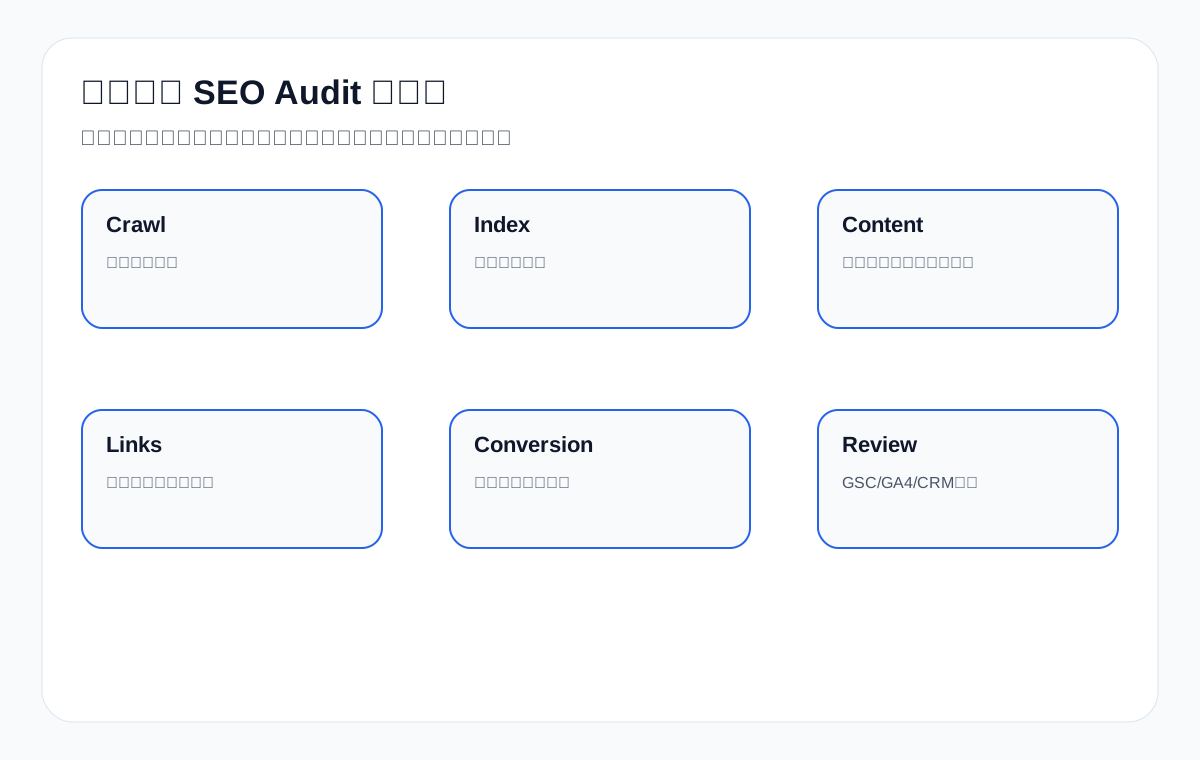
Official source boundaries: an SEO Audit is not a tool screenshot, but a traceable evidence chain
When doing an SEO Audit for an export website, you cannot just compile red-flag screenshots from a tool. A genuinely useful audit grounds every issue in official, reviewable fields: whether Google can discover the URL, whether the page allows crawling and indexing, whether the canonical is clear, whether internal links can be followed, whether structured data matches the body content, whether GSC has real query/page data, and whether GA4 can record inquiry actions.
This boundary matters. For export sites in custom metal parts, LED flood light, packaging machine, medical probe, waterproof connector, industrial valve supplier, and similar lines, a vague “technically fine” report still leaves the company unsure whether to fix the homepage, category pages, product pages, resource pages, or the inquiry path. The deliverable of an SEO Audit should be reviewable, rather than a broad conclusion people are asked to trust.
Official sources mapped to SEO Audit acceptance fields
| Official source | Audit judgments it supports | Export website acceptance fields | Conclusions it cannot support |
|---|---|---|---|
| Google Search Central: SEO Starter Guide | Pages should serve real users; content should be clear, discoverable, and understandable. | Whether product parameters, application scenarios, FAQ, resource downloads, and inquiry entry points are complete. | Cannot judge page quality by word count or plugin score. |
| Google Search Central: Search Essentials | Pages must meet basic crawlability, indexability, and content quality requirements. | HTTP status, indexing tags, spam content risk, page accessibility. | Cannot present basic compliance as search performance. |
| Google Search Central: Sitemaps overview | A sitemap provides URL discovery and update-time clues. | Whether home, category, product, blog, and resource pages are in the sitemap. | A URL in the sitemap does not mean it is indexed. |
| Google Search Central: robots.txt introduction | robots.txt manages crawler access scope. | Whether core pages, images, PDFs, and script resources are mistakenly blocked. | Cannot present “robots allowed” as “indexed.” |
| Google Search Central: Preferred URL guidance | Can verify duplicate URLs, parameter pages, canonical, and consolidation signals. | Canonical relationships among product filter pages, multilingual pages, similar articles, and legacy URLs. | Canonical is a signal, not a command. |
| Google Search Central: Block Search indexing with noindex | When a page is not suitable as a search entry point, noindex can express indexing boundaries. | Whether internal search pages, duplicate filter pages, and temporary campaign pages should be noindex. | Cannot use noindex to replace content cleanup and redirects. |
| Google Search Central: Crawlable links | Links must be crawlable so the search system can discover pages along the path. | Whether in-body internal links, navigation entries, related product links, and resource page links are genuinely clickable. | Cannot look only at the sitemap and ignore access paths within pages. |
| Google Search Central: Structured data general guidelines | Structured data must match visible page content. | Whether Product, Article, Breadcrumb, and FAQ field sources are real. | Schema cannot replace body facts, nor promise special displays. |
| Google Search Central: Debugging drops in Google Search traffic | Search performance changes must separate technical, demand, page, SERP, and seasonal factors. | Change dates, affected pages, query types, countries, and devices. | Cannot attribute a decline to a single error on sight. |
| Search Console Help: Performance report | Can view clicks, impressions, CTR, and average position by query, page, country, and device. | Whether pages capture the expected English product terms, supplier terms, and application questions. | Without row data, cannot write in rankings, clicks, or CTR. |
| Search Console Help: URL Inspection tool | Can spot-check a single URL’s indexing status, crawl status, and the page Google sees. | Core category pages, product pages, resource pages, and post-audit target pages. | Cannot alone prove a page will gain search performance. |
| Search Console Help: Page indexing report | Can observe page indexing status and reasons for non-indexing. | Whether core URLs are excluded, duplicated, redirected, or failed to crawl. | Cannot look only at total counts and ignore URL roles. |
| Google Analytics Help: About events | GA4 events can observe on-site actions such as forms, email, WhatsApp, resource downloads, and RFQ clicks. | Whether SEO pages can support inquiry preparation and sales communication. | Cannot present on-site events directly as search ranking results. |
| Google Search Central: AI features and your website | AI features still depend on pages being accessible, indexable, clearly written, and consistent with structured data. | During audits, check AI-readable product facts, FAQ, resource pages, and entity information. | Cannot promise that AI answers will definitely cite your official site. |
| OpenAI Platform: Bots | Can distinguish access boundaries for OAI-SearchBot, GPTBot, ChatGPT-User, and others. | Whether robots, logs, and security rules mistakenly block target AI access. | Cannot present allowing a bot as a guaranteed AI visibility outcome. |
| Bing Webmaster Blog: AI Performance | Can observe citations, cited pages, and grounding query phrases in Bing AI Performance. | If data exists, record cited URLs, query phrases, dates, and competitor sources. | A citation is not a fixed position, ranking, or inquiry. |
| IndexNow: Documentation | Can submit a notification after a URL is added, updated, or deleted. | Submitted URLs, return status, submission time, and later log/GSC/Bing re-checks. | HTTP 200 only means the notification was received, not that it is indexed. |
SEO Audit acceptance checklist: separate technical, content, links, structured data, and inquiries
A workable SEO Audit should separate “finding problems” from “judging priority.” Not all technical problems are urgent, not all content gaps require writing articles, not all link problems require backlinks, and not all conversion problems can be solved by SEO alone.
| Audit module | Fields that must be recorded | Priority pages for export sites | Acceptable deliverable |
|---|---|---|---|
| Crawling and indexing | HTTP status, robots, meta robots, canonical, sitemap, URL inspection. | Homepage, category pages, product pages, application pages, resource pages. | Each issue maps to a URL, evidence, risk, and next action. |
| Content completeness | Product facts, parameters, materials, certifications, applications, FAQ, image captions, and downloadable resources. | Product pages such as custom metal parts, medical probe, waterproof connector. | Point out which purchasing decision fields are missing, rather than only saying the content is thin. |
| Page elements | title, description, H1/H2, above-the-fold body copy, image alt, internal anchor text. | Category pages, product pages, blog pages, resource pages. | Page titles and body roles align, avoiding generic titles that compete for the wrong terms. |
| Internal links | In-body internal links, related products, category entries, resource pages, inquiry pages. | From the LED flood light category page to installation guides, certification pages, and the RFQ page. | Users and crawlers can follow real links to core pages. |
| Structured data | Type, field source, consistency with visible body content, test results, errors. | Product, Breadcrumb, Article, FAQ. | Fields come from real pages; do not fabricate ratings, stock, prices, or certifications. |
| Speed and mobile | Core page load, mobile tables, image dimensions, blocking scripts, above-the-fold readability. | Product detail pages, category pages, long-table blog pages. | Mobile users can read tables and product parameters with no horizontal overflow. |
| External signals | Citation sources, third-party resources, brand consistency, backlink risk. | Industry directories, certification pages, media mentions, partner pages. | Look first at credible sources and brand entities; do not treat backlink count as the only goal. |
| Conversion path | RFQ, forms, email, WhatsApp, downloads, sample requests, sales feedback. | Inquiry entry points for packaging machine and industrial valve supplier. | SEO pages can support purchasing actions and be observed through GA4 events. |
| AI visibility | Query sets, answer samples, official site citations, competitor sources, incorrect facts, bot access boundaries. | Product fact pages, FAQ, resource pages, brand entity pages. | Record samples and boundaries; do not write uncontrollable outcomes. |
Without GSC data, an SEO Audit can only establish a baseline, not write about search performance
If GSC has no query, page, or page-query rows for 28 days or 90 days, an SEO Audit is still possible, but the conclusions must be more restrained. You can verify the technical chain, page roles, content fields, internal link paths, event configuration, and an AI sampling baseline; you cannot write about page rankings, CTR, click growth, or inquiry growth. If there is no data, write that there is no data.
| Current evidence | Can be written as | Should not be written as | Next re-check |
|---|---|---|---|
| GSC has no query/page rows | No GSC baseline is currently available for judging search performance. | A page’s ranking or clicks have already improved. | Re-check query, page, and page-query after 7-14 days. |
| Sitemap contains the target URL | Important URLs have entered the discovery clues. | The page is already indexed or has impressions. | Combine URL Inspection, Page indexing, and logs. |
| No public blocks found in robots | No obvious robots-level blocks found. | Google will definitely crawl and adopt the page. | Keep looking at status codes, logs, GSC, and the actual page. |
| Page content has been filled in | The page now has clearer product and purchasing fields. | Inquiry volume has already improved. | Configure GA4 events and inquiry source tracking. |
| AI answer samples have been established | There is a repeatable sampling observation standard. | The official site will be consistently cited by AI. | Re-test by date, platform, query, and citation source. |
SEO Audit delivery boundaries: you can deliver evidence and actions, not uncontrollable outcomes
A reliable SEO Audit deliverable should let an export company know “what has been found now, which URLs are affected, how to fix it next, when to re-check, and what data to use for judgment.” What can be promised is the audit scope, evidence fields, page actions, and review cadence; what cannot be promised is that the search system will give a certain position, that an AI platform will definitely cite the site, or that inquiries will definitely grow.
| Deliverable | Work that can be promised | Outcomes that can only be observed | Reason |
|---|---|---|---|
| Technical audit | Check status codes, robots, canonical, sitemap, indexing tags, mobile tables. | When Google crawls, indexes, and displays. | Crawling and indexing are decided by the search system. |
| Content audit | Fill in product facts, application scenarios, FAQ, resource pages, internal links, and heading structure. | Specific keyword ranking positions. | Rankings are jointly affected by competition, demand, SERP, and system judgment. |
| Link audit | Organize internal link paths, external citation sources, brand consistency, and risky links. | Fixed outcomes directly caused by backlink volume. | Link value is not a single-number issue. |
| AI visibility | Build query sets, AI answer samples, citation records, and a correction table for incorrect facts. | Fixed AI citations, fixed recommendations, or fixed answer positions. | AI answers change with platform, time, query phrasing, and competing content. |
| Inquiry review | Configure events and record forms, email, WhatsApp, downloads, and RFQ paths. | A definite inquiry volume or deal outcome. | Inquiries are also affected by product strength, price, lead time, and sales follow-up. |
30-60-90 day review: look at fix logs, GSC, GA4, AI samples, and inquiries separately
An SEO Audit does not end on the day the report is delivered. After fix actions go live, the first stage checks whether the technical actions actually took effect; the second stage checks whether explainable query and page rows appear in GSC; the third stage puts GA4 events, inquiry quality, AI citations, and sales feedback into the same table for review.
| Period | Re-check focus | Recorded fields | What it is suitable for judging |
|---|---|---|---|
| 0-30 days | URL status, robots, sitemap, canonical, content fields, mobile tables. | URL, issue, fix action, go-live date, owner, re-check result. | Whether technical actions and page roles landed. |
| 31-60 days | Whether GSC query/page rows appear, whether GA4 events can be recorded. | Query, page, country, device, event, download, form, email clicks. | Whether pages are starting to form an observable baseline. |
| 61-90 days | Whether search performance, AI answer samples, inquiry fields, and sales feedback can be connected. | GSC row data, AI samples, citations, inquiry products, sales notes. | Which pages and product lines to prioritize in the next round. |
II. The correct definition of an SEO Audit: not finding errors, but finding growth blockers
An SEO Audit can be understood as a search-growth health check. It checks whether the website has the foundation to be crawled, indexed, understood, trusted, and converted by Google, and it ranks discovered issues by impact scope, fix difficulty, business value, and verification cycle. A good SEO Audit not only lists problems but also explains the business consequences behind them.
For example, if a custom metal parts website’s product pages lack materials, processes, tolerances, surface treatment, application industries, and drawing upload instructions, then even if the title says custom metal parts manufacturer, it is hard to capture real purchasing intent. If an LED flood light website’s category pages only list product cards without wattage, IP rating, application scenarios, installation methods, and certification details, both search engines and buyers struggle to judge the page’s value.
So the audit should upgrade from “does this page have a problem” to “do these problems block English product keyword rankings, buyer judgment, and inquiry conversion.” The same duplicate-title issue is low priority on a traffic-less legacy tag page, but should be fixed immediately on a core product category page.
The difference between an ordinary check and a growth-oriented audit
| Dimension | Ordinary check | Growth-oriented SEO Audit |
|---|---|---|
| Goal | Find errors | Find growth blockers |
| Output | Problem list | Priority, fix path, review metrics |
| Page perspective | Scan all pages equally | Layer by product, category, application, and resource pages |
| Basis for judgment | Tool hints | Tool data + search intent + inquiry value |
| Result verification | Fewer problems | Changes in indexing, query terms, inquiry quality |
III. Page layering for export website SEO Audits
An export website is not only articles. The pages that genuinely affect inquiries usually include the homepage, product category pages, product detail pages, application scenario pages, industry solution pages, technical resource pages, certification pages, About Us, Contact, and blog tutorials. An SEO Audit must layer pages first; otherwise it is easy to misjudge every page with the same standard.
The task of product category pages is to capture commercial terms such as supplier, manufacturer, wholesale, custom, and factory; product detail pages capture model, specification, material, and parameter terms; application pages capture scenario terms such as for marine, for food processing, for hospital, and for construction; resource pages capture verification terms such as datasheet, manual, catalog, and certificate; tutorial pages capture research terms such as how to choose, what is, comparison, and troubleshooting.
After layering, the audit knows what to check for each page type. A contact page does not need to be a 20,000-word essay, but it does need to state response time, materials to prepare, inquiry fields, and service boundaries. Tutorial pages, by contrast, need enough depth to explain the problem, give judgment criteria, and guide users to related products or service pages.
Export website page layering audit table
| Page type | Term types it captures | Key audit items | Common gaps |
|---|---|---|---|
| Homepage | Brand terms, core capability terms | Positioning, product lines, trust entry points | Only a welcome message, no capability evidence |
| Category page | supplier/manufacturer/custom | Product range, filters, applications, FAQ | Only a product list, no purchasing information |
| Product page | Model, specification, parameter terms | Parameters, materials, drawings, MOQ, certifications | Information too thin to request a quote |
| Application page | Product + scenario terms | Industry problems, selection, case-style explanations | Only piles up industry names without usage conditions |
| Resource page | datasheet/manual/certificate | Downloads, versions, structured information | Resources scattered and hard to cite |
| Tutorial page | how/what/compare | Deep explanations, tables, FAQ, internal links | Vague and generic, no product scenarios |
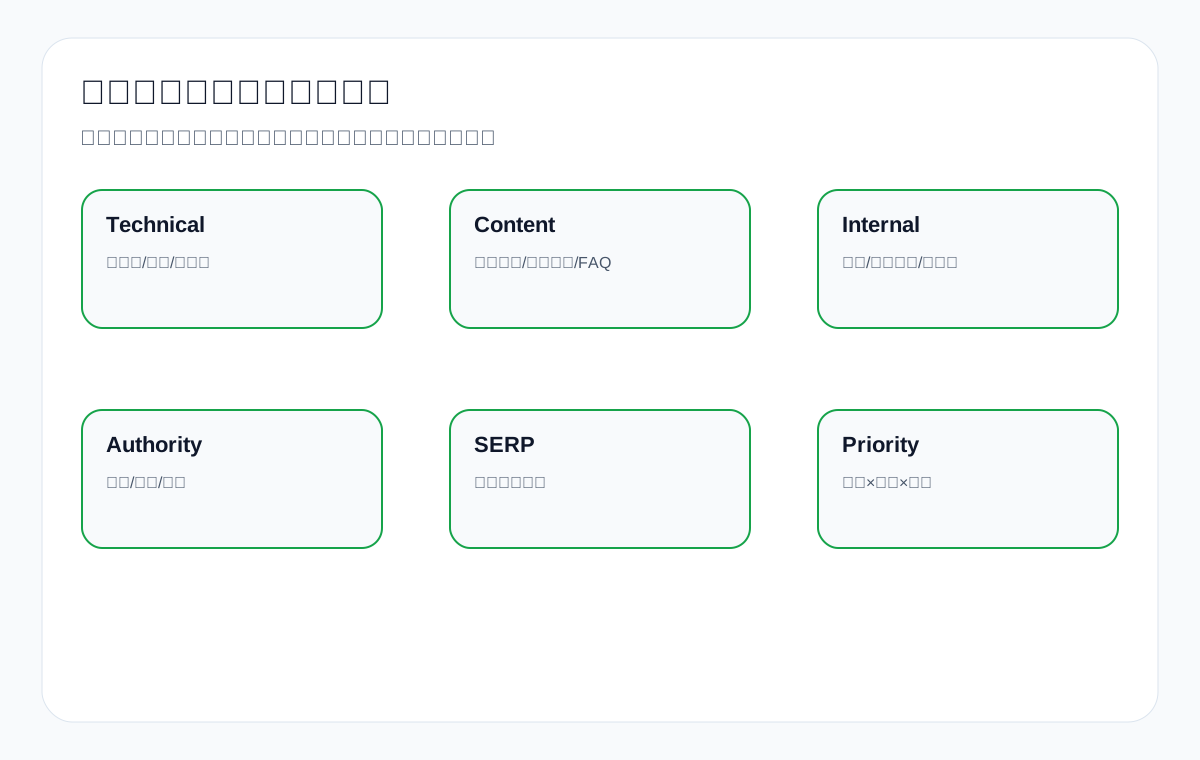
IV. Technical audit: first confirm whether Google can access and understand the site normally
The first layer of a technical audit is accessibility. Common problems on export websites include robots.txt mistakenly blocking, important pages set to noindex, canonical pointing to the wrong URL, pagination and filter pages in disarray, core content appearing only after JS rendering, lazy-loaded images with no alternative text, mobile navigation that cannot be crawled, and overly long status-code redirect chains.
For a product line like packaging machine, if category page product cards are loaded by JavaScript while the server-side HTML contains no product names, parameters, or links, Google may only see an empty shell page. For a waterproof connector website, if filter pages generate a large number of low-value URLs without canonical and indexing strategy, crawl resources may be wasted.
The priority of a technical problem depends on its impact scope: a 404 on a low-value tag page should not take over core resources; a core category page set to noindex, canonicalized to the homepage, unable to open on mobile, or extremely slow should be fixed immediately.
Technical audit priority judgment
| Check item | High-priority situation | Low-priority situation | Verification method |
|---|---|---|---|
| robots/noindex | Core product pages blocked | Worthless filter pages blocked | GSC URL Inspection |
| Status codes | Core pages 404/5xx | Legacy campaign pages expired | Crawler + server logs |
| canonical | Category pages pointing to the wrong page | Duplicate parameter pages consolidated | Page source + GSC |
| JS rendering | Body content and links require JS to appear | Auxiliary interactive JS | Rendered HTML comparison |
| Speed | Mobile core pages very slow | Slightly slow non-entry pages | CWV + real visit data |
V. Indexing audit: not all pages should be indexed, but core pages must be
Many export websites treat index count as the only goal, but what matters more is that pages which should be indexed are indexed and pages which should not be indexed do not create noise. The Page indexing report in Google Search Console should be read together with page type, not just by the “not indexed” count.
For example, the core category pages, material pages, surface treatment pages, and application pages of cnc machining parts should be indexed; search result pages, duplicate filter pages, empty tag pages, and empty category pages should not necessarily be indexed. If a medical probe website’s certification pages and resource pages are not indexed, that may affect credibility and AI citations; but an internal search page not being indexed is usually normal.
During the audit, sample core URLs and use URL Inspection to view crawl time, user-declared canonical, Google-selected canonical, whether indexing is allowed, and whether referring pages were found. Then read the results together with the sitemap, internal links, and server logs.
Indexing status interpretation table
| GSC status | Possible meaning | How an export website should handle it |
|---|---|---|
| Crawled – currently not indexed | Page quality or duplication problem | Check content depth, internal links, and unique value |
| Discovered – currently not indexed | Discovered but not crawled | Strengthen internal links, reduce low-value URLs, improve speed |
| Duplicate without user-selected canonical | Confusing duplicate signals | Clarify canonical and page purpose |
| Excluded by noindex | Deliberately not indexed | Confirm whether a core page was mistakenly set |
| Indexed | In the index | Keep watching query terms and conversions; it does not mean success |
VI. Content audit: do export pages answer what buyers actually care about
A content audit is not just counting words; it checks whether a page lets an overseas buyer complete their judgment. An industrial valve supplier page should at minimum explain valve type, materials, pressure rating, application industries, certifications, testing process, lead time, customization capability, and resource downloads; if it only says “high quality, professional team, welcome to inquire,” it is hard to create search value.
Tutorial content cannot be conceptual only. When writing “how to choose LED flood light,” include wattage, lumens, IP rating, color temperature, installation height, heat dissipation, certifications, applications, and common mistakes; when writing “custom metal parts tolerances,” cover materials, processes, drawings, inspection methods, cost impact, and quote-request materials.
A content audit should compare each page against its target query terms: what information does the person searching this term need? Does the page answer directly? Are there tables, parameters, steps, images, FAQ? Can it naturally guide users to product pages, resource pages, or the inquiry page?
Content completeness matrix
| Page topic | Must cover | Common weaknesses | How to strengthen |
|---|---|---|---|
| Product category | Product range, parameters, applications, selection advice | Only product cards | Add a selection table and FAQ |
| Product detail | Specifications, materials, drawings, certifications, MOQ | Missing purchasing information | Add a parameter table and quote checklist |
| Application scenarios | Scenario problems, recommended products, usage conditions | Only industry names | Add scenario judgment and solutions |
| Technical tutorial | Definition, steps, common mistakes, cases, review | Vague and generic | Add export product examples |
| Resource page | Downloads, versions, applicable products, usage instructions | Resource silo | Add related products and FAQ |
VII. Title, description, and H tag audit: not stuffing keywords, but lowering judgment cost
Title, Meta Description, H1, and H2 exist to let Google and users quickly judge a page’s topic. Common problems on export websites include titles that are too brand-focused, repeated titles across pages, category page titles that only say Products, product pages that only show a model number, and tutorial page titles with no scenario.
For example, “ABC-200” is unclear to both buyers and search engines and could become “ABC-200 IP67 Waterproof Connector for Marine Lighting.” “Products” could become “LED Flood Light Manufacturer: 50W to 500W Outdoor Lighting Solutions.” But titles must not promise guaranteed results or stuff a string of irrelevant keywords.
When auditing titles, focus on whether they include the main product or problem, match search intent, match the body content, and avoid multiple pages competing for the same term. Descriptions should explain what judgment the page helps users make, not repeat slogans.
Page element audit table
| Element | Good practice | Bad practice |
|---|---|---|
| Title | Product/problem + scenario + value | Only brand or keyword stuffing |
| Meta Description | Explain page content and who it suits | Exaggerated promises or empty talk |
| H1 | Consistent with the page’s single topic | Multiple H1s or mixed topics |
| H2 | Split by purchasing decision | All written as marketing slogans |
| Alt text | Describe the product/process in the image | Blank or keyword-stuffed |
VIII. Internal link audit: in-body links are closer to real paths than an isolated sitemap
An internal link audit checks whether users and crawlers can get from important pages to related pages. Export websites cannot rely only on a sitemap. Google can discover URLs through the sitemap, but in-body links, navigation, breadcrumbs, related products, and related resources better explain the relationships between pages.
For example, a waterproof connector category page should link to related pages such as IP67, M12, 4 pin, for marine, datasheet, and custom cable assembly; a how to choose waterproof connector tutorial should link to the category page, parameter pages, and inquiry page. The material pages of cnc machining parts should link to aluminum, stainless steel, surface finish, tolerance guide, and upload drawing pages.
During the audit, look for orphan pages, pages with navigation but no in-body links, pages that over-link to the homepage, links with vague anchor text, and important product pages that get no support from tutorials and category pages.
Internal link audit matrix
| Problem | Business impact | Fix suggestion |
|---|---|---|
| Few entry points to core product pages | Hard for Google and users to discover | Add in-body links from category, tutorial, and application pages |
| Vague anchor text | Unclear relationships | Describe links with product, scenario, and resource terms |
| Tutorials do not lead to products | Traffic hard to convert | Add related products and resource entry points |
| Orphan resource pages | Hard for AI and users to cite | Link to resource pages from product pages and FAQ |
| Too many irrelevant links | Dilutes topical focus | Keep contextually relevant links |
IX. Backlink and authority signal audit: look at credible resources first, then count
Backlink audits for export websites cannot look only at quantity. What many B2B manufacturers truly lack is citable material: specification sheets, certifications, testing processes, installation guides, material descriptions, industry application explanations, and FAQ. Without this content, link building easily turns into low-quality directory submissions.
When auditing backlinks, look at whether sources are relevant, whether anchor text is natural, whether linked pages can capture the traffic, whether there are obvious spam links, and whether there are citations from industry media, trade shows, associations, customer cases, supply chain platforms, or technical resources.
For a ceramic dinnerware manufacturer, high-quality citations may come from tableware safety standards, material guides, glaze descriptions, and packaging test resources; for a packaging machine manufacturer, they may come from industry application articles, equipment selection resources, video demonstrations, and maintenance guides.
Authority signal audit table
| Signal type | Auditable question | Direction for export sites to strengthen |
|---|---|---|
| External links | Are sources relevant and natural | Industry directories, trade shows, technical resource citations |
| Brand mentions | Does anyone search brand + product | Unify brand, product, and company information |
| Resource assets | Are there citable pages | datasheet, manual, certificate, test report |
| Author and company | Are they credible | Add factory information, inspection processes, contact details |
| AI citation foundation | Are pages excerptable | Clear definitions, clear tables, clear FAQ |
X. Structured data audit: helps understanding, does not replace content
Structured data can help search engines understand products, FAQ, breadcrumbs, organization information, and article information, but it cannot replace real content. Many export websites install a plugin and assume Schema has solved the problem, while the actual pages still lack product parameters, application descriptions, and credible resources.
Product pages can check whether Product, Offer, and AggregateRating are real and compliant; tutorial pages can check Article, FAQPage, and BreadcrumbList; company information can check Organization, LocalBusiness, or a more suitable organization markup. Do not mark information that does not exist on the page, do not fabricate fake ratings, and do not apply the same schema to every page.
For the audit, you can sample with Rich Results Test, Schema Validator, and page source. The focus is not “is there schema” but whether schema matches page content, whether there are errors, and whether it could mislead.
Structured data checklist
| Page type | Suitable markup | Notes |
|---|---|---|
| Product page | Product, BreadcrumbList | Prices and stock must be real; do not fabricate ratings |
| Tutorial page | Article, FAQPage | FAQ must be visible on the page |
| Company page | Organization | Name, Logo, and contact details must be consistent |
| Resource page | CreativeWork/Article | State the resource version and applicable scope |
| Navigation path | BreadcrumbList | Consistent with the actual breadcrumbs |
XI. SERP audit: see what format search results require
An SEO Audit cannot be done only on-site; it must also look at the search results for target query terms. The SERP tells you what page type users expect: a definition article, a list, a product category, a comparison page, a video, an image, an FAQ, or local results. Different result formats mean different content requirements.
For example, “how to choose LED flood light” may require a tutorial, parameter table, application diagrams, and FAQ; “waterproof connector supplier” needs more of a supplier capability page with product range, certifications, MOQ, and contact entry points; “cnc machining parts tolerance chart” may require a table and downloadable resources.
When auditing the SERP, record the Top1/Top3 titles, page types, H2 structure, and whether there are tables, images, FAQ, tools, videos, resource downloads, author information, and update dates. Then judge whether our page merely “also wrote about it” or solves export purchasing decisions better.
SERP benchmarking record fields
| Field | Purpose of recording |
|---|---|
| Target query term | Determine which search intent the page must win |
| Top1 URL | Clarify the benchmark target |
| Page type | Judge whether we are using the wrong page type |
| Structural strengths | Cover what competitors already have |
| Content gap | Find room to surpass |
| Our strengthening | Form concrete writing and revision tasks |
XII. Competitor audit: not copying peers, but finding purchasing decision gaps
When doing a competitor audit for an export website, do not look only at peers’ titles and keyword density. More important is whether they have more complete product categories, clearer parameters, stronger application pages, better resource downloads, richer FAQ, and a smoother inquiry path.
If competitor A’s industrial valve pages have pressure ratings, materials, testing standards, and industry applications, while we have only a few introductory paragraphs, the gap is not an SEO trick but insufficient page assets. If competitor B’s packaging machine pages have videos, capacity parameters, packaging samples, maintenance instructions, and form entry points, we need to fill in the purchasing decision materials.
Competitor audits should also avoid blind copying. The other party may target retail, marketplace sellers, or peer service providers, while we target B2B export buyers. We should extract the structures they got right, then replace them with our own product facts, factory capabilities, and customer questions.
Competitor audit table
| Dimension | What to look at | Our action |
|---|---|---|
| Product structure | Are categories clear | Add product lines and filter entry points |
| Content depth | Do they cover parameters and applications | Add tables, FAQ, resources |
| Trust evidence | Certifications, testing, factory information | Add verifiable evidence |
| Conversion path | Forms, downloads, contact entry points | Reduce inquiry friction |
| Search assets | Tutorials, comparisons, resource pages | Build supporting content |
XIII. Conversion audit: rankings without inquiries is usually not a single SEO problem
An SEO Audit must look at the inquiry path. Export websites sometimes already have impressions and clicks but few inquiries; the reason may be insufficient trust on the page, forms that are too complex, unclear CTAs, hard-to-use mobile forms, missing product resources, no explanation of lead time and customization capability, or traffic terms with weak intent themselves.
During the audit, check along the visit path: after entering from a tutorial page, can users reach related product pages; from a product page, can they find resource downloads and the inquiry form; does the form require too many irrelevant fields; is there clear feedback after submission; can the sales team determine the lead source in GA4 or a CRM.
For products like private label activewear manufacturer, users may first look at fabric, MOQ, sizes, craftsmanship, packaging, and sampling lead time; if the page only says “welcome to contact us,” conversion will be weak. An SEO Audit should write these conversion gaps into the fix plan.
Conversion path checklist
| Entry page | User’s next step | Audit focus |
|---|---|---|
| Tutorial page | Look at products after understanding the problem | Are there related product and resource links |
| Category page | Filter suppliers | Are there capability, range, FAQ, and contact entry points |
| Product page | Prepare to request a quote | Are there parameters, drawings, MOQ, and a form |
| Resource page | Verify credibility | Does it connect to products and the contact page |
| Contact page | Submit requirements | Are fields clear and response expectations explicit |
XIV. GSC audit: use query terms to judge whether pages are correctly understood
Google Search Console is a core data source for an SEO Audit. When reading GSC, do not look only at total clicks and total impressions; break down by page, query term, country, device, and time trend. Export companies especially need to see whether English product terms, supplier terms, parameter terms, application terms, and question terms appear on the correct pages.
For example, if an LED flood light category page gets many “how to install led flood light” queries, the page may be mixing in tutorial intent; if a tutorial page gets “led flood light supplier” queries, it may need to guide users to the category page. If a custom metal parts page only has Chinese or brand queries, the English search assets are not yet sufficient.
A GSC audit should form page-level judgments: which pages Google already understands but ranks low, which pages have no query terms, which pages have query terms mismatched with page intent, and which query terms are worth building new pages or adding sections for.
GSC query term audit table
| Symptom | Possible cause | Action |
|---|---|---|
| Many impressions, few clicks | Title/description mismatch or low ranking | Optimize title, description, and content depth |
| No query terms for a page | Not understood or no internal links | Add content, internal links, indexing checks |
| Query term mismatch | Mixed page intent | Split or rewrite the page |
| Country mismatch | Unclear content and market positioning | Add target market language |
| Question terms growing | Tutorial opportunity | Add FAQ and product orientation |
XV. GA4 and inquiry data audit: connect traffic quality back to the business
GA4 can help judge behavior after a page visit, but export websites cannot look only at average time on page. More valuable is looking at entry pages, scroll, resource download clicks, form starts, form submissions, WhatsApp/email clicks, returning visits, country, and device.
At the same time, inquiry quality must be connected back to sales feedback. A page that brings 20 invalid inquiries is not necessarily better than another page that brings 3 high-quality inquiries. Sales can tag inquiry product, country, budget, purchasing stage, whether drawings are available, whether samples are needed, and whether it entered quoting.
The review metrics of an SEO Audit should put GSC query terms, GA4 behavior, and inquiry quality in the CRM/forms together. Only then can you judge whether the fixes brought real opportunities or just low-quality visits.
Review metrics table
| Metric | What to look at | How to judge |
|---|---|---|
| GSC query terms | Growth in product terms and question terms | Whether they match page goals |
| GA4 behavior | Scroll, clicks, form events | Whether users move to the next step |
| Inquiry quality | Product, country, budget, completeness of materials | Whether sales tags are valid |
| Page path | Tutorial to product to contact | Whether a path forms |
| AI citations | Whether brand and resources are cited | Regular manual and tool spot checks |
XVI. AI search and GEO audit: is the page suitable for citation and paraphrase
As answer-based search such as ChatGPT, AI Overviews, and Perplexity influences purchasing research, export websites need to check whether pages have clear definitions, tables, steps, FAQ, resource citations, and company entity information. AI more easily cites content that is clearly structured, factually explicit, and excerptable.
For example, a page on “how to choose waterproof connector for outdoor lighting,” with an IP rating table, application scenarios, selection steps, common mistakes, and product resource links, is more suitable for answer citation than a marketing paragraph. If a medical probe resource page has materials, compatible devices, certifications, and cleaning instructions, it is also more likely to become a citation source.
A GEO audit should not promise fixed AI recommendations; it should check the citation foundation: does the page clearly answer the question, are there verifiable facts, are brand and product names consistent, is there credible author/company information, and is it consistent with information on other platforms.
AI citation foundation audit table
| Element | Check question | How to strengthen |
|---|---|---|
| Clear definition | Does one sentence explain the concept | Give a definition at the start |
| Tables and matrices | Is it easy to excerpt | Add parameter, process, and comparison tables |
| FAQ | Does it cover purchasing questions | Add real questions and answers |
| Entity consistency | Are company/brand/product unified | Unify About page, footer, and resources |
| Evidence links | Are there resources and sources | Add certifications, manuals, standard explanations |
XVII. How to use SEO Audit tools: tools give signals, people judge priority
Common tools include Google Search Console, GA4, Screaming Frog, Sitebulb, Ahrefs, Semrush, PageSpeed Insights, Rich Results Test, log analysis tools, and internal search data. Tools can find problems but cannot judge business priority for you.
For example, a tool reports 300 titles that are too long, of which 250 are low-value tag pages; the ones that truly need immediate changes may be only 20 core product pages. A tool reports oversized images, but if the core problem is that product pages lack parameters and resources, merely compressing images will not solve the inquiry problem.
When export companies use tools, they should turn the output into three types of tasks: technical blockers to fix immediately, page assets that need content added, and data changes to observe. That way the team will not be intimidated by the tool report, nor spend energy on low-impact issues.
Tool-to-purpose mapping table
| Tool | Main purpose | Do not misuse |
|---|---|---|
| GSC | Indexing, query terms, page performance | Do not look only at total clicks |
| GA4 | Behavior and conversion events | Do not look only at time on page |
| Screaming Frog | Crawling and page elements | Do not treat all warnings equally |
| Ahrefs/Semrush | Backlinks, competitors, keywords | Do not blindly copy keywords |
| PSI/CWV | Speed and experience | Do not ignore content quality |
XVIII. Issue priority: impact scope, fix difficulty, business value, verification cycle
The most critical output of an SEO Audit is priority. A report without priorities throws the team into chaos: technical colleagues fix low-value minor issues, content colleagues fill in traffic-less pages, sales sees no results, and the boss feels SEO has no direction.
It is recommended to score on four dimensions: impact scope, fix difficulty, business value, and verification cycle. A noindex on a core category page is high impact, low difficulty, and short cycle, and should be handled immediately; building a full set of application pages is high value but medium-to-long cycle and should be included in the content asset plan; duplicate titles on low-value tag pages can usually be deprioritized.
Priority should also combine product margin and market strategy. High-margin product pages for industrial valve supplier, flagship model pages for packaging machine, and the upload drawing entry point for custom metal parts are usually worth prioritizing over ordinary blog tag pages.
Priority matrix
| Issue type | Impact scope | Fix difficulty | Business value | Recommended order |
|---|---|---|---|---|
| Core page noindex | High | Low | High | Immediate |
| Thin category page content | High | Medium | High | First batch |
| Missing product page parameters | Medium-high | Medium | High | First batch |
| Tutorial without internal links | Medium | Low | Medium-high | Second batch |
| Low-value duplicate tags | Low | Low | Low | Later or ignore |
XIX. Fix plan: how to arrange 30, 60, and 90 days
After an export website SEO Audit, it is not advisable to dump all problems on the team at once. A more reasonable approach is to split by 30, 60, and 90 days. The first 30 days handle blocking technical issues and core pages; 60 days add content assets and internal links; 90 days review data and continue expanding high-value topics.
Within 30 days, prioritize checking robots/noindex/canonical, core product page indexing, mobile experience, form usability, duplicate titles, and thin content on core category pages. Within 60 days, add product page parameters, category page selection tables, application pages, resource pages, FAQ, and in-body internal links. At 90 days, review GSC query terms, GA4 behavior, inquiry quality, AI citations, and sales feedback.
This cadence suits Chinese export companies because product resources, images, certifications, and sales feedback often require coordination across departments. The SEO Audit report should help the team divide work, not create anxiety.
90-day fix roadmap
| Period | Key tasks | Deliverables | Review metrics |
|---|---|---|---|
| 0-30 days | Technical blockers and core pages | Fix list, core page updates | Indexing status, HTTP, forms |
| 31-60 days | Content and internal link assets | Category pages, product pages, application pages | Query terms, page entry points |
| 61-90 days | Review and expansion | New topic plan, resource pages | Inquiry quality, AI citations |
XX. How to write an SEO Audit report for the boss and the team
A good SEO Audit report should let the boss know where the opportunities are, let the technical team know what to fix, let the content team know what to add, and let sales know how to feed back inquiry quality. The report should not be full of tool jargon, nor should it be only a pile of screenshots.
Recommended report contents: summary, key findings, business impact, priority, page list, fix recommendations, owners, expected verification cycle, review metrics, and risk boundaries. Every issue should explain why it matters, rather than merely saying “recommend optimizing.”
For example, “duplicate product page titles” should be written as: “The titles of 12 flagship LED flood light product pages show only model numbers, and cannot express wattage, application, and supply attributes, which may affect product term understanding. Recommend rewriting as model + core parameters + application scenario, and observing GSC query term changes over 4-8 weeks.”
Audit report fields
| Field | Content requirements |
|---|---|
| Key findings | 3-5 most important issues |
| Business impact | Affects indexing, rankings, inquiries, or trust |
| Evidence | GSC, crawler, page screenshots, or source code |
| Fix recommendations | Specific to pages and actions |
| Priority | Immediate, first batch, second batch, observe |
| Review metrics | What data to use to judge the effect |
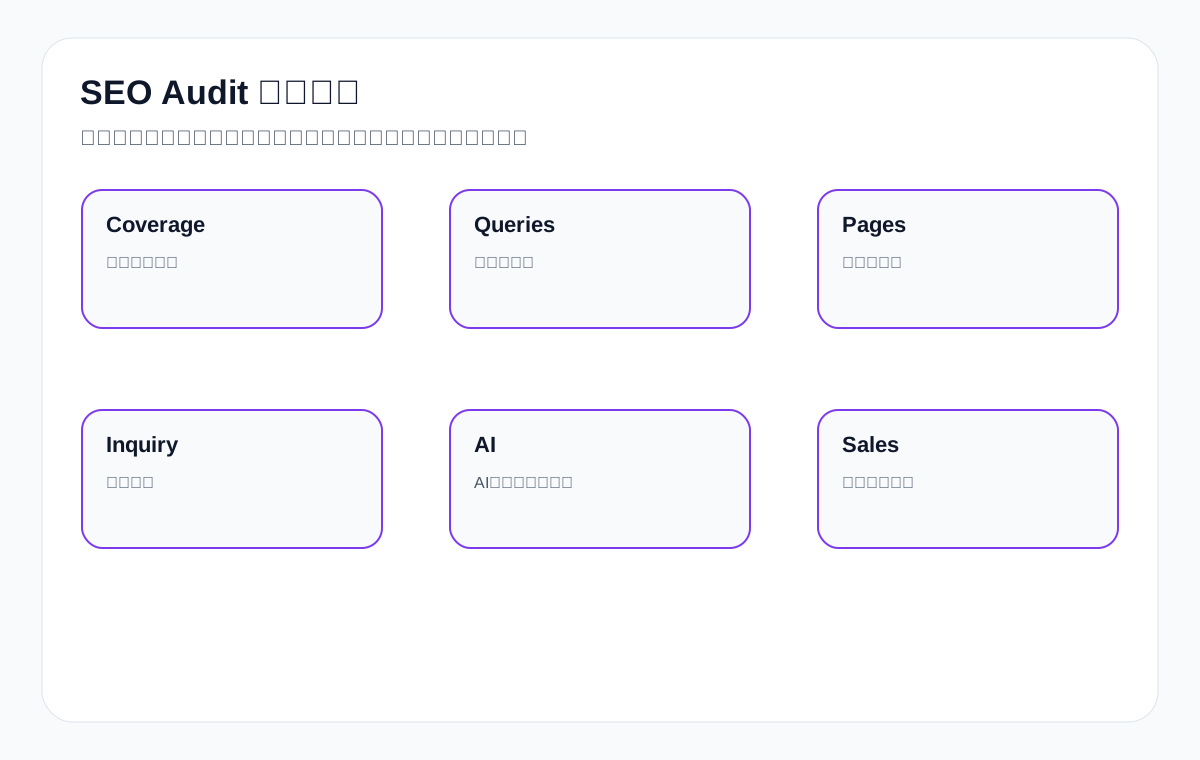
XXI. Export product line SEO Audit example: waterproof connector
Suppose a waterproof connector factory website shows the following: the homepage has visits, product pages are rarely indexed, category pages have no supplier-related query terms, inquiries mostly come from old customers, and GSC has a few queries for waterproof connector 4 pin, IP67 connector, and marine waterproof connector. The audit should not just say “add more content”; it should locate the role of each page.
Category pages should capture waterproof connector supplier, waterproof connector manufacturer, and custom waterproof connector; product pages capture M12 waterproof connector 4 pin and IP67 cable connector; application pages capture waterproof connector for marine lighting and outdoor LED lighting connector; tutorial pages capture how to choose waterproof connector.
The fix plan could be: first add product range, certifications, customization capability, and FAQ to the category page; then add parameters to 10 flagship product pages; then build 3 application pages; then link tutorial pages to products and resource pages. For review, check whether GSC query terms are distributed by page and whether inquiries carry clearer specification information.
waterproof connector audit example
| Page | Current problem | Fix direction | Review metric |
|---|---|---|---|
| Category page | Only a product list | Add supply capability, certifications, selection table | supplier term impressions |
| Product page | Incomplete parameters | Add specifications, materials, drawing entry | Growth in specific model terms |
| Application page | Missing | Build marine/lighting/outdoor scenarios | Scenario terms appear |
| Tutorial page | Does not lead to products | Add internal links and a selection table | Tutorial-to-product clicks |
| Contact page | Few quote fields | Add product, quantity, and drawing fields | Valid inquiry ratio |
XXII. Export product line SEO Audit example: packaging machine
A common problem on packaging machine websites is a complex product line without a page structure split by material, packaging format, capacity, and industry application. Buyers may search powder packing machine, liquid filling machine, vertical packaging machine, or food packaging machine supplier; if the website has only one Products page, it is hard to cover these intents.
During the audit, check whether categories are split by equipment type and application, and whether product pages cover capacity, packaging range, precision, applicable materials, videos, samples, and maintenance instructions, and whether FAQ answers questions about pricing, lead time, customization, installation, and after-sales issues.
Content strengthening should not just say “we have advanced equipment”; it should help buyers judge whether materials are compatible, whether capacity is sufficient, how packaging specifications are confirmed, and what materials are needed for a quote.
packaging machine audit example
| Search intent | Target page | Content needed |
|---|---|---|
| powder packing machine | Product category/detail | Materials, speed, precision, packaging range |
| food packaging machine supplier | Supplier capability page | Industry experience, certifications, after-sales, cases |
| how to choose packing machine | Tutorial page | Selection process, common mistakes, parameter table |
| packing machine maintenance | Resource/tutorial | Maintenance cycle, wear parts, videos |
| automatic packing machine price | FAQ/inquiry page | Factors affecting quotes and document checklist |
XXIII. Common misconceptions: why many audit reports look professional but have no effect
Misconception one: outputting only tool screenshots. Screenshots can prove a problem exists, but they cannot prove priority, nor tell the team how to fix it.
Misconception two: treating every red warning as something that must be fixed immediately. Export websites have limited resources and should fix issues affecting core product terms and the inquiry path first.
Misconception three: looking only on-site and not at the SERP. Search results already show what format users want; if our page format does not match, it is hard to improve through minor tweaks alone.
Misconception four: changing only titles without adding content. Titles can improve clicks and understanding, but if the page itself has no parameters, applications, FAQ, and resources, it still cannot build trust.
Misconception five: no review. An audit is not a one-time report; after fixes, watch data changes over 4-12 weeks.
Misconceptions and correct practices
| Misconception | Consequence | Correct practice |
|---|---|---|
| Reports packed with tool screenshots | Team does not know what to do first | Turn them into priorities and actions |
| Treating all issues equally | Wasted resources | Rank by impact and business value |
| Not looking at search results | Page format mismatch | Record Top1 and SERP formats |
| Changing only page elements | Content remains thin | Add purchasing decision information |
| Not looking at inquiry quality | Traffic disconnected from business | Connect sales feedback |
XXIV. How to review after an SEO Audit: do not just ask whether rankings went up
Review after SEO fixes should be staged. After technical blockers are fixed, look short-term at crawling, indexing, status codes, and page usability; after content is strengthened, look mid-term at query terms, impressions, clicks, page entry points, and dwell behavior; after conversion optimization, look at form starts, submissions, email clicks, WhatsApp clicks, and sales feedback.
Do not just ask “did rankings go up.” Some fixes first bring more long-tail query terms, some first improve indexing, some first improve inquiry quality, and some require waiting for the next crawl and indexing cycle. Export websites especially need to look at country, device, product line, and inquiry stage.
If there is no change in query terms for core pages after 8-12 weeks, go back and check whether the target query terms are too difficult, whether the page is still thin, whether internal links are insufficient, whether the SERP format does not match, and whether the product itself lacks credible resources.
Review cadence table
| Time | What to look at | Possible conclusion |
|---|---|---|
| 1-2 weeks | Crawling, indexing, HTTP | Whether technical problems are resolved |
| 3-6 weeks | Query terms, impressions, page entry points | Whether Google re-understands the page |
| 6-12 weeks | Clicks, inquiry events, sales feedback | Whether business signals appear |
| After 12 weeks | Expand topics and pages | Decide whether to continue expanding or adjust strategy |
XXV. FAQ: common questions about export website SEO Audits
How often should an SEO Audit be done?
For a new site or after a redesign, do a complete audit first, then a focused review each quarter; if there is a migration, redesign, product line change, or abnormal traffic decline, do a dedicated audit immediately.
What is the difference between an SEO Audit and keyword research?
Keyword research answers what users search for and what pages capture; an SEO Audit answers why the existing website is not being fully crawled, understood, ranked, and converted. The two should be combined.
Is it better for an export website to have fewer problems?
No. Fewer trivial problems do not necessarily bring inquiries. What matters more is whether core product pages, category pages, application pages, and resource pages can capture purchasing intent.
The tool shows many errors; do they all need fixing?
Not all at once. First rank by impact scope, fix difficulty, business value, and verification cycle, and prioritize core pages and blocking issues.
Can an SEO Audit be done without GSC data?
You can do a basic technical, content, and structural audit, but data-based judgment will be limited. After launch, connect GSC, GA4, and inquiry source tracking as soon as possible.
Can an SEO Audit guarantee specific ranking improvements?
Specific rankings cannot be promised. It can help find and fix problems blocking search performance and build a more reviewable growth foundation.
Why audit conversion on tutorial pages too?
Tutorial pages often capture early research traffic; without related products, resources, and contact paths, visits are hard to turn into later inquiries.
Is an AI search audit mandatory?
It is recommended to include it. More and more export buyers use AI tools for preliminary research, and pages with clear structure, explicit facts, and complete resources are more suitable for citation.
Does the contact page need to be a long article?
No. The contact page should clearly state what can be discussed, what materials to prepare, response methods, and form fields, and should not force in a long article.
Who should the audit report be written for?
The boss looks at opportunities and priorities, technical staff look at fix items, content staff look at page strengthening, and sales look at inquiry quality and feedback fields.
XXVI. Conclusion: the value of an SEO Audit is turning problems into an executable growth roadmap
The real value of an SEO Audit is not proving how many problems a website has, but turning problems into an executable, rankable, reviewable growth roadmap. For Chinese export manufacturers and trading companies, the audit should serve English product term visibility, buyer judgment, inquiry conversion, and long-term content asset building.
A qualified audit should answer four questions at once: can Google crawl and index core pages; can pages clearly explain products and applications; can users smoothly complete resource judgment and quoting; can the team review results using GSC, GA4, inquiry quality, and changes in AI citations.
If an audit stops at tool red flags and vague suggestions, it is hard for it to bring change. Only by putting technical, content, links, SERP, conversion, and sales feedback in the same framework can an export website’s SEO Audit truly help a company know what to do first, why, and how to evaluate it afterward.
Final checklist
| Check item | Completed? |
|---|---|
| Target query terms and search intent | Clear for every core page |
| Top1/authority benchmark | Record structure, strengths, and gaps |
| Technical blockers | robots, noindex, canonical, status codes, speed |
| Page content | Products, parameters, applications, FAQ, resources |
| Internal link paths | Tutorials, categories, products, resources, and contact interlinked |
| Conversion path | Forms, downloads, contact, sales feedback |
| Review metrics | GSC, GA4, inquiry quality, AI citations |
Continue reading this SEO series
If you are systematically working through export website SEO, continue with the following articles. First clarify the relationships among crawling, indexing, content, links, and review, then decide which page to change next.
- What is a Content Audit: A guide to judging content updates, merges, and deletions for export websites
- Robots, Noindex, Canonical, Sitemap: A guide to indexing checks for export websites
- How to do content SEO: A guide to search intent, information gain, and indexable content
- How to do keyword research: A process for export product terms, search intent, and page mapping
- How to mine competitor keywords: From competitor pages and English product terms to inquiry opportunities
- How to choose keyword tools: Select by diagnostic scenario, not by following a tool checklist
This page is machine-translated from the Simplified Chinese version and awaiting human review. It has not yet been proofread.