Google SEO traffic is getting harder to win, and it is not only because of AI Overviews. AI answers do divert some shallow clicks, but the more common problems for export websites also include: a crowded SERP, more ads and rich results, heavily homogenized content, overly broad page intent, pages competing with each other for the same keywords, a weak brand entity, insufficient external evidence, a disconnect between product pages and content pages, and visits that arrive with no inquiry path. The real way to judge the situation is to break a traffic decline into diagnosable causes instead of attributing every change to AI.
This article is written for Chinese export manufacturers and trading companies, and uses English product terms such as custom metal parts, LED flood light, packaging machine, medical probe, cnc machining parts, ceramic dinnerware, waterproof connector, industrial valve supplier, and private label activewear manufacturer as examples to help you decide: when traffic gets harder, should you check technology, the SERP, content, brand, or inquiry conversion?
Benchmarking against the top-ranking and authoritative references: from “AI caused the traffic drop” to a multi-cause diagnosis
In today’s English SERPs, articles from Search Engine Journal, Search Engine Land, Ahrefs, Semrush, SparkToro zero-click research, Amsive, and others on AI Overviews, zero-click search, and organic traffic decline usually mention that AI answers and search features affect clicks, and that ads, rich results, platform content, shifts in user behavior, and brand demand also change organic traffic. Google’s public documentation, meanwhile, emphasizes that search results keep changing and that AI Overviews are designed to help users get answers faster, but that does not mean every click decline comes from AI.
The strength of that material is that it explains macro trends, but it is not concrete enough for an export business to diagnose its own site. Many articles do not clearly separate English product terms, product pages, category pages, application pages, inquiry quality, internal cannibalization, and GSC query splits.
The way this article adds to that is by breaking “SEO is getting harder” into an actionable diagnostic table: first rule out technical and indexing problems, then look at the shape of the SERP, then at content homogenization and page intent, then at brand and external evidence, and finally at the inquiry path and AI citations.
| Benchmark dimension | Common authoritative content | What this article adds |
|---|---|---|
| AI impact | Explains AI Overviews and zero-click | Separates AI diversion from other causes |
| SERP changes | Covers ads / rich results / platform placements | Ties them to product-term CTR and page types |
| Content competition | Covers content quality and homogenization | Adds export product facts and buying judgment |
| Brand signals | Covers authority and trust | Adds entity consistency and external evidence |
| Business review | Rarely covers inquiries | Adds GA4, forms, and sales feedback |
1. First distinguish four types of decline: ranking, impressions, clicks, and inquiries
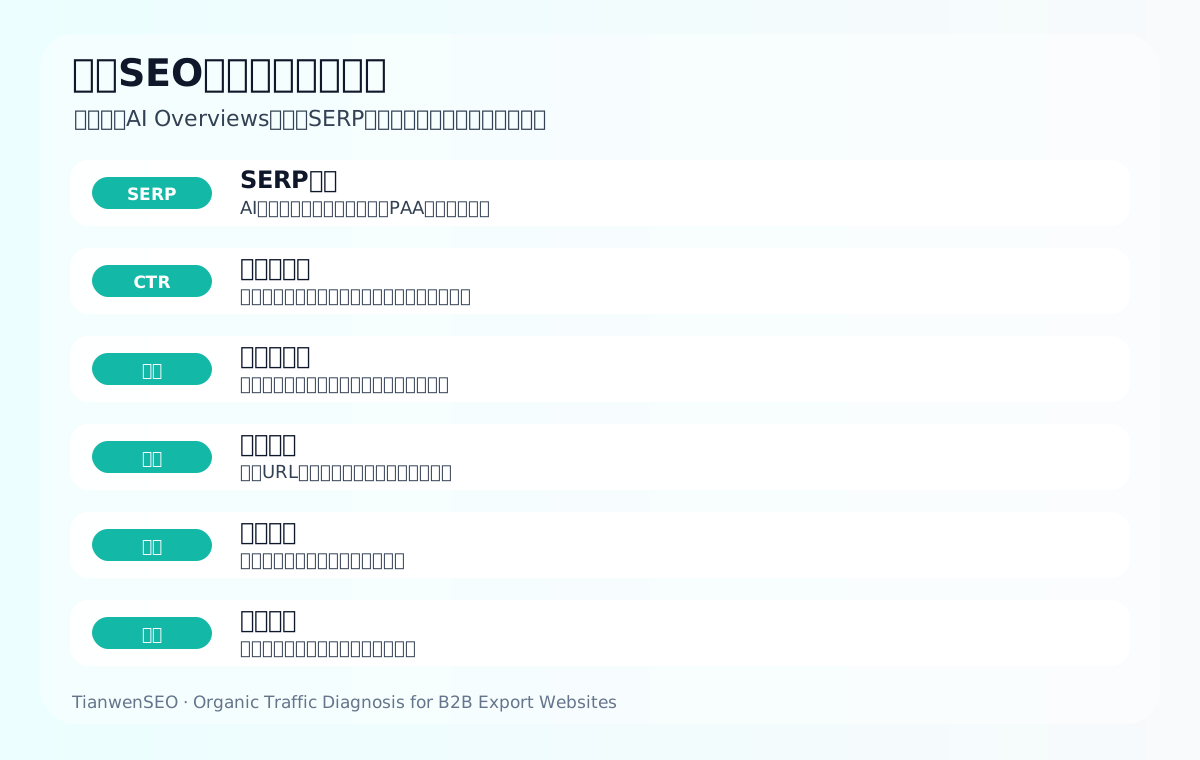
Many teams only look at “traffic is down,” but different types of decline call for completely different actions. Falling rankings, falling impressions, falling CTR, falling inquiries, and missing AI citations are different problems.
For example, if an LED flood light page keeps its ranking but loses clicks, the SERP may have gained an AI answer or images; if impressions fall, the page intent may be outdated; if there are clicks but no inquiries, the page may have no product entry point.
| Type of decline | Common causes | Priority action |
|---|---|---|
| Ranking decline | Stronger competitors or insufficient page quality | Benchmark the SERP and the content gap |
| Impression decline | Changes in indexing, demand, or page intent | Check GSC and indexing |
| CTR decline | Crowded SERP or a weak title | Check the shape of the search results |
| Inquiry decline | Mismatched audience or path | Check GA4 and the forms |
| Missing from AI | Insufficient entity signals and citability | Check citation sources and page structure |
2. AI Overviews do affect clicks, but they are not the only explanation
AI Overviews answer some informational questions directly, which can reduce shallow clicks, especially for definitions, simple tutorials, lists, and general-knowledge queries. But complex B2B sourcing questions still require specifications, certifications, supply capability, quotation documents, and conversation.
So export sites should not abandon SEO. They should upgrade shallow content into purchasing-decision content, so that a page answers not only “what is it” but also “how to choose, how to request a quote, and what the risks are.”
| Query type | AI impact | Export-site response |
|---|---|---|
| Definition terms | Easy to answer directly | Add buying judgment and product entry points |
| Specification terms | Still need detail | Add parameter tables and images |
| Supplier terms | Brand and evidence matter | Add company and certificate material |
| Application terms | Need scenario explanation | Add solution and case-style explanations |
| Quote terms | Need interaction | Add an inquiry checklist |
3. Crowded SERPs: you can lose clicks even with an unchanged ranking
Ads, AI answers, images, videos, PAA, shopping/product results, platform pages, and local results in the search results all compete for user attention. Even if your organic ranking has not dropped noticeably, clicks can still fall.
For terms like custom metal parts or packaging machine, the SERP may show platform pages, images, videos, and ads, so the site’s title and above-the-fold answer have to be more specific.
| SERP element | Impact | Response |
|---|---|---|
| AI answers | Satisfy shallow questions directly | Add citable and deeper content |
| Ads | Take clicks on commercial terms | Strengthen the title and trust signals |
| Images/videos | Occupy visual space | Optimize product images and captions |
| PAA | Question demand is obvious | Add an FAQ |
| Platform pages | Strong third-party authority | Add official-site material and entity signals |
4. Content homogenization: the problem is not too few articles but too little difference
Many export sites publish more and more articles, but the content keeps repeating “good quality, competitive price, good service” without concrete information such as materials, parameters, applications, certifications, MOQ, lead times, packaging, quality inspection, or quotation material. Content like that is hard to earn clicks consistently even when it is indexed.
If a waterproof connector page has no IP rating, wire gauge, current, outdoor applications, installation risks, or FAQ, and only repeats the keyword, it will struggle to beat a more specific page.
| Symptom of homogenization | Consequence | Fix |
|---|---|---|
| Generic introduction | Cannot support a buying decision | Add product facts |
| Only the title changes | Duplicated page intent | Merge or reassign intent |
| No tables | Hard to compare | Add specification/selection tables |
| No evidence | Not enough trust | Add certifications/material |
| No path | Visits do not convert | Add product and inquiry entry points |
5. Internal cannibalization: more pages do not necessarily mean more traffic
When several pages chase the same set of queries, the signals get split. After publishing for a long time, export sites often end up with multiple articles covering the same product selection, the same application scenario, or the same set of FAQs.
If pages about ceramic dinnerware wholesale, custom ceramic dinnerware, and bulk dinnerware supplier are spread across several similar pages, decide whether to merge them or reassign their page intent.
| Cannibalization signal | How to check | What to do |
|---|---|---|
| One query, several URLs | GSC Queries × Pages | Pick the primary URL |
| Similar titles | Crawl report | Rename or merge |
| Duplicate content | Manual comparison | Keep the differentiated parts |
| Scattered internal links | Crawl map | Unify the entry point |
| All stuck in the middle | SERP comparison | Consolidate into one strong page |
6. Brand and entity signals: small sites need to be even clearer about who they are
As SERPs get more crowded and AI answers rely more on sources, brand entities and credible evidence matter more. The company name, English brand, product lines, certificates, address, trade shows, B2B platforms, and social media profiles should be consistent.
For an industrial valve supplier, if the official website, certificates, platforms, and trade show material do not match, both search engines and AI systems will struggle to form a clear understanding.
| Entity material | Common problem | Correction |
|---|---|---|
| Company name | Chinese and English versions differ | Unify the legal entity |
| Product lines | Descriptions are scattered | Create core descriptions |
| Certificates | The entity is unclear | Add a certificate page |
| Platform profiles | Outdated information | Update item by item |
| External mentions | Missing industry-relevant sources | Add real material |
7. Traffic without inquiries: not every click is valuable
When traffic is hard to win, it matters even more to separate visits from qualified inquiries. Many pages get visits, but users never reach a product page, a resource page, or a contact page, which means the page path is broken or the audience does not match.
If a private label activewear manufacturer page attracts a large number of small retail-order users, those clicks are not good traffic even if there are many of them.
| Symptom | Possible cause | Action |
|---|---|---|
| High visits, few inquiries | Content is too broad | Narrow the intent |
| Few visits to product pages | Weak internal links | Add product entry points |
| Few form starts | Unclear CTA | Add inquiry instructions |
| Poor inquiry quality | Audience mismatch | Adjust the title and content |
| Poor sales feedback | Unclear page promises | Add limitations and conditions |
8. Export SEO has to move from a traffic mindset to an asset mindset
In the past, many teams chased publishing more articles and covering more keywords. What matters more now is building page assets that can be reused over the long term: core product pages, category pages, application pages, resource pages, selection guides, troubleshooting pages, and FAQs.
Every page needs a clear role. Not every page should chase traffic; some pages build trust, some explain, and some convert.
| Page asset | Role | Review metric |
|---|---|---|
| Product page | Capture inquiries | Product terms and forms |
| Category page | Capture category terms | Category terms and paths to product pages |
| Application page | Capture scenario terms | Industry inquiries |
| Resource page | Build trust | Downloads and citations |
| Guide page | Explain problems | Long-tail terms and internal links |
9. How to diagnose harder traffic in GSC
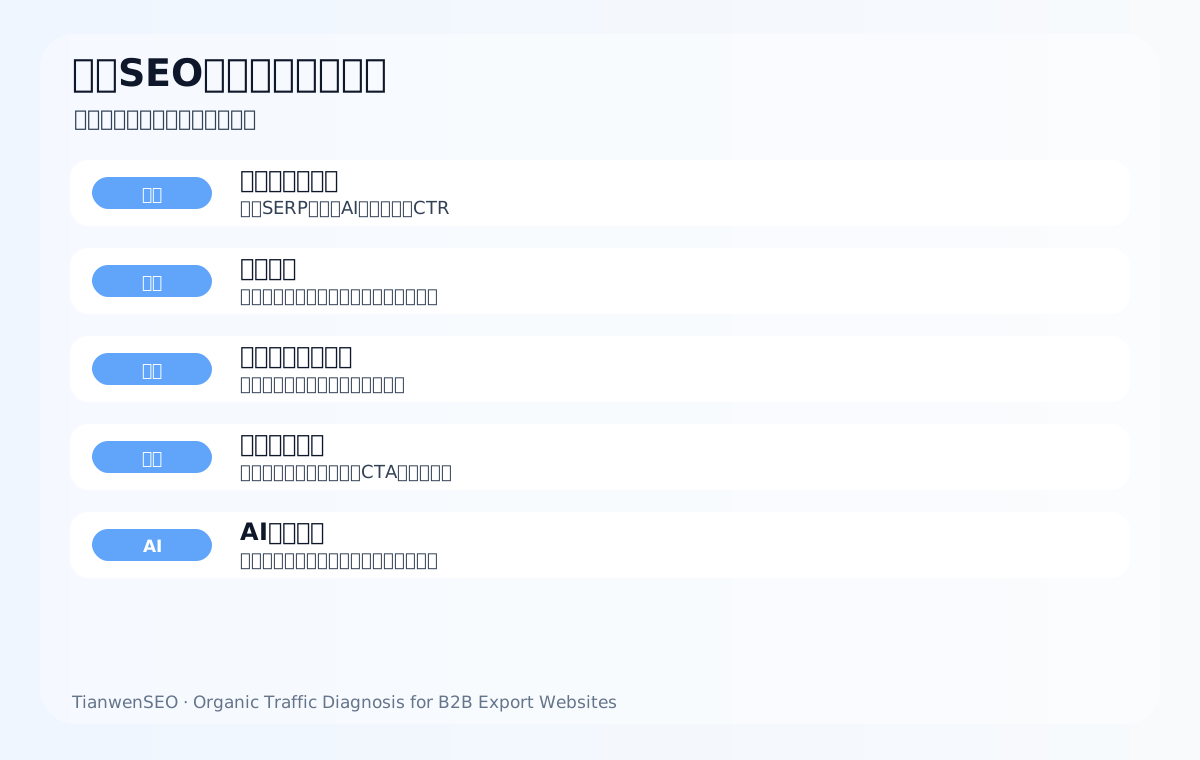
In GSC, look separately by page and by query: whether impressions fell, whether CTR fell, whether average position changed, whether queries became broader, and whether the country and device mix changed.
In practice this has to land on specific English product terms and URLs, such as custom metal parts, LED flood light, packaging machine, medical probe, and waterproof connector, judging traffic, clicks, inquiries, and AI visibility for each product line separately.
10. How GA4 adds to the diagnosis
GA4 shows whether visitors go on to a product page, a resource page, or a contact page, and whether they trigger form, email, or WhatsApp events.
In practice this has to land on specific English product terms and URLs, such as custom metal parts, LED flood light, packaging machine, medical probe, and waterproof connector, judging traffic, clicks, inquiries, and AI visibility for each product line separately.
11. How to do manual SERP observation
Take screenshots of, or record, the SERP for core product terms on a regular basis, and note AI answers, ads, images, videos, PAA, and the types of competitor pages.
In practice this has to land on specific English product terms and URLs, such as custom metal parts, LED flood light, packaging machine, medical probe, and waterproof connector, judging traffic, clicks, inquiries, and AI visibility for each product line separately.
12. How to refresh content
Do not rewrite the whole article the moment you see a decline. First decide whether it is the title, the above-the-fold content, a table, the FAQ, the product entry point, the evidence, or the page intent that needs updating.
In practice this has to land on specific English product terms and URLs, such as custom metal parts, LED flood light, packaging machine, medical probe, and waterproof connector, judging traffic, clicks, inquiries, and AI visibility for each product line separately.
13. How to merge pages
When several pages compete for the same queries, pick the strongest URL, merge the valuable sections, FAQs, and images into it, and then update internal links.
In practice this has to land on specific English product terms and URLs, such as custom metal parts, LED flood light, packaging machine, medical probe, and waterproof connector, judging traffic, clicks, inquiries, and AI visibility for each product line separately.
14. How to review AI citations
Record whether the AI answer mentions the official website, whether it describes the company accurately, what sources it cites, and whether the page has quotable definitions and tables.
In practice this has to land on specific English product terms and URLs, such as custom metal parts, LED flood light, packaging machine, medical probe, and waterproof connector, judging traffic, clicks, inquiries, and AI visibility for each product line separately.
15. How to observe brand search
If brand searches and direct visits are rising, trust paths outside search may be getting stronger; if competitors or platforms are suppressing your brand, add entity material.
In practice this has to land on specific English product terms and URLs, such as custom metal parts, LED flood light, packaging machine, medical probe, and waterproof connector, judging traffic, clicks, inquiries, and AI visibility for each product line separately.
16. Do not treat low-value traffic as the goal
Informational traffic does not necessarily bring inquiries. Export sites should prioritize supplier terms, specification terms, application terms, and quote-readiness terms.
In practice this has to land on specific English product terms and URLs, such as custom metal parts, LED flood light, packaging machine, medical probe, and waterproof connector, judging traffic, clicks, inquiries, and AI visibility for each product line separately.
17. Do not attribute every problem to the algorithm
Algorithm changes affect results, but site structure, content quality, technical foundations, and brand evidence are still under your control.
In practice this has to land on specific English product terms and URLs, such as custom metal parts, LED flood light, packaging machine, medical probe, and waterproof connector, judging traffic, clicks, inquiries, and AI visibility for each product line separately.
18. How a team should set up a review cadence
Look at anomalies weekly, core pages monthly, and product-line assets and content consolidation quarterly. Do not make panicked edits every day because of ranking fluctuations.
In practice this has to land on specific English product terms and URLs, such as custom metal parts, LED flood light, packaging machine, medical probe, and waterproof connector, judging traffic, clicks, inquiries, and AI visibility for each product line separately.
Export example 1: how to investigate when custom metal parts traffic gets harder
When traffic to the custom metal parts page declines, first check in GSC whether queries about materials, tolerances, surface finishing, drawings, and quotation material are still getting impressions, then check whether the SERP shows AI answers, platform pages, or image results. Then check whether the page has enough product facts, tables, FAQs, resources, and inquiry entry points.
If the page gets visits but inquiry quality is poor, use GA4 paths and sales feedback to judge whether the audience has drifted. Real optimization is not just about winning clicks back; it is about getting the right buyers to the right page.
Export example 2: how to investigate when LED flood light traffic gets harder
When traffic to the LED flood light page declines, first check in GSC whether queries about power, waterproofing, mounting height, beam angle, and warranty are still getting impressions, then check whether the SERP shows AI answers, platform pages, or image results. Then check whether the page has enough product facts, tables, FAQs, resources, and inquiry entry points.
If the page gets visits but inquiry quality is poor, use GA4 paths and sales feedback to judge whether the audience has drifted. Real optimization is not just about winning clicks back; it is about getting the right buyers to the right page.
Export example 3: how to investigate when packaging machine traffic gets harder
When traffic to the packaging machine page declines, first check in GSC whether queries about materials, speed, packaging format, automation, and after-sales support are still getting impressions, then check whether the SERP shows AI answers, platform pages, or image results. Then check whether the page has enough product facts, tables, FAQs, resources, and inquiry entry points.
If the page gets visits but inquiry quality is poor, use GA4 paths and sales feedback to judge whether the audience has drifted. Real optimization is not just about winning clicks back; it is about getting the right buyers to the right page.
Export example 4: how to investigate when medical probe traffic gets harder
When traffic to the medical probe page declines, first check in GSC whether queries about certifications, compatible devices, materials, and testing are still getting impressions, then check whether the SERP shows AI answers, platform pages, or image results. Then check whether the page has enough product facts, tables, FAQs, resources, and inquiry entry points.
If the page gets visits but inquiry quality is poor, use GA4 paths and sales feedback to judge whether the audience has drifted. Real optimization is not just about winning clicks back; it is about getting the right buyers to the right page.
Export example 5: how to investigate when cnc machining parts traffic gets harder
When traffic to the cnc machining parts page declines, first check in GSC whether queries about DFM, volume production, inspection reports, and lead times are still getting impressions, then check whether the SERP shows AI answers, platform pages, or image results. Then check whether the page has enough product facts, tables, FAQs, resources, and inquiry entry points.
If the page gets visits but inquiry quality is poor, use GA4 paths and sales feedback to judge whether the audience has drifted. Real optimization is not just about winning clicks back; it is about getting the right buyers to the right page.
Export example 6: how to investigate when ceramic dinnerware traffic gets harder
When traffic to the ceramic dinnerware page declines, first check in GSC whether queries about material, glaze color, packaging, MOQ, and customization are still getting impressions, then check whether the SERP shows AI answers, platform pages, or image results. Then check whether the page has enough product facts, tables, FAQs, resources, and inquiry entry points.
If the page gets visits but inquiry quality is poor, use GA4 paths and sales feedback to judge whether the audience has drifted. Real optimization is not just about winning clicks back; it is about getting the right buyers to the right page.
Export example 7: how to investigate when waterproof connector traffic gets harder
When traffic to the waterproof connector page declines, first check in GSC whether queries about IP rating, wire gauge, current, and outdoor applications are still getting impressions, then check whether the SERP shows AI answers, platform pages, or image results. Then check whether the page has enough product facts, tables, FAQs, resources, and inquiry entry points.
If the page gets visits but inquiry quality is poor, use GA4 paths and sales feedback to judge whether the audience has drifted. Real optimization is not just about winning clicks back; it is about getting the right buyers to the right page.
Export example 8: how to investigate when industrial valve supplier traffic gets harder
When traffic to the industrial valve supplier page declines, first check in GSC whether queries about materials, pressure, standards, and operating conditions are still getting impressions, then check whether the SERP shows AI answers, platform pages, or image results. Then check whether the page has enough product facts, tables, FAQs, resources, and inquiry entry points.
If the page gets visits but inquiry quality is poor, use GA4 paths and sales feedback to judge whether the audience has drifted. Real optimization is not just about winning clicks back; it is about getting the right buyers to the right page.
Export example 9: how to investigate when private label activewear manufacturer traffic gets harder
When traffic to the private label activewear manufacturer page declines, first check in GSC whether queries about fabric, sizing, sampling, MOQ, and packaging are still getting impressions, then check whether the SERP shows AI answers, platform pages, or image results. Then check whether the page has enough product facts, tables, FAQs, resources, and inquiry entry points.
If the page gets visits but inquiry quality is poor, use GA4 paths and sales feedback to judge whether the audience has drifted. Real optimization is not just about winning clicks back; it is about getting the right buyers to the right page.
Export example 10: how to investigate when solar mounting bracket traffic gets harder
When traffic to the solar mounting bracket page declines, first check in GSC whether queries about materials, wind load, installation, and certification are still getting impressions, then check whether the SERP shows AI answers, platform pages, or image results. Then check whether the page has enough product facts, tables, FAQs, resources, and inquiry entry points.
If the page gets visits but inquiry quality is poor, use GA4 paths and sales feedback to judge whether the audience has drifted. Real optimization is not just about winning clicks back; it is about getting the right buyers to the right page.
19. When traffic gets harder, do not increase publishing frequency first
Many teams react by publishing even more articles, but if the problem comes from a crowded SERP, internal cannibalization, mismatched page intent, or a broken inquiry path, more articles only create more duplicate pages. A better approach is to audit the core URLs you already have first and find out which pages are worth refreshing, merging, or strengthening.
For export product lines such as custom metal parts, LED flood light, packaging machine, medical probe, and waterproof connector, every decline has to be traced back to specific queries, specific URLs, and a specific inquiry path. Only after the cause is broken down clearly can you decide whether to change the title, add a table, merge pages, fix technical issues, add brand material, or replan the product-line content.
20. How to tell whether the SERP composition is causing the click decline
Pick 10 to 20 core English product terms and record whether the current search results contain AI answers, ads, images, videos, PAA, platform pages, and competitor websites. Then compare that with the CTR change in GSC. If the ranking has barely moved but CTR has fallen clearly, the SERP composition is the prime suspect.
For export product lines such as custom metal parts, LED flood light, packaging machine, medical probe, and waterproof connector, every decline has to be traced back to specific queries, specific URLs, and a specific inquiry path. Only after the cause is broken down clearly can you decide whether to change the title, add a table, merge pages, fix technical issues, add brand material, or replan the product-line content.
21. How to tell whether the content intent has changed
List the page types ranking on the first few pages: product pages, category pages, guide pages, platform pages, video pages, or resource pages. If the SERP has shifted from tutorial-style to supplier-style, the old blog post may no longer be the right page to capture the target term.
For export product lines such as custom metal parts, LED flood light, packaging machine, medical probe, and waterproof connector, every decline has to be traced back to specific queries, specific URLs, and a specific inquiry path. Only after the cause is broken down clearly can you decide whether to change the title, add a table, merge pages, fix technical issues, add brand material, or replan the product-line content.
22. How to tell whether internal content cannibalization is the cause
In GSC, check by query whether several URLs appear at the same time. If the same product term is being chased by several articles, category pages, and tag pages at once, you need to reassign page roles, choose the primary URL, and merge the weak pages.
For export product lines such as custom metal parts, LED flood light, packaging machine, medical probe, and waterproof connector, every decline has to be traced back to specific queries, specific URLs, and a specific inquiry path. Only after the cause is broken down clearly can you decide whether to change the title, add a table, merge pages, fix technical issues, add brand material, or replan the product-line content.
23. How to tell whether brand trust is insufficient
If competitor pages are not obviously longer but still win more clicks, citations, and AI mentions, check whether their brand entity, external evidence, certificate material, industry directories, trade show pages, and company introduction are more complete.
For export product lines such as custom metal parts, LED flood light, packaging machine, medical probe, and waterproof connector, every decline has to be traced back to specific queries, specific URLs, and a specific inquiry path. Only after the cause is broken down clearly can you decide whether to change the title, add a table, merge pages, fix technical issues, add brand material, or replan the product-line content.
24. How to tell whether the inquiry path is broken
In GA4, check whether users on content pages go on to a product page, a resource page, or a contact page. If users read the article and leave immediately, the page is not offering a next step, or the next step does not match the buying intent.
For export product lines such as custom metal parts, LED flood light, packaging machine, medical probe, and waterproof connector, every decline has to be traced back to specific queries, specific URLs, and a specific inquiry path. Only after the cause is broken down clearly can you decide whether to change the title, add a table, merge pages, fix technical issues, add brand material, or replan the product-line content.
25. How to tell whether the target terms are too broad
Terms that are too broad tend to bring in a lot of informational users but few inquiries. Export sites should split a broad topic into product terms, specification terms, application terms, supplier terms, and quote-readiness terms.
For export product lines such as custom metal parts, LED flood light, packaging machine, medical probe, and waterproof connector, every decline has to be traced back to specific queries, specific URLs, and a specific inquiry path. Only after the cause is broken down clearly can you decide whether to change the title, add a table, merge pages, fix technical issues, add brand material, or replan the product-line content.
26. How to tell whether image and video results are taking the clicks
If images and videos take up obvious space in the SERP, then product images, application images, installation images, process diagrams, and short explanatory videos will affect click appeal. Export sites cannot compete with text pages alone.
For export product lines such as custom metal parts, LED flood light, packaging machine, medical probe, and waterproof connector, every decline has to be traced back to specific queries, specific URLs, and a specific inquiry path. Only after the cause is broken down clearly can you decide whether to change the title, add a table, merge pages, fix technical issues, add brand material, or replan the product-line content.
27. How to tell whether platform pages are suppressing the official site
B2B platforms, directories, and industry sites are sometimes very strong on supplier terms. The official website has to add more complete company information, product scope, certificates, FAQs, and inquiry paths instead of relying only on platform pages.
For export product lines such as custom metal parts, LED flood light, packaging machine, medical probe, and waterproof connector, every decline has to be traced back to specific queries, specific URLs, and a specific inquiry path. Only after the cause is broken down clearly can you decide whether to change the title, add a table, merge pages, fix technical issues, add brand material, or replan the product-line content.
28. How to tell whether the page is outdated
If competitor pages have added new standards, new materials, new applications, new certifications, or clearer comparison tables while your page still carries the old introduction, it will gradually lose clicks and citations.
For export product lines such as custom metal parts, LED flood light, packaging machine, medical probe, and waterproof connector, every decline has to be traced back to specific queries, specific URLs, and a specific inquiry path. Only after the cause is broken down clearly can you decide whether to change the title, add a table, merge pages, fix technical issues, add brand material, or replan the product-line content.
29. How to tell whether low-value pages are dragging down overall quality
A large number of thin articles, duplicate tag pages, valueless archive pages, and expired content dilute site quality. Resources should be concentrated on the page assets that carry product-line value.
For export product lines such as custom metal parts, LED flood light, packaging machine, medical probe, and waterproof connector, every decline has to be traced back to specific queries, specific URLs, and a specific inquiry path. Only after the cause is broken down clearly can you decide whether to change the title, add a table, merge pages, fix technical issues, add brand material, or replan the product-line content.
30. How to tell whether market demand itself has changed
Use Google Trends, long-term GSC trends, changes in inquired products, and sales feedback to judge whether demand has shifted. If the popularity of certain product models is falling, SEO technique alone should not be the explanation.
For export product lines such as custom metal parts, LED flood light, packaging machine, medical probe, and waterproof connector, every decline has to be traced back to specific queries, specific URLs, and a specific inquiry path. Only after the cause is broken down clearly can you decide whether to change the title, add a table, merge pages, fix technical issues, add brand material, or replan the product-line content.
31. Recovery strategy table for harder traffic
When traffic gets harder, the recovery strategy cannot be just “write more articles.” Different causes call for different actions: a crowded SERP needs better titles and above-the-fold answers, content homogenization needs product facts, internal cannibalization needs page consolidation, a weak brand needs entity and external evidence, and weak conversion needs product entry points and inquiry instructions.
| Main cause | Priority action | Not recommended | Review metric |
|---|---|---|---|
| Crowded SERP | Optimize the title, above-the-fold content, images, and FAQ | Blindly expanding the whole article | CTR, SERP records |
| AI diversion | Add citable definitions, tables, and deeper sourcing content | Giving up on SEO | Accuracy of AI citations |
| Content homogenization | Add specifications, applications, evidence, and inquiry material | Publishing more similar articles | Query coverage and inquiry quality |
| Internal cannibalization | Merge weak pages and define the primary URL | Adding more pages of the same kind | Impressions and ranking of the primary URL |
| Broken conversion | Add product entry points, CTAs, and resource downloads | Looking only at visit counts | Paths to product pages and forms |
32. What to do first within 30 days
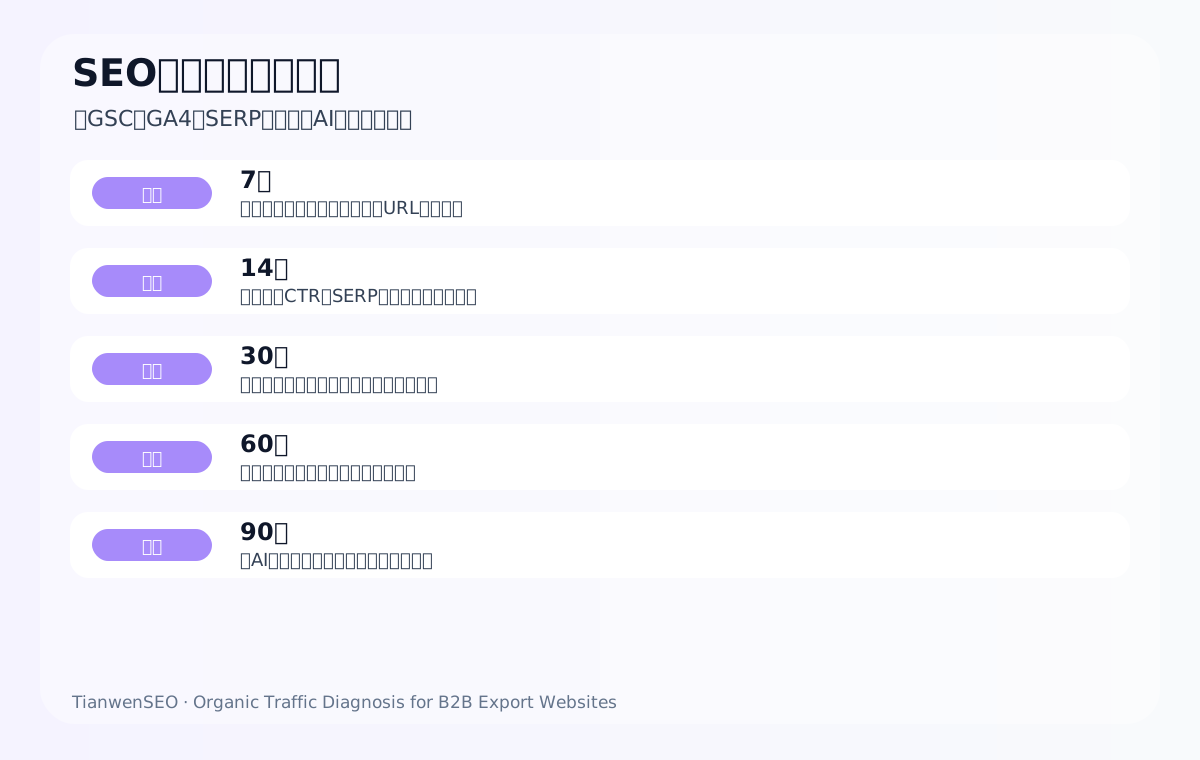
Do not overhaul the whole site in the first 30 days. Pick the 10 to 20 URLs closest to an inquiry and check technical health, indexing, core queries, SERP composition, title CTR, product entry points, and the inquiry path. Decide on just one main problem per URL so that you can still review what changed.
For example, for an LED flood light category page, start with queries such as supplier, manufacturer, 200w, outdoor, and parking lot; for a packaging machine page, start with queries about materials, bag type, speed, and automation; for a medical probe page, start with queries about certification, compatibility, and testing.
33. How to build a new growth model within 90 days
Within 90 days, shift from “chasing traffic” to “building assets”: each product line should have at least one strong category page, several key product pages, a number of application pages, one selection guide, and one FAQ or resource page, all connected by internal links. That way, even if shallow clicks are diverted by AI, complex sourcing questions can still come back to the official website.
When reviewing, do not only look at whether traffic has returned to the old level. Look at whether core English product terms are more stable, whether inquiries are clearer, whether sales has to explain the same things less often, whether AI answers are more accurate, and whether competitors still hold the key sources.
Also be careful not to judge whether SEO has failed using total site traffic alone. Export sites should break things down by product line: which product terms lost impressions, which application terms gained clicks, which countries are sending better inquiries, and which content pages have low traffic but reliably move buyers to product pages. Falling total traffic does not necessarily mean falling business value, and rising total traffic does not necessarily mean better inquiry quality.
If a team keeps these review records by product line, then the next time the algorithm, the SERP, or AI answers change, it can identify the real cause faster instead of starting over from guesses, which reduces wasted edits.
This is also one of the important criteria for long-term SEO asset management.
Keep recording.
FAQ: Why is Google SEO traffic getting harder to win
Is every Google SEO traffic decline caused by AI Overviews?
No. AI is only one cause; you also have to look at SERP crowding, ads, rich results, content homogenization, internal cannibalization, brand signals, and the conversion path.
What should I do if the ranking has not changed but clicks are down?
First check whether the SERP now shows AI answers, ads, images, PAA, or stronger competitor titles, then improve the title and the above-the-fold answer.
Why does traffic not grow when I publish more and more articles?
It may be duplicate content, unclear page intent, internal cannibalization, too high a share of low-value pages, or missing product entry points.
Should an export site keep writing blog posts?
Yes, but the blog should serve the product lines and sourcing questions, and support product pages and category pages through internal links.
Is SEO still useful in the age of AI search?
Yes. SEO fundamentals still determine whether a page is discoverable, understandable, and trustworthy, and AI citations also need clear sources.
Should I rewrite a page immediately when traffic drops?
No. First identify the type of decline, then decide whether to refresh, rewrite, merge, fix technical issues, or adjust the title.
What does it mean when there are clicks but no inquiries?
It may mean an audience mismatch, a broken page path, an unclear CTA, insufficient product information, or an inquiry threshold that is not explained.
How do I tell whether brand signals are weak?
Look at brand search, consistency of external material, certificates, industry directories, social media, and whether AI answers describe the company accurately.
When SEO gets harder, what should I do first?
First protect the core product pages, category pages, application pages, and the inquiry path, then update content and internal links.
Can you promise a recovery to past traffic levels?
No. Market, SERP, and AI environments cannot be fully controlled; you can only keep improving page quality and review capability.
Conclusion: when traffic gets harder, break the causes down even further
Google SEO traffic is getting harder to win because the search environment, user behavior, content supply, and AI answers are all changing together. Export businesses should not simply blame AI, nor should they keep using more generic articles to solve every problem.
The steadier approach is to break a traffic decline into five types of problems — ranking, impressions, clicks, inquiries, and AI citations — and check technology, the SERP, content, internal links, brand, and the business path page by page. That is how you put limited resources into the page assets that actually affect export inquiries in a harder environment.
Official sources and the boundaries of explaining traffic changes
Harder Google SEO traffic cannot be attributed to AI Overviews alone. Page quality, search intent, ranking systems, the competitive environment, technical accessibility, and the post-click conversion path all have to be examined separately.
| Official source | What it verifies | Delivery boundary |
|---|---|---|
| Google AI features and your website | Understand how AI Overviews and AI Mode are counted in Search Console | AI features cannot be treated as the only cause |
| Google Search ranking systems guide | Understand the multiple ranking systems and page-level signals | A single change cannot be written up as a definite search change |
| Helpful, reliable, people-first content | Check whether the content really solves user problems | Chasing trends alone does not equal useful content |
| Search Console Performance report | Break changes down by query, page, country, and device | Zero rows and low rows cannot be written up as trend conclusions |
| GA4 events | Separate post-visit actions such as inquiries, downloads, and forms | GA4 events do not replace search impression data |
Review acceptance table
| Check item | Record fields | How to write it up in a low-data period |
|---|---|---|
| Traffic change | query/page/country/device/date | If there is no GSC row, write that it cannot be determined |
| Page actions | URLs updated, content updated, internal links, technical items | Record only the actions actually taken |
| AI impact | AI feature samples, cited URLs, query terms | Do not attribute without samples |
| Conversion path | GA4 events, forms, downloads, inquiry entry points | Fix tracking first, then judge |
Keep reading this set of SEO material
If you are working through export website SEO systematically, these next articles are worth reading in order. First sort out how crawling, indexing, content, links, and review relate to one another, then decide which page to change next.
- Why Google SEO rankings will not improve: check technical issues or content first
- What is the difference between Google SEO and Baidu SEO: how to separate content, links, indexing, and inquiry reviews for export websites
- How to write AI Citation-Ready content: a complete guide to making export pages easier for AI to cite
- How much did AI Overviews cut click-through rates in 2026: how export SEO should read it
- WordPress may be blocking AI crawlers: why SEO tools do not show the problem
- The link logic inside Google AI Mode and AI Overviews: how independent export sites should respond
{
“@context”: “https://schema.org”,
“@type”: “FAQPage”,
“mainEntity”: [
{
“@type”: “Question”,
“name”: “Is every Google SEO traffic decline caused by AI Overviews?”,
“acceptedAnswer”: {
“@type”: “Answer”,
“text”: “No. AI is only one cause; you also have to look at SERP crowding, ads, rich results, content homogenization, internal cannibalization, brand signals, and the conversion path.”
}
},
{
“@type”: “Question”,
“name”: “What should I do if the ranking has not changed but clicks are down?”,
“acceptedAnswer”: {
“@type”: “Answer”,
“text”: “First check whether the SERP now shows AI answers, ads, images, PAA, or stronger competitor titles, then improve the title and the above-the-fold answer.”
}
},
{
“@type”: “Question”,
“name”: “Why does traffic not grow when I publish more and more articles?”,
“acceptedAnswer”: {
“@type”: “Answer”,
“text”: “It may be duplicate content, unclear page intent, internal cannibalization, too high a share of low-value pages, or missing product entry points.”
}
},
{
“@type”: “Question”,
“name”: “Should an export site keep writing blog posts?”,
“acceptedAnswer”: {
“@type”: “Answer”,
“text”: “Yes, but the blog should serve the product lines and sourcing questions, and support product pages and category pages through internal links.”
}
},
{
“@type”: “Question”,
“name”: “Is SEO still useful in the age of AI search?”,
“acceptedAnswer”: {
“@type”: “Answer”,
“text”: “Yes. SEO fundamentals still determine whether a page is discoverable, understandable, and trustworthy, and AI citations also need clear sources.”
}
}
]
}
This page is machine-translated from the Simplified Chinese version and awaiting human review. It has not yet been proofread.