An SEO tool stack is not about buying every popular tool; it is about combining crawling, indexing, speed, logs, rankings, content and inquiry review in layers. For export manufacturers and trading companies, the tool stack ultimately has to answer three questions: Can Google discover and understand the pages? Can buyers quickly judge the product? Can visits turn into clearer inquiries?
This article uses export-oriented English product terms such as custom metal parts, LED flood light, packaging machine, medical probe, cnc machining parts, ceramic dinnerware, waterproof connector, industrial valve supplier and private label activewear manufacturer as examples. Rather than piling up a list by tool brand, we build a minimum viable tool stack and an advanced tool stack around the diagnostic tasks that are common on export websites.
Benchmarking against the top result and authoritative references: upgrading from a tool list to a diagnostic architecture
In the current English SERP, tool-list pages from Semrush, Ahrefs, Backlinko, Zapier and others cover a very wide scope, with common sections including keyword research, technical audits, content optimisation, rank tracking, link analysis and competitor analysis. Screaming Frog, Sitebulb, PageSpeed Insights, Google Search Console, GA4 and server log analysis are the authoritative benchmarks for a technical tool stack.
The strength of this content is that the tool names are complete and the feature descriptions are clear, which makes it good for quick shortlisting. The gap is that most pages are organised by tool brand and lack an order for “which layer first diagnoses which problem”; they rarely put logs, inquiry sources, sales feedback and AI citations into the same review; and examples for export product pages, category pages, application pages and resource pages are not specific enough.
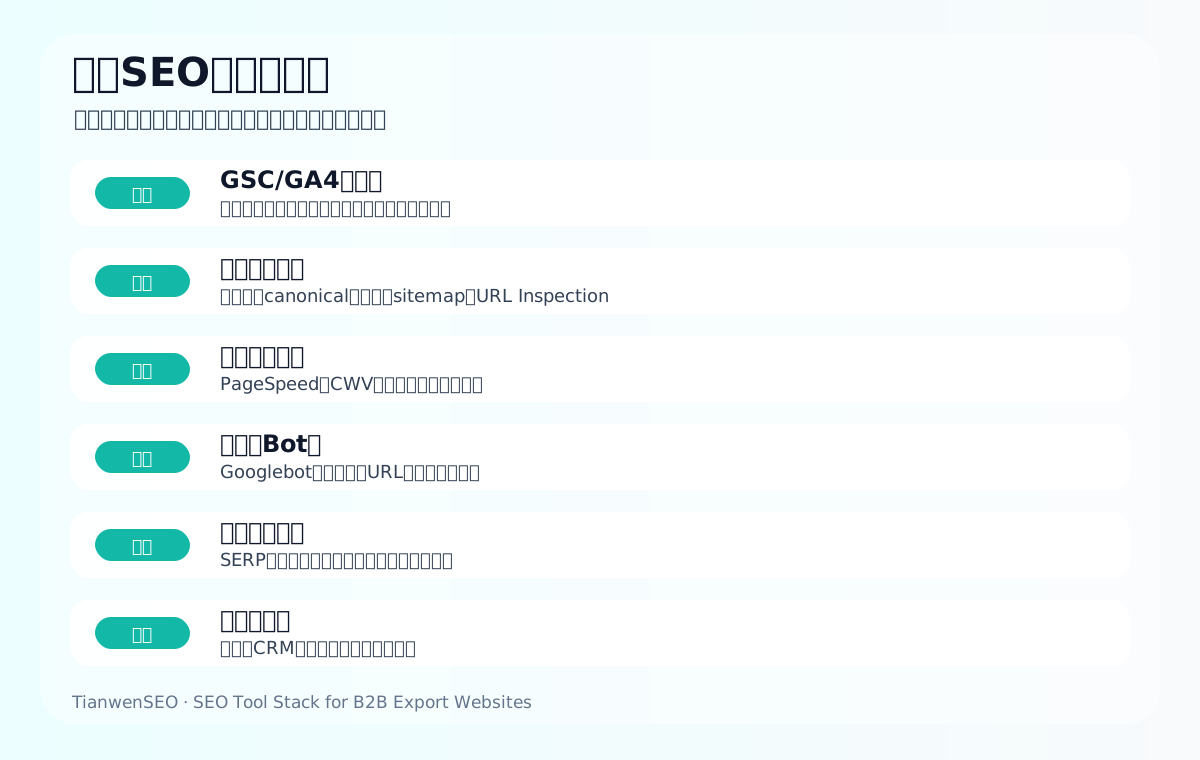
The goal of this article is to upgrade a tool list into a tool stack architecture: the base layer looks at real data, the crawl and index layer checks technical issues, the speed and experience layer checks the buyer’s cost, the log layer shows what search engines actually visit, the content and ranking layer checks competition and intent, and the inquiry review layer judges business quality.
| Benchmarking dimension | Common authoritative content | What this article adds |
|---|---|---|
| Organisation | By tool brand or feature list | By diagnostic layer and execution order |
| Technical depth | Covers crawling, speed and rankings | Adds logs, indexing and inquiry review |
| Business scenario | Mostly generic websites | Grounded in export product pages and English product terms |
| Tool boundaries | Explains what tools can do | Explains what judgement tools cannot replace |
| Review method | Looks at rankings or traffic | Adds GA4, forms, sales feedback and AI citations |
1. Minimum viable tool stack: close the loop first, then expand the tools
Small teams do not need to buy a lot of tools from the start. The minimum viable combination is GSC, GA4, manual Google SERP checks, URL Inspection, PageSpeed Insights, one crawling tool and a page review sheet. Once this workflow runs end to end, it can solve most of the problems early-stage export websites face.
The goal of a minimum tool stack is not to cover every feature, but to give every page a data source, a diagnostic action and a review metric.
| Layer | Minimum setup | Purpose |
|---|---|---|
| Search performance | GSC | Queries, clicks, impressions, indexing clues |
| Behaviour | GA4 | Product page entry, forms, paths |
| Technical | Crawling tool + URL Inspection | Status codes, canonical, internal links, indexing |
| Speed | PageSpeed Insights | Mobile and core experience |
| Record-keeping | Spreadsheet | Actions, dates, review results |
2. Crawling layer: confirm URL structure and discoverability first
Tools in the crawling layer simulate how search engines discover a website. They need to check status codes, redirects, canonical, noindex, titles, descriptions, heading tags, internal link depth, orphan pages, image alt text, structured data and page size.
For example, if the application pages of a waterproof connector website sit too far from the home page, or the product specification pages have no internal links at all, the crawling layer will expose the problem first.
| Check | Export site risk | Action |
|---|---|---|
| 404s/redirects | Product pages broken | Fix the URL or redirect |
| canonical | Category page signals point to the wrong URL | Correct the canonical URL |
| Internal link depth | Key product pages are hard to find | Add navigation and article entry points |
| Image alt | Product details are not understandable | Add English product descriptions |
| Duplicate titles | Page roles are confusing | Rewrite titles and clarify page roles |
3. Indexing layer: a tool being able to access a page does not mean Google has indexed it
Many teams assume that because a crawling tool can reach a page, Google will definitely index it. Real indexing depends on GSC, URL Inspection, sitemap, robots, canonical, duplicate pages and page value.
If a medical probe page opens technically but duplicates other pages, lacks unique information and has weak internal links, it may still show no impressions for a long time.
| Index status | Check first | Action |
|---|---|---|
| Not discovered | sitemap and internal links | Add entry points |
| Crawled, not indexed | Content uniqueness and duplication | Strengthen the value or merge the page |
| Alternate URL | canonical and duplicate pages | Consolidate to one primary URL |
| Indexed, no impressions | Query match and page intent | Rework the content structure |
| Mobile issues | Rendering and visible text | Fix the mobile content |
4. Speed and experience layer: look at the buyer’s waiting cost
Speed tools are not just about chasing a score. Export buyers may be visiting from overseas, and images, fonts, scripts, caching and server distance all add to the waiting cost. PageSpeed, CrUX, Lighthouse, server monitoring and image compression tools should be looked at together.
If an LED flood light page has many high-resolution product images that are not compressed, the mobile page loads slowly and buyers leave before they even see the wattage table, which hurts both SEO and conversion.
| Metric | Description | Optimisation direction |
|---|---|---|
| LCP | Loading of the main above-the-fold content | Compress images and reduce blocking |
| INP | Interaction responsiveness | Reduce heavy scripts |
| CLS | Layout stability | Set fixed image dimensions |
| Overseas latency | Slow access from target markets | CDN and caching |
| Image weight | Product images are too heavy | WebP and size optimisation |
5. Log layer: see what Googlebot actually visited
Log analysis is the layer most easily overlooked in an advanced tool stack. It tells you which URLs Googlebot actually visited, how often it visited, what status codes it received, which parameters were unusual, which pages have no value and whether important pages are being crawled.
For large export sites or sites with multiple product lines, logs help determine whether crawl resources are being wasted on filter pages, parameter pages and low-value legacy pages while the core product pages are visited too little.
| Log signal | Possible problem | Handling |
|---|---|---|
| Important pages rarely visited | Weak internal links or insufficient authority | Add entry points and internal links |
| Parameter pages visited frequently | Wasted crawling | Normalise parameters and use robots |
| Many 404s | Old links or incorrect internal links | Fix and redirect |
| Image/resource errors | Incomplete rendering | Fix resource access |
| Falling crawl frequency | Site quality or response problems | Check performance and content value |
6. Ranking and competitor layer: watch trends, do not act on single-day fluctuations
Rank tracking and competitor tools are good for watching trends, country differences, changes in page types and competitor updates. They help you spot which competitor pages have added tables, FAQs, videos, images, downloadable materials or stronger product descriptions.
If a custom metal parts page is overtaken by a competitor, do not look only at the competitor’s link count; also check whether they added a material table, tolerance specifications, surface finishing cases and quotation documents.
| Tool output | How to use it | Pitfall |
|---|---|---|
| Ranking trends | Watch weekly/monthly changes | Do not rewrite based on a single day |
| Competitor URLs | Look at page types and modules | Do not look only at domain strength |
| Keyword gaps | Find uncovered demand | Do not chase irrelevant terms |
| Link gap | Look at industry-relevant evidence | Do not chase volume alone |
| SERP features | Explain CTR changes | Do not ignore AI, images or ads |
7. Content inspection layer: look at purchasing decisions, not just scores
Content inspection tools can help you spot gaps in paragraphs, vocabulary, FAQs, headings and competitor structure, but they cannot replace product and purchasing judgement. Whether export site content has value depends on whether buyers can settle their judgement on specifications, applications, suppliers, risks and quotations.
A packaging machine page needs materials, speed, packaging formats, level of automation, after-sales service and maintenance; a ceramic dinnerware page needs material, glaze colour, packaging, MOQ, customisation and quality control.
| Inspection dimension | What the tool can flag | What a human must judge |
|---|---|---|
| Topic coverage | Modules common among competitors | Whether it matches the product facts |
| Vocabulary | Related-term gaps | Whether it is natural and accurate |
| FAQ | A list of questions | Whether they are real purchasing questions |
| Structure | H2/H3 suggestions | Whether it suits the page’s role |
| Readability | Sentences and paragraphs | Whether it lowers the buyer’s cost |
8. Inquiry review layer: the tool stack must connect to business results
If the tool stack stops at rankings and traffic, it is incomplete. An export website must connect inquiry sources, form fields, email clicks, WhatsApp clicks, product page paths and sales feedback.
After a private label activewear manufacturer page is updated, what really matters is whether inquiries include fabric, sizing, quantity, packaging, sampling and target market, not just the number of visits.
| Business metric | Description | Optimisation action |
|---|---|---|
| Product terms | Whether inquiries match the product line | Adjust page intent |
| Country/region | Whether it matches the target market | Add market-specific content |
| Quantity/MOQ | Whether the purchasing stage fits | Add MOQ and sampling information |
| Completeness of information | How high the communication cost is | Add an inquiry checklist |
| Sales feedback | Whether it is a valid opportunity | Fix the content and CTA |
9. Order of building the tool stack: do not start with paid tools
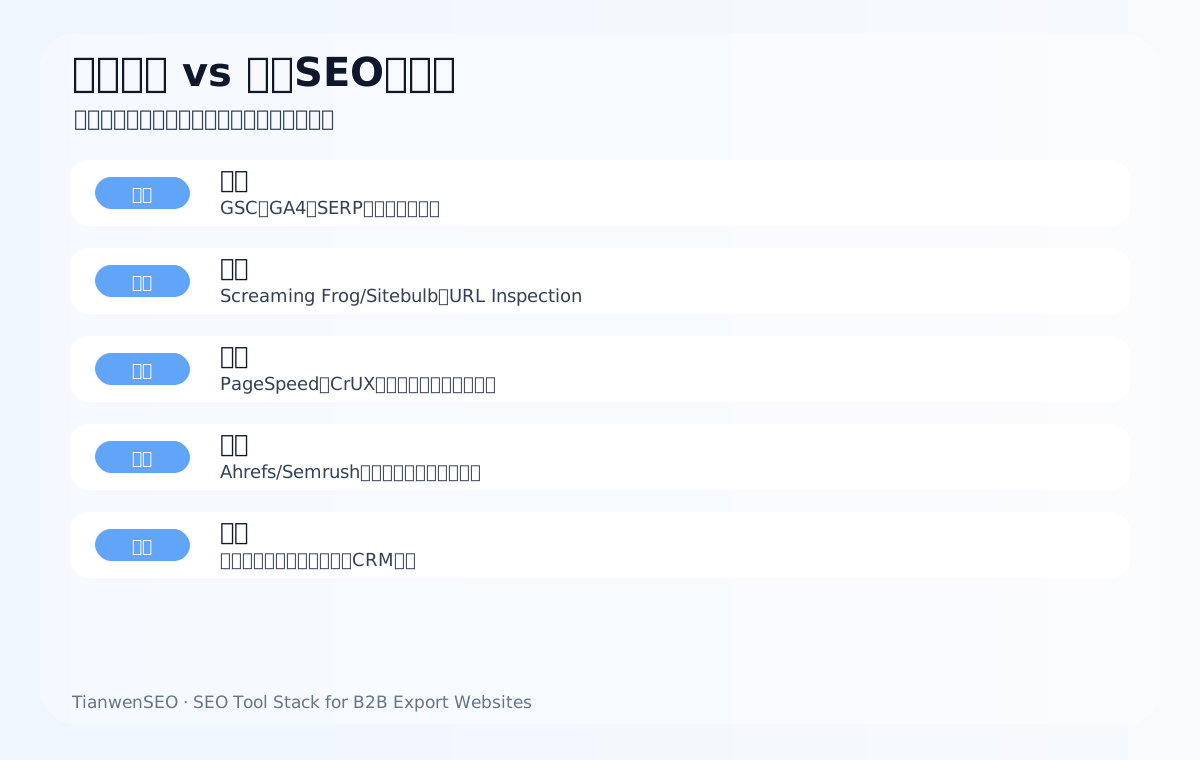
First confirm that GSC and GA4 data is being collected properly, then add crawling and speed tools, and only after that consider keyword, competitor, content, log and monitoring tools. Otherwise you will buy a lot of dashboards without a unified standard for judgement.
When an export company puts this into practice, it can build separate sheets for product lines such as custom metal parts, LED flood light, packaging machine, medical probe and waterproof connector, recording the core pages, diagnostic tools, problems found, update actions and review results for each product line.
10. How to build a tool stack for product pages
Product pages should focus on indexing, speed, specification visibility, images, FAQs, product page paths and inquiry fields. Ranking tools are only an aid; what really matters is whether buyers can judge the specifications and submit a clear request.
When an export company puts this into practice, it can build separate sheets for product lines such as custom metal parts, LED flood light, packaging machine, medical probe and waterproof connector, recording the core pages, diagnostic tools, problems found, update actions and review results for each product line.
11. How to build a tool stack for category pages
Category pages should focus on the main category terms, subcategory entry points, filter page normalisation, internal links, product counts, supply capability and differences between country markets.
When an export company puts this into practice, it can build separate sheets for product lines such as custom metal parts, LED flood light, packaging machine, medical probe and waterproof connector, recording the core pages, diagnostic tools, problems found, update actions and review results for each product line.
12. How to build a tool stack for application pages
Application pages should focus on industry terms, problem terms, the solution structure, the corresponding product entry points and sales feedback.
When an export company puts this into practice, it can build separate sheets for product lines such as custom metal parts, LED flood light, packaging machine, medical probe and waterproof connector, recording the core pages, diagnostic tools, problems found, update actions and review results for each product line.
13. How to build a tool stack for blog guides
Blogs should focus on long-tail queries, SERP intent, content gaps, internal links to product pages, AI citation structure and the onward visit path.
When an export company puts this into practice, it can build separate sheets for product lines such as custom metal parts, LED flood light, packaging machine, medical probe and waterproof connector, recording the core pages, diagnostic tools, problems found, update actions and review results for each product line.
14. How to add log analysis to a large export website
When there are many pages, many parameter pages, complex filter pages or indexing anomalies, log analysis helps determine whether Googlebot is spending its resources on the right pages.
When an export company puts this into practice, it can build separate sheets for product lines such as custom metal parts, LED flood light, packaging machine, medical probe and waterproof connector, recording the core pages, diagnostic tools, problems found, update actions and review results for each product line.
15. How to budget for the tool stack
The budget follows the bottleneck: buy keyword tools when demand is missing, buy crawling and monitoring tools when there are many technical problems, buy content assistance when content is updated frequently, buy log and monitoring tools when the page count is large, and improve forms and GA4 first when business review is weak.
When an export company puts this into practice, it can build separate sheets for product lines such as custom metal parts, LED flood light, packaging machine, medical probe and waterproof connector, recording the core pages, diagnostic tools, problems found, update actions and review results for each product line.
16. Common mistakes with tool stacks
Common mistakes include looking only at a tool’s health score, looking only at search volume, treating third-party estimates as official data, ignoring inquiry quality, and evaluating every page with the same set of metrics.
When an export company puts this into practice, it can build separate sheets for product lines such as custom metal parts, LED flood light, packaging machine, medical probe and waterproof connector, recording the core pages, diagnostic tools, problems found, update actions and review results for each product line.
17. How to add a layer to the tool stack in the AI search era
AI search visibility can serve as an extension of the content and brand layer in your review. Check definitions, tables, FAQs, entity consistency, evidence sources and citation accuracy, and do not treat AI monitoring as the only goal.
When an export company puts this into practice, it can build separate sheets for product lines such as custom metal parts, LED flood light, packaging machine, medical probe and waterproof connector, recording the core pages, diagnostic tools, problems found, update actions and review results for each product line.
18. How to manage tool output when a team works together
Every issue must be tied to a URL, query, screenshot, tool source, judgement, action and review date. Otherwise tool output scatters across different accounts and reports, and no one knows what the next step is.
When an export company puts this into practice, it can build separate sheets for product lines such as custom metal parts, LED flood light, packaging machine, medical probe and waterproof connector, recording the core pages, diagnostic tools, problems found, update actions and review results for each product line.
Export example 1: how the tool stack for custom metal parts works in practice
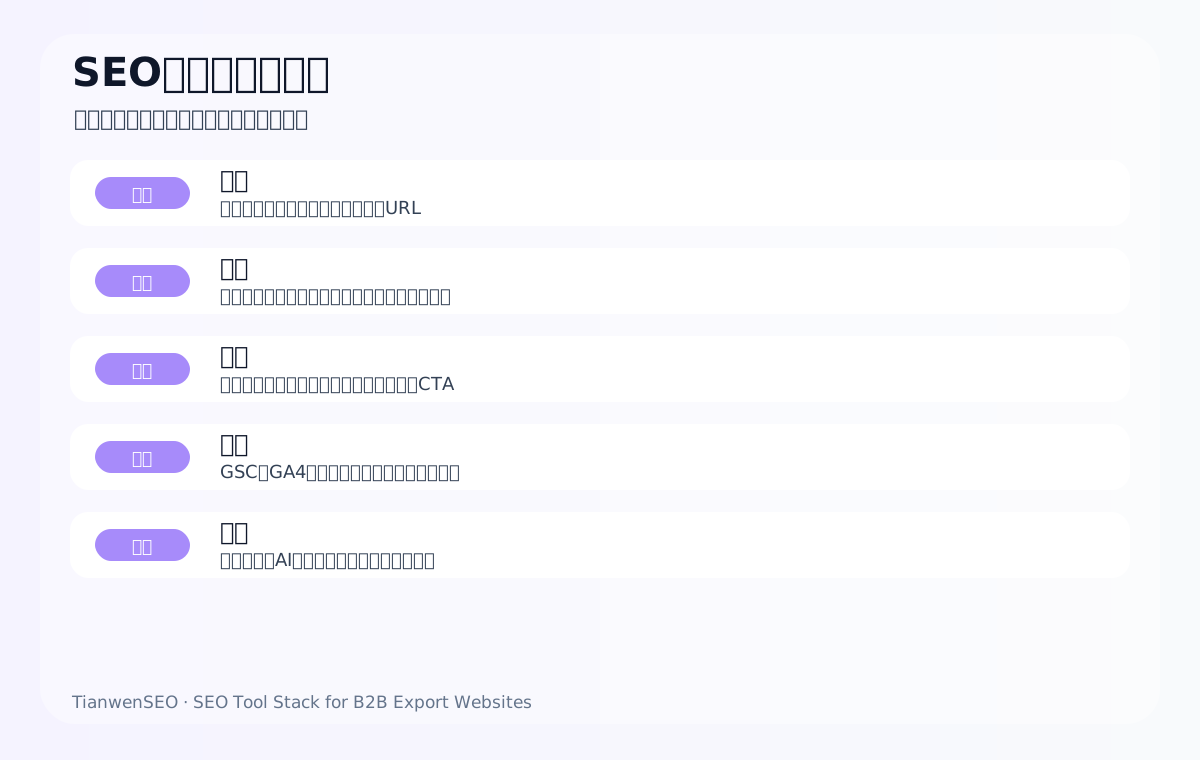
The tool stack for a custom metal parts page has to revolve around drawings, tolerances, materials, surface finishing and quotation documents. Start with keyword tools and GSC to confirm how buyers search, then use a crawling tool to confirm whether the relevant URLs can be discovered and understood, then use PageSpeed to confirm the overseas visiting experience, then benchmark against the SERP to see whether competitors offer a more complete decision table, and finally use GA4 and inquiry records to verify whether visits enter the product and contact paths.
If the tool results show that a page gets impressions but no inquiries, do not just change the title; if they show no impressions at all, do not start by adding a long article; if they show poor inquiry quality, go back to the product facts and the purchasing threshold. The point of a tool stack is to reduce this kind of misjudgement.
Export example 2: how the tool stack for LED flood light works in practice
The tool stack for an LED flood light page has to revolve around wattage, mounting height, waterproofing, beam angle and warranty. Start with keyword tools and GSC to confirm how buyers search, then use a crawling tool to confirm whether the relevant URLs can be discovered and understood, then use PageSpeed to confirm the overseas visiting experience, then benchmark against the SERP to see whether competitors offer a more complete decision table, and finally use GA4 and inquiry records to verify whether visits enter the product and contact paths.
If the tool results show that a page gets impressions but no inquiries, do not just change the title; if they show no impressions at all, do not start by adding a long article; if they show poor inquiry quality, go back to the product facts and the purchasing threshold. The point of a tool stack is to reduce this kind of misjudgement.
Export example 3: how the tool stack for packaging machine works in practice
The tool stack for a packaging machine page has to revolve around materials, speed, bag type, automation and maintenance. Start with keyword tools and GSC to confirm how buyers search, then use a crawling tool to confirm whether the relevant URLs can be discovered and understood, then use PageSpeed to confirm the overseas visiting experience, then benchmark against the SERP to see whether competitors offer a more complete decision table, and finally use GA4 and inquiry records to verify whether visits enter the product and contact paths.
If the tool results show that a page gets impressions but no inquiries, do not just change the title; if they show no impressions at all, do not start by adding a long article; if they show poor inquiry quality, go back to the product facts and the purchasing threshold. The point of a tool stack is to reduce this kind of misjudgement.
Export example 4: how the tool stack for medical probe works in practice
The tool stack for a medical probe page has to revolve around certification, compatibility, materials, testing and sterilisation. Start with keyword tools and GSC to confirm how buyers search, then use a crawling tool to confirm whether the relevant URLs can be discovered and understood, then use PageSpeed to confirm the overseas visiting experience, then benchmark against the SERP to see whether competitors offer a more complete decision table, and finally use GA4 and inquiry records to verify whether visits enter the product and contact paths.
If the tool results show that a page gets impressions but no inquiries, do not just change the title; if they show no impressions at all, do not start by adding a long article; if they show poor inquiry quality, go back to the product facts and the purchasing threshold. The point of a tool stack is to reduce this kind of misjudgement.
Export example 5: how the tool stack for cnc machining parts works in practice
The tool stack for a cnc machining parts page has to revolve around DFM, mass production, inspection and lead time. Start with keyword tools and GSC to confirm how buyers search, then use a crawling tool to confirm whether the relevant URLs can be discovered and understood, then use PageSpeed to confirm the overseas visiting experience, then benchmark against the SERP to see whether competitors offer a more complete decision table, and finally use GA4 and inquiry records to verify whether visits enter the product and contact paths.
If the tool results show that a page gets impressions but no inquiries, do not just change the title; if they show no impressions at all, do not start by adding a long article; if they show poor inquiry quality, go back to the product facts and the purchasing threshold. The point of a tool stack is to reduce this kind of misjudgement.
Export example 6: how the tool stack for ceramic dinnerware works in practice
The tool stack for a ceramic dinnerware page has to revolve around material, glaze colour, packaging, MOQ and customisation. Start with keyword tools and GSC to confirm how buyers search, then use a crawling tool to confirm whether the relevant URLs can be discovered and understood, then use PageSpeed to confirm the overseas visiting experience, then benchmark against the SERP to see whether competitors offer a more complete decision table, and finally use GA4 and inquiry records to verify whether visits enter the product and contact paths.
If the tool results show that a page gets impressions but no inquiries, do not just change the title; if they show no impressions at all, do not start by adding a long article; if they show poor inquiry quality, go back to the product facts and the purchasing threshold. The point of a tool stack is to reduce this kind of misjudgement.
Export example 7: how the tool stack for waterproof connector works in practice
The tool stack for a waterproof connector page has to revolve around IP rating, wire diameter, current and application scenarios. Start with keyword tools and GSC to confirm how buyers search, then use a crawling tool to confirm whether the relevant URLs can be discovered and understood, then use PageSpeed to confirm the overseas visiting experience, then benchmark against the SERP to see whether competitors offer a more complete decision table, and finally use GA4 and inquiry records to verify whether visits enter the product and contact paths.
If the tool results show that a page gets impressions but no inquiries, do not just change the title; if they show no impressions at all, do not start by adding a long article; if they show poor inquiry quality, go back to the product facts and the purchasing threshold. The point of a tool stack is to reduce this kind of misjudgement.
Export example 8: how the tool stack for industrial valve supplier works in practice
The tool stack for an industrial valve supplier page has to revolve around materials, pressure, standards and industry operating conditions. Start with keyword tools and GSC to confirm how buyers search, then use a crawling tool to confirm whether the relevant URLs can be discovered and understood, then use PageSpeed to confirm the overseas visiting experience, then benchmark against the SERP to see whether competitors offer a more complete decision table, and finally use GA4 and inquiry records to verify whether visits enter the product and contact paths.
If the tool results show that a page gets impressions but no inquiries, do not just change the title; if they show no impressions at all, do not start by adding a long article; if they show poor inquiry quality, go back to the product facts and the purchasing threshold. The point of a tool stack is to reduce this kind of misjudgement.
Export example 9: how the tool stack for private label activewear manufacturer works in practice
The tool stack for a private label activewear manufacturer page has to revolve around fabric, sizing, sampling, packaging and lead time. Start with keyword tools and GSC to confirm how buyers search, then use a crawling tool to confirm whether the relevant URLs can be discovered and understood, then use PageSpeed to confirm the overseas visiting experience, then benchmark against the SERP to see whether competitors offer a more complete decision table, and finally use GA4 and inquiry records to verify whether visits enter the product and contact paths.
If the tool results show that a page gets impressions but no inquiries, do not just change the title; if they show no impressions at all, do not start by adding a long article; if they show poor inquiry quality, go back to the product facts and the purchasing threshold. The point of a tool stack is to reduce this kind of misjudgement.
Export example 10: how the tool stack for stainless steel hose clamp works in practice
The tool stack for a stainless steel hose clamp page has to revolve around material, dimensions, salt spray testing and packaging. Start with keyword tools and GSC to confirm how buyers search, then use a crawling tool to confirm whether the relevant URLs can be discovered and understood, then use PageSpeed to confirm the overseas visiting experience, then benchmark against the SERP to see whether competitors offer a more complete decision table, and finally use GA4 and inquiry records to verify whether visits enter the product and contact paths.
If the tool results show that a page gets impressions but no inquiries, do not just change the title; if they show no impressions at all, do not start by adding a long article; if they show poor inquiry quality, go back to the product facts and the purchasing threshold. The point of a tool stack is to reduce this kind of misjudgement.
19. Assign tool stack responsibilities by team role
The owner or manager does not need to look at every tool every day, but should look at priorities, budget and review results; operations staff handle GSC, GA4, content updates and spreadsheet records; technical staff handle crawling, indexing, speed, logs and server issues; sales staff feed back inquiry quality, product fit and the questions customers ask most often. Only when the tool stack is assigned to roles will it stop being just another report.
For example, on an export site selling waterproof connectors, the technical staff may find through a crawling tool that the application pages lack internal links, the content staff may find through the SERP that a competitor has an IP rating comparison table, and the sales staff may report that customers often ask about wire diameter and the installation environment. Once the three pieces of information are combined, the page actions become clear: add internal links, add a comparison table, add FAQs and inquiry fields, rather than buying yet another tool.
20. A fixed monthly rhythm for maintaining the tool stack
Look at GSC anomalies, indexing, core pages and inquiry paths every week; run a crawl and speed check once a month; review competitors, content and link gaps once a quarter; and check logs, information architecture and the division of work between product line pages once every six months. Different frequencies correspond to different tools, and there is no need to open every system every day.
For example, on an export site selling waterproof connectors, the technical staff may find through a crawling tool that the application pages lack internal links, the content staff may find through the SERP that a competitor has an IP rating comparison table, and the sales staff may report that customers often ask about wire diameter and the installation environment. Once the three pieces of information are combined, the page actions become clear: add internal links, add a comparison table, add FAQs and inquiry fields, rather than buying yet another tool.
21. How a crawl report becomes page tasks
A crawling tool outputs a large number of issues, but not every issue is equally important. Filter for core product pages, category pages, application pages and resource pages first, then deal with the issues that affect indexing, internal links and user understanding. Minor heading issues on low-value archive pages can wait, and do not let the sheer number of report items distort your priorities.
For example, on an export site selling waterproof connectors, the technical staff may find through a crawling tool that the application pages lack internal links, the content staff may find through the SERP that a competitor has an IP rating comparison table, and the sales staff may report that customers often ask about wire diameter and the installation environment. Once the three pieces of information are combined, the page actions become clear: add internal links, add a comparison table, add FAQs and inquiry fields, rather than buying yet another tool.
22. How a speed tool report becomes page tasks
PageSpeed gives a lot of recommendations, but an export site should first deal with the issues that affect overseas access and above-the-fold understanding: large above-the-fold images, uncompressed product images, blocking scripts, fonts, caching, server response and mobile layout. Do not sacrifice product presentation for a score, and do not ignore the countries visitors actually come from.
For example, on an export site selling waterproof connectors, the technical staff may find through a crawling tool that the application pages lack internal links, the content staff may find through the SERP that a competitor has an IP rating comparison table, and the sales staff may report that customers often ask about wire diameter and the installation environment. Once the three pieces of information are combined, the page actions become clear: add internal links, add a comparison table, add FAQs and inquiry fields, rather than buying yet another tool.
23. How a log tool report becomes page tasks
The most valuable part of log analysis is not a good-looking chart, but finding out whether Googlebot visits the core pages, whether it wastes time on parameter pages, whether it frequently hits errors and whether it ignores new product lines. Then decide on internal links, robots, canonical, sitemap and page consolidation.
For example, on an export site selling waterproof connectors, the technical staff may find through a crawling tool that the application pages lack internal links, the content staff may find through the SERP that a competitor has an IP rating comparison table, and the sales staff may report that customers often ask about wire diameter and the installation environment. Once the three pieces of information are combined, the page actions become clear: add internal links, add a comparison table, add FAQs and inquiry fields, rather than buying yet another tool.
24. How a content tool report becomes page tasks
Content tools often produce a lot of suggestions, so when executing, filter them by the purchasing path first: definitions, specifications, applications, comparisons, certifications, FAQs, quotation materials and product entry points. Vocabulary suggestions unrelated to purchasing can be dropped, so that the page does not turn into keyword stuffing.
For example, on an export site selling waterproof connectors, the technical staff may find through a crawling tool that the application pages lack internal links, the content staff may find through the SERP that a competitor has an IP rating comparison table, and the sales staff may report that customers often ask about wire diameter and the installation environment. Once the three pieces of information are combined, the page actions become clear: add internal links, add a comparison table, add FAQs and inquiry fields, rather than buying yet another tool.
25. How a ranking tool report becomes page tasks
Ranking drops must be judged together with GSC and the SERP. If rankings fall but impressions remain, it may be a CTR or competitor module issue; if impressions disappear, it may be an intent shift or an indexing issue; if the target country is different, the content may need to be adjusted by market.
For example, on an export site selling waterproof connectors, the technical staff may find through a crawling tool that the application pages lack internal links, the content staff may find through the SERP that a competitor has an IP rating comparison table, and the sales staff may report that customers often ask about wire diameter and the installation environment. Once the three pieces of information are combined, the page actions become clear: add internal links, add a comparison table, add FAQs and inquiry fields, rather than buying yet another tool.
26. How CRM and sales feedback enter the SEO tool stack
SEO tools cannot know whether each inquiry is valuable, but sales feedback can fill that layer. Record which URL the inquiry came from, what product was asked about, what quantity, which country, and whether it matches the target customer, then work backwards to decide whether the page title, FAQ, CTA and product information need adjusting.
For example, on an export site selling waterproof connectors, the technical staff may find through a crawling tool that the application pages lack internal links, the content staff may find through the SERP that a competitor has an IP rating comparison table, and the sales staff may report that customers often ask about wire diameter and the installation environment. Once the three pieces of information are combined, the page actions become clear: add internal links, add a comparison table, add FAQs and inquiry fields, rather than buying yet another tool.
27. How the tool stack supports content asset building
A long-form asset is not simply about writing more; it is about building a page system you can review. The tool stack should help you find weaknesses in old pages, competitor strengths, shifts in search intent, gaps in images and tables, gaps in internal links and gaps in AI citations, and then turn these into an update plan.
For example, on an export site selling waterproof connectors, the technical staff may find through a crawling tool that the application pages lack internal links, the content staff may find through the SERP that a competitor has an IP rating comparison table, and the sales staff may report that customers often ask about wire diameter and the installation environment. Once the three pieces of information are combined, the page actions become clear: add internal links, add a comparison table, add FAQs and inquiry fields, rather than buying yet another tool.
28. How the tool stack supports expansion across multiple product lines
When a website has several product lines, do not manage all content with the same keyword sheet. You can build separate libraries by product line such as custom metal parts, LED flood light, packaging machine and medical probe, with each product line having its own core terms, pages, tool output and review metrics.
For example, on an export site selling waterproof connectors, the technical staff may find through a crawling tool that the application pages lack internal links, the content staff may find through the SERP that a competitor has an IP rating comparison table, and the sales staff may report that customers often ask about wire diameter and the installation environment. Once the three pieces of information are combined, the page actions become clear: add internal links, add a comparison table, add FAQs and inquiry fields, rather than buying yet another tool.
29. How the tool stack avoids unproductive busyness
The typical sign of unproductive busyness is checking rankings every day, exporting reports every week and constantly switching tools, while no pages go live and no reviews happen. The solution is that every tool output must map to one URL and one action: fix, refresh, rewrite, merge, add internal links, add images, change the CTA or keep watching.
For example, on an export site selling waterproof connectors, the technical staff may find through a crawling tool that the application pages lack internal links, the content staff may find through the SERP that a competitor has an IP rating comparison table, and the sales staff may report that customers often ask about wire diameter and the installation environment. Once the three pieces of information are combined, the page actions become clear: add internal links, add a comparison table, add FAQs and inquiry fields, rather than buying yet another tool.
30. How the tool stack can leave an interface for AI search
AI search visibility will become more important in the future, but it is not a castle in the air separate from SEO. The tool stack can add AI answer sampling, brand entity checks, citation accuracy records and FAQ extractability checks, but the foundation is still crawlable, indexable, clearly written content with real evidence.
For example, on an export site selling waterproof connectors, the technical staff may find through a crawling tool that the application pages lack internal links, the content staff may find through the SERP that a competitor has an IP rating comparison table, and the sales staff may report that customers often ask about wire diameter and the installation environment. Once the three pieces of information are combined, the page actions become clear: add internal links, add a comparison table, add FAQs and inquiry fields, rather than buying yet another tool.
If you can remember only one principle, it is this: build the tool stack around pages and product lines, not around tool brands. Every tool must answer one clear question and be able to turn that answer into a verifiable page action. That is how an export team gets clearer over time instead of becoming more dependent on complicated reports.
This matters especially for multi-product-line export sites: every tool output should map to a specific English product term, a specific URL, a specific change and a specific review date.
FAQ: Common questions about the SEO tool stack
What is the minimum set of tools for an SEO tool stack?
GSC, GA4, manual SERP checks, URL Inspection, PageSpeed, one crawling tool and one review sheet.
When is log analysis needed?
Log analysis is needed when the page count is large, there are many parameter URLs, indexing is abnormal or important pages are not crawled enough.
Do I have to buy a rank tracking tool?
No. It is more valuable when you target many markets, have many keywords and face strong competition.
Can content tools replace editorial judgement?
No. Content tools can only flag gaps; product facts and purchasing judgement must be confirmed by a human.
Does a low speed tool score always hurt rankings?
It cannot be judged that simply, but poor speed affects experience and conversion, especially for overseas visitors.
How can the tool stack avoid becoming more and more complex?
Every tool must map to a diagnostic question and a page action; do not add a tool that produces no action.
Which layer should a small export site start with?
Start with the GSC, GA4, crawling, indexing and speed basics, then move on to content and competitors.
Can an SEO tool stack promise rankings and inquiries?
No. A tool stack can only improve the quality of diagnosis, execution and review; it cannot promise specific results.
Does AI search need a separate tool stack?
Not necessarily. Get the SEO basics, content structure and brand entity right first, then add AI citation monitoring.
How often should the tool stack be reviewed?
Review once a month whether the tools help decision-making, and once a quarter whether tools should be added or removed.
Conclusion: a good tool stack is not expensive, it gives every layer a job
A good SEO tool stack should help the team judge faster whether a problem belongs to crawling, indexing, speed, logs, content, rankings, links or inquiry quality, rather than creating more dashboards. For export companies, the tool stack must ultimately serve English product terms, core pages, purchasing decisions and valid inquiries.
If you do not know where to start right now, build the minimum viable tool stack first: GSC for search performance, GA4 for visit paths, a crawling tool for technical issues, PageSpeed for experience, the SERP for competitors, and a spreadsheet for recording actions and reviews. Once this loop runs end to end, add more specialised tools according to the real bottlenecks.
Official sources and acceptance boundaries for the SEO tool stack
The value of an SEO tool stack lies not in the number of tools, but in whether crawling, indexing, pages, queries, events and inquiry paths can be strung together into review evidence. Tool output must return to official data and page facts.
| Official source | What it is used to judge | Acceptance boundary |
|---|---|---|
| Search Console Performance report | The core source for search queries and page performance | Third-party tools cannot replace GSC facts |
| GA4 events | Records forms, downloads, email clicks and inquiry entry points after a visit | GA4 cannot explain every reason for search impressions |
| Google: SEO Starter Guide | Constrains tool checks so that they cover basic SEO | A tool score does not equal search performance |
| Google: Sitemaps overview | Verify URL submission and discovery status | Submission status is not indexing status |
| Google: JavaScript SEO basics | Verify rendering and resource accessibility | A tool screenshot is not final evidence |
Low-data review checklist
| Check | Fields to record | How to write it in a low-data period |
|---|---|---|
| Indexing entry points | index/follow, canonical, sitemap, internal links, HTTP status codes | Record only the current accessible state; do not write judgements about search results |
| Content evidence | Page role, product or service information, images, structured data, update date | When information is insufficient, list the gaps; do not add fabricated cases |
| Search Console | query, page, country, device, date window | If GSC returns zero rows, write zero rows; do not extrapolate rankings or clicks |
| GA4 review | Forms, downloads, email clicks, inquiry entry points, key events | If there are no events, fix tracking first; do not write conversion conclusions |
Continue reading this SEO series
If you are working through export website SEO systematically, it is worth continuing with the articles below. Sort out the relationships between crawling, indexing, content, links and review first, then decide which page to change next.
- How to use Google SEO analysis tools: combining GSC, GA4 and page diagnostics to read export inquiries
- How Google crawling, indexing and ranking work: a diagnostic guide for export websites from indexing to inquiries
- How search engines work: a guide to crawling, indexing, ranking and export website diagnostics
- Technical SEO audit checklist: a diagnostic guide to crawling, indexing, structure and inquiry paths on export websites
- Sitemap technical guide: submission, indexing diagnostics and troubleshooting common errors
- How to check Googlebot content accessibility: a guide to rendering, text, links and resources
{
“@context”: “https://schema.org”,
“@type”: “FAQPage”,
“mainEntity”: [
{
“@type”: “Question”,
“name”: “What is the minimum set of tools for an SEO tool stack?”,
“acceptedAnswer”: {
“@type”: “Answer”,
“text”: “GSC, GA4, manual SERP checks, URL Inspection, PageSpeed, one crawling tool and one review sheet.”
}
},
{
“@type”: “Question”,
“name”: “When is log analysis needed?”,
“acceptedAnswer”: {
“@type”: “Answer”,
“text”: “Log analysis is needed when the page count is large, there are many parameter URLs, indexing is abnormal or important pages are not crawled enough.”
}
},
{
“@type”: “Question”,
“name”: “Do I have to buy a rank tracking tool?”,
“acceptedAnswer”: {
“@type”: “Answer”,
“text”: “No. It is more valuable when you target many markets, have many keywords and face strong competition.”
}
},
{
“@type”: “Question”,
“name”: “Can content tools replace editorial judgement?”,
“acceptedAnswer”: {
“@type”: “Answer”,
“text”: “No. Content tools can only flag gaps; product facts and purchasing judgement must be confirmed by a human.”
}
},
{
“@type”: “Question”,
“name”: “Does a low speed tool score always hurt rankings?”,
“acceptedAnswer”: {
“@type”: “Answer”,
“text”: “It cannot be judged that simply, but poor speed affects experience and conversion, especially for overseas visitors.”
}
}
]
}
This page is machine-translated from the Simplified Chinese version and awaiting human review. It has not yet been proofread.