AI search optimization should not start with “let’s revise a few articles first,” nor with “let’s buy a tool first.” For export manufacturers, factories, and trading companies, the steadier starting point is: first build a set of buyer questions, then look at how AI currently answers them, then map those questions to existing pages, and only then decide whether to revise category pages, product pages, application pages, resource pages, FAQs, or inquiry pages.
If your website sells custom metal parts, LED flood light, packaging machine, medical probe, cnc machining parts, ceramic dinnerware, waterproof connector, industrial valve supplier, or private label activewear manufacturer, the starting point of AI search optimization is not to write abstractly that “we are professional,” but to answer what buyers will ask in AI: can you quote from drawings? What application scenarios is it suitable for? What is the MOQ? How are certificates verified? How do you judge lead time? Are the resources downloadable?
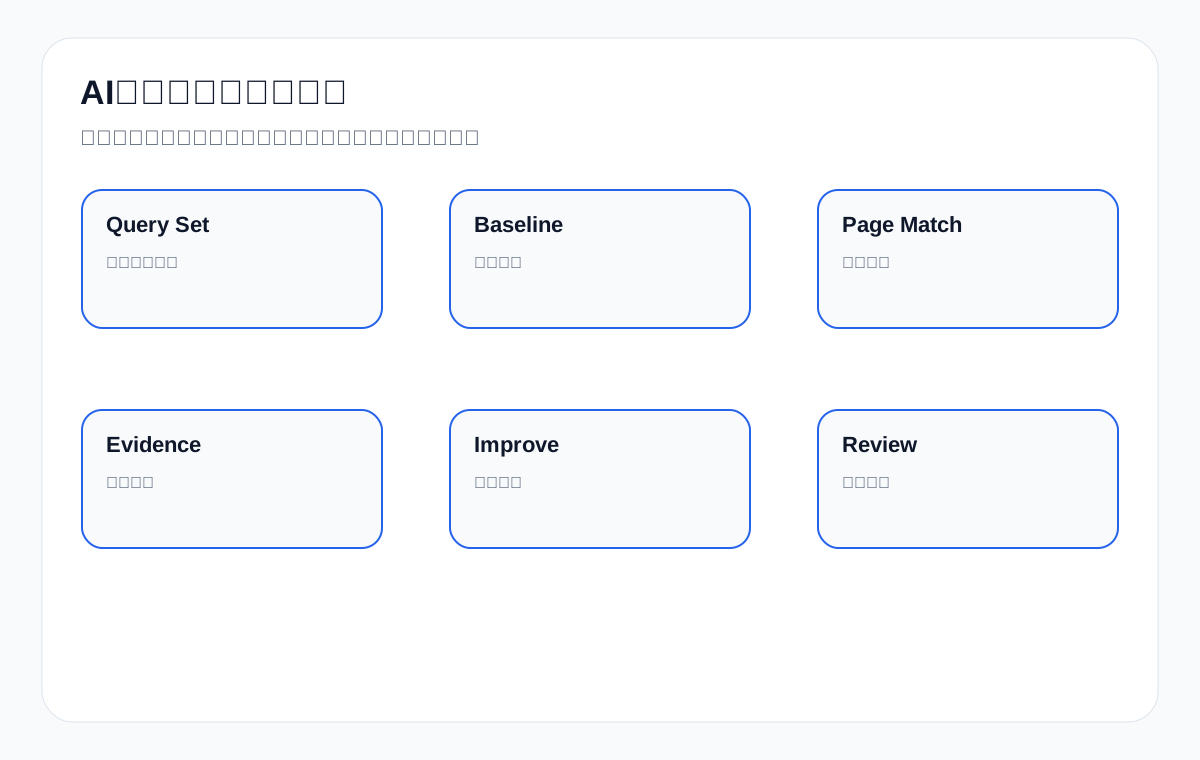
Official source boundaries: AI search optimization starts with a query set, an answer baseline, and a page map
AI search optimization is not about revising articles the moment you begin, nor about buying monitoring tools first. The steadier starting point is to establish three things first: what buyers will ask, what the current answer baseline is, and which URLs on the official website should host those questions. Only when these three things are clear do later page revisions, structured data, internal links, GSC, GA4, AI samples, and inquiry reviews have a direction.
For export product lines such as custom metal parts, LED flood light, packaging machine, medical probe, waterproof connector, industrial valve supplier, ceramic dinnerware, and private label activewear manufacturer, the first round of AI search optimization should not be written as “get the platform to adopt the official website.” It should be written as a reviewable baseline: which pages correspond to product terms, application terms, supplier terms, resource terms, comparison terms, and RFQ terms; whether pages are crawlable, indexable, and quotable; and which data will be used later to observe changes.
Table mapping official sources to AI search optimization startup fields
| Official source | Corresponding startup field | What it can validate | What it cannot prove |
|---|---|---|---|
| Google Search Central: AI features and your website | Basic boundaries of AI search | AI features still depend on pages being accessible, indexable, clearly written, and consistent with structured data. | It cannot promise that AI answers will use the official website. |
| Google Search Central: SEO Starter Guide | Basic page quality | Whether titles, body copy, image captions, internal links, and page purpose serve real users. | It cannot be written up as a specified ranking or a specified click result. |
| Google Search Central: Search Essentials | Basic search eligibility | Whether pages are accessible and indexable, and whether spammy and misleading content is avoided. | Basic compliance does not mean search performance has already materialized. |
| Google Search Central: Sitemaps overview | URL discovery path | Whether key articles, category pages, product pages, application pages, and resource pages are included in the sitemap. | A sitemap containing a URL does not mean the page has been indexed. |
| Google Search Central: robots.txt introduction | Crawl rules | Whether pages, images, PDFs, JS/CSS, and product resources are blocked by mistake. | robots allowing a page does not mean the page will be shown. |
| Google Search Central: Consolidate duplicate URLs | canonical and duplicate URLs | Whether parameter pages, pagination, filter pages, variant pages, and multilingual URLs have a clear canonicalization strategy. | canonical is not a mandatory command, nor a ranking promise. |
| Google Search Central: Structured data general guidelines | Structured data boundaries | Whether Schema fields come from visible page content, and whether duplicate plugin output and fabricated fields are avoided. | Schema is not a controller of rich results or AI answers. |
| Google Search Central: Product structured data | Product fact fields | Whether fields such as product name, image, description, brand, SKU, and Offer match the facts on the page. | Do not fabricate price, stock, ratings, certifications, or brand fields. |
| Search Console Help: Performance report | GSC search performance | query, page, clicks, impressions, CTR, average position, country, device. | When there is no GSC row data, do not fill in rankings, clicks, or CTR. |
| Search Console Help: URL Inspection tool | Single URL inspection | The index status, crawling, canonical, and the version Google sees for key URLs. | A single URL being inspectable does not mean it has already been shown. |
| Google Analytics Help: About events | GA4 behavior events | On-site behaviors such as forms, email, WhatsApp, downloads, RFQ, and button clicks. | Event changes cannot directly replace search or AI citation conclusions. |
| Google Analytics Help: Recommended events for online sales | Item path events | Events such as view_item, select_item, add_to_cart, and purchase can help observe the item path. | B2B inquiry sites also need to look separately at RFQ, email, and downloads. |
| OpenAI Platform: Bots | AI crawler access | The purposes and access boundaries of OAI-SearchBot, GPTBot, and ChatGPT-User should be checked separately. | Allowing a certain bot to access does not mean AI search results will change. |
| Bing Webmaster Blog: AI Performance | Bing AI observation | If visible in the account, you can record citations, cited pages, and grounding query phrases. | A citation is not a ranking, an answer position, or an inquiry result. |
| IndexNow: Documentation | URL update notification | After adding, updating, or deleting URLs, record the submission time, the URL list, and the response status. | HTTP 200 only means the notification was received; it does not mean the page has been indexed. |
AI search optimization startup order: query set, answer baseline, URL mapping, page actions
The startup order must be reviewable. List the questions first, then record the current answers, then map the questions to official website pages, and finally decide which pages to change. This is a little slower, but it will not cram every question into articles, and it will not leave product pages, category pages, and resource pages sitting on the sidelines.
| Step | What to produce | Export example | How to validate |
|---|---|---|---|
| Query set | Product terms, application terms, supplier terms, resource terms, comparison terms, RFQ terms. | waterproof connector manufacturer for outdoor lighting. | Question ID, language, intent, product line, priority. |
| Answer baseline | Platform, date, question, answer summary, whether the official website appears, competitor sources, factual errors. | Whether AI mixes up IP rating, M12, and cable connector. | Sample table, screenshot IDs, cited URLs. |
| URL mapping | Each question corresponds to a category page, product page, application page, resource page, article page, or inquiry page. | The powder pouch question for packaging machine should map to the application page and product page. | URL table, page type, current status. |
| Technical baseline | sitemap, robots, index/follow, canonical, Schema, mobile tables. | Whether the medical probe resource page and PDF summary can be accessed normally. | Source code, sitemap, URL inspection, front-end screenshots. |
| Page actions | Add definitions, specifications, FAQ, certificates, applications, resource downloads, RFQ fields, and internal links. | Add material, tolerance, drawing, and quantity to custom metal parts. | Before-and-after summaries, page source code, review records. |
When there is no GSC data, AI search optimization can only build a startup baseline first
If Search Console has no query, page, or page-query rows for the last 28 or 90 days, the startup report must be downgraded. You can say that the query set, answer baseline, URL mapping, technical baseline, page actions, and event definitions have been established; you cannot write that rankings, impressions, clicks, CTR, AI citations, or inquiries have changed. When there is no data, restraint matters more than excitement.
| Current evidence | Can be written as | Cannot be written as | Next step |
|---|---|---|---|
| GSC has no query or page rows | There is currently no data baseline for judging search performance. | Rankings, clicks, or CTR have improved. | Recheck query, page, and page-query after 7-14 days. |
| AI samples have been established | There is a repeatable set of questions and answer records. | The samples represent long-term results or results in all regions. | Retest the same question set continuously. |
| URL mapping is complete | The hosting relationship between questions and pages is clearer. | The platform has already adopted these pages. | Look at indexing, GSC, AI samples, and logs. |
| Pages have been given evidence modules | Page facts, structure, and purchasing fields are more complete. | Inquiries will definitely grow. | Look at GA4 events, inquiry products, and sales feedback. |
| IndexNow has been submitted | The URL update notification has been sent. | The pages have already been crawled or indexed. | Keep watching logs, GSC, Bing, and the sitemap. |
How to build the query set: don’t ask only about brand names; cover the purchasing process
The query set for an export business cannot contain only brand names. What buyers actually ask about is products, uses, specifications, suppliers, certificates, MOQ, lead time, resources, and risks. Only by starting from these questions will AI search optimization point to real page actions.
| Question type | Example question | Hosting page | What the page needs to add |
|---|---|---|---|
| Product terms | waterproof connector manufacturer. | Category page, product page. | Product family definition, representative models, interfaces, IP rating. |
| Application terms | LED flood light for outdoor sports field. | Application page, category page. | Scenarios, wattage, installation height, certifications, and risk notes. |
| Resource terms | medical probe datasheet supplier. | Resource page, product page. | Compatible models, materials, test data, download summary. |
| RFQ terms | custom metal parts quote with drawing. | Product page, inquiry page. | drawing, material, tolerance, quantity, lead time. |
| Comparison terms | packaging machine for powder pouch vs granule. | Article page, application page. | Material differences, capacity, maintenance, applicable boundaries. |
How to do page mapping: articles are not the only answer
If AI search optimization only produces articles, an export website will increasingly look like a reference library rather than a site that can take inquiries. The right approach is to let articles explain questions, let category pages host product families, let product pages host models and specifications, let application pages host scenarios, let resource pages host evidence, and let inquiry pages host the next action.
| Page type | What questions it suits | What it is not suited for | Validation fields |
|---|---|---|---|
| Category page | Product family, application scope, representative products, certifications, FAQ. | Only product cards. | Body copy, internal links, representative products, sitemap. |
| Product page | Model, specifications, material, MOQ, lead time, packaging, RFQ. | Only images and a short description. | Specification table, FAQ, Schema, inquiry entry point. |
| Application page | Scenario questions, selection criteria, risk notes, candidate products. | Only industry concepts. | Scenarios, decision table, product internal links. |
| Resource page | Certificates, installation, maintenance, manual, datasheet. | Only a PDF file name. | HTML summary, download events, image captions. |
| Inquiry page | RFQ, drawings, samples, quantity, country, lead time. | Only writing Contact us. | Fields, form events, sales feedback. |
30-60-90 day review: during the startup phase, check whether the baseline is turning into data
After AI search optimization starts, don’t immediately ask “is it working.” In the first 30 days, look at whether the query set, URL mapping, and page actions have landed; at 60 days, look at whether GSC, GA4, and Bing have observable data; at 90 days, put AI samples, inquiry fields, and sales feedback together to judge the priorities for the next round.
| Period | Review focus | Fields to record | What it helps judge |
|---|---|---|---|
| 0-30 days | Query set, answer baseline, URL mapping, sitemap, robots, Schema, page facts. | Question ID, URL, action, launch date, review result. | Whether the startup baseline is complete. |
| 31-60 days | Whether GSC shows query/page rows and whether GA4 events work normally. | query, page, country, device, events, downloads, forms, email clicks. | Whether observable data is starting to form. |
| 61-90 days | The relationship between AI answer samples, Bing citations, inquiry products, sales feedback, and page actions. | Platform, question, cited URL, competitor sources, inquiry fields, sales notes. | Which product line, page type, and evidence module to fix first in the next round. |
2. Why you shouldn’t start by revising content
Many websites hear “AI search optimization” and immediately start expanding articles or adding FAQs. The problem is that without a query set, you don’t know what buyers will actually ask; without an answer baseline, you don’t know how AI currently understands this industry; without page mapping, you don’t know which type of page to change; and without review metrics, you don’t know whether the changes worked.
The most common waste at export websites is pouring a great deal of effort into generic educational articles while failing to channel purchasing questions toward product pages. For example, writing many articles about “what is a waterproof connector” while the product page has no IP rating, current, cable diameter, material, certificate, or quote fields; or writing many articles about “how to choose a packaging machine” while the application page has no material, speed, packaging format, or capacity guidance. Even if AI answers see the articles, they cannot find enough evidence to support supplier selection.
Risks of revising content directly
| Risk | Symptom | Consequence | Correct approach |
|---|---|---|---|
| Inaccurate questions | The team writes topics based on gut feeling | Content fails to cover real purchasing questions | Build an English purchasing question set first |
| Page mismatch | Articles take on the job of product pages | Buyers cannot find specifications or a quote entry point | Map queries to category, product, application, resource, and inquiry pages |
| Insufficient evidence | Only slogans, no specifications | AI struggles to cite it and customers struggle to judge | Add specification tables, certificate notes, FAQ, and RFQ fields |
| No way to review | Only going by feeling after publishing | You don’t know whether it brings valid inquiries | Build GSC, GA4, inquiry, and AI answer sampling tables |
3. Step one: build an export AI query set
The query set is the real starting point of AI search optimization. It is not a traditional keyword list, but a set of questions that overseas buyers might ask AI. For export businesses, the query set must cover product terms, inquiry terms, solution terms, comparison terms, resource terms, risk terms, and supplier judgment terms. Every question must be able to map to a page or a page that needs to be created.
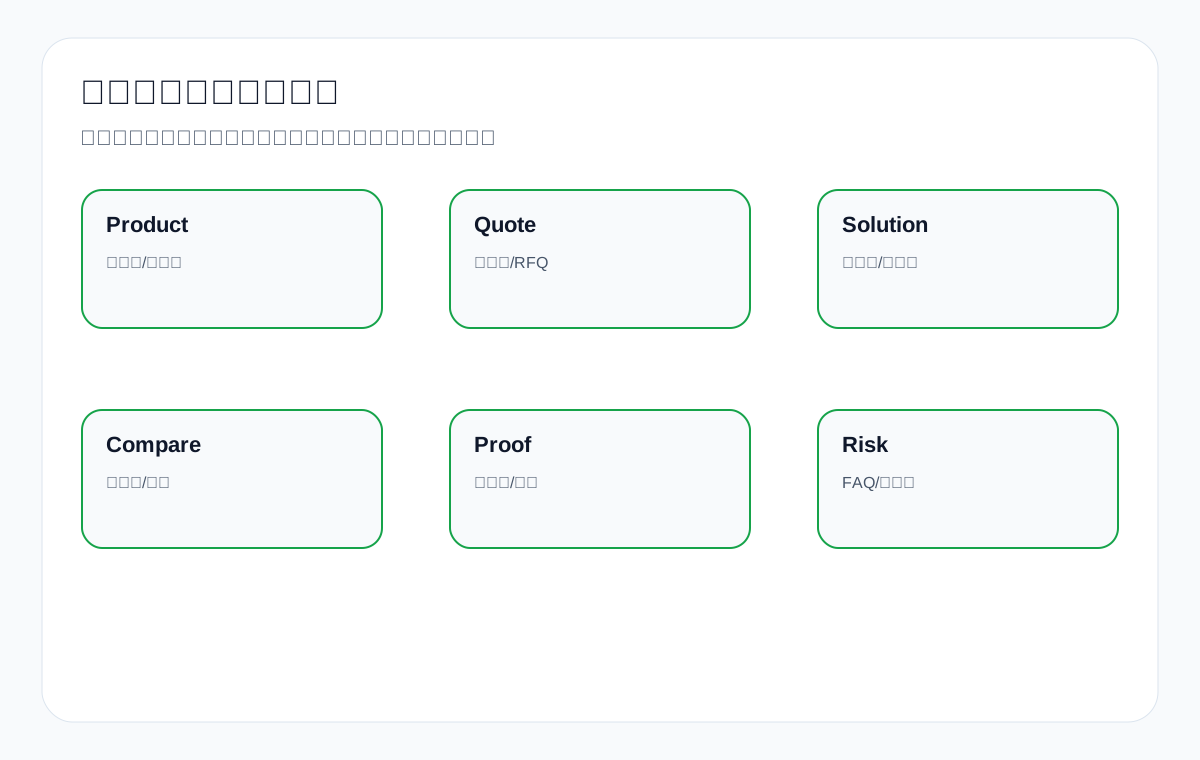
Export AI query set categories
| Category | English question example | Search intent | Hosting page |
|---|---|---|---|
| Product terms | What is an IP67 waterproof connector used for? | Understand the product definition and use | Category page, product page, article |
| Inquiry terms | How to get a custom cnc machining parts quote with drawings? | Prepare quote materials | Product page, inquiry page, RFQ guide |
| Solution terms | Which LED flood light is suitable for warehouse high ceilings? | Choose by application scenario | Application page, category page, product page |
| Comparison terms | Porcelain vs stoneware ceramic dinnerware for wholesale buyers | Compare materials and purchasing risks | Comparison article, category page |
| Resource terms | What certificates should an industrial valve supplier provide? | Verify the supplier and quality | Resource page, FAQ, product page |
| Risk terms | Private label activewear manufacturer MOQ and lead time risks | Assess cooperation risks | Process page, FAQ, inquiry page |
Start the query set small and precise. For one product line, choosing 20 to 50 questions is enough; don’t try to create thousands of terms at the outset. Each question needs an English phrasing, a Chinese explanation, an intent category, a target page, whether the current page exists, whether materials need to be added, and a review frequency.
4. Step two: record the AI answer baseline
Once the query set exists, don’t rush to revise content. First, use the fixed questions to sample across different AI search environments and record what the current answers say, whether they mention your website, whether they cite the official website, which competitors they cite, and what the answers lack. This process is called the answer baseline. It helps you judge: is the problem that the brand doesn’t exist, that the page isn’t cited, that the content evidence is insufficient, or that AI has misunderstood your product.
Answer baseline record table
| Field | What to record | Why it matters | Example |
|---|---|---|---|
| Question | A fixed English question | Ensures consistent before-and-after comparison | best waterproof connector supplier for outdoor LED lighting |
| Tool | ChatGPT, Gemini, Perplexity, AI Overviews, etc. | Results differ across environments | Recheck the same question in the same tool every month |
| Whether mentioned | Whether the brand or official website appears | Measures entity visibility | Keep not mentioned, brand mentioned, and official website cited as three separate states |
| Competitors | Which peers or platforms the answer mentions | Reveals trust and content gaps | Record competitor page types and evidence modules |
| Gaps | What the answer does not cover | Determines the direction for content reinforcement | Missing MOQ, lead time, certificate, application |
The answer baseline is not meant to prove “it already works,” but to avoid blind changes. For example, if AI answers cite only industry blogs, you lack citable explanations; if they cite only platform pages, your official website lacks authority and resources; if they mention competitor product pages, competitors are clearer on specifications and application notes; if they provide no suppliers at all, the question may be more educational, so you should add content evidence rather than just change the title.
5. Step three: map queries to pages instead of writing everything as articles
AI search optimization for export websites cannot rely on articles alone. Buyer questions come at different stages: the awareness stage needs explanations, the selection stage needs category pages and application pages, the quote stage needs product pages and inquiry pages, and the verification stage needs resource pages and certificate notes. Writing all questions as blog posts will break the purchasing path.
Query-to-page mapping rules
| Query intent | Not recommended | Recommended page | The page must answer |
|---|---|---|---|
| Definition and awareness | Writing only a company introduction | Article, definition at the start of a category page | What the product is, what it suits, and where its boundaries are |
| Selection judgment | Listing products only | Category page, application page | Model differences, scenario requirements, selection criteria |
| Quote preparation | Writing only Contact us | Product page, inquiry page | What materials are needed, MOQ, samples, lead time |
| Resource verification | Providing only a download button | Resource page, product page | What the certificate represents, applicable standards, and how to use it after download |
| Risk comparison | Writing only advantage slogans | FAQ, comparison page, process page | Common risks, judgment criteria, and how to reduce misunderstanding |
For example, “custom metal parts quote with drawing” should not be handled by a single tutorial. A tutorial can explain the quote process, but what should really host it is the CNC machining product page and inquiry page: which drawing formats are supported, how material and tolerance affect the quote, how surface treatment is chosen, how batch quantity affects unit price, and how soon feedback arrives after files are uploaded.
6. Step four: decide which type of page to revise first
Page priority can be judged on four dimensions: commercial value, current gaps, ease of change, and review visibility. The higher the commercial value, the thinner the current page, the easier the change, and the clearer the review, the more suitable it is to do first. Don’t put the first batch on the most complex site-wide structure; pick one product line and build a closed loop first.
Page priority scoring
| Dimension | High score | Low score | How to judge |
|---|---|---|---|
| Commercial value | High product profit, high inquiry quality, clear deal cycle | Low profit or no longer a sales focus | Ask sales and the boss, don’t just look at search volume |
| Clear demand | English questions are concentrated and customers ask them often | Questions are too broad and the purchasing action is weak | Look at GSC, email, WhatsApp, sales records |
| Content gaps | The page lacks specifications, FAQ, resources, scenarios | The page is already complete | Manually review the target page |
| Difficulty of change | You can add text, tables, diagrams, internal links | Requires system re-architecture or complex development | Prioritize publishable content revisions |
| Review visibility | GSC impressions, GA4 paths, inquiry fields | No tracking at all | Add basic tracking first, then evaluate |
For most export websites, the first batch should start with product lines that “have search demand but insufficient page evidence.” Products such as waterproof connector, packaging machine, industrial valve, and custom metal parts naturally have specifications, applications, resources, and inquiry fields, making them easy to turn into citable content.
7. Step five: add evidence modules first when revising content
Content revision for AI search optimization is not about making paragraphs more flowery; it is about filling in evidence modules. Evidence modules include: a definition paragraph, a specification table, a selection matrix, application scenarios, FAQ, resource notes, inquiry fields, risk notes, and internal link paths. Every module must answer a buyer question and also be extractable by AI systems.
Evidence module checklist
| Module | How to write it | Export example | Suitable page |
|---|---|---|---|
| Definition paragraph | Explain the product, use, and boundaries in one sentence | A medical probe cable assembly connects sensing components with stable signal transmission in diagnostic devices. | Article, category page, product page |
| Specification table | List key specifications as text | rated current, cable diameter, material, IP rating, temperature range | Product page, resource page |
| Selection matrix | Judge the model by scenario | Select warehouse LED flood light by installation height and illuminance | Category page, application page |
| FAQ | Answer real purchasing questions | Can I get samples before bulk order? | Product page, inquiry page, article |
| Resource notes | Explain certificates and downloadable files | pressure test certificate shows valve test medium and standard | Resource page, product page |
| RFQ fields | Tell the customer what to submit | drawing, material, tolerance, quantity, finish, target application | Inquiry page, product page |
Present these modules in text rather than pure images as much as possible. Images can aid understanding, but specifications, FAQ, certificate notes, and selection criteria should be in the HTML body copy. That way Google, AI answer systems, and readers can all read them.
8. Step six: build internal link paths so questions lead to inquiries
AI answers may cite articles first, but inquiries usually happen on product pages or contact pages. Therefore, every content revision should design internal links at the same time. Articles should link to category pages, product pages, application pages, and resource pages; category pages should link to key products and applications; product pages should link to resources and inquiries; resource pages should link to product pages and RFQ.
Content internal link paths
| Content starting point | Recommended next step | Anchor text example | Purpose |
|---|---|---|---|
| AI search tutorial | Product line pages | View the waterproof connector IP rating selection table | Direct awareness traffic to product judgment |
| Application scenario page | Recommended product pages | Compare warehouse LED flood light wattage and mounting options | Move from scenario into model selection |
| Product page | Resource pages and inquiry pages | Download the datasheet and submit a custom quote request | Let buyers complete verification and get in touch |
| FAQ | Related products and the quote guide | Prepare materials for a CNC machining parts drawing quote | Turn questions into action |
Anchor text should describe what the next step gets you; don’t just write “click here.” For example, “submit RFQ for custom metal parts with drawings” is clearer than “contact us”; “compare IP67 and IP68 waterproof connectors” helps AI understand the page relationship better than “products.”
9. Step seven: review with four types of metrics after publishing
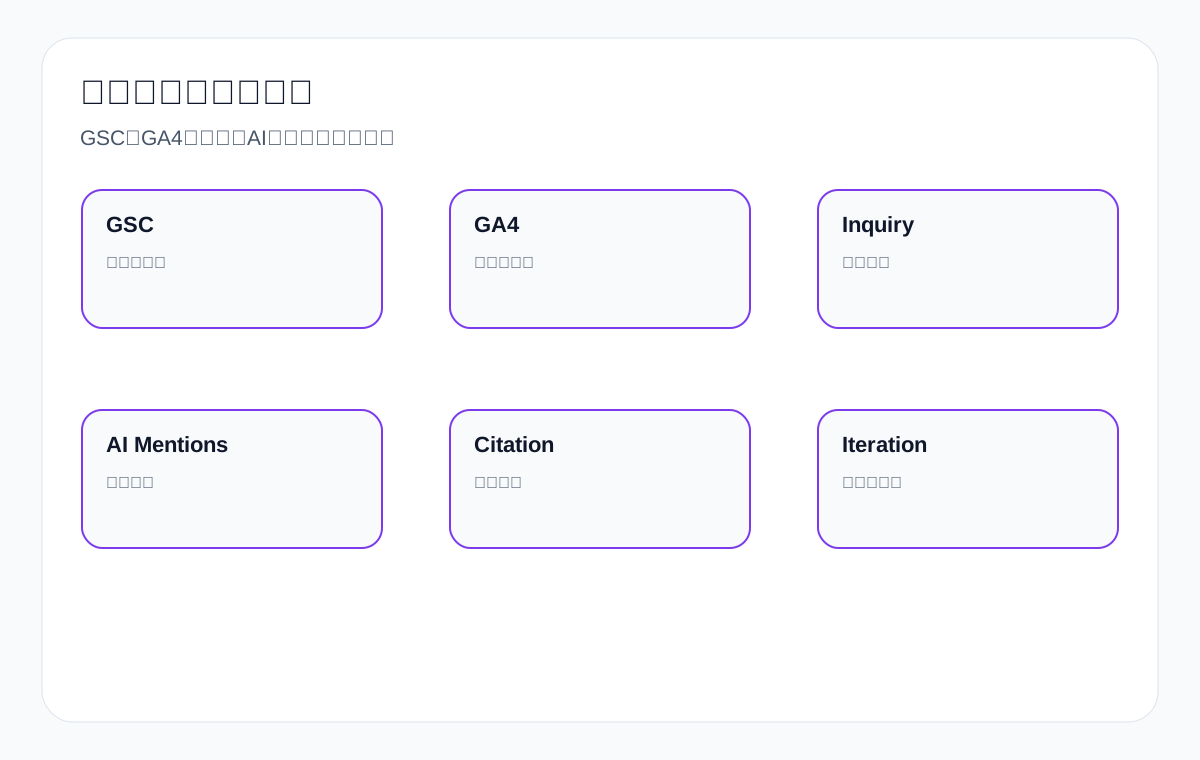
After AI search optimization is published, look at at least four types of metrics: GSC query terms, GA4 paths, inquiry sources, and AI answer sampling. Only by looking at all four together can you judge whether the content truly helps the export business. A single AI mention cannot prove long-term results; a rise in clicks on a single article does not mean inquiry quality has improved.
Post-publish review metrics
| Metric | What to observe | What it indicates | Cycle |
|---|---|---|---|
| GSC | Impressions, clicks, CTR, query terms, target pages | Whether Google is starting to understand the relevant products and questions | Look for discovery at 7-14 days, trends at 30-60 days |
| GA4 | Landing page, next page, form events, resource downloads | Whether users enter the product and inquiry path | Review paths weekly, conversions monthly |
| Inquiries | Source page, product line, requirement completeness, country and region | Whether it brings clearer purchasing requirements | Review with sales every month |
| AI answers | Brand mentions, official website citations, competitor co-occurrence, answer accuracy | Whether AI gradually understands and cites the official website | Sample the fixed question set monthly |
If GSC has impressions but no clicks, you may need to optimize the title and the above-the-fold answer; if articles get clicks but visitors don’t reach the product page, you may need to add internal links and CTAs; if AI mentions competitors but not you, you may need to analyze competitor evidence modules; if inquiry quality is low, the RFQ fields and page qualifying information may be insufficient.
10. 30-day startup plan: build a closed loop on a small scale
30-day AI search optimization startup plan
| Time | Task | Deliverable | Acceptance criteria |
|---|---|---|---|
| Days 1-3 | Choose the product line and business goal | Product line, country market, target customers, key inquiry types | The team agrees on which line to do first |
| Days 4-7 | Build the query set and answer baseline | 20-50 English questions, AI answer record table | Every question has an intent and a target page |
| Days 8-14 | Page mapping and gap audit | Page role table, content gap table, internal link gap table | Know which 5-10 pages to change first |
| Days 15-24 | Add evidence modules and internal links | Specification tables, FAQ, selection matrix, resource notes, RFQ fields | Pages are readable, crawlable, and quotable |
| Days 25-30 | Publish, recheck, and set up monitoring | GSC/GA4/inquiry/AI answer review table | Can judge trends after 30-60 days |
The point of this plan is the closed loop, not completing the entire site at once. Export businesses are better off validating one product line first and copying the method to other product lines once it works. For example, do waterproof connector first, then cable assembly; do packaging machine for powder first, then liquid filling machine.
11. How to start with different team resources
Resource allocation suggestions
| Team situation | Suggested starting point | What not to do first | Reason |
|---|---|---|---|
| Only the boss and export salespeople | Organize frequently asked customer questions and product materials | Don’t chase complex tools first | Real purchasing questions matter more than a tool dashboard |
| Has a website editor | Revise core product pages and FAQ first | Don’t publish only generic educational articles | Product evidence is the foundation for AI citations |
| Has technical staff | Check crawlability, indexing, structured data, and speed | Don’t only change the front-end appearance | Both AI and search need accessible content |
| Has sales data | Work backward from inquiry questions to content modules | Don’t look only at search volume | Inquiry quality can prove commercial value |
| Has a multilingual site | First unify the English main site’s entity and product lines | Don’t let each language version say different things | Entity consistency affects machine understanding |
The fewer resources you have, the more you should start from real customer questions. Organizing the questions your salespeople answer every day into an English FAQ and then mapping them to product pages and application pages is usually more effective than blindly chasing trends.
12. Three export product line examples: how to land the startup process on pages
To keep AI search optimization from staying at the conceptual level, here are three common export product lines. Each example follows the order of “query set, answer baseline, page mapping, content evidence, review metrics.” You can treat it as a checklist for internal discussion, but the final page wording should face overseas buyers rather than read like an internal execution record.
Example 1: waterproof connector product line
If a company sells waterproof connectors, the first batch of queries can center on outdoor LED lighting, marine equipment, solar system, industrial control cabinet, IP67 vs IP68, cable diameter, rated current, and custom pin layout. The answer baseline should check whether AI can explain the selection dimensions for waterproof connectors, whether it mentions competitor or platform pages, and whether it cites certain encyclopedias or distributor materials.
waterproof connector startup checklist
| Stage | Actions to take | Page destination | Verifiable output |
|---|---|---|---|
| Query set | Organize IP rating, cable diameter, current, application scenario, and quote questions | Product category page, application page, FAQ | 20-30 English questions |
| Answer baseline | Record AI answers about IP67/IP68 and outdoor lighting connectors | Answer baseline table | Competitors, citation sources, gaps |
| Page mapping | Route selection questions to the category page and quote questions to the product page/inquiry page | Category page, product page, inquiry page | Every question has a hosting URL |
| Content evidence | Add an IP rating table, current table, material notes, and installation environment FAQ | Category page, product page, resource page | Specifications are readable as text |
| Review | Look at GSC solution terms, product page paths, and RFQ field completeness | GSC/GA4/inquiry table | Record trends monthly |
The most common mistake in this product line is saying only “waterproof, durable, high quality” without writing the IP rating, cable diameter, current, material, connection method, temperature, and application boundaries. What AI systems need is quotable selection logic; what buyers need is specification information they can use in an inquiry.
Example 2: packaging machine product line
If a company sells packaging machines, the query set cannot center only on packaging machine supplier; it must also break down into powder filling machine, granule packing machine, liquid packaging machine, automatic pouch packing, capacity calculation, material compatibility, cleaning requirement, after-sales support, and similar questions. AI answers often emphasize equipment type and application, but export company websites need to fill in capacity, materials, bag type, precision, cleaning, lead time, and after-sales materials.
packaging machine startup checklist
| Stage | Actions to take | Page destination | Verifiable output |
|---|---|---|---|
| Query set | Break questions down by material, packaging format, speed, and degree of automation | Application page, category page | Questions cover powder, granules, liquid, and bag types |
| Answer baseline | Record which equipment types and judgment dimensions AI answers use | Answer baseline table | Identify missing capacity and material questions |
| Page mapping | Route material questions to the application page, quote questions to the inquiry page, and specification questions to the product page | Application page, product page, RFQ page | Each type of question has a next-step path |
| Content evidence | Add capacity calculations, applicable materials, bag types, and cleaning and maintenance FAQ | Application page, resource page | Tables and FAQ can be cited directly |
| Review | Look at solution term impressions, resource downloads, and equipment inquiry fields | GSC/GA4/inquiry table | Judge whether inquiries are more specific |
Packaging machinery pages should place special emphasis on application scenarios, because buyers are usually not there to read concepts but to judge “can my material be packaged, is the speed sufficient, are the bag types supported, and are cleaning and maintenance troublesome.” If these questions are not answered on the page, AI answers will find it hard to treat the official website as a useful source.
Example 3: private label activewear manufacturer product line
The starting point of AI search optimization for apparel export websites should center on private label activewear manufacturer, custom sportswear MOQ, fabric options, size chart, logo printing, sample lead time, bulk production, quality inspection, and packaging. The answer baseline should check whether AI tends to cite platforms, directory sites, apparel knowledge articles, or specific manufacturer pages.
private label activewear startup checklist
| Stage | Actions to take | Page destination | Verifiable output |
|---|---|---|---|
| Query set | Break questions down by fabric, fit, logo, sizing, MOQ, sampling, and packaging | Customization process page, product page, FAQ | Cover the buyer’s path from sample to bulk |
| Answer baseline | Record how AI explains the private label cooperation process | Answer baseline table | Find out whether competitors explain MOQ and lead time |
| Page mapping | Route process questions to the customization page, product questions to the collection page, and risk questions to the FAQ | Customization page, category page, FAQ | The path from question to inquiry is clear |
| Content evidence | Add a fabric table, size chart, craft table, sampling process, and QC checklist | Product page, resource page | Customers can judge the fit |
| Review | Check whether inquiries include fabric, quantity, logo, and target market information | Inquiry table and sales feedback | Whether inquiry quality improves |
Apparel pages are most easily written as “we support OEM/ODM, good quality, fast lead time.” A stronger approach is to break down fabric, fit, sizing, logo craft, sample confirmation, packaging, QC, and bulk production milestones clearly. Only then can AI answers understand which purchasing scenarios you can support, and buyers can more easily submit complete requirements.
13. Page revision priority: let gaps decide the action
Once the query set and page mapping are complete, the team will have many pages to change. At this point, don’t spread effort evenly; let gaps decide the action. Some pages only need FAQ and internal links added, some need the above-the-fold section and specification table rewritten, and some are actually not suitable for further expansion and should instead be merged into a category page or turned into a resource page.
Gap-to-action decision table
| Gap found | Priority action | Not recommended | Acceptance criteria |
|---|---|---|---|
| AI answer lacks a definition | Add a clear definition sentence at the start of the category page and the article | Write a long brand introduction | One sentence explains the product, use, and boundaries |
| AI answer lacks specifications | Add a specification table and resource notes to the product page | Only change the title | Key specifications are text and readable |
| Buyers ask about applications | Create or improve the application page | Cram everything into the product page | Scenarios, selection criteria, recommended products, and risks are clear |
| Inquiries are incomplete | Change the inquiry page fields and the RFQ notes on the product page | Only add a contact button | Customers know what materials to provide |
| Competitors are cited | Break down competitor page structure and evidence modules, and fill your own gaps | Copy competitor wording | Provide more product facts and purchasing judgment than competitors |
| Pages compete for the same terms | Re-map intent and internal links, and merge when necessary | Keep expanding every page | Each query has only one primary hosting page |
This decision table avoids the mistake of “writing a long article on every page.” Long articles suit technical tutorials, methodologies, diagnostic guides, and complex selection questions; product pages and inquiry pages need high-density evidence and a conversion path; contact pages, pure navigation pages, and archive pages should not be stuffed with words.
14. Pre-publish checklist: avoid content that looks long but has no value
Before publishing AI search optimization content, run a quality check. The focus is not whether the sentences are flowery, but whether the content faces export buyers, whether it contains English product terms, whether it has tables and FAQ, whether it has review metrics, and whether it avoids uncontrollable promises and internal tone.
Pre-publish quality checklist
| Check item | Pass standard | Fail symptom | How to handle |
|---|---|---|---|
| Export perspective | Aimed at export manufacturers, trading companies, and overseas buyers | Heavy use of examples from your own industry | Replace with English product terms and purchasing scenarios |
| Product terms | Specific English product, application, and inquiry terms appear | Only generic Chinese terms or abstract concepts | Add terms such as custom, quote, MOQ, lead time |
| Structure | H2/H3, tables, lists, and FAQ are clear | Long blocks of text with no judgment criteria | Break into steps, matrices, and FAQ |
| Evidence | Specifications, resources, applications, risks, and RFQ information are complete | Only advantage slogans | Add facts and boundaries |
| Promises | No guaranteed rankings, guaranteed citations, or guaranteed inquiry promises | Using guarantee-style wording | Change to probability improvement and review observation |
| Review | Includes GSC, GA4, inquiry, and AI answer metrics | No way to measure after publishing | Add a review table and cycle |
If an article is very long but has no tables, no purchasing scenarios, no specific English product terms, no FAQ, and no next-step page path, it is still not strong content. Strong content should let the boss, salespeople, editors, buyers, and search systems all understand it: what question does this page answer, why is it credible, and what should the reader do next.
15. How to turn sales questions into AI search content assets
Many export businesses do not lack content material; what they lack is turning the questions sales answers every day into page assets. The questions salespeople answer repeatedly in emails, WhatsApp, trade shows, and video calls are often exactly the AI search questions best suited to the query set. For example, when customers ask “Can you quote based on STEP drawings?”, “What is your MOQ for custom logo ceramic dinnerware?”, or “Can this LED flood light work in a dusty warehouse?”, these questions should all be organized into product pages, application pages, or FAQ.
Sales question to content asset table
| Common sales question | Corresponding AI query | Where to add it | Content asset format |
|---|---|---|---|
| Customer asks whether you can quote from drawings | custom cnc machining parts quote with STEP drawing | Product page, inquiry page | RFQ fields, drawing format notes, quote material checklist |
| Customer asks how to choose a warehouse light | LED flood light for warehouse high ceiling | Application page, category page | Installation height selection table, illuminance notes, FAQ |
| Customer asks about the MOQ for ceramic dinnerware | custom ceramic dinnerware MOQ for wholesale | Product page, FAQ | MOQ notes, packaging options, logo customization conditions |
| Customer asks about valve certificates | industrial valve pressure test certificate | Resource page, product page | Certificate notes, test standards, download entry point |
| Customer asks about the activewear sampling cycle | private label activewear sample lead time | Customization process page, inquiry page | Sampling process, fabric confirmation, production milestone table |
The benefit of this method is that it never drifts away from the business. Search tools can tell you the direction of demand, while sales questions can tell you what buyers are genuinely worried about. Combine the two, and you get content that both suits AI understanding and helps real inquiries. Every sales question can be broken into four parts: the customer’s own words, the English query phrasing, the target page, and the evidence module that needs to be added.
For new sites with little GSC data, this step is especially important. A new site cannot wait until data is sufficient to act; it can first build a first version of the query set from sales questions, competitor pages, industry materials, and the AI answer baseline. Once Google Search Console starts showing impressions and clicks, use the real query terms to correct titles, FAQ, internal links, and page focus.
16. Common post-publish signals: how to decide what to change next
Post-publish review is not simply checking whether traffic went up. Different signals call for different actions. For example, GSC having impressions but no clicks suggests the title and description may be weak; having clicks but no conversions suggests internal links and the page path may be weak; AI answers mentioning competitors but not you suggests the entity and evidence may be weak; having many inquiries but low quality suggests page qualification and RFQ fields may be weak.
Review signals and next actions
| Signal | Possible cause | Next action | Don’t misjudge as |
|---|---|---|---|
| Impressions grow but clicks are low | The title isn’t specific enough or search intent doesn’t match | Optimize the title, above-the-fold answer, and meta description | The content failed completely |
| Clicks grow but there are no inquiries | The product page and inquiry path are weak | Add internal links, CTA, RFQ fields, and resource downloads | The traffic has no value |
| AI mentions competitors but not you | Competitor evidence is more complete or their entity is stronger | Add specifications, certificates, resource pages, and About page consistency | The AI tool is inaccurate |
| Inquiry quality is low | The page has no qualifying criteria | Add MOQ, application boundaries, file requirements, and target market fields | The keyword direction is wrong |
| The product page is visited but the bounce rate is high | Specifications or scenarios are unclear | Add a selection table, FAQ, application diagrams, and related products | The page doesn’t need optimization |
This step determines how the second round is done. Don’t write new articles every time; often it is more appropriate to change product pages, category pages, resource pages, or inquiry pages. What really makes export AI search optimization effective is connecting content, product evidence, and the inquiry path into one closed loop.
17. Common pitfalls: these ways of starting easily go off track
Buying a monitoring tool first, then thinking about content
Tools can help record AI mentions and citations, but they cannot replace the query set, page evidence, and product materials. Without a content foundation, a tool can only tell you that “you are currently invisible.”
Writing many generic articles first
Generic articles easily cover concepts but cannot answer purchasing judgment. Export websites must ground content in product terms, application scenarios, specifications, resources, and inquiry fields.
Treating AI search optimization as a one-off project
AI answers, search demand, and competitor content all change. A more reasonable approach is to set up a monthly review and treat content iteration as long-term asset building.
Focusing only on brand-name questions
Buyers ask more about products and solutions, and not necessarily about brands directly. Look at non-brand questions such as waterproof connector supplier, custom metal parts quote, and LED flood light for warehouse.
Mistaking platform results for the startup goal
AI answers are not controlled by a single website. You can increase the probability that content is discovered, understood, cited, and verified, but you cannot write platform results as certain results.
Ignoring product pages and inquiry pages
If articles can be cited by AI but product pages and inquiry pages cannot host the follow-through, it is still hard to generate valid inquiries in the end.
18. FAQ: common questions about starting AI search optimization
What exactly is the first step of AI search optimization?
The first step is to build an English query set aimed at buyers and record the current AI answer baseline. Without a query set and baseline, it is very hard to judge which pages to change.
Should I revise articles or product pages first?
It depends on the query intent. If the question is about definitions and methods, you can revise articles first; if the question involves specifications, quotes, MOQ, lead time, and certifications, prioritize product pages, resource pages, and inquiry pages.
Can I start without an AI monitoring tool?
Yes. First use a fixed question set to manually sample and record AI answers, while reviewing with GSC, GA4, and inquiry data. Tools can improve efficiency, but they are not a precondition for starting.
What if a new export site has no GSC data?
First build a first version of the query set from product materials, sales questions, competitor pages, and the AI answer baseline. Once GSC has impressions, use the real query terms to correct the direction.
How long should content be to suit AI search?
Length is not the only standard. Technical long-form content can reach 12,000 words or more, but it must have information gain: tables, steps, judgment criteria, FAQ, review metrics, and product evidence—not vague padding.
Is structured data mandatory?
Structured data helps, but it must be consistent with the visible content on the page. First write the body copy, specification tables, FAQ, and resource notes clearly, then consider markup such as Product, FAQ, Breadcrumb, and Organization.
How long until results appear?
Usually, look first at whether it is discovered and indexed within 7-14 days, then at changes in query terms, clicks, paths, and inquiry quality over 30-60 days. AI answer citations are more volatile, so observe them long-term with a fixed question set.
Will AI search optimization conflict with traditional SEO?
No. Crawlable content, clear titles, internal links, structured information, authoritative evidence, FAQ, and user value generally benefit both traditional search and AI answer understanding at the same time.
19. Startup checklist for export businesses
- Pick one high-value product line; don’t do the entire site at once.
- Organize 20-50 English purchasing questions covering products, inquiries, solutions, comparisons, resources, and risks.
- Sample the fixed questions across AI search environments and record answers, competitors, mentions, and citations.
- Map each question to a category page, product page, application page, resource page, FAQ, or inquiry page.
- Prioritize adding specification tables, selection matrices, FAQ, resource notes, RFQ fields, and internal link paths.
- Before publishing, check for restricted words, uncontrollable promises, English export product terms, tables, diagrams, and FAQ.
- After publishing, look at GSC, GA4, inquiry sources, AI mentions, official website citations, and competitor co-occurrence.
- After 30-60 days, add titles, FAQ, internal links, resource pages, or new pages based on the data.
In one sentence: the starting point of AI search optimization is not “revise content right away,” but “first figure out how buyers ask, how AI answers now, and which type of page on the website should host the answer.” Once the query set, answer baseline, page mapping, and review metrics are in place, content revision will not become guessing-based word padding, but a long-term reusable growth asset for the export website.
{
“@context”: “https://schema.org”,
“@type”: “FAQPage”,
“mainEntity”: [
{
“@type”: “Question”,
“name”: “What exactly is the first step of AI search optimization?”,
“acceptedAnswer”: {
“@type”: “Answer”,
“text”: “The first step is to build an English query set aimed at buyers and record the current AI answer baseline. Without a query set and baseline, it is very hard to judge which pages to change.”
}
},
{
“@type”: “Question”,
“name”: “Should I revise articles or product pages first?”,
“acceptedAnswer”: {
“@type”: “Answer”,
“text”: “It depends on the query intent. If the question is about definitions and methods, you can revise articles first; if the question involves specifications, quotes, MOQ, lead time, and certifications, prioritize product pages, resource pages, and inquiry pages.”
}
},
{
“@type”: “Question”,
“name”: “Can I start without an AI monitoring tool?”,
“acceptedAnswer”: {
“@type”: “Answer”,
“text”: “Yes. First use a fixed question set to manually sample and record AI answers, while reviewing with GSC, GA4, and inquiry data. Tools can improve efficiency, but they are not a precondition for starting.”
}
},
{
“@type”: “Question”,
“name”: “What if a new export site has no GSC data?”,
“acceptedAnswer”: {
“@type”: “Answer”,
“text”: “First build a first version of the query set from product materials, sales questions, competitor pages, and the AI answer baseline. Once GSC has impressions, use the real query terms to correct the direction.”
}
},
{
“@type”: “Question”,
“name”: “How long should content be to suit AI search?”,
“acceptedAnswer”: {
“@type”: “Answer”,
“text”: “Length is not the only standard. Technical long-form content can reach 12,000 words or more, but it must have information gain: tables, steps, judgment criteria, FAQ, review metrics, and product evidence—not vague padding.”
}
}
]
}
Continue reading this GEO series
If you are systematically learning about GEO and AI search visibility, we suggest continuing with the following articles. Understand the concepts first, then move on to diagnostics, monitoring, content structure, and cooperation boundaries.
- How to choose an AI search visibility service team: a capability checklist for export businesses evaluating GEO partners
- How to build B2B export AI search visibility: a guide to getting inquiry terms and solution terms into AI answers
- How to do GEO: what to change first, from page structure to citation probability
- What is Schema structured data: which types export websites should add in SEO and AI search
- How to build Shopify AI search visibility: a guide to optimizing collection pages, product pages, and AI understanding
- How to build WooCommerce AI search visibility: a guide to optimizing category pages, product pages, and Schema
This page is machine-translated from the Simplified Chinese version and awaiting human review. It has not yet been proofread.