Many foreign-trade companies build English independent sites on Shopify and then treat optimization as “installing a few SEO apps, editing titles, and writing product descriptions.” Those actions help, but they are far from enough. The core of Shopify Google acquisition optimization is not a single button; it is making sure both search engines and buyers clearly understand: what products you sell, which pages carry sourcing terms, which pages explain selection questions, whether product data is credible, whether mobile experience is smooth, and whether the inquiry entry point makes buyers willing to get in touch.
This article is for Chinese export manufacturers, factories, and trading companies. Rather than writing Shopify SEO as a generic feature introduction, we break it down along the foreign-trade acquisition chain: collection pages carry product family and supplier terms, product pages carry model and specification terms, application pages carry industry scenario terms, articles carry selection and comparison questions, structured data helps Google understand products, speed and mobile experience affect the sourcing experience, and finally GSC, GA4, Merchant Center, inquiry sources, and AI citations are used to review results. Examples use foreign-trade English product terms such as custom metal parts, LED flood light, packaging machine, medical probe, cnc machining parts, ceramic dinnerware, waterproof connector, industrial valve supplier, and private label activewear manufacturer.
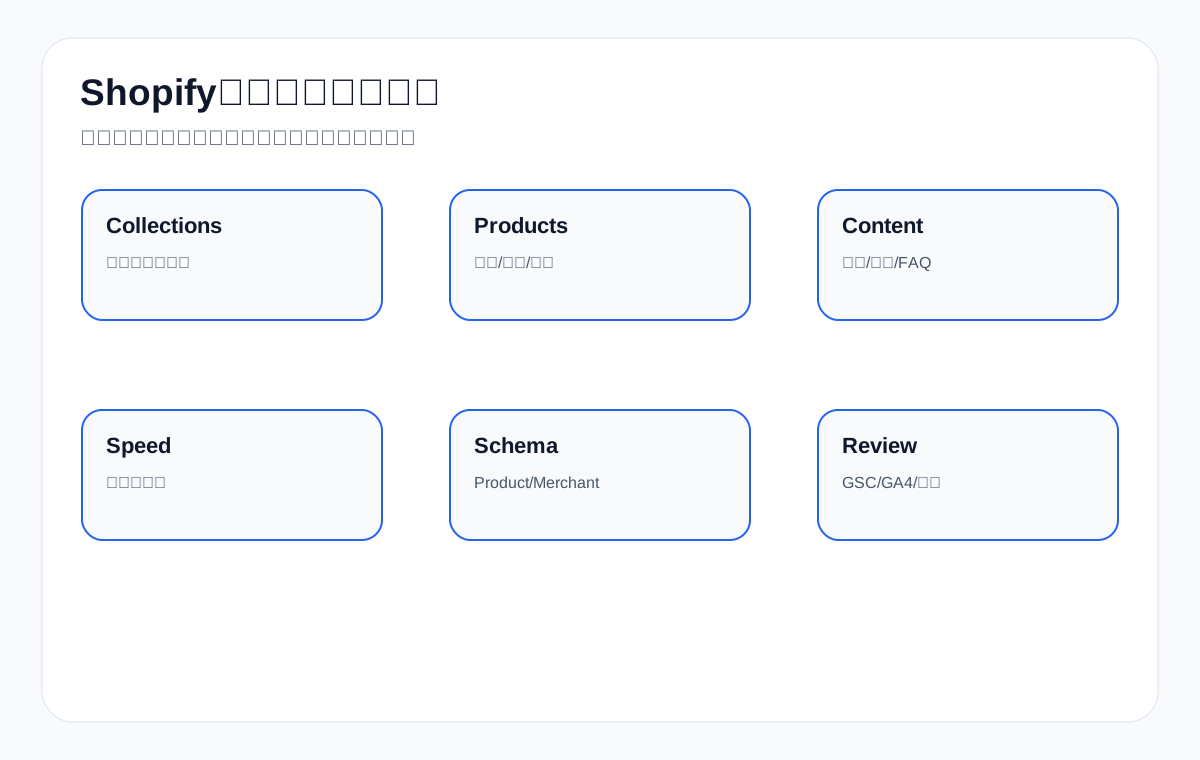
Official acceptance boundaries: Shopify Google foreign-trade acquisition optimization must separate platform capabilities, Google eligibility, and the inquiry path
Shopify can provide product pages, collection pages, images, URLs, sitemaps, robots, themes, and app capabilities, but it will not automatically complete foreign-trade acquisition. Google will not automatically understand your products, sourcing boundaries, and inquiry value just because a page runs on Shopify. A qualified Shopify Google foreign-trade acquisition optimization effort needs to be accepted item by item: platform settings, product data, page content, structured data, speed, GSC, GA4, Merchant Center, and sales feedback.
For foreign-trade product terms such as custom metal parts, LED flood light, packaging machine, medical probe, cnc machining parts, and industrial valve supplier, pages must first answer whether a buyer can judge whether the product matches, and only then discuss search and AI visibility. The division of labor among collection pages, product pages, application pages, FAQs, resource pages, and inquiry pages matters more than installing a particular SEO app.
Official documentation and Shopify foreign-trade acquisition field mapping table
| Official documentation | What it can be used to validate | What it cannot directly prove |
|---|---|---|
| Shopify Help: Improving SEO | Shopify titles, descriptions, image alt text, site structure, and basic SEO capabilities | Does not mean a page will automatically gain external search performance |
| Shopify Developers: SEO for themes | Theme-level SEO, structure, meta, canonical, and discoverability | Does not replace business page content design |
| Shopify Developers: Theme performance best practices | Theme performance, resource loading, mobile experience, and app impact | Cannot judge acquisition quality by speed score alone |
| Google Search Central: SEO Starter Guide | Titles, content, links, images, and basic page optimization | Cannot imply that a particular collection page will get a fixed search position |
| Google Search Central: Search Essentials | Crawling, indexing, content, and spam boundaries | Does not replace URL-level diagnostics |
| Search Console Help: Performance report | query, page, country, device, clicks, impressions, CTR, position | Do not fabricate trends from pages with no row data |
| Search Console Help: URL Inspection tool | Whether priority collection pages and product pages are crawlable, indexable, and load resources correctly | Does not replace long-term query performance |
| Google Search Central: Sitemaps overview | Whether priority URLs are included in the sitemap and easy to discover | Does not mean a page will get clicks or inquiries |
| Google Search Central: robots.txt introduction | Whether robots rules block crawling of important pages | Does not replace content and indexing checks |
| Google Search Central: Consolidate duplicate URLs | Whether multiple product paths, collection paths, and canonicals are clear | Does not replace page role division |
| Google Search Central: Product structured data | Product fields such as price, availability, reviews, and shipping on product pages | Cannot use structured data to make up for a vague product page |
| Google Search Central: Structured data general guidelines | Whether structured data meets the general guidelines | Does not mean rich results will definitely appear |
| Google Merchant Center Help: Product data specification | Product titles, descriptions, images, price, availability, and product data consistency | Does not replace visible page content |
| Google Search Central: Page experience | Page experience, mobile, Core Web Vitals, and usability direction | Do not look only at scores and ignore the sourcing path |
| Google Analytics Help: About events | On-site events such as product page navigation, forms, RFQs, downloads, and email clicks | Does not replace Search Console query data |
| Google Search Central: AI features and your website | The basic relationship between page content, preview controls, and AI features | Cannot imply how external AI answers will present results |
| OpenAI Platform: Bots | OpenAI-related crawler access rules and log identification entry points | Does not replace Google and on-site data |
Shopify Google foreign-trade acquisition acceptance criteria: validate the page system first, then the inquiry path
| Module | Verifiable fields | Delivery boundary |
|---|---|---|
| Collection page | Product family terms, supplier/manufacturer terms, filter rules, internal links, sitemap, canonical | Deliver page structure and fields; do not promise search positions |
| Product page | Title, specifications, image alt text, variants, Product structured data, FAQ, RFQ entry point | Deliver information for sourcing decisions; do not promise inquiry volume |
| Application page/guide page | Scenario terms, applicability boundaries, selection tables, related products, resource downloads | Deliver content paths; does not replace sales feedback |
| Speed and apps | LCP, INP, CLS, mobile layout, third-party scripts, form usability | Deliver experience issues and optimization actions; do not treat scores as results |
| Product data | Visible page content, structured data, Merchant Center feed, price or inquiry explanation | Deliver consistency checks; do not promise rich result display |
| Review | GSC query/page, GA4 events, Merchant Center issues, inquiry quality, and sales feedback | With data, report data; without data, report baselines and items to watch |
How to downgrade Shopify foreign-trade acquisition conclusions when there is no GSC data
If the site currently has no usable GSC query/page row data, the Shopify optimization report can only state a baseline: whether priority collection and product pages are index/follow, whether they are included in the sitemap, whether robots blocks them, whether canonicals are clear, whether Product structured data matches the page content, and whether GA4 can record RFQ, download, contact, and product page navigation events. It cannot claim click growth, ranking changes, external AI answer presentation, inquiry improvement, or sourcing conversion.
A qualified deliverable should be written as a page system: which collection pages carry product family terms, which product pages carry model terms, which application pages carry scenario terms, which FAQs and resource pages support sourcing decisions, and which form fields help sales judge lead quality. Only then is Shopify not just a single site-building tool but a reviewable foreign-trade acquisition page system.
1. Conclusion first: Shopify Google foreign-trade acquisition optimization covers six layers
Shopify itself has some basic SEO capabilities, such as editable titles, descriptions, URLs, image alt text, sitemaps, robots, and collection and product page structures. But these basic capabilities cannot automatically solve a foreign-trade company’s acquisition problem. What really needs to be done is to align Shopify’s page system with buyer search intent: collection pages answer “what products and supply capabilities are available,” product pages answer “is this model right for me,” application pages answer “how should I choose for my scenario,” articles answer “how do I judge before sourcing,” the technical layer ensures crawling, speed, structured data, and indexing, and the review layer judges whether visits bring valid inquiries.
Shopify foreign-trade acquisition optimization scope table
| Layer | Main tasks | Foreign-trade English example | Optimization focus |
|---|---|---|---|
| Collection page | Carry product family, supplier, manufacturer, wholesale, and application category terms | LED flood light supplier | Title, category description, filter controls, internal links, FAQ |
| Product page | Carry model, specification, material, color, size, and certification terms | M12 waterproof connector IP67 | Unique description, specification table, images, variants, Product structured data |
| Application/industry page | Carry “for” scenarios, industry solutions, and selection questions | packaging machine for food factory | Scenario pain points, selection tables, product recommendations, inquiry entry point |
| Article/guide | Carry how to, what is, vs, and checklist queries | how to choose cnc machining parts supplier | Decision criteria, misconceptions, FAQ, internal links to collection and product pages |
| Resource page | Carry catalog, datasheet, manual, and standard queries | medical probe datasheet | Downloadable resources, specification notes, scope of application |
| Inquiry page | Carry quote, sample, custom, and OEM queries | custom metal parts quote | Form fields, sample lead time, MOQ, communication information |
For example, a factory that makes LED flood lights cannot just upload products one by one to Shopify. It needs at least a collection page targeting LED flood light supplier or outdoor LED flood light; product pages explaining wattage, color temperature, IP rating, certification, and application environment; an article explaining how to choose LED flood light for warehouse; application pages covering scenarios such as factories, sports courts, and parking lots; and it must make product data, images, speed, and the inquiry entry point work together.
2. What the top-ranking/authoritative baselines provide, and what foreign-trade Shopify sites still lack
Current Shopify official SEO help documentation and the Shopify 2026 SEO checklist cover many basic actions: optimizing product page titles, descriptions, images, structured data, site structure, menus, file names, internal links, sitemap, robots, and search engine discoverability. Google Search Central’s Product structured data documentation emphasizes that product pages can provide price, availability, reviews, and shipping information through Product or merchant listing markup, and that Merchant Center feeds and page structured data can complement each other. These are all authoritative baselines that must be referenced.
But this material is generally aimed at global ecommerce sellers, and it will not break down the B2B export scenario for Chinese foreign-trade manufacturers: how collection pages and product pages should divide the work, where supplier terms and manufacturer terms should live, how to avoid thin content when there are many SKUs but each product description is similar, how to write Product data when the goal is an inquiry rather than a direct order, how to look at Google Search Console queries together with real RFQ quality, and what extractable information AI search citations need. These are the gaps this article is meant to fill.
3. Shopify page roles: do not cram every keyword onto product pages
The most common problem on foreign-trade Shopify sites is cramming every keyword they hope to rank for onto product pages. For retail sites, product pages matter a lot; but for B2B export manufacturers, many sourcing terms fit collection pages, application pages, or resource pages better. For example, industrial valve supplier is more like a collection/commercial page, stainless steel ball valve is more like a category or product page, valve for chemical plant is more like an application page, how to choose valve material is more like an article, and valve catalog is more like a resource page.
Shopify page role matrix
| Search intent | Recommended page | English example | What the page needs to answer |
|---|---|---|---|
| Product family term | Collection page | industrial valve supplier | Explain product range, materials, standards, applications, and sourcing boundaries |
| Specification term | Product page | 100W LED flood light IP65 | Add specifications, certifications, installation, images, and FAQs |
| Application term | Application page/collection page | waterproof connector for outdoor lighting | Explain the scenario, risks, and recommended product lines |
| Comparison term | Article/guide | ceramic vs porcelain dinnerware | Use tables to help buyers decide |
| Customization term | Service/inquiry page | custom metal parts OEM | Explain drawings, materials, processes, inspection, and the sampling workflow |
| Resource term | Resource page/product page | medical probe datasheet | Provide specifications, compatible devices, and a download entry point |
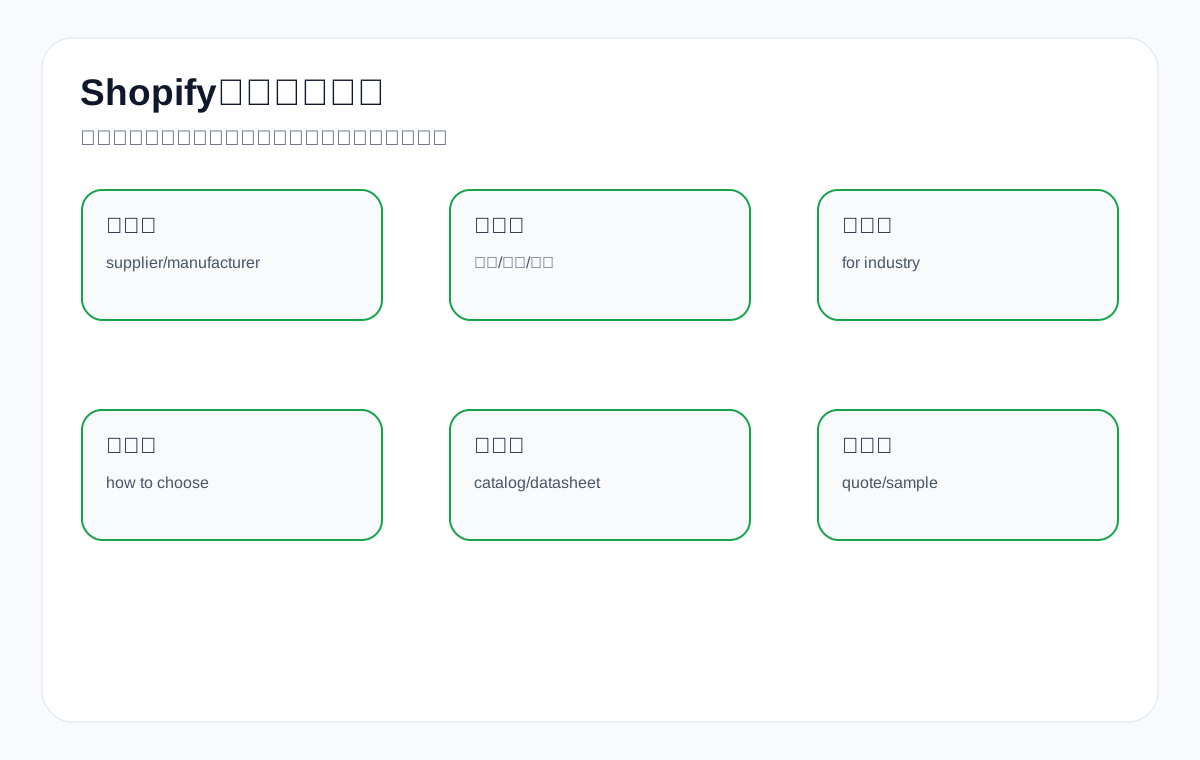
Take waterproof connector as an example: waterproof connector supplier should not be carried by a single product page; M12 waterproof connector IP67 suits a specific product page; waterproof connector for outdoor lighting suits an application page; how to choose waterproof connector suits an article; waterproof connector datasheet suits a resource page; and custom waterproof cable connector quote suits an inquiry page. The clearer the page roles, the easier it is for search engines to understand the site structure and for buyers to find the next step.
4. How to build collection pages: the core entry point for Shopify foreign-trade acquisition
Shopify collection pages are often treated by foreign-trade companies as product lists, but in Google acquisition, collection pages are often the core entry point for product family, supplier, manufacturer, wholesale, application category, and commercial investigation terms. A collection page cannot consist only of product cards; it needs a clear title, a short but informative introduction, product categorization logic, filter controls, internal links, sourcing questions, selection tables, and entry points to related products.
For example, a collection page for private label activewear manufacturer should not just show product cards for leggings, sports bras, and shorts. It should also explain customizable fabrics, size ranges, MOQ, sampling lead time, production capacity, labeling and packaging, and whether it serves brand clients or wholesale clients; it should also link to sub-collections or product pages such as yoga leggings manufacturer, custom sports bra, and seamless activewear supplier. Only then does the collection page feel like a sourcing entry point rather than an ordinary product list.
Shopify collection page optimization checklist
| Module | What to do | Criteria |
|---|---|---|
| Title and H1 | Include the product family and commercial intent | Makes clear this is a supply/manufacturer/wholesale/category entry point |
| Above-the-fold description | Use brief text to explain the product range and sourcing value | Buyers know within 30 seconds whether it matches |
| Filters and sorting | Keep useful filters and control low-value parameter URLs | Does not create a large number of worthless indexed pages |
| Category description | Add information on materials, specifications, applications, certifications, MOQ, and more | Not just product cards |
| Internal links | Link to product pages, application pages, guides, and the inquiry page | Forms a path from learning to requesting a quote |
| FAQ | Answer questions on lead time, customization, samples, certification, and packaging | Reduces buyer concerns |
5. How to build product pages: not long descriptions, but enabling buyers to judge
The job of a Shopify product page is to let search engines understand the product and let buyers judge whether it is worth an inquiry. The problem with many foreign-trade product pages is not a lack of words but a lack of sourcing decision information. Writing only “high quality, competitive price, fast delivery” helps neither Google nor buyers. A product page should include model, specifications, material, size, color, certification, application, packaging, MOQ, samples, lead time, customizable range, images, video, FAQ, and related products.
Take medical probe as an example: the product page should explain compatible devices, materials, connectors, sensor type, sterilization method, operating temperature, packaging, certification or testing requirements, and whether OEM is supported. Take ceramic dinnerware as an example: the product page should explain material, glaze, size, restaurant/hotel/retail use, microwave/dishwasher suitability, packaging, minimum order quantity, and custom patterns. Shopify’s product fields are only where information lives; the real key is whether the information supports a sourcing decision.
Shopify product page sourcing decision table
| Module | What buyers care about | How the page should be written |
|---|---|---|
| Product title | Are the model and core specifications clear | Do not use only a generic product name; include key specifications |
| Images | Can the structure, details, and application be seen clearly | Use multi-angle, dimension, scenario, and packaging images |
| Specification table | Can it be used for technical screening | Material, size, certification, compatibility, temperature, and more |
| Variants | Are color/size/specification clear | Avoid relying only on dropdown options; explain in the body text too |
| Description | Does it answer applicable scenarios and boundaries | Explain what uses it is and is not suitable for |
| Inquiry entry point | Does it make quote communication easy | Form fields include quantity, drawings, and target market |
6. Structured data and Merchant Center: making product information easier for Google to understand
Google Search Central’s Product structured data documentation emphasizes that product pages can use structured data to provide price, availability, reviews, and shipping information; if a page can be purchased from directly, merchant listing information is especially important; and Merchant Center feeds can also help Google validate product data. For foreign-trade Shopify sites, even if many orders ultimately close through an inquiry, product data should still be as clear and consistent as possible, because both search engines and AI systems need structured, verifiable information.
Note that structured data is not “add it and rich results are guaranteed.” Its role is to help understanding and improve eligibility; final display depends on Google’s judgment of the page, policies, query, and quality. Foreign-trade companies should focus on data consistency: visible page content, product fields, price/inquiry explanations, availability status, images, reviews, shipping policies, return rules, and the Merchant Center feed should not contradict each other.
Shopify product data checklist
| Item | Why it matters | How to check |
|---|---|---|
| Product structured data | Helps Google understand product attributes | Rich Results Test and GSC enhancement reports |
| Price/inquiry explanation | Prevents buyers from misunderstanding the transaction model | Visible page content matches structured data |
| Availability/lead time | Affects trust and commercial judgment | Do not display information that conflicts with actual delivery |
| Images | Affects search, shopping, and AI understanding | High quality, crawlable, and clearly described file names |
| Merchant Center | Supplements product feeds and free listing opportunities | Check feed errors and policy warnings |
| Policy information | Shipping, returns, and payment increase credibility | Clearly reachable in the footer or on a policy page |
7. Speed and mobile: control Shopify apps, images, and theme code
Shopify sites can easily slow down because of too many apps, oversized images, and excess fonts and tracking code. For foreign-trade acquisition, speed is not about a good-looking score; it affects how quickly buyers can open the page, Google’s crawl efficiency, mobile browsing, and the inquiry path. Sites with many product images, many variants, many videos, and many third-party chat tools especially need to regularly check LCP, INP, CLS, the mobile above-the-fold view, and product page interactions.
For example, a packaging machine product page usually has machine photos, detail shots, videos, specification tables, and application notes. If images are not compressed, videos autoload, and multiple apps inject code at the same time, the page may be slow on overseas mobile networks. When optimizing, do not simply delete content; keep the images and text that support sourcing decisions, compress images, defer non-critical resources, reduce unnecessary apps, and optimize fonts and the above-the-fold structure.
Shopify speed diagnostic table
| Issue | Possible impact | Optimization direction |
|---|---|---|
| Oversized above-the-fold hero image | Slow LCP, long waits on mobile | Compress, use appropriate dimensions, WebP/AVIF |
| Too many apps | Script blocking and interaction delays | Keep necessary functions, remove low-value apps |
| Too many fonts and animations | Slow rendering, poor visual stability | Reduce font packages and complex animations |
| Unnamed product images | Weak image search and understanding | Descriptive file names and alt text |
| Slow variant switching | Users struggle to compare specifications | Optimize variant data and interactions |
| Slow form loading | Affects inquiry submission | Ensure the inquiry entry point is fast and available |
8. Content division of labor: Shopify needs sourcing judgment content, not just product descriptions
If a foreign-trade Shopify site only uploads products, it can hardly cover the full sourcing journey. From search to inquiry, buyers typically go through problem identification, solution comparison, supplier screening, specification confirmation, price communication, and risk elimination. Different stages need different content: articles handle how to choose, what is, and vs; application pages handle for industry; collection pages handle supplier/manufacturer; product pages handle specifications and models; FAQs handle MOQ, samples, certification, and lead time; inquiry pages handle quote information.
Take cnc machining parts as an example. The content system can be divided like this: the collection page targets custom CNC machining parts manufacturer; material pages cover aluminum, stainless steel, and brass; process pages cover milling, turning, and surface treatment; articles cover how to choose CNC machining supplier; product or case-type pages show specific part types; and the inquiry page reminds users to upload drawings, material, quantity, tolerances, and surface treatment requirements. This kind of content is not generic knowledge writing; it helps buyers judge step by step.
Shopify content division of labor table
| Sourcing stage | User question | Suitable page | Content focus |
|---|---|---|---|
| Problem discovery | What is this type of product, and what does it solve | Article/application page | Definition, scenarios, applicability boundaries |
| Solution comparison | How to choose material, specifications, and process | Guide/comparison page | Tables, pros and cons, selection criteria |
| Supplier screening | Who can produce it, and are they reliable | Collection/commercial page | Capabilities, certifications, MOQ, delivery scope |
| Product confirmation | Is this model suitable | Product page | Specifications, images, applications, FAQ |
| Preparing an inquiry | What information needs to be provided | Inquiry page | Drawings, quantity, target market, lead time |
| Repeat purchase expansion | What related products are there | Internal links/recommendation modules | Related collections and complementary products |
9. International markets and multiple languages: Shopify foreign-trade sites should not just copy Chinese logic
When domestic companies build English Shopify sites, they often translate Chinese product categories and sales pitches directly. The problem is that overseas buyers’ search wording, certification concerns, logistics worries, payment habits, and country market terms may differ. For example, US buyers may care about UL, ETL, lead time, and custom packaging; European buyers may care more about CE, RoHS, and REACH; Middle East markets may care about project supply, weather resistance, and large-volume delivery. Pages need to respond to the target market, not just translate product names.
If a Shopify site is multilingual or multi-regional, it needs to check language paths, hreflang, currency, shipping, policies, product sellability, and country SERPs. Do not let one English page try to serve every need in every country at the same time. For key markets, you can add country-related certifications, use scenarios, and sourcing questions to collection or application pages, but avoid fabricating local cases or unsupported promises.
10. AI search visibility: Shopify pages need to be more structured and more citable
AI search does not mean traditional SEO stops working. For foreign-trade Shopify sites, AI systems need clear product entities, specifications, applications, comparisons, FAQs, reviews, and brand information even more. Pages with only marketing adjectives are hard to extract; pages with structured specification tables, selection tables, scenario descriptions, FAQs, product images, policy information, and reliable sources are easier to understand and cite. Here, too, you cannot promise external AI answer presentation; you can only improve the conditions for a page to be understood and cited.
For example, on an industrial valve supplier page, clearly writing out valve types, materials, pressure ratings, applicable industries, standards, testing, delivery methods, and inquiry information makes it easier for AI to understand the page’s expertise when answering questions like “how to choose industrial valve supplier.” Conversely, writing only “we are professional manufacturer with good quality” provides little citable information.
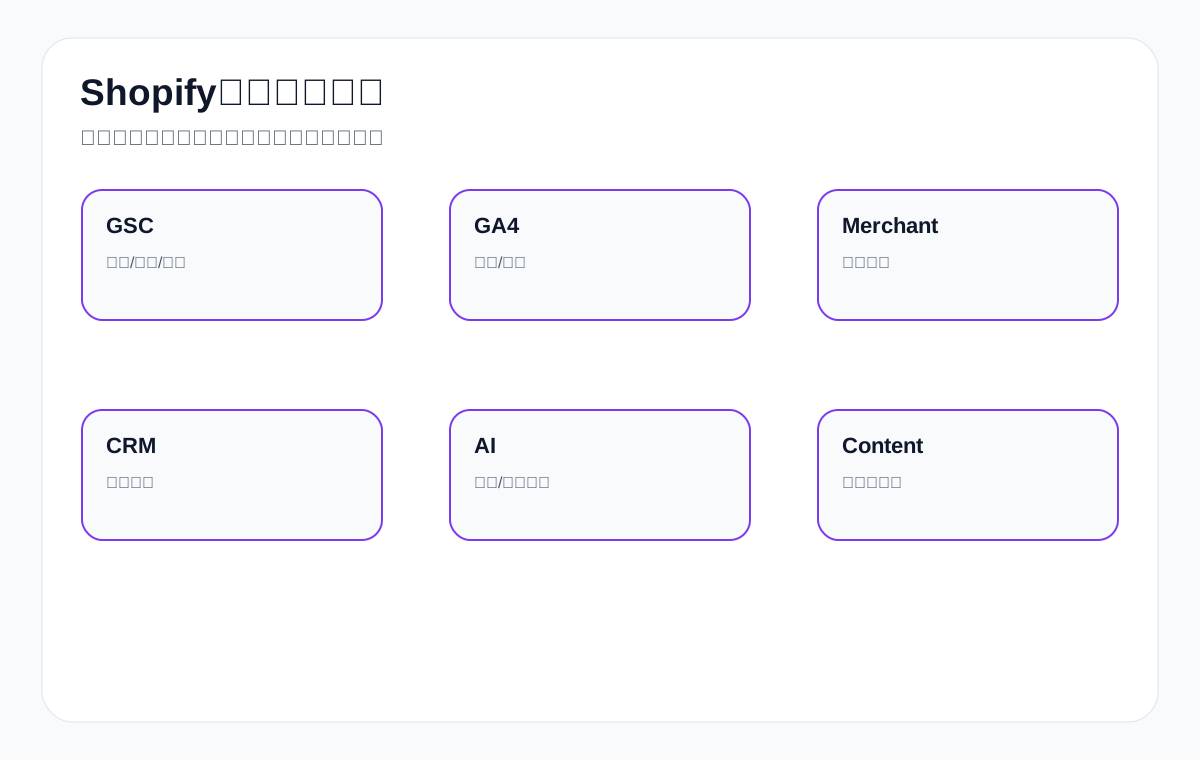
11. A practical workflow for Shopify foreign-trade acquisition optimization
Step 1: Confirm product lines and target markets
First list your main products, exportable countries, profit products, delivery capabilities, and the requests you do not take. Without these boundaries, keywords and pages will drift.
Step 2: Map out the collection page structure
Build collection levels by product family, application, material, specification, or industry, so that commercial terms such as supplier, manufacturer, wholesale, and custom have pages to land on.
Step 3: Rewrite priority product pages
Prioritize products with search value or profit value, and add specifications, images, applications, FAQ, structured data, and inquiry information.
Step 4: Build application pages and guide pages
Turn needs such as how to, for industry, vs, and material choice into application pages and articles, then link internally to collection and product pages.
Step 5: Check the technical foundation
Confirm sitemap, robots, canonical, URLs, speed, mobile, structured data, Merchant Center, and form usability.
Step 6: Set up the review framework
Use GSC to look at queries and pages, GA4 to look at paths, Merchant Center to look at product data, and inquiry records to look at lead quality.
Step 7: Update content monthly
Based on impressions, clicks, countries, inquiries, and competitor changes, add FAQs, comparison tables, specification notes, and internal links.
12. Common misconceptions: launching a Shopify site does not mean buyers can find it
Misconception 1: Only changing titles, not page targeting
Titles help clicks, but if the page has no sourcing decision information, it is still hard to get valid inquiries.
Misconception 2: Only piling up products, not building collection pages
Many B2B sourcing terms fit collection pages and application pages better; not every term suits a product page.
Misconception 3: A large number of similar product descriptions
If each product has only a small amount of repeated description, neither search engines nor buyers can tell the differences.
Misconception 4: Ignoring structured data
If product data, price, availability, images, reviews, and policies are unclear, it affects Google’s understanding of the product.
Misconception 5: The more apps, the better
Too many apps can slow down speed, increase code conflicts, and hurt the overseas mobile experience.
Misconception 6: Looking only at rankings, not inquiries
Foreign-trade acquisition requires looking at queries, pages, countries, visit paths, and lead quality—not just the position of one keyword.
Misconception 7: Treating AI search as a shortcut
AI visibility depends on clear content, entities, structured information, and credible sources; it is not solved by adding a few words.
13. How to review after launch: Shopify acquisition optimization looks at four types of metrics
After Shopify foreign-trade site optimization is complete, do not just check whether pages are live. Observe at least at 7 days, 30 days, 60 days, and 90 days. In the early stage, look at crawling and indexing; in the middle stage, look at queries and clicks; in the later stage, look at paths and inquiry quality. If a collection page gets impressions but a low CTR, the title or snippet may not be clear enough; if a product page gets many visits but no inquiries, specifications and calls to action may be insufficient; if an article gets traffic but does not drive product page visits, the internal linking path may be unclear.
Shopify acquisition review metrics table
| Time | Search metrics | Page metrics | Business metrics |
|---|---|---|---|
| 7 days | Whether GSC discovered new URLs and whether important collection pages were crawled | Page opening, image loading, form usability | Do not judge inquiry volume yet |
| 30 days | Whether target queries appear and whether the country dimension matches | Entry pages, time on page, scrolling, product clicks | Whether inquiries about related products appear |
| 60 days | Whether queries for collection pages and product pages are clearly divided | Whether a path from guides to collections/products has formed | Whether inquiries are closer to the target product lines |
| 90 days | Whether ranking stability, CTR, and page matching improved | Whether speed, structured data, and content gaps decreased | Quality of quotes, samples, and specification confirmations |
14. FAQ: common questions about Shopify Google foreign-trade acquisition optimization
Shopify has built-in SEO features, so why is optimization still needed?
Shopify provides basic capabilities, but it will not automatically research foreign-trade product terms, divide page roles, create sourcing content, validate structured data, manage speed, and review inquiries for you.
Which matters more on Shopify, collection pages or product pages?
Both matter, but they carry different intent. Collection pages are better for product family, supplier, manufacturer, and commercial investigation terms; product pages are better for model, specification, material, and specific purchase decision terms.
Should product pages be very long?
Longer is not better; complete information is. Specifications, images, applications, certifications, MOQ, lead time, customizable range, FAQ, and inquiry information matter more than vague descriptions.
Does Shopify structured data always bring rich results?
No promise can be made. Structured data helps Google understand products and improves eligibility, but final display depends on the query, page quality, policies, and Google’s judgment.
Does Shopify speed optimization mean using fewer images?
It is not simply about using fewer images, but about keeping images that help sourcing decisions while compressing them, using appropriate dimensions, deferring non-critical resources, and reducing low-value scripts.
Is Shopify suitable for B2B foreign-trade sites?
If the product catalog, inquiry flow, content structure, and product data are designed properly, Shopify can be used for B2B presentation and inquiry acquisition; but you need to add sourcing decision content instead of launching with a retail product page mindset only.
Are AI search optimization and Shopify SEO two different things?
Not entirely separate. Clear product entities, specification tables, FAQs, structured data, brand consistency, and credible content help both traditional search and AI search understand the site.
How often should Shopify SEO results be checked?
It is recommended to check GSC queries, pages, countries, GA4 paths, Merchant Center errors, and inquiry quality monthly; update priority pages based on data every 30–90 days.
15. Shopify technical SEO checks: first make sure important pages can be found and understood
Shopify’s technical foundation is relatively friendly, but that does not mean checks can be skipped. Common problems on foreign-trade sites include: unclear menu hierarchy, with important collection pages not reachable from the homepage or navigation; products accessed through multiple collection paths, with the team unsure which URL is the main page; filters and tags generating a large number of low-value URLs; discontinued products with no suitable replacement; oversized image files; unclear multilingual paths and canonical signals; and internal search result pages or tag pages mistaken for content pages. These problems do not necessarily break the site immediately, but they make it harder for search engines to determine which pages matter most.
When checking, do not start with tool errors; start with business pages. First list the 20 most important collection pages, the 20 most important product pages, and 5–10 application pages and guide pages, then check one by one whether they are reachable from the homepage, menus, collections, articles, and breadcrumbs; whether they have a unique and clear title; whether they have enough explanatory text; whether they appear in the sitemap; whether the canonical points to themselves; whether they open smoothly on mobile; and whether they have a visible inquiry entry point. For high commercial value terms such as custom metal parts, industrial valve supplier, and private label activewear manufacturer, the corresponding pages must be checked first.
Shopify technical checklist
| Check item | Normal state | Warning sign | Action direction |
|---|---|---|---|
| Navigation entry | Important collection pages are reachable from the homepage and menus | Only reachable through search or old links | Add navigation, collection entry points, and internal links from related articles |
| Canonical | The main product URL is stable | Confusing signals from multiple paths for the same product | Unify the main URL and internal links |
| Sitemap | Priority pages appear in the sitemap | Important pages are not submitted or cannot be crawled | Check publish status and indexing settings |
| Filter parameters | Only valuable pages are indexed | Color, tag, and sort parameters create thin pages | Control parameter pages and internal links |
| Discontinued products | There is a replacement product or collection page path | Many 404s or pages with no explanation | Recommend replacements, update links, or redirect |
| Mobile | Images, variants, and forms work | Slow above-the-fold view, hard-to-tap buttons, table overflow | Optimize mobile layout and resource loading |
16. Choosing Shopify apps: do not let apps break the acquisition path
Many Shopify sites install review, chat, popup, discount, translation, currency, form, SEO, image compression, tracking, and membership apps to add functionality. Apps themselves are not the problem; the problem is that every app can add scripts, styles, DOM elements, third-party requests, and maintenance cost. Foreign-trade acquisition sites should be especially careful: a popup may cover product specifications, a chat tool may slow down the above-the-fold view, a translation app may cause language URL confusion, and an SEO app may generate structured data that does not match the page.
When choosing apps, first ask whether it serves sourcing decisions. Apps that help with inquiry fields, sample requests, product comparisons, image compression, structured data validation, form conversion, and B2B quoting can be kept with caution; apps that exist only for flashy animations, generic marketing popups, or duplicate functions should be reduced. After adding any app, recheck whether product page speed, mobile layout, form submission, structured data, and titles and descriptions have changed.
Shopify app trade-off table
| App type | Potential value | Risk | Recommendation |
|---|---|---|---|
| Inquiry/quote forms | Collect quantity, drawings, and target market | Slow loading or too many fields | Keep and optimize the fields |
| Image compression | Improves speed and image loading | Over-compression hurts detail | Use it while preserving clarity |
| Reviews/ratings | Strengthens trust and product data | An empty review module reduces credibility | Only display when there are real reviews |
| Popup marketing | Collects emails or announces promotions | Blocks specifications and the inquiry entry point | Use with caution, especially sparingly on mobile |
| Translation/currency | Serves multiple country markets | URL, hreflang, and price confusion | Check country paths before launch |
| SEO automation | Assists with bulk titles and data checks | Generates content that does not match the business | Use only as an aid; does not replace human judgment |
17. Inquiry pages and forms: Shopify foreign-trade sites cannot just have Add to cart
Many B2B foreign-trade Shopify sites do not focus on direct ordering but on inquiries, samples, quotes, customization, and bulk purchase communication. If a page only has Add to cart, or the inquiry form is buried deep, buyers may not know how to get in touch. For complex sourcing such as custom metal parts, cnc machining parts, industrial valve supplier, and private label activewear manufacturer, the form should guide users to provide key materials rather than just leaving a name and email.
A good inquiry form is not about being long, but about fields matching sourcing decisions. Custom processing should ask for drawings, material, quantity, tolerances, surface treatment, and target lead time; lighting products should ask for wattage, installation environment, certification, quantity, and project country; packaging machinery should ask for product type, capacity, packaging format, and factory voltage; custom apparel should ask for fabric, size, color, brand labels, packaging, and MOQ. The closer the form fields are to a real quote, the more efficient the sales follow-up will be.
Suggested Shopify B2B inquiry fields
| Product type | Suggested fields | Why it is needed |
|---|---|---|
| custom metal parts | Drawings, material, quantity, tolerances, surface treatment | Determines the machining method and quote accuracy |
| LED flood light | Wattage, color temperature, IP rating, project country, quantity | Determines the model, certification, and application scenario |
| packaging machine | Product type, capacity, packaging format, voltage, space | Determines the machine solution and configuration |
| medical probe | Compatible devices, connector, material, sterilization requirements | Determines compatibility and quality requirements |
| ceramic dinnerware | Use, size, pattern, packaging, quantity | Determines the production and packaging solution |
| private label activewear | Fabric, size, color, labels, MOQ | Determines sampling and production arrangements |
18. Internal links: let guides, collection pages, and product pages support each other
Shopify foreign-trade sites should avoid page islands. If an article about how to choose waterproof connector does not link to the waterproof connector collection page and key product pages, it is hard to turn informational visits into sourcing behavior; if a collection page does not link to a selection guide, buyers may not know how to compare; if a product page does not link to application and resource pages, users may not be able to confirm whether it fits their scenario. Internal links are not about piling up links but about helping users and search engines understand page relationships.
It is recommended that every priority collection page links to 2–4 related guides, 3–8 key products, and 1 inquiry entry point; every guide links at least to the corresponding collection page, related product pages, and application pages; and every product page links to the parent collection, similar products, application notes, and resource pages. Anchor text should naturally describe the page’s task, for example “view the IP67 waterproof connector product series,” “read the LED flood light for warehouse selection guide,” and “submit a custom metal parts drawing inquiry.”
Shopify internal link division table
| Source page | Should link to | Anchor text example | Purpose |
|---|---|---|---|
| Collection page | Product pages, application pages, guides, inquiry page | 100W LED flood light, warehouse lighting guide | Move from category to specific decisions |
| Product page | Collection page, related products, resource pages | waterproof connector series, datasheet | Help compare and confirm specifications |
| Article page | Collection pages, product pages, application pages | custom CNC machining parts options | Guide learning visits toward sourcing pages |
| Application page | Recommended products, inquiry page, related guides | packaging machine for food factory quote | Move from scenario to solution and contact |
| Resource page | Product pages, inquiry page | request sample with this specification | Move from technical confirmation to action |
How does sales feedback revise pages in reverse?
After Shopify pages go live, feedback from the sales team is very important. If inquiries often ask about the same specification, the page does not explain it clearly; if customers always misunderstand MOQ or the customization scope, the boundaries between collection pages and product pages are unclear; if customers from a certain country repeatedly ask about certification, plugs, voltage, or packaging, the page needs country market information. Feed these questions back into FAQs, specification tables, application pages, and inquiry fields every month, and the pages will get closer to real sourcing needs. This also reduces the time sales spend repeatedly explaining basic questions, so that content updates, product organization, and inquiry follow-up share the same judgment framework.
19. Final judgment: Shopify foreign-trade acquisition optimization is a page system, not a single setting
Shopify lets foreign-trade companies quickly build an English independent site, but what truly brings Google acquisition capability is a clear page system: collection pages carry commercial terms, product pages carry specification terms, application pages carry scenario terms, articles carry decision terms, resource pages carry specification and download needs, and inquiry pages carry quote and sample communication. The technical foundation, speed, structured data, Merchant Center, internal links, and review metrics ensure that this system can be discovered, understood, and continuously improved by search engines.
For domestic foreign-trade manufacturers and trading companies, the most important thing is not to make Shopify look like an ordinary retail store, but to let buyers who search for custom metal parts, LED flood light, packaging machine, medical probe, cnc machining parts, waterproof connector, or industrial valve supplier land on the corresponding page, quickly judge whether the product matches, and be willing to submit an inquiry. Only when this logic is clear does Shopify truly become a foreign-trade acquisition asset rather than just a site-building tool.
{
“@context”: “https://schema.org”,
“@type”: “FAQPage”,
“mainEntity”: [
{
“@type”: “Question”,
“name”: “Shopify acquisition review metrics tablenTime Search metrics Page metrics Business metricsn7 days Whether GSC discovered new URLs and whether important collection pages were crawled Page opening, image loading, form usability Do not judge inquiry volume yetn30 days Whether target queries appear and whether the country dimension matches Entry pages, time on page, scrolling, product clicks Whether inquiries about related products appearn60 days Whether queries for collection pages and product pages are clearly divided Whether a path from guides to collections/products has formed Whether inquiries are closer to the target product linesn90 days Whether ranking stability, CTR, and page matching improved Whether speed, structured data, and content gaps decreased Quality of quotes, samples, and specification confirmationsnn14. FAQ: Common questions about Shopify Google foreign-trade acquisition optimizationnShopify has built-in SEO features, so why is optimization still needed?”,
“acceptedAnswer”: {
“@type”: “Answer”,
“text”: “Shopify provides basic capabilities, but it will not automatically research foreign-trade product terms, divide page roles, create sourcing content, validate structured data, manage speed, and review inquiries for you.”
}
},
{
“@type”: “Question”,
“name”: “Which matters more on Shopify, collection pages or product pages?”,
“acceptedAnswer”: {
“@type”: “Answer”,
“text”: “Both matter, but they carry different intent. Collection pages are better for product family, supplier, manufacturer, and commercial investigation terms; product pages are better for model, specification, material, and specific purchase decision terms.”
}
},
{
“@type”: “Question”,
“name”: “Should product pages be very long?”,
“acceptedAnswer”: {
“@type”: “Answer”,
“text”: “Longer is not better; complete information is. Specifications, images, applications, certifications, MOQ, lead time, customizable range, FAQ, and inquiry information matter more than vague descriptions.”
}
},
{
“@type”: “Question”,
“name”: “Does Shopify structured data always bring rich results?”,
“acceptedAnswer”: {
“@type”: “Answer”,
“text”: “No promise can be made. Structured data helps Google understand products and improves eligibility, but final display depends on the query, page quality, policies, and Google’s judgment.”
}
},
{
“@type”: “Question”,
“name”: “Does Shopify speed optimization mean using fewer images?”,
“acceptedAnswer”: {
“@type”: “Answer”,
“text”: “It is not simply about using fewer images, but about keeping images that help sourcing decisions while compressing them, using appropriate dimensions, deferring non-critical resources, and reducing low-value scripts.”
}
}
]
}
Continue reading this SEO series
If you are systematically working through foreign-trade website SEO, we suggest continuing with the articles below. First get the relationships among crawling, indexing, content, links, and review straight, then decide which page to change next.
- What B2B Google foreign-trade acquisition optimization includes: a guide to long decision cycles, page systems, and inquiry review
- What WooCommerce Google foreign-trade acquisition optimization includes: how to optimize category pages, filter pages, and product pages
- Google crawling, indexing, and ranking process: a diagnostic guide for foreign-trade websites from indexing to inquiry
- How search engines work: a guide to crawling, indexing, ranking, and foreign-trade website diagnostics
- Technical SEO audit checklist: a diagnostic guide for crawling, indexing, structure, and inquiry paths on foreign-trade websites
- Sitemap technical guide: sitemap submission, index diagnostics, and troubleshooting common errors
This page is machine-translated from the Simplified Chinese version and awaiting human review. It has not yet been proofread.