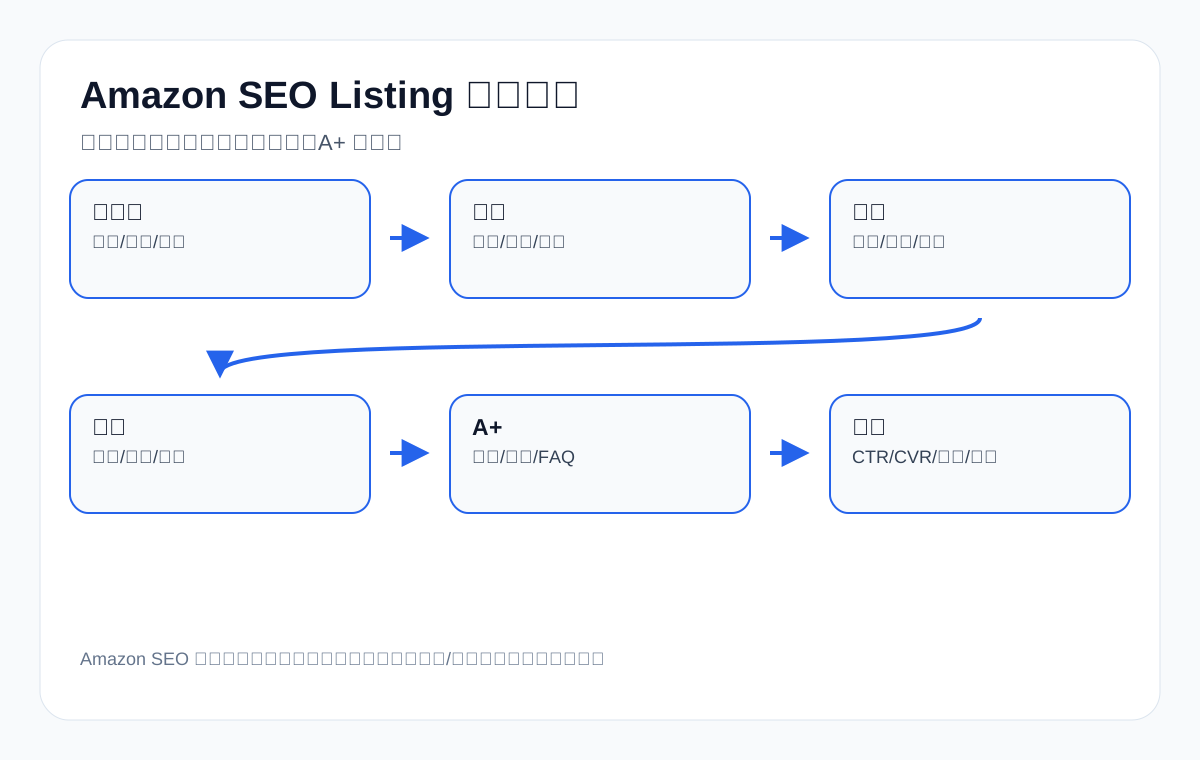
Amazon SEO is not about stuffing keywords into the title. It is about making a product easier to match, click, understand, and trust in Amazon search, and ultimately achieving better conversion performance. For export-oriented manufacturers, brand owners, and trading companies, Amazon SEO has to handle the title, bullet points, images, A+ Content, the search terms field, category attributes, reviews, Q&A, advertising data, conversion rate, and inventory and pricing all at the same time.
For example, when a LED flood light is listed on Amazon, the title should not simply pile up wattage, outdoor, and waterproof; it should let buyers see the wattage, application, waterproof rating, certifications, and differences at a glance. ceramic dinnerware needs to make clear the number of pieces in the set, the material, whether it is dishwasher safe and microwave safe, and whether it suits a restaurant or a home. private label activewear needs to convey fabric, fit, size, support, and wash care. waterproof connector needs to cover IP rating, pin count, wire gauge, and application. packaging machine and industrial valve supplier may not be typical Amazon retail products, but they can still use Amazon Listing optimization logic to understand the relationship between the title, selling points, images, and conversion rate.
+
+
+
SERP Top 1 / Authority Benchmark Card
+
| Benchmark source | What it gets right | Gap | Tianwen SEO Research additions |
|---|---|---|---|
| Amazon Product Detail Page / Seller University materials | Emphasizes titles, bullet points, images, descriptions, search terms, and customer experience. | Platform-rule oriented; does not break down English product terms and review workflows for Chinese export sellers. | Turned into a writing and quality checklist for export product Listings. |
| Semrush / Seller Labs / SellerSprout Amazon Listing guides | Covers titles, bullet points, the search terms field, A+, conversion rate, and common mistakes. | Mostly aimed at generic categories for Amazon sellers; lacks the factory and export product data perspective. | Adds product data, supply chain selling points, buyer objections, and advertising/review review. |
| Industry Listing checklist | Emphasizes mobile-first, images, bullets, reviews, and A/B testing. | Easily becomes a fixed format that does not distinguish products and categories. | Customizes the structure with product terms, category attributes, and buyer questions. |
+
+
+
How Amazon SEO differs from Google SEO
+
Google SEO mainly directs users to website pages, while Amazon SEO happens inside a marketplace. Amazon search is closer to a “product matching + purchase conversion” system, where relevance, click-through rate, conversion rate, price, inventory, fulfillment, reviews, advertising performance, and category competition all affect performance. Amazon SEO therefore cannot be about writing keywords alone; it also has to improve the Listing’s power to persuade a purchase.
+
| Dimension | Google SEO | Amazon SEO | Key point for export sellers |
|---|---|---|---|
| Search goal | Information, commercial, and navigational intents | Purchase and comparison intent is stronger | The Listing must rank and convert at the same time |
| Page assets | Website pages, articles, product pages | Product detail pages, brand store, A+, advertising | Every ASIN must be optimized independently |
| Keyword locations | Title, body, H tags, internal links, Schema | Title, Bullets, Description, Backend, Attributes | Avoid repeating keywords; cover key attributes |
| Conversion impact | Inquiries, forms, paths | Clicks, add-to-cart, purchases, reviews | Watch CTR, CVR, advertising, and reviews |
+
+
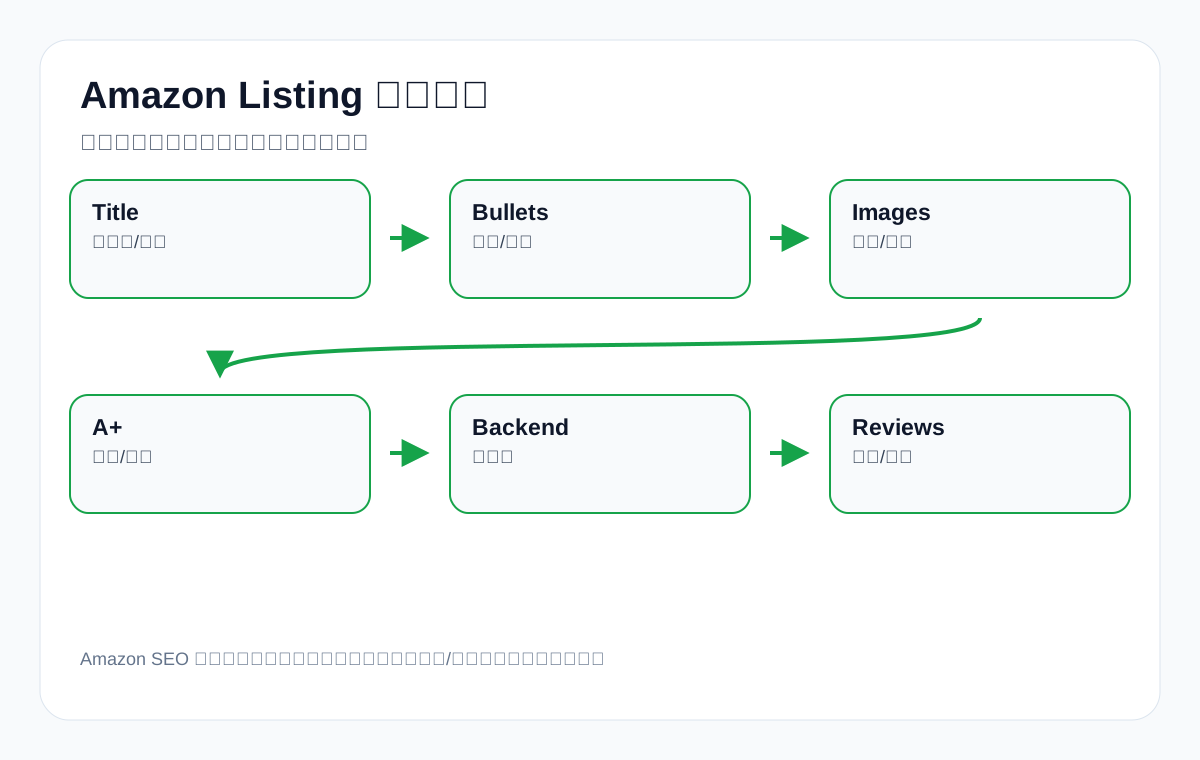
Division of labor across Listing elements: every position carries a different task
+
+
| Element | Main task | Writing focus | Common mistakes |
|---|---|---|---|
| Title | Relevance and clicks | Main keyword, brand, core attributes, quantity/size, use | Keyword stuffing, poor readability |
| Bullets | Persuasion and objection handling | One selling point per bullet, turn features into benefits, resolve doubts | Writing only high quality and generic claims |
| Images | Visual trust and scenario understanding | Main image, size chart, lifestyle image, comparison image, packaging image | Too few images, no dimensions, no application |
| A+ Content | Brand, comparison, and in-depth explanation | Explain differences, scenarios, and FAQ in modules | Repeating the bullet points, lacking persuasion |
| Search Terms Field | Supplement synonyms and long-tail terms | Do not repeat title/bullets; add variants and synonyms | Repeated stuffing, filling in irrelevant terms |
| Reviews/Q&A | Real feedback and source of objections | Used to find Listing gaps | Not reading reviews, not updating content |
+
+
Keyword research: start from buyer searches and category attributes
+
Amazon keyword research should combine search suggestions, competitor Listings, advertising search terms, Brand Analytics, reviews, and Q&A. Keywords are not just product names; they also include use, material, size, color, set, scenario, questions, and synonyms. For Chinese export sellers, it is also important to avoid unnatural English caused by literal translation from Chinese.
+
| Keyword type | Purpose | Example | Where it goes |
|---|---|---|---|
| Main keyword | Defines the product | LED flood light | Front of the Title |
| Core attributes | Help with filtering | 100W, IP65, outdoor | Title/Bullets/Attributes |
| Scenario terms | Explain the use | warehouse, stadium, garage | Bullets/Images/A+ |
| Material terms | Prove characteristics | ceramic, stainless steel, spandex | Title/Bullets |
| Synonyms | Cover different phrasings | dinnerware set / dish set | Backend/Description |
| Question terms | Handle doubts | dishwasher safe, waterproof, non slip | Bullets/A+/Q&A |
+
+
How to write the title: readability matters more than stuffing keywords
+
An Amazon title must let the system and the buyer understand the product at the same time. A common structure is: brand + main keyword + core attributes + quantity/size + use scenario + important difference. Rules differ by category, and Amazon category guidelines must be followed. Do not repeat the same keyword in the title, and do not stuff in irrelevant traffic terms.
+
| Product | What the title should include | Example direction | Avoid |
|---|---|---|---|
| LED flood light | Wattage, waterproofing, scenario, quantity | 100W LED Flood Light Outdoor, IP65 Waterproof, for Warehouse/Garage | Repeating flood light many times |
| ceramic dinnerware | Piece count, material, safety, scenario | Ceramic Dinnerware Set, 16-Piece, Dishwasher and Microwave Safe | Only writing beautiful dishes |
| waterproof connector | IP rating, pin, wire gauge, use | IP67 Waterproof Connector 4 Pin for Outdoor Electrical Cable | Missing key specs |
| activewear | Fabric, style, support, size | Women’s High Waisted Activewear Leggings, Moisture Wicking | Only stuffing yoga pants keywords |
+
+
How to write bullet points: turn features into buyer benefits
+
Bullet points are the key place to persuade buyers. Each bullet should cover only one core selling point: give a scannable subhead first, then explain the feature, the benefit, the evidence, and the applicable scenario. Do not turn the bullet points into a pile of specs, and do not write vague phrases such as high quality.
+
| Bullet position | Suggested task | Example | Note |
|---|---|---|---|
| Bullet 1 | The single most important use value | Bright Outdoor Lighting for Driveways and Warehouses | Shown first on mobile; must be strong |
| Bullet 2 | Material/durability/quality | IP65 waterproof housing for outdoor use | Back it with evidence |
| Bullet 3 | Size/compatibility/specs | 4-pin connector fits 20–22 AWG cable | Reduces returns and negative reviews |
| Bullet 4 | Use scenarios | Suitable for garage, patio, warehouse | Covers scenario terms |
| Bullet 5 | Packaging, installation, after-sales boundaries | Includes mounting hardware and user guide | Do not exaggerate promises |
+
+
Images and video: the core of Amazon conversion rate
+
Amazon buyers look at the main image and the first few images first. Images should answer: what the product looks like, how big it is, how it is used, what is in the package, how it differs from competitors, and which scenarios it suits. If an export factory uploads only white-background images, it will struggle to fully persuade buyers.
+
| Image type | Task | Example | Common gap |
|---|---|---|---|
| Main image | Show the product clearly | White background, clear subject | Poor angle, cluttered |
| Size chart | Reduce mistaken purchases | connector pin size, dinnerware dimensions | No scale or units |
| Lifestyle image | Help buyers picture themselves using it | LED light in warehouse | Unrealistic scenario |
| Selling-point image | Explain features | waterproof, dishwasher safe, stretch fabric | Too much text |
| Packaging image | Show what is included | set contents, accessories | Buyers do not know what they will receive |
+
+
A+ Content: do not repeat the title and bullet points
+
A+ Content is better suited to explaining the brand, comparing product series, use scenarios, material evidence, installation steps, FAQ, and differentiation. It should not simply turn the bullet points into images, and it should not contain exaggerated claims that cannot be substantiated.
+
| A+ module | Suitable content | Example | Value |
|---|---|---|---|
| Brand story | Brand positioning and target audience | home kitchen dinnerware brand | Builds trust |
| Comparison table | Differences between models/sets | LED flood light wattage comparison | Helps selection |
| Scenario module | Use scenarios and problems | activewear for gym/yoga/running | Improves conversion |
| FAQ | Size, care, compatibility, installation | dishwasher safe, installation steps | Reduces returns and negative reviews |
| Quality evidence | Materials, testing, packaging | IP65 waterproof test illustration | Strengthens credibility |
+
+
How to fill in the search terms field
+
The search terms field supplements synonyms, variants, spellings, and long-tail terms that are not covered in the visible parts of the Listing. Do not repeat words that already appear in the title and bullet points, and do not enter brand-infringing terms, irrelevant terms, or exaggerated terms. The search terms field should come from real searches and competitor research.
+
| Type | Can consider | Not recommended |
|---|---|---|
| Synonyms | dinnerware set / dish set | Irrelevant broad terms |
| Spelling variants | common spelling variations | Deliberately stuffing misspellings |
| Scenario terms | garage lighting, patio light | Scenarios unrelated to the product |
| Material/attributes | ceramic, spandex, waterproof | Attributes the product does not have |
| Competitor brands | Not recommended | Risk of infringement or misleading |
+
+
Category attributes: Amazon SEO does not rely only on visible copy
The relevance of an Amazon Listing comes not only from the title and bullet points, but also from fields such as category, attributes, variations, size, color, material, and applicable scenario. A common problem for Chinese sellers is that the visible copy says a lot, but the attribute fields are incomplete, which makes it hard for the system to match filters and category searches.
| Field | Why it matters | Export example | Optimization action |
|---|---|---|---|
| Material | Buyers filter by material | ceramic dinnerware, stainless steel valve | Keep the field consistent with the page copy |
| Size/Dimensions | Reduces mistaken purchases and returns | waterproof connector pin size, dinnerware plate size | State it clearly in the title, images, and attributes |
| Use/Application | Matches scenario terms | LED flood light for warehouse, garage | Explain it in the bullet points and images |
| Color/Variation | Affects variations and filtering | activewear color and size | Keep the variation structure clear |
| Compatibility | Critical for technical products | medical probe compatible devices | Avoid exaggeration; state the boundaries |
Variation structure: do not sacrifice relevance just to merge reviews
Variations help buyers compare size, color, quantity, and specs, and they also concentrate reviews and the selection path. But wrong variations create relevance confusion. For example, LED flood light units of different wattages can be variations, but products with completely different applications or different product lines are not necessarily suitable for forced merging; ceramic dinnerware colors, piece counts, and collections can be variations, but be careful when the material and use differ too much.
| Variation type | Suitable for | Risk | Recommendation |
|---|---|---|---|
| Size | activewear, connector, dinnerware | Returns caused by an unclear size chart | Explain it in images and A+ |
| Color | Apparel, home, tableware | Negative reviews caused by color differences | Real images consistent with color names |
| Quantity/set | dinnerware, connector pack | Buyers misunderstand the pack quantity | State it clearly in the title and main image |
| Wattage/specs | LED light, connector, valve | Reviews of different specs get mixed | Merge only within the same product line |
| Completely different products | Not recommended | Declining relevance and experience | Split them into separate Listings |
Reviews and Q&A: the most authentic Listing optimization material
Reviews and Q&A are not just customer feedback; they are also material for updating the Listing. Negative reviews often expose problems such as size misunderstanding, difficult installation, material expectations, damaged packaging, color deviation, and unclear compatibility. Sellers should turn this feedback into improvements to the title, bullet points, images, and A+, rather than only replying to the review.
| Feedback type | What it indicates | Listing action | Example |
|---|---|---|---|
| Size misunderstanding | Image or title is unclear | Add a size chart and title specs | ceramic dinnerware plate diameter |
| Difficult installation | Insufficient explanation | Add installation images and A+ steps | LED flood light mounting |
| Compatibility problem | Applicable boundaries not stated clearly | Add a compatibility table | medical probe, waterproof connector |
| Material expectations | Buyers misunderstand the material | State the material clearly in the title and bullet points | activewear fabric blend |
| Damaged packaging | Logistics and packaging problem | Add packaging images and change the packaging | dinnerware set packaging |
How advertising data feeds back into Amazon SEO
Amazon advertising search terms help sellers judge which terms get impressions, clicks, and conversions. You cannot look only at organic ranking, and you cannot look only at ACOS. High-converting ad terms should enter the wording of the title, bullet points, images, or A+; for high-click, low-conversion terms, check whether the Listing is misleading or the product does not match.
| Advertising signal | Explanation | SEO action |
|---|---|---|
| High impressions, low clicks | Weak main image, title, price, or reviews | Test the main image and title |
| High clicks, low conversion | Weak Listing persuasion or product mismatch | Optimize bullet points, images, A+, price |
| High-converting long-tail terms | Strong real purchase intent | Add to the title/bullets/search terms field |
| High ACOS terms | Term mismatch or too much competition | Negate the term or adjust the Listing |
| Strong in both organic and advertising | Core opportunity terms | Keep maintaining inventory and reviews |
Export product Listing example: custom metal parts
Although custom metal parts is more common on B2B standalone sites and inquiry-driven businesses, its Listing logic still has reference value: buyers need to see material, process, precision, drawing formats, surface finishing, and the quoting process. If similar products are listed on a marketplace or a catalog page, this information should also go into the title, bullet points, images, and documents.
| Element | Content focus | Example |
|---|---|---|
| Title | Process, material, customization attributes | Custom CNC Machining Parts, Aluminum/Stainless Steel |
| Bullets | Material, tolerance, surface finishing, drawing requirements | Supports STEP, DWG, PDF drawings |
| Images | Sample parts, dimensions, surface finishing, QC | machined parts detail and inspection |
| A+ | Process, quality, application industries | from drawing to QC process |
| Q&A | MOQ, sample, lead time, tolerance | quote preparation checklist |
Export product Listing example: private label activewear
| Element | Content focus | Example |
|---|---|---|
| Title | Category, fabric, function, size | High Waisted Activewear Leggings, Moisture Wicking |
| Bullets | support, stretch, non-see-through, wash care | 4-way stretch fabric for yoga and gym |
| Images | Model, details, size, scenario | size chart and fabric close-up |
| A+ | Fabric, collection, wearing scenarios, care | fabric comparison and care guide |
| Reviews | Size, opacity, stretch, changes after washing | Update the size chart and bullet copy |
Amazon SEO pre-launch acceptance checklist
| Check item | Pass criteria | Failure signs |
|---|---|---|
| Keywords | Main, attribute, scenario, and synonym terms are clearly allocated | All terms stuffed into the title |
| Title | Readable, compliant, covers core attributes | Repeated stuffing or missing specs |
| Bullet points | Each bullet resolves one purchase doubt | Vague high quality |
| Images | Main image, size, scenario, packaging, and selling-point images complete | Only white-background images |
| A+ | Adds brand, comparison, FAQ, and scenarios | Repeats the bullet points |
| Search terms field | Adds synonyms and long-tail terms without irrelevant repetition | Filled with infringing or irrelevant terms |
| Review | Looks at CTR, CVR, advertising, reviews, inventory | Looks only at ranking |
Mobile first: what Amazon buyers see first
A large share of Amazon purchase decisions happen on mobile. Mobile display space is limited, so the front of the title, the main image, price, star rating, the first few images, and the first few lines of the bullet points matter especially. When optimizing a Listing, check it on an actual phone; do not edit only on a desktop.
| Mobile position | What buyers see first | Optimization focus | Example |
|---|---|---|---|
| Search results | Main image, front of the title, price, rating | Clear main image; the front of the title contains the main term and core attributes | LED Flood Light Outdoor 100W |
| Detail page first screen | Images, title, variations, price | Do not push key specs too far down | IP67 4 Pin Waterproof Connector |
| Image swipe | The first 3 images matter most | Prioritize the main image, size chart, and lifestyle image | ceramic dinnerware set contents |
| Collapsed bullet points | The first few lines are the summary | Start every bullet with the value directly | Moisture-Wicking Fabric |
| A+ modules | Only seen after scrolling down | Use for deeper persuasion; does not replace the main image and bullet points | comparison chart and care guide |
International wording: do not translate Chinese selling points directly into an English Listing
Chinese factories and sellers often translate Chinese materials straight into English, producing language that overseas buyers would not search for or understand. Amazon SEO has to verify how overseas buyers actually phrase things: product names, materials, scenarios, functions, and units all need to match category conventions.
| Chinese way of thinking | Possible problem | Better English wording | Applicable product |
|---|---|---|---|
| High-quality lighting | Too vague | IP65 Outdoor LED Flood Light, 100W | LED flood light |
| Ceramic tableware set | Missing piece count and use scenario | 16-Piece Ceramic Dinnerware Set, Dishwasher Safe | ceramic dinnerware |
| Waterproof connector | Missing IP rating and pin count | IP67 Waterproof Connector 4 Pin | waterproof connector |
| Stretch sport pants | Missing fabric and scenario | High Waisted Yoga Leggings, 4-Way Stretch | activewear |
| Precision machined parts | Missing process and material | CNC Machining Parts, Aluminum/Stainless Steel | cnc machining parts |
Price, inventory, and fulfillment: they also affect SEO performance
Amazon SEO is not purely copywriting. Uncompetitive pricing, unstable inventory, slow fulfillment, out-of-stock variations, and confusing promotions all affect clicks and conversion. Listing copy optimization has to be read together with operational data.
| Operational factor | Impact | Review action |
|---|---|---|
| Price | Affects CTR and CVR | Compare with competitor prices, promotions, and pack counts |
| Inventory | Stockouts interrupt the sales rhythm | Confirm inventory before promoting core terms |
| Fulfillment | Affects purchase decisions | Watch FBA/FBM, delivery time, and the returns experience |
| Coupons | Affect clicks in search results | Coordinate with the launch period and advertising tests |
| Variation inventory | Stockouts of best-selling specs hurt conversion | Look at sales and inventory by variation |
| Review star rating | Affects clicks and conversion | Reduce negative reviews through product and expectation management |
A 30-60-90 day review rhythm for Amazon SEO
| Time | What to look at | Judgment | Action |
|---|---|---|---|
| 30 days | Impressions, clicks, advertising search terms | Whether relevance and clicks are sufficient | Adjust the title, main image, and advertising terms |
| 60 days | Conversion rate, bullet points, images, A+ | Whether buyers are persuaded | Add selling points, lifestyle images, and FAQ |
| 90 days | Reviews, Q&A, returns, inventory | Whether product expectations are accurate | Update images, sizes, and usage boundaries |
| Quarterly | Competitor changes, category trends, advertising structure | Whether the Listing needs to be rebuilt | Run A/B tests and refresh content |
Category case: breaking down an LED flood light Listing
LED flood light is a typical product that has to balance search and conversion. Buyers care about wattage, brightness, waterproofing, installation, application scenarios, lifespan, certification, and packaging. The title explains the core attributes, the images show brightness and installation, the bullet points explain durability and application, and A+ compares different wattages and scenarios.
| Module | How to write it | Review point |
|---|---|---|
| Title | Brand + 100W LED Flood Light Outdoor + IP65 Waterproof | Core keyword impressions and CTR |
| Bullet 1 | Bright lighting for warehouse, garage, yard | Scenario term conversion |
| Bullet 2 | IP65 waterproof housing for outdoor use | Fewer waterproofing questions |
| Image | Dimensions, installation, light coverage | Image clicks and conversion |
| A+ | Wattage comparison, installation steps, application scenarios | CVR and Q&A changes |
Category case: breaking down a ceramic dinnerware Listing
ceramic dinnerware buyers care a great deal about the number of pieces in the set, the dimensions, dishwasher and microwave suitability, the glaze, packaging, and breakage risk. The Listing must state this information clearly to reduce returns and negative reviews.
| Buyer question | Listing position | Content |
|---|---|---|
| What is included in a set | Title, main image, packaging image | 16-piece set, plates, bowls, mugs |
| Dishwasher/microwave safe or not | Title, bullet points, A+ | dishwasher and microwave safe |
| Whether the size fits | Images, A+ | plate and bowl dimensions |
| Whether it will break in shipping | Bullet points, images, Q&A | protective packaging |
| Which scenarios it suits | Lifestyle images, A+ | home, restaurant, gift |
Category case: breaking down a medical probe or technical accessory Listing
medical probe and similar products are more sensitive, so the Listing should avoid exaggerating results and focus instead on compatibility scope, materials, specs, quality documents, packaging, and applicable boundaries. Without evidence, do not write claims beyond what can be verified.
| Content | Should write | Do not write |
|---|---|---|
| Compatibility | compatible models and required confirmation | fits all devices |
| Material | material type and quality standard | unverified safety claims |
| Documents | available documents and scope | unsupported certification |
| Images | connector, packaging, dimensions | misleading medical use image |
| Q&A | answer compatibility and storage questions | overpromise performance |
Listing optimization collaboration roles
| Role | Responsibility | Output |
|---|---|---|
| Product/factory | Specs, materials, packaging, QC | Product data and images |
| Operations | Title, bullet points, images, A+, advertising | Listing optimization records |
| Design | Main image, size chart, lifestyle images, A+ images | Image assets |
| Customer service | Reviews, Q&A, return reasons | Buyer concern list |
| Supply chain | Inventory, packaging, lead time | Inventory and fulfillment plan |
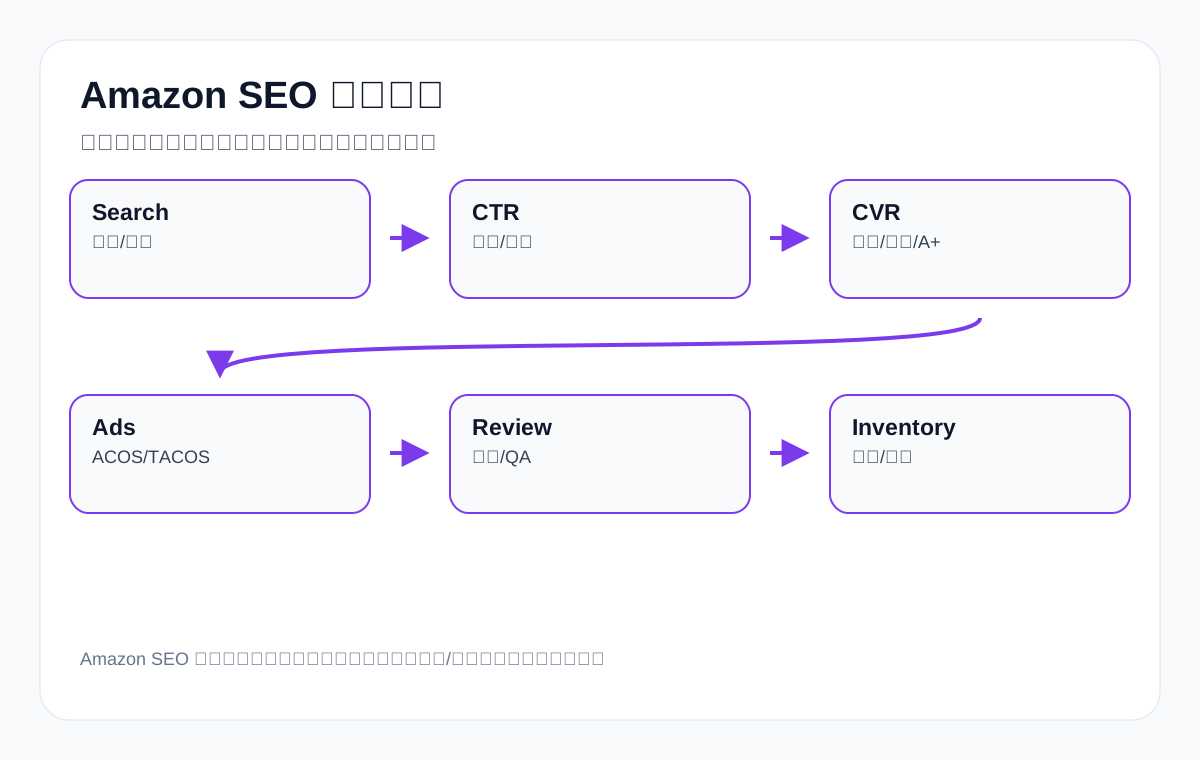
Conversion rate and ranking: Amazon SEO cannot look only at keywords
+
Amazon search performance is closely tied to purchasing behavior. If no one clicks after an impression, the title, main image, price, or reviews may be weak; if people click but do not buy, the bullet points, images, A+, price, reviews, variations, inventory, or fulfillment may have problems. SEO optimization has to be done together with conversion rate optimization.
+
+
| Metric | Possible problem | Action |
|---|---|---|
| Low impressions | Insufficient relevance, category coverage, or keyword coverage | Check the title, search terms field, attributes, and advertising terms |
| Low CTR | Weak main image, title, price, or reviews | Test the main image and title; optimize price and reviews |
| Low CVR | Insufficient bullet points, images, A+, reviews, Q&A | Add selling points, objection handling, and evidence |
| High advertising ACOS | Term mismatch or weak Listing conversion | Negate terms, restructure ad groups, optimize the Listing |
| Many returns/negative reviews | Insufficient expectation management | Add size, material, and usage boundaries |
| Stockouts | Inventory affects the sales rhythm | Align inventory forecasting with the advertising rhythm |
+
+
Export product Listing example: ceramic dinnerware
+
| Element | What to emphasize | Example direction |
|---|---|---|
| Title | Material, piece count, scenario, safety | Ceramic Dinnerware Set, 16-Piece, Dishwasher Safe |
| Bullets | Durability, easy cleaning, set contents, applicable scenarios | restaurant, home, gift, microwave safe |
| Images | Set contents, dimensions, dining table scenario, packaging | plate/bowl/mug dimensions |
| A+ | Collection comparison, glaze, use and care | care guide and collection comparison |
| Reviews/Q&A | Breakage, color, size, cleaning | Add packaging and size explanations |
+
+
Export product Listing example: waterproof connector
+
| Element | What to emphasize | Example direction |
|---|---|---|
| Title | IP rating, pin, wire gauge, use | IP67 Waterproof Connector 4 Pin for Outdoor Cable |
| Bullets | Waterproofing, compatibility, installation, material, application | outdoor lighting, marine, industrial equipment |
| Images | Size chart, wiring diagram, application image | pin layout and cable diameter |
| A+ | Selection table and installation steps | IP rating comparison |
| Backend | Synonyms and scenario terms | cable connector, outdoor electrical connector |
+
+
Common misconceptions
+
- Repeating and stuffing keywords in the title, which hurts readability.
- Writing only features in the bullet points without explaining buyer benefits.
- Using only white-background images, with no dimensions, scenarios, or comparisons.
- Repeating the bullet points in A+ Content without resolving purchase doubts.
- Repeating title terms in the search terms field or filling it with irrelevant terms.
- Looking only at ranking, not at CTR, CVR, advertising, and reviews.
- Failing to update the Listing based on negative reviews and Q&A.
- Translating from Chinese thinking directly into English, producing wording that does not match overseas buyer habits.
+
+
FAQ: common Amazon SEO questions
+
Is the title the most important thing in Amazon SEO?
The title is very important, but it is not the only factor. The title affects relevance and clicks, while the bullet points, images, A+, price, reviews, inventory, and conversion rate all affect the final performance.
+
Should bullet points contain keywords?
Relevant keywords can be included naturally, but the more important job of the bullet points is to persuade buyers. Each bullet should answer one purchase doubt or highlight one specific benefit.
+
Is a longer search terms field always better?
No. The search terms field should supplement synonyms and long-tail terms, and avoid repetition, irrelevant terms, and infringing brand terms.
+
Does A+ Content directly improve ranking?
A+ mainly affects conversion and brand persuasion. It can indirectly help performance by improving page experience and purchase decisions, but it cannot replace the title, bullet points, images, and reviews.
+
How often should an Amazon Listing be reviewed?
During the launch period, check advertising and conversion data every 1–2 weeks; once things stabilize, review keywords, CTR, CVR, reviews, Q&A, and inventory monthly.
+
How should negative reviews be used for SEO optimization?
Negative reviews can expose expectation management problems. If buyers misunderstand size, material, installation, or the scope of use, explain it more clearly in the title, bullet points, images, or A+.
+
Where do Chinese factories most easily go wrong with Amazon SEO?
A common mistake is translating factory specs directly into a Listing, with no buyer benefits, use scenarios, image expression, or review feedback loop.
+
Can Amazon SEO guarantee sales?
No. Sales are affected by price, reviews, inventory, advertising, competition, fulfillment, and product strength. SEO can improve the foundation for a Listing to be understood and to convert, but it cannot promise results.
+
+
Compliance and risk: Amazon SEO must not sacrifice account safety
Listing optimization must follow platform rules and category requirements. Do not write irrelevant keywords, competitor brand terms, unprovable certifications, exaggerated efficacy, misleading dimensions, or fake reviews for search traffic. Short-term clicks may increase, but in the long run this brings complaints, negative reviews, takedowns, and account risk.
| Risk | Sign | Consequence | Correct approach |
|---|---|---|---|
| Irrelevant keywords | Stuffing unrelated terms into the title or search terms field | Poor conversion, poor experience | Use only genuinely relevant terms |
| Competitor brand terms | Borrowing someone else’s brand traffic | Risk of infringement and complaints | Use your own brand and generic terms |
| Exaggerated certifications | Claiming certification without documents | Risk of misleading and takedown | Claim only what can be proven |
| Exaggerated features | Writing effects that cannot be verified | Negative reviews and compliance risk | State the applicable boundaries clearly |
| Misleading images | Dimensions, quantity, or scenario do not match the real product | Returns and negative reviews | Keep the main image and lifestyle images accurate |
Minimum viable standard for Amazon SEO
If resources are limited, at least complete one minimum standard first: the title covers the main keyword and core attributes, the bullet points answer purchase doubts, the images include the main image, dimensions, scenarios, and packaging, A+ does not repeat the bullet points, the search terms field adds synonyms, reviews and Q&A are reviewed monthly, and advertising search terms feed back into the Listing.
| Standard | Minimum requirement | Verification method |
|---|---|---|
| Title | Main term, attributes, and scenarios readable | Check search results on a phone |
| Bullet points | One benefit and one piece of evidence per bullet | Are buyer doubts answered |
| Images | Main image, dimensions, scenarios, packaging | Swipe check on mobile |
| A+ | Comparison, FAQ, brand, and scenarios | Does it add information beyond the bullet points |
| Review | CTR, CVR, advertising, reviews, inventory | Monthly records |
FAQ supplement: more practical Amazon SEO questions
Is it better to put title keywords as early as possible?
Core terms should be as early as possible, but not at the expense of readability and category rules. The front of the title should let buyers understand the product quickly, not just stack terms.
Do images affect Amazon SEO?
Images affect clicks and conversion, which in turn affect Listing performance. The main image, size chart, lifestyle image, and packaging image can all reduce misunderstandings and improve purchase confidence.
Is poor advertising performance always a keyword problem?
Not necessarily. It may be a main image, title, price, review, bullet point, A+, inventory, or fulfillment problem. Judge it together with CTR and CVR.
Should an old Listing be rewritten?
If sales are stable, a one-time overhaul is not recommended. You can first test the title, images, and bullet points step by step based on advertising terms, negative reviews, Q&A, and conversion data.
This minimum standard helps sellers first solidify the foundational positions that most affect search and conversion, before moving on to more detailed advertising, review, and A/B test optimization.
Conclusion: Amazon SEO is the joint optimization of Listing relevance and conversion rate
+
Amazon SEO is not a keyword game; it is about letting buyers quickly judge in the search results and on the detail page whether a product suits them. The title is responsible for being found and clicked, the bullet points for explaining benefits and objections, the images for building visual trust, A+ for deepening the brand and scenarios, the search terms field for supplementing coverage, and reviews and Q&A for continuous feedback.
+
For Chinese export sellers and factories, whether the product is LED flood light, ceramic dinnerware, waterproof connector, or private label activewear, the starting point has to be real product data, the language of overseas buyers, and conversion data. Doing this cannot promise ranking or sales, but it can make the Listing clearer, more credible, and closer to the buyer’s purchase decision.
+
Official sources and Amazon SEO acceptance boundaries
An Amazon SEO article needs to distinguish between on-platform titles, bullet points, images, and keywords, and external search visibility. What Tianwen SEO Research can verify is content facts, product structure, page materials, and search reviews; it cannot present platform conversion or ranking as a controllable result.
| Official source | What it is used to verify | Boundary that must not be crossed |
|---|---|---|
| Google: Product structured data | Check the boundaries of structured fields such as product information, price, and reviews | Structured data does not guarantee rich results or platform conversion |
| Schema.org: Product | Understand product entity fields and their relationship to page facts | Schema fields cannot fabricate product facts |
| Google: Helpful content | Confirm whether the content solves real product selection, spec, and procurement questions | It cannot be keyword stuffing only |
| Google: SEO Starter Guide | Check the basics of titles, images, links, and body copy | Page optimization does not equal Amazon platform results |
| Search Console Performance report | Review real data about pages entered from external search | Do not write about search performance without data |
| GA4 events | Observe clicks, downloads, and inquiry events after a visit | Events cannot prove platform transactions |
Low-data period review table
| Review item | Record fields | How to write it during a low-data period |
|---|---|---|
| Search Console baseline | query, page, country, device, click, impression, date range | If GSC returns zero rows, write zero rows; do not extrapolate ranking, clicks, or impressions |
| GA4 events | Entry page, form, download, email click, WhatsApp, or other configured events | If events are not configured, write “to be configured”; do not infer inquiry results |
| Page eligibility | HTTP status, index/follow, canonical, sitemap, body text, internal links | Record only the current state; do not write a technical pass as a search result |
| Business boundaries | Executable actions, metrics to watch, next review date | Separate what has been observed, what is pending observation, and what cannot be promised |
The point of acceptance here is to record official sources, Search Console, GA4, page status, and business actions separately. What can be promised is checking, correcting, adding evidence, and building a review table; what cannot be promised is a specific search position, a specific AI citation, a specific number of inquiries, or a specific platform presentation.
Continue reading this set of SEO resources
If you are systematically working through SEO for an export website, it is worth continuing with the following articles. First clarify the relationships between crawling, indexing, content, links, and review, and then decide which page to change next.
- How to do Marketplace SEO: a guide to platform listing pages, seller pages, on-site search, and the inquiry path
- How to do YouTube SEO: a guide to titles, thumbnails, chapters, captions, and retention for export videos
- How to do content SEO: a guide to search intent, information gain, and indexable content
- How to do keyword research: a process for export product terms, search intent, and page mapping
- How to mine competitor keywords: from competitor pages and English product terms to inquiry opportunities
- How to choose keyword tools: choose by diagnosis scenario, not by following a tool list
{
“@context”: “https://schema.org”,
“@type”: “FAQPage”,
“mainEntity”: [
{
“@type”: “Question”,
“name”: “Is the title the most important thing in Amazon SEO?”,
“acceptedAnswer”: {
“@type”: “Answer”,
“text”: “The title is very important, but it is not the only factor. The title affects relevance and clicks, while the bullet points, images, A+, price, reviews, inventory, and conversion rate all affect the final performance.”
}
},
{
“@type”: “Question”,
“name”: “Should bullet points contain keywords?”,
“acceptedAnswer”: {
“@type”: “Answer”,
“text”: “Relevant keywords can be included naturally, but the more important job of the bullet points is to persuade buyers. Each bullet should answer one purchase doubt or highlight one specific benefit.”
}
},
{
“@type”: “Question”,
“name”: “Is a longer search terms field always better?”,
“acceptedAnswer”: {
“@type”: “Answer”,
“text”: “No. The search terms field should supplement synonyms and long-tail terms, and avoid repetition, irrelevant terms, and infringing brand terms.”
}
},
{
“@type”: “Question”,
“name”: “Does A+ Content directly improve ranking?”,
“acceptedAnswer”: {
“@type”: “Answer”,
“text”: “A+ mainly affects conversion and brand persuasion. It can indirectly help performance by improving page experience and purchase decisions, but it cannot replace the title, bullet points, images, and reviews.”
}
},
{
“@type”: “Question”,
“name”: “How often should an Amazon Listing be reviewed?”,
“acceptedAnswer”: {
“@type”: “Answer”,
“text”: “During the launch period, check advertising and conversion data every 1–2 weeks; once things stabilize, review keywords, CTR, CVR, reviews, Q&A, and inventory monthly.”
}
}
]
}
This page is machine-translated from the Simplified Chinese version and awaiting human review. It has not yet been proofread.