Content update tools are not meant to rewrite an existing article from scratch. For export businesses, the real problem to solve is: which pages are losing valuable exposure on English product terms, which pages have only become less compelling in their titles, which pages have been rendered obsolete by buyers’ new questions, which pages are competing with each other for the same queries, and which pages should be merged into a stronger product-line asset. Only after the cause of the decline is judged clearly do tools become decision support instead of a generator of more content noise.
This article is written for export manufacturers, factories and trading companies in China, and its examples use export English product terms such as custom metal parts, LED flood light, packaging machine, medical probe, cnc machining parts, ceramic dinnerware, waterproof connector, industrial valve supplier and private label activewear manufacturer. What we discuss is how to maintain content on product pages, category pages, application pages, blog tutorials, resource download pages and inquiry pages — not a tool list for peers.
Official source boundaries: content update tools must re-check page facts before deciding to refresh, rewrite or merge
Content update tools cannot decide for the team which page to delete, which to merge or which to rewrite. They can only help organize candidate pages, surface changes and record actions. The real judgment goes back to page facts: whether GSC has query/page row data, whether the URL is indexed, whether the canonical is correct, whether noindex is misused, whether redirects make sense, whether GA4 events can explain the visit path, and whether the page content still satisfies current purchasing intent.
For export websites, product-term pages such as custom metal parts, LED flood light, packaging machine, medical probe and waterproof connector should be reviewed against queries, page type and sales feedback before any update. Tools can help organize the gaps, but they cannot replace GSC, GA4, crawl checks and human review.
Official sources and content update fields: mapping table
| Official source | What it is used to re-check | What it cannot establish directly |
|---|---|---|
| Google Search Central: Creating helpful, reliable, people-first content | Whether the page is still helpful, reliable and people-first | Cannot decide a rewrite or a deletion from a tool score alone |
| Google Search Central: Search Essentials | Baseline boundaries for crawling, indexing, content and spam | Cannot replace troubleshooting on a specific URL |
| Google Search Central: SEO Starter Guide | Titles, content organization, links, images and basic SEO actions | Cannot establish that an update will produce external results |
| Search Console Help: Performance report | query, page, country, device, clicks, impressions, CTR, position | Cannot fabricate trends from pages with no row data |
| Search Console Help: URL Inspection tool | Crawlability, indexing, resources and enhancement status of a single URL | Cannot replace long-term performance review |
| Search Console Help: Page indexing report | Whether pages enter the index and why they are excluded | Cannot directly determine a page’s business value |
| Google Search Central: Consolidating duplicate URLs | Whether duplicate pages, merged pages and canonicals are clear | Cannot replace judgment about content differences |
| Google Search Central: Redirections and Google Search | Redirect relationships after pages are merged or migrated | Cannot merge unrelated pages at will |
| Google Search Central: noindex guidelines | Whether indexing should be blocked and whether important pages are hit by mistake | Cannot treat noindex as the default content cleanup action |
| Google Search Central: Sitemaps overview | Whether priority URLs are still submitted and discovered | Does not mean the page will recover its performance |
| Google Search Central: robots.txt introduction | Whether crawl paths are blocked | Cannot replace indexing and content checks |
| Google Search Central: Structured data general guidelines | Whether updated structured data still follows the guidelines | Does not mean search or AI answers will use the page |
| Google Analytics Help: About events | On-site events such as product page entry, downloads, contact and RFQ | Cannot replace Search Console query data |
| Google Search Central: AI features and your website | The basic relationship between page content, preview controls and AI features | Cannot establish how AI answers will present results |
| OpenAI Platform: Bots | Access rules for OpenAI-related crawlers and where to identify them in logs | Cannot replace page quality and GSC data |
| IndexNow: Documentation | URL update notification capability and submission records | Does not mean the URL will be adopted by search systems |
Content update acceptance criteria: tool suggestions must turn into reviewable actions
| Action | Acceptance fields | Delivery boundary |
|---|---|---|
| Partial refresh | Old content, missing questions, new sections, go-live date, review date | Delivers page changes; does not promise external search positions |
| Rewrite | Target queries, page type, competitor structure, product terms, FAQ, internal links | Delivers content structure and readability; does not replace long-term GSC review |
| Merge | Kept URL, merged URLs, canonical, redirects, internal link fixes | Delivers technical relationships and content consolidation; does not merge different purchasing intents at will |
| noindex or keep and observe | Index status, page value, sales feedback, replacement pages | Delivers the basis for the decision; does not treat noindex as the default cleanup method |
| Post-update review | Day 7/14/30/60/90 GSC, GA4, inquiry quality and next actions | Write data where data exists; write baselines and open items where it does not |
How to downgrade content update tool conclusions when there is no GSC data
If the site currently has no usable GSC query/page row data, a content update report can only document page baselines: which URLs are update candidates, whether pages are index/follow, whether they are in the sitemap, whether robots blocks them, whether the canonical is clear, whether the page has duplicate or outdated content, and whether GA4 events record the visit path. It cannot claim click recovery, ranking changes, AI answer presentation or inquiry improvement.
A qualified deliverable should turn tool suggestions into a reviewable checklist: what was changed this time, why it was changed, which English product term or application term it maps to, when it will be reviewed after go-live, and which fields the review will look at. That is what makes a content update tool part of a judgment system rather than an automatic rewrite button.
Top 1 and authority benchmark comparison: what we need to beat
In the current English SERP, Ahrefs’ content decay guide is one of the most worthwhile authority benchmarks. It defines content decay as a page’s organic traffic and rankings gradually declining over time, and stresses judging whether an update is worthwhile from Top Pages, traffic decline, keyword difficulty, content gaps, update history and follow-up monitoring. Content pruning articles such as those from Single Grain and seo.software put more emphasis on choosing between rewrite, merge and delete. Tool-oriented pages such as Frase Content Guard, Refresh Agent and RobotSpeed focus on monitoring, automatically generating update suggestions and connecting to a CMS. Their shared strength is clear concepts, explicit tool paths and easy, fast understanding for content teams.
The gaps in these pages are also obvious: most examples lean toward English SaaS, media sites or general content teams, and are not close enough to the product pages, category pages, RFQs, specifications, MOQ, certifications, application scenarios and sales follow-up of Chinese export businesses; many articles say “update old articles” without separating falling clicks, falling impressions, falling CTR, falling average position, falling inquiry quality and missing AI answers; and they rarely explain when you should not update but instead merge, downweight, redo the page intent or fix indexing first. This article aims to fill those gaps.
| Benchmark dimension | Common practice in authority content | How this article strengthens it |
|---|---|---|
| Concept definition | Explains content decay, ranking decline and traffic loss | Adds export product terms, inquiry value, product line life cycle and AI citation dimensions |
| Tool selection | Recommends Ahrefs, GSC and content gap tools | Splits tools into five categories: discover, diagnose, decide, execute, review |
| Update actions | Mostly discusses update or rewrite | Clarifies the boundaries of refresh, rewrite, merge, downweight, redirect and keep and observe |
| Example scenarios | Mostly blog or SaaS content | Uses export scenarios such as LED flood light, cnc machining parts and packaging machine |
| Review metrics | Looks at ranking and traffic recovery | Also looks at GSC, GA4, inquiry sources, sales feedback and AI citation accuracy |
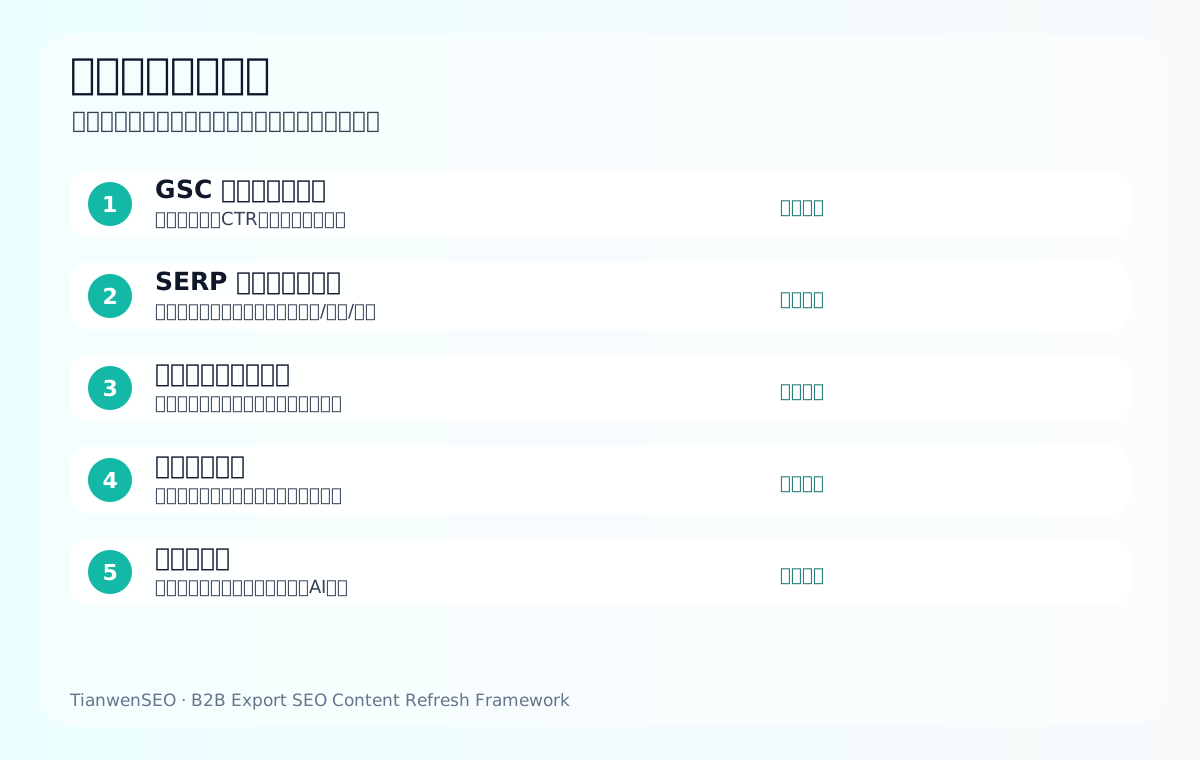
1. Start by understanding “content update tools” as a judgment system
When export businesses choose content update tools, the most common mistake is to ask first “which tool can automatically rewrite articles”. The better question is: can this tool help me judge why a page weakened, can it map causes to actions, and can it avoid damaging valuable URLs?
For example, a waterproof connector manufacturer may have an article that used to bring inquiries through waterproof connector IP67, M12 waterproof connector and waterproof connector for outdoor lighting. A later drop in clicks does not necessarily mean the article is outdated. It could be that the SERP now shows more videos and images, that the title no longer reads like a purchasing guide, that a competitor added a specification table, or that another article you published is taking the same queries.
So tools need layers: GSC to spot changes, GA4 to see visit behavior, crawling tools to see whether the page can be understood reliably, keyword and SERP tools to see demand shifts, content editing tools to help fill out structure, and spreadsheets or project management tools to record actions and owners. A single rewriting tool can hardly complete the whole judgment.
| Tool category | Problem it solves | How export sites use it |
|---|---|---|
| GSC | Changes in queries, pages, clicks, impressions, CTR and average position | See whether product terms such as custom metal parts and LED flood light are declining |
| GA4 | User behavior, conversion paths, inquiry entry points | See whether content pages move users to product pages and RFQ |
| Crawling tools | Titles, status codes, canonical, internal links, images, structured data | Judge whether pages are discovered and understood reliably |
| SERP/keyword tools | Currently ranking pages, intent, competitor coverage | See whether purchasing intent has shifted from explanation to selection comparison |
| Content assist tools | Gap organization, section expansion, FAQ additions | Assist only; do not replace business judgment |
2. Content decay is not the same as traffic decline: separate five kinds of decline first
Many export websites rewrite an entire article the moment traffic drops. This is risky, because different kinds of decline require completely different actions. Falling clicks may only be a CTR problem, falling impressions may be an indexing or demand coverage problem, falling rankings may mean competitors have more complete content, falling inquiries may mean the page attracts the wrong audience, and missing AI answers may mean the page lacks quotable definitions and structure.
Take packaging machine as an example. If a page loses impressions on terms such as automatic packaging machine, small packaging machine for food and powder packaging machine, first check whether those queries are still handled by the same type of page. If the SERP has moved from “what is a packaging machine” to “how to choose a packaging machine for different materials”, the article needs to change from a primer into a selection guide. If only CTR fell, it may be better to change the title, the opening paragraph and the comparison table first rather than rewriting the whole text.
| Decline type | Data pattern | First thing to check | Possible action |
|---|---|---|---|
| Falling clicks | Impressions stable but clicks down | Title, snippet, SERP features, competitor titles | Change the title, add an above-the-fold answer, strengthen the FAQ |
| Falling impressions | Fewer impressions on core queries | Indexing, intent shift, content gaps | Rewrite the structure or add key modules |
| Falling rankings | Average position worsens | Whether competitors updated, links and content depth | Close gaps, strengthen evidence, internal links |
| Falling conversion | Traffic is not low but inquiries are few | Whether the audience is browsing for information or comes from low-value regions | Adjust CTAs, product entry points, scenario explanations |
| Missing from AI | Ranks in search but AI answers do not cite it | Definitions, tables, evidence, entity consistency | Add extractable answers and data structure |
3. Export websites must layer page value before updating
Not every page deserves the same effort. Export site resources should go first to pages that influence inquiries and product line trust: core product pages, category pages, application pages, selection guides, troubleshooting pages, resource pages and case-based explanation pages. Low-value general articles may bring some traffic but are not necessarily worth rewriting into long-form content.
For example, if a ceramic dinnerware factory has a “tableware care tips” article losing traffic, it may not need a major change; but if the category pages and selection pages targeting “ceramic dinnerware wholesale”, “custom ceramic dinnerware manufacturer” and “stoneware dinnerware set bulk” are declining, those should be handled first, because they directly affect inquiries.
Page value layering also depends on the state of the product line. If a product is no longer a priority, the page can keep basic information without heavy expansion; if a product is a key export direction for the next two years, it is worth building a more complete search entry through content updates even if current traffic is low.
| Page type | Business value | Update priority | Judgment metric |
|---|---|---|---|
| Core product page | High | Highest | Inquiry product terms, conversion path, sales feedback |
| Product category page | High | Highest | Category terms, specification terms, supplier terms |
| Application page | Medium-high | High | Industry terms, solution terms, purchasing questions |
| Technical blog | Medium | Ranked by query value | Whether it can lead to product pages |
| General knowledge article | Low to medium | Cautious | Whether there is a clear product entry and inquiry value |
4. Tool choice one: GSC finds the change; it does not decide the action for you
Google Search Console is the first entry point for content updates, but it can only show you symptoms, not tell you the action directly. You can use it to filter for falling clicks, falling impressions, falling CTR, changes in query structure and page-query mismatches, but you cannot decide on a rewrite from a single declining number.
Start by exporting pages for the last 3 months against the previous period, then check by query which terms the decline comes from. For export sites in particular, separate brand terms, product terms, specification terms, industry application terms, country and region terms, and low-value learning terms. For an LED flood light page, a decline in “what is led flood light” may have low commercial impact; a decline in “200w led flood light supplier” or “led flood light manufacturer china” is much higher priority.
GSC also shows whether a URL is picking up the wrong queries. For example, if a blog post suddenly gains many “seo service” queries, that has no value for an export product business; but if a waterproof connector application page shows queries such as outdoor lighting connector, marine waterproof plug and IP68 cable connector, it means the page can be expanded into application and selection content.
| GSC field | How not to misread it | Correct use |
|---|---|---|
| Clicks | Few clicks means rewrite | First check whether impressions and CTR moved together |
| Impressions | Falling impressions means change the title | First check whether the query disappeared or moved to another URL |
| CTR | Low CTR means a bad title | Also check whether the SERP has images, ads or AI answers |
| Average position | Worse position means bad content | Distinguish a few high-ranking terms from a large number of long-tail terms |
| Queries | Chase every query that appears | Chase only queries with purchasing meaning or that support the product line |
5. Tool choice two: GA4 judges visit quality and the inquiry path
Content updates cannot rely on search data alone. For export businesses, the final judgment is whether the page moves the right buyers to the next step. GA4 helps you see time on page, scrolling, outbound clicks, forms, WhatsApp and email clicks, product page navigation and the inquiry path.
For example, a selection article for a private label activewear manufacturer may perform well in search but produce visits that never reach the product or contact pages, which may mean the article is too general and lacks what buyers care about: MOQ, fabric, sampling lead time, sizes, packaging, certifications and production capacity. In that case the update is not more SEO jargon but more purchasing decision modules.
The point of GA4 is to turn “traffic recovery” into “business quality recovery”. If a page gains clicks after an update but inquiries get worse, it is attracting learners or low-budget visitors; if clicks do not rise much but the inquiries are clearer, the products match better and sales response rates are higher, that is the better update.
| GA4 signal | What it may indicate | Update direction |
|---|---|---|
| Low rate of entry to product pages | The article and the product entry points are disconnected | Add product category, specification and application entry points |
| Few form starts | CTA unclear or trust is insufficient | Add quote preparation, certifications, delivery information |
| Short time on page | The above-the-fold answer does not match | Rewrite the opening paragraph and the outline |
| Deep scrolling but no conversion | Information is useful but the next step is weak | Add comparison tables, downloadable resources, contact entry points |
| Poor inquiry quality | Audience mismatch | Narrow the title and examples to the target buyer |
6. Tool choice three: crawling tools find technical obstacles
If the page itself is not crawled and understood reliably, even excellent content struggles to work. Crawling tools should check status codes, canonical, noindex, duplicate titles, missing descriptions, internal link depth, image alt text, structured data, mobile visibility and rendering issues.
If modules such as JavaScript, lazy loading, collapsed content, product parameter tables, FAQ and downloadable resources are invisible from a crawling perspective, search engines and AI answer systems may not be able to understand the page fully. A common problem on export sites is that product parameters sit in images, application scenarios sit in carousels and FAQ sits in interactive components, leaving very little readable content on the page.
So before deciding to rewrite, rule out technical problems first. For example, falling impressions on an industrial valve supplier category page may not be outdated content but a new navigation that reduced internal links, pagination canonicalized incorrectly, images too large that slow loading, or important product models missing from the HTML text.
| Check item | Risk | Recommended handling |
|---|---|---|
| Status code | Intermittent 404/500 on the page | Fix stable access first |
| canonical | Signals point to the wrong URL | Correct the canonical address |
| Internal link depth | Important pages are too far from the homepage | Add category page and article entry points |
| Image text | Parameters exist only in images | Add text tables and alt |
| Structured data | FAQ/product information is unclear | Add valid markup that matches the real content |
7. When a partial refresh is enough
A partial refresh suits pages whose basic structure is still correct, whose core queries still match, whose URL has historical signals and whose content is only partly outdated. Common partial refreshes on export sites include updating the year, adding new specifications, adding certification changes, adding delivery lead time explanations, adding purchasing questions, updating comparison tables and adding new internal links.
For example, a post titled “How to choose LED flood light for warehouse” still satisfies warehouse lighting selection intent but lacks the energy efficiency standards, mounting height, beam angle, IP rating and warranty explanations common in 2026. It should be partially refreshed rather than turned into a completely different “LED lighting encyclopedia”.
A partial refresh should preserve the core intent of the original URL; do not shift the page just because you see new keywords. The baseline of content updating is to make the page serve more accurately the people it was meant to serve, not to stuff every related need into one page.
| Signals that suit a partial refresh | Signals that do not | Action |
|---|---|---|
| A small ranking decline | Intent has already changed | Add facts, FAQ, tables |
| Falling CTR | The page no longer covers the core need | Change the title and the opening paragraph |
| Outdated data | Multiple URLs compete for the same terms | Update the year and parameters |
| Competitors added a new module | The product line is no longer a priority | Add a similar module with export scenarios |
| Insufficient internal links | Indexing anomalies | Add related product and resource entry points |
8. When a rewrite is needed
A rewrite suits situations where the page’s original structure can no longer satisfy current search intent. You do not rewrite because the word count is low, but because the questions the page answers, the section order, the examples, the evidence and the next action no longer suit the target buyer.
For example, a “cnc machining parts guide” used to explain only what CNC machining is, while the top of the SERP now answers material selection, tolerances, surface finishing, DFM, MOQ, prototyping, mass production, quality inspection and quote preparation. Adding a few paragraphs is not enough at that point; it should be rewritten as a purchasing decision guide.
Before rewriting, preserve the page’s historical advantages: existing ranking terms, backlinks, internal links, the URL users know and the original high-value sections. A rewrite is not a demolition but a reorganization of the page around current intent, so that buyers can move from problem, judgment and comparison to resource preparation and the inquiry path.
| Rewrite trigger | Export example | Rewrite focus |
|---|---|---|
| Search intent changed | packaging machine moved from definition to selection | Redo the outline and the above-the-fold answer |
| Competitor coverage is more complete | medical probe page lacks certifications and applications | Add parameters, certifications, applications and FAQ |
| The original is too general | waterproof connector explains concepts only | Add IP rating, cable diameter, scenarios, quote materials |
| The structure cannot expand | Old sections are messy and cannot support long-tail terms | Rebuild H2/H3 and tables |
| The conversion path is broken | Readers do not know what to prepare for a quote | Add a quote checklist and product entry points |
9. When to merge instead of adding more pages
Merging suits situations where multiple pages cover the same or highly similar queries, splitting signals, confusing internal links and leaving users unsure which page to read. After long-term publishing, export sites easily end up with several articles covering the same product selection, the same application scenario or the same set of specification terms.
For example, if a ceramic dinnerware site has three posts — “ceramic dinnerware wholesale guide”, “stoneware dinnerware wholesale” and “custom dinnerware manufacturer guide” — and they all compete for ceramic dinnerware wholesale, custom ceramic dinnerware manufacturer and bulk dinnerware supplier, you should judge whether to merge them into one stronger purchasing guide and redirect the weaker pages or turn them into more specific sub-intents.
Merging is not simple concatenation. Choose the strongest URL to carry the core intent, integrate the valuable sections, FAQ, images, internal links and query coverage from the other pages, then handle redirects, internal link updates, sitemaps and review.
| Merge signal | How to judge | Execution point |
|---|---|---|
| Multiple URLs share the same queries | Look at page distribution by query in GSC | Choose the strongest URL |
| Highly duplicated content | Compare titles, H2s, FAQ and examples | Keep the differentiating sections |
| Scattered internal links | On-site links point to several similar entry points | Unify the main entry point |
| Sales cannot tell them apart | Inquiry source pages mean similar things | Rename by product line |
| All rankings are middling | Each page is weaker than a competitor’s comprehensive guide | Combine into one strong page |
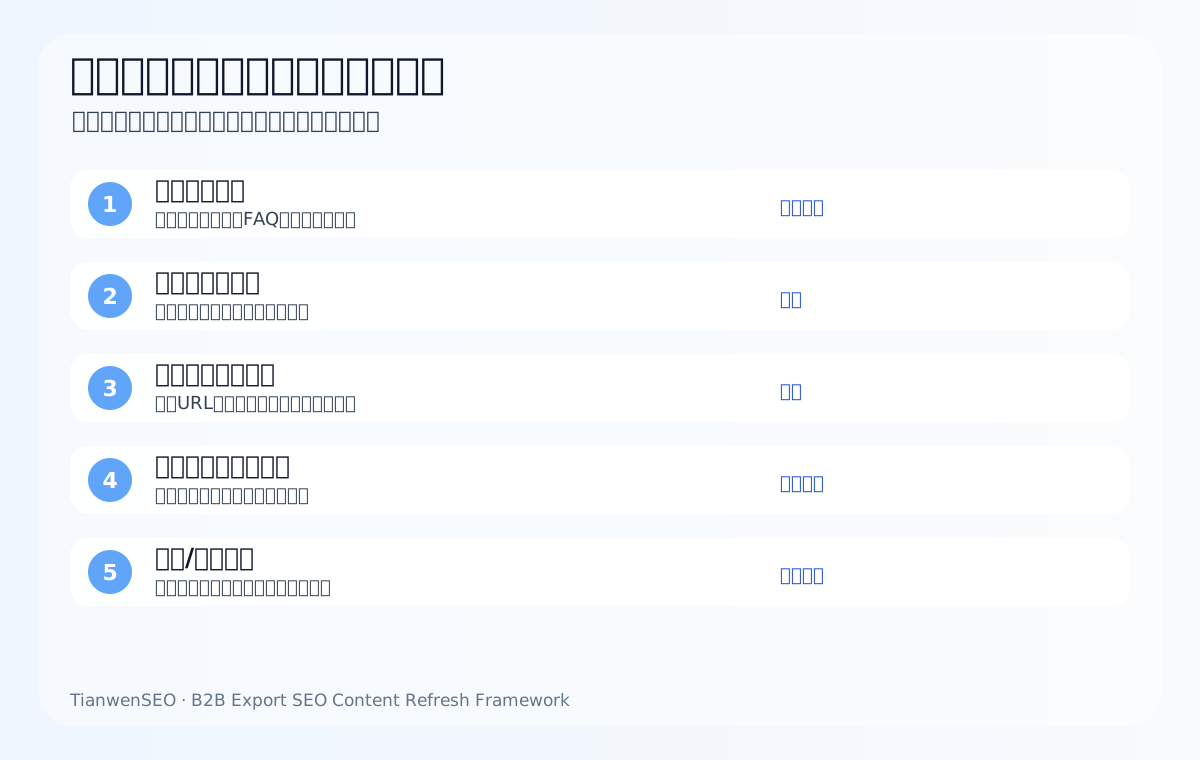
10. When to consider downweighting or noindex
Some pages are not worth pursuing search exposure any further. They may have no commercial value, be thin on content, belong to a discontinued product line, attract the wrong audience, duplicate core pages, or have no effective queries over the long term. Continuing to expand such pages dilutes site quality.
Downweighting requires care, especially for pages that already have backlinks, historical inquiries or important internal link entry points. Before handling them, check whether there is transferable value: can they be merged into a product page, redirected to a more relevant category page, turned into a resource page, or kept for users but excluded from search?
For example, an industrial valve site may have many early short posts that only explain “what a valve is”, with no models, materials, pressure, applications, standards or quote materials, and no effective queries. If such pages cannot be upgraded into a real purchasing guide, consider merging them or excluding them from search instead of continuing to spend maintenance effort.
| Page state | Recommended action | Notes |
|---|---|---|
| No traffic, no inquiries, no internal links | Merge or downweight | First confirm there is no backlink value |
| Discontinued product line | Keep an explanation or point to a replacement product | Avoid misleading buyers |
| Duplicate of a strong page | Merge and redirect | Update internal links |
| Low-quality general knowledge | No need to force expansion | See whether it can become a purchasing FAQ |
| Attracts the wrong audience | Narrow it or downweight | Avoid wasting sales time |
11. Content update tool combinations: a lightweight setup for export businesses
Export businesses do not necessarily need expensive tools from day one. A workable lightweight combination is: GSC for query and page changes, GA4 for visit paths, Screaming Frog or a similar crawling tool for technical issues, manual Google SERP checks for the current top pages, a spreadsheet to record page status and actions, and content assist tools to organize gaps and FAQ.
If budget allows, you can add Ahrefs, Semrush, Sitebulb, ContentKing, Frase, Surfer, Clearscope or similar tools for keyword trends, content gaps, competitor changes, real-time monitoring and editing assistance. But the more tools you have, the more you need unified judgment criteria; otherwise each tool gives a score and the team still does not know what to fix first.
When choosing tools, do not just ask “can it generate articles”; ask whether it can import GSC/GA4, show historical changes by URL, show the current SERP, distinguish update, merge, rewrite and downweight, and output a reviewable task record.
| Budget stage | Tool combination | Best fit |
|---|---|---|
| Basic stage | GSC + GA4 + manual SERP checks + spreadsheet | Export sites with few pages |
| Intermediate stage | Add crawling and keyword tools | Sites with more product lines |
| Scale stage | Add content gap and monitoring tools | Many articles and category pages |
| AI-assisted stage | Add content assist and citation monitoring | Need to maintain AI search visibility |
| Team stage | Add task management and change records | Multiple people maintaining content assets |
12. Export product term examples: how to decide what a page should become
Content updates must land on specific English product terms. The following typical export industries show how the same decline maps to different actions in different product scenarios.
If a custom metal parts page declines, check whether buyers need materials, tolerances, surface finishing, samples, mass production and quality inspection information; if an LED flood light page declines, check wattage, color temperature, beam angle, waterproof rating, mounting height and application scenarios; if a packaging machine page declines, check materials, speed, packaging format, automation level and after-sales service; if a medical probe page declines, check certifications, materials, sterilization, compatible devices and quality systems.
| Industry term | High-value queries | Update focus |
|---|---|---|
| custom metal parts | custom metal parts manufacturer, cnc machining parts supplier | Materials, tolerances, surface finishing, DFM, quote materials |
| LED flood light | 200w led flood light supplier, outdoor led flood light | Wattage, waterproofing, installation, certifications, warranty |
| packaging machine | powder packaging machine, automatic packaging machine | Materials, speed, bag type, automation, maintenance |
| medical probe | medical probe manufacturer, ultrasound probe cable | Certifications, compatibility, materials, testing |
| ceramic dinnerware | ceramic dinnerware wholesale, custom dinnerware manufacturer | Material, glaze color, packaging, MOQ, customization |
13. Update execution checklist: from exporting data to post-launch review
Content updates can follow a stable process: export data, filter pages, determine the decline type, re-check the SERP, inspect technical issues, decide the action, write the update note, publish, submit for crawling, review. Each step has a clear output; do not make changes by feel.
Keep an update record card for each page, noting the target query, page type, reason for the update, benchmark pages, action type, change summary, go-live date, review date, GSC performance, GA4 path, inquiry quality and next step. Then three months later you can see which actions worked and which merely wasted time.
| Step | Output | Acceptance criteria |
|---|---|---|
| Export data | Page and query change table | Clicks/impressions/CTR/position changes are visible |
| Filter pages | Priority queue | Sorted by business value |
| Re-check SERP | Benchmark card | You know where the top pages are strong |
| Technical check | Crawl issue list | Indexing and visibility problems are ruled out |
| Decide the action | Refresh/rewrite/merge/downweight | Each action maps to a reason |
| Publish and review | Update records and metrics | Tracked at 7/14/30/60/90 days |
14. Common pitfalls: why so many content updates make things messier
Pitfall one: treating a tool score as the final judgment. Content tool scores can only hint at coverage gaps; they cannot judge product line value, inquiry quality or sales feedback.
Pitfall two: rewriting the whole text whenever traffic falls. A full rewrite can destroy the structure that was ranking, especially when the URL already has stable queries.
Pitfall three: making every page longer. On export sites some pages need to be clearer, some need to be more complete, and some need to be merged; not every page suits long-form content.
Pitfall four: updating only the date and a few sentences. Search engines and buyers both need substantive improvement; changing the date alone does not make a page more useful.
Pitfall five: using your own industry terms in examples. A tutorial written for export businesses should illustrate with export English product terms, purchasing questions, product pages and inquiry paths.
| Pitfall | Consequence | Fix |
|---|---|---|
| Looking only at tool scores | Business value is ignored | Add product line and inquiry judgment |
| Rewriting everything when traffic falls | The existing query structure is damaged | Determine the decline type first |
| Lengthening every page | Maintenance resources are wasted | Decide depth by page role |
| Changing only the date | No substantive improvement | Add facts, tables, FAQ, paths |
| Examples that are not close to export | Clients cannot relate | Use English product terms and purchasing scenarios |
15. Post-update review metrics: do not look at rankings alone
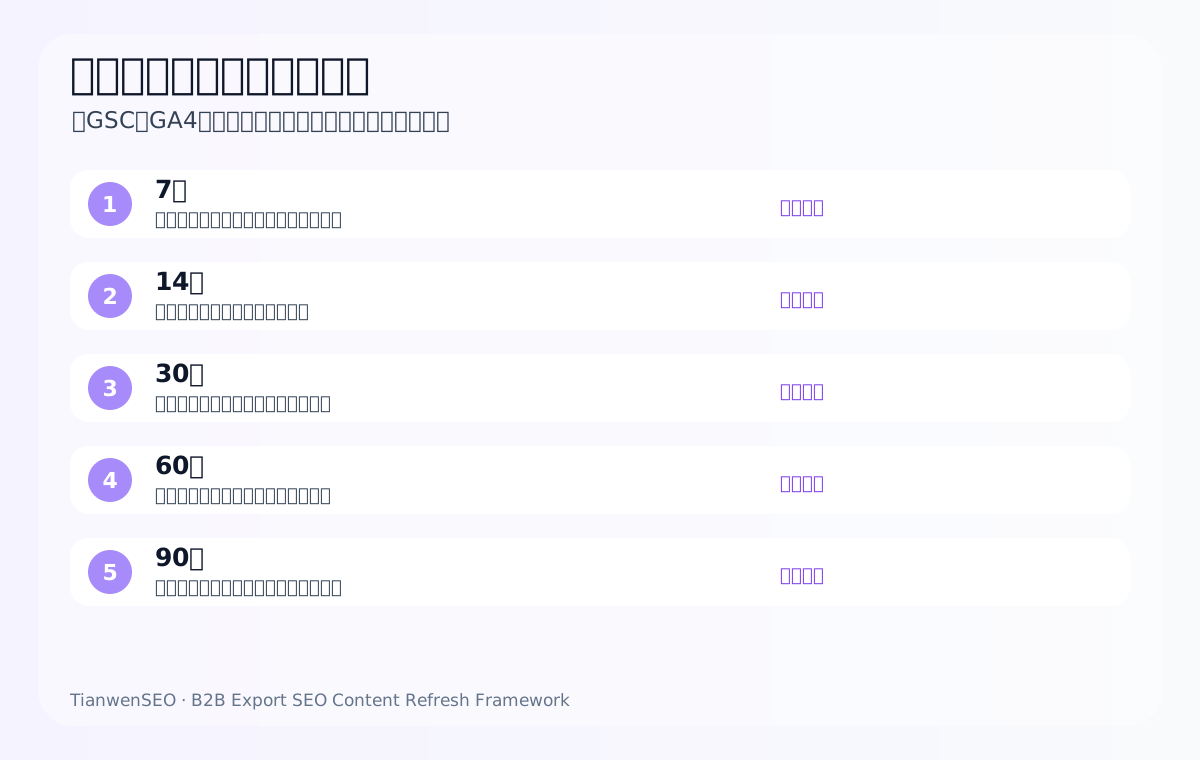
Review after publishing should be staged. Within 7 days, check whether the page is accessible, whether it is crawled, whether the title displays normally, whether images load and whether internal links work. At 14 days, check whether GSC impressions are recovering. At 30 days, check query coverage and visit paths. At 60 days, check inquiry quality. At 90 days, decide whether to keep expanding, merge a second batch, or keep observing.
AI search visibility should also be part of the review, but you cannot promise citations. The safer approach is to check whether the page has clear definitions, tables, steps, FAQ, entity consistency, product facts and credible sources. If AI tools cite incorrect information, go back and add clearer statements to the page rather than chasing appearances.
| Timing | What to look at | How to judge |
|---|---|---|
| 7 days | Access, indexing, title, images, internal links | Technical re-check passes |
| 14 days | Impressions and core queries | Whether coverage starts to recover |
| 30 days | Clicks, CTR, page paths | Whether the right audience is attracted |
| 60 days | Inquiry products, countries, quality | Whether sales feedback matches better |
| 90 days | AI citations, ranking stability, next batch of actions | Decide to expand or merge |
Detail 1: GSC query grouping must land in the custom metal parts scenario
Take custom metal parts as an example. A content update is not about making the text sound more like a marketing pitch; it is about making the page answer the questions buyers are asking now more accurately. Look separately at manufacturer, supplier, tolerance, surface finish, prototype and bulk order. If the page only adds general explanations without purchasing judgment, clicks may recover slightly, but inquiry quality will not improve steadily.
When executing, you can group queries into informational, selection, specification, supplier, quote preparation and after-sales risk types. Informational questions go to explanations, selection questions go to tables, specification questions go to parameters, supplier questions go to trust proof, and quote preparation questions go to the inquiry checklist. That is how the updated page stays aligned with the business.
Detail 2: Handling falling CTR must land in the LED flood light scenario
Take LED flood light as an example. A content update is not about making the text sound more like a marketing pitch; it is about making the page answer the questions buyers are asking now more accurately. Titles should state wattage, application, waterproof rating and supplier attributes. If the page only adds general explanations without purchasing judgment, clicks may recover slightly, but inquiry quality will not improve steadily.
When executing, you can group queries into informational, selection, specification, supplier, quote preparation and after-sales risk types. Informational questions go to explanations, selection questions go to tables, specification questions go to parameters, supplier questions go to trust proof, and quote preparation questions go to the inquiry checklist. That is how the updated page stays aligned with the business.
Detail 3: Handling falling impressions must land in the packaging machine scenario
Take packaging machine as an example. A content update is not about making the text sound more like a marketing pitch; it is about making the page answer the questions buyers are asking now more accurately. Judge whether demand has shifted from definitions to selection by material and packaging format. If the page only adds general explanations without purchasing judgment, clicks may recover slightly, but inquiry quality will not improve steadily.
When executing, you can group queries into informational, selection, specification, supplier, quote preparation and after-sales risk types. Informational questions go to explanations, selection questions go to tables, specification questions go to parameters, supplier questions go to trust proof, and quote preparation questions go to the inquiry checklist. That is how the updated page stays aligned with the business.
Detail 4: Merge handling must land in the ceramic dinnerware scenario
Take ceramic dinnerware as an example. A content update is not about making the text sound more like a marketing pitch; it is about making the page answer the questions buyers are asking now more accurately. Reallocate the overlapping queries for wholesale, custom and manufacturer. If the page only adds general explanations without purchasing judgment, clicks may recover slightly, but inquiry quality will not improve steadily.
When executing, you can group queries into informational, selection, specification, supplier, quote preparation and after-sales risk types. Informational questions go to explanations, selection questions go to tables, specification questions go to parameters, supplier questions go to trust proof, and quote preparation questions go to the inquiry checklist. That is how the updated page stays aligned with the business.
Detail 5: Resource page updates must land in the medical probe scenario
Take medical probe as an example. A content update is not about making the text sound more like a marketing pitch; it is about making the page answer the questions buyers are asking now more accurately. Add certifications, compatible devices, testing processes and quality documentation. If the page only adds general explanations without purchasing judgment, clicks may recover slightly, but inquiry quality will not improve steadily.
When executing, you can group queries into informational, selection, specification, supplier, quote preparation and after-sales risk types. Informational questions go to explanations, selection questions go to tables, specification questions go to parameters, supplier questions go to trust proof, and quote preparation questions go to the inquiry checklist. That is how the updated page stays aligned with the business.
Detail 6: Category page updates must land in the waterproof connector scenario
Take waterproof connector as an example. A content update is not about making the text sound more like a marketing pitch; it is about making the page answer the questions buyers are asking now more accurately. Add IP rating, cable diameter, application scenarios and installation questions. If the page only adds general explanations without purchasing judgment, clicks may recover slightly, but inquiry quality will not improve steadily.
When executing, you can group queries into informational, selection, specification, supplier, quote preparation and after-sales risk types. Informational questions go to explanations, selection questions go to tables, specification questions go to parameters, supplier questions go to trust proof, and quote preparation questions go to the inquiry checklist. That is how the updated page stays aligned with the business.
Detail 7: Application page updates must land in the industrial valve supplier scenario
Take industrial valve supplier as an example. A content update is not about making the text sound more like a marketing pitch; it is about making the page answer the questions buyers are asking now more accurately. Organize content by industry working conditions, pressure, materials and standards. If the page only adds general explanations without purchasing judgment, clicks may recover slightly, but inquiry quality will not improve steadily.
When executing, you can group queries into informational, selection, specification, supplier, quote preparation and after-sales risk types. Informational questions go to explanations, selection questions go to tables, specification questions go to parameters, supplier questions go to trust proof, and quote preparation questions go to the inquiry checklist. That is how the updated page stays aligned with the business.
Detail 8: Selection page updates must land in the private label activewear manufacturer scenario
Take private label activewear manufacturer as an example. A content update is not about making the text sound more like a marketing pitch; it is about making the page answer the questions buyers are asking now more accurately. Add fabric, sizes, sampling, MOQ, packaging and lead time. If the page only adds general explanations without purchasing judgment, clicks may recover slightly, but inquiry quality will not improve steadily.
When executing, you can group queries into informational, selection, specification, supplier, quote preparation and after-sales risk types. Informational questions go to explanations, selection questions go to tables, specification questions go to parameters, supplier questions go to trust proof, and quote preparation questions go to the inquiry checklist. That is how the updated page stays aligned with the business.
Detail 9: AI citation review must land in the cnc machining parts scenario
Take cnc machining parts as an example. A content update is not about making the text sound more like a marketing pitch; it is about making the page answer the questions buyers are asking now more accurately. Write definitions, processes, decision tables and quote materials so they are easier to excerpt. If the page only adds general explanations without purchasing judgment, clicks may recover slightly, but inquiry quality will not improve steadily.
When executing, you can group queries into informational, selection, specification, supplier, quote preparation and after-sales risk types. Informational questions go to explanations, selection questions go to tables, specification questions go to parameters, supplier questions go to trust proof, and quote preparation questions go to the inquiry checklist. That is how the updated page stays aligned with the business.
Detail 10: Inquiry quality review must land in the LED flood light scenario
Take LED flood light as an example. A content update is not about making the text sound more like a marketing pitch; it is about making the page answer the questions buyers are asking now more accurately. Check whether post-update inquiries include wattage, quantity, installation scenario and target market. If the page only adds general explanations without purchasing judgment, clicks may recover slightly, but inquiry quality will not improve steadily.
When executing, you can group queries into informational, selection, specification, supplier, quote preparation and after-sales risk types. Informational questions go to explanations, selection questions go to tables, specification questions go to parameters, supplier questions go to trust proof, and quote preparation questions go to the inquiry checklist. That is how the updated page stays aligned with the business.
FAQ: common questions about content update tools, decay judgment, rewriting and merging
Which content update tool should I choose first?
Start with GSC and GA4 to build the judgment baseline, then add crawling tools, keyword tools, content gap tools and monitoring tools according to page count and budget.
Is content decay only about falling traffic?
No. Separate clicks, impressions, CTR, average position, inquiry quality and AI answer visibility.
When is a partial refresh enough?
When page intent still matches, the URL has historical signals and only some facts, tables, FAQ or titles are outdated, prefer a partial refresh.
When should a page be rewritten?
Only consider a rewrite when the current SERP and buyer needs have changed and the original structure can no longer satisfy the target queries.
When should pages be merged?
Merge when multiple pages cover the same set of queries, content is highly duplicated, internal links are scattered and each page is weaker than one comprehensive page.
Can noindex hurt the website?
Used on pages with no search value, duplicates or pages that no longer serve the business, it can help concentrate quality signals; but first confirm there is no backlink or inquiry value.
Can AI decide directly which pages to delete?
Not advisable. AI can help organize gaps, but deletion, merging and redirects must be judged together with GSC, GA4, the product line and sales feedback.
How soon should an export site check results after an update?
7 days for a technical re-check, 14 days for impressions, 30 days for clicks and paths, 60 days for inquiry quality, 90 days to decide the next step.
Does updated content need a changed publish date?
You may show the update date truthfully, but only if the page has substantive changes; do not change the date alone.
Do product pages and blog articles have the same update focus?
No. Product pages focus on parameters, applications, certifications and quote materials; blog posts focus on explaining problems, selection, comparison and internal entry points.
What if rankings keep falling after the update?
Re-check SERP intent, technical visibility, on-site duplication, internal links and competitor gaps, and do not keep blindly changing the same page.
Can content updates guarantee inquiry recovery?
Specific results cannot be guaranteed. What you can control is better page matching, understandability, credibility and review quality.
Conclusion: tools are only aids; the real competitive advantage is your judgment standard
For export websites, content updating is not about repackaging old articles. It is about continuously maintaining how well the product line can be understood in search and in AI answers. Which page is worth keeping, which needs a rewrite, which should be merged, and which should no longer participate in search all come back to buyer questions, product terms, page roles, inquiry quality and long-term review.
If you already have a batch of export website articles or product pages, start with the 20 URLs closest to inquiry: export GSC data, tag the core English product terms, re-check the current SERP, check on-site duplication, decide the action, then review at 7/14/30/60/90 days. This is steadier than blindly publishing new articles, and it more easily turns existing pages into genuinely valuable long-term assets.
Keep reading this set of SEO resources
If you are systematically working through SEO for export websites, it is worth continuing with the articles below. Clarify how crawling, indexing, content, links and review relate to each other first, then decide which page to change next.
- Which AI Overviews monitoring tools are there? Which can see citations and which cannot
- Why publishing more articles no longer reliably brings traffic: a guide to content cannibalization, merging and pruning for export websites
- How to do content SEO: a guide to search intent, information gain and indexable content
- How to do keyword research: a process for export product terms, search intent and page mapping
- How to mine competitor keywords: from competitor pages and English product terms to inquiry opportunities
- How to choose keyword tools: choose by diagnostic scenario, not by working through a tool list
{
“@context”: “https://schema.org”,
“@type”: “FAQPage”,
“mainEntity”: [
{
“@type”: “Question”,
“name”: “Which content update tool should I choose first?”,
“acceptedAnswer”: {
“@type”: “Answer”,
“text”: “Start with GSC and GA4 to build the judgment baseline, then add crawling tools, keyword tools, content gap tools and monitoring tools according to page count and budget.”
}
},
{
“@type”: “Question”,
“name”: “Is content decay only about falling traffic?”,
“acceptedAnswer”: {
“@type”: “Answer”,
“text”: “No. Separate clicks, impressions, CTR, average position, inquiry quality and AI answer visibility.”
}
},
{
“@type”: “Question”,
“name”: “When is a partial refresh enough?”,
“acceptedAnswer”: {
“@type”: “Answer”,
“text”: “When page intent still matches, the URL has historical signals and only some facts, tables, FAQ or titles are outdated, prefer a partial refresh.”
}
},
{
“@type”: “Question”,
“name”: “When should a page be rewritten?”,
“acceptedAnswer”: {
“@type”: “Answer”,
“text”: “Only consider a rewrite when the current SERP and buyer needs have changed and the original structure can no longer satisfy the target queries.”
}
},
{
“@type”: “Question”,
“name”: “When should pages be merged?”,
“acceptedAnswer”: {
“@type”: “Answer”,
“text”: “Merge when multiple pages cover the same set of queries, content is highly duplicated, internal links are scattered and each page is weaker than one comprehensive page.”
}
}
]
}
This page is machine-translated from the Simplified Chinese version and awaiting human review. It has not yet been proofread.