What is GEO? Explained in one sentence: GEO is a set of content and website optimization methods that make your brand, products, evidence, and page content easier for generative AI search to understand, cite, and synthesize. SEO focuses more on how pages are discovered, indexed, ranked, and clicked in search results such as Google; AEO focuses more on whether a page can be extracted as a direct answer; GEO goes further and focuses on whether systems such as ChatGPT, Google AI Overviews, Gemini, and Perplexity can use your company, products, capabilities, and materials as trustworthy sources when they assemble answers. For export manufacturers and trading companies, GEO is not a fancy new term but a real shift: buyers can see the answer before they ever click into your website.
This article does not treat GEO as mysticism, nor does it force SEO, AEO, and GEO into three mutually exclusive systems. A more accurate understanding is this: SEO is the foundation, AEO is the answer structure, and GEO is the ability to be an entity, source of evidence, and citation within generative answers. When export businesses do GEO, they should not only ask “will AI recommend me?” but also ask: when an overseas buyer searches for or asks about custom metal parts supplier, LED flood light for warehouse, packaging machine for small business, medical probe manufacturer, cnc machining parts tolerance, ceramic dinnerware wholesale, or waterproof connector IP67, can AI accurately understand your products, capabilities, limitations, evidence, and next-step inquiry path?
Target query terms: What is GEO, what is the difference between GEO and SEO, what is the difference between GEO and AEO, generative engine optimization, Generative Engine Optimization. Search intent: users want to quickly judge whether GEO is a new-concept fad, whether it replaces traditional SEO, whether an export website needs to do it, what to do first, and how to review results. Top-1 benchmark: in current search results, RivalScope’s “GEO vs SEO vs AEO — What’s the Difference?” ranks high, with a clear structure covering definitions, comparisons, overlaps, and priorities; pages from Yext, Geosaur, AEOAuthority, and others offer similar explanations. Their shared strength is a clear breakdown of concepts; their gap is insufficient coverage of export product pages, category pages, application pages, inquiry quality, GSC/GA4 review, correction of AI answer errors, and practical scenarios for Chinese export businesses. The goal of this article is to fill those gaps.
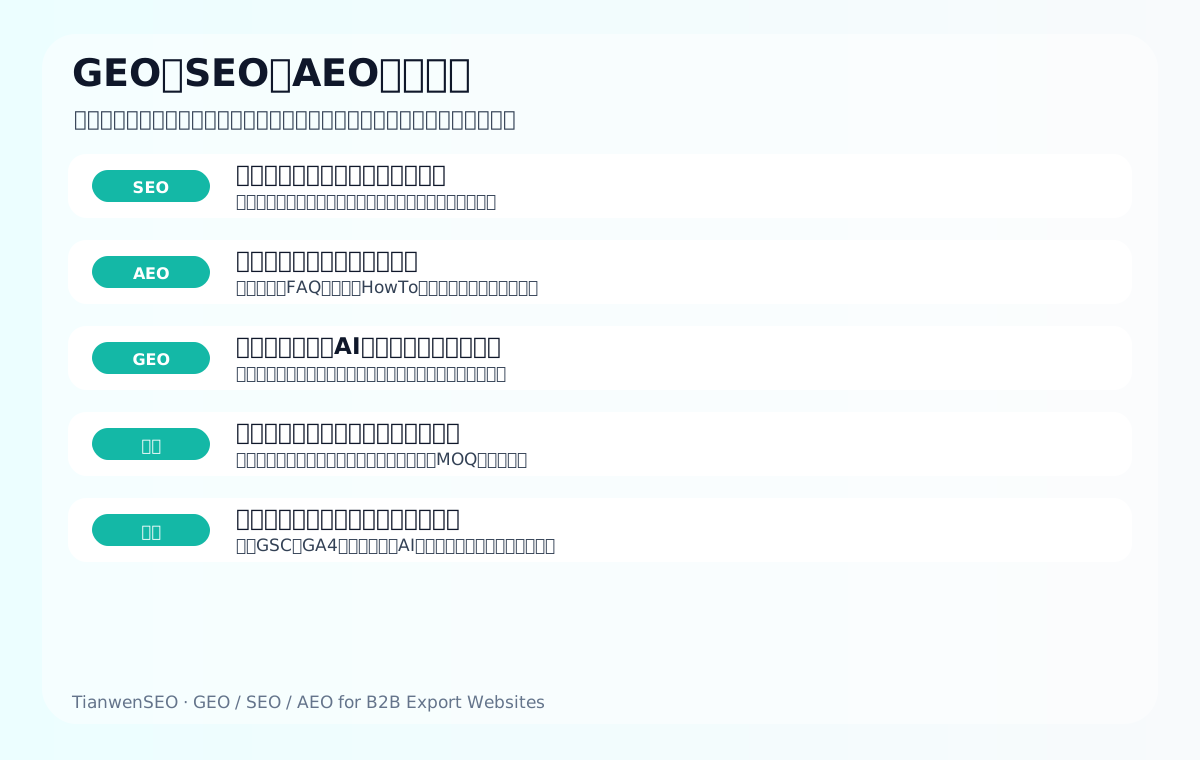
Start with the conclusion: GEO does not replace SEO; it pushes SEO to a higher standard
When many export businesses first hear about GEO, they instinctively feel that yet another concept has appeared: first there was SEO, and now there are AEO, GEO, and AI SEO — is this just a new word to keep selling anxiety? That suspicion is reasonable. If a page cannot even be reliably crawled by Google, if core product terms have no clear page, if English titles and product descriptions are chaotic, and if product specifications are incomplete, then it cannot suddenly become stronger in generative answers just because someone wrote a few “AI-friendly” paragraphs.
The real value of GEO is not to bypass SEO, but to remind export businesses that search results are changing from “ten blue links” into a mix of answers, summaries, citations, follow-up questions, and links. Buyers may first look at conclusions in AI Overviews, or ask ChatGPT “which Chinese manufacturers can make custom stainless steel parts for marine equipment,” or compare “LED flood light supplier with CE and RoHS certification” in Perplexity. If your website content is written only for rankings, without clear facts, citable tables, product evidence, and brand entities, then even if an AI system crawls the page, it will find it hard to use it with confidence.
So GEO is not starting from scratch; it raises three higher demands on traditional SEO: first, pages must be understandable by both search engines and AI; second, content must be quotable, restatable, and verifiable; third, the brand, products, evidence, and external materials must stay consistent. For an export website, this means product pages, category pages, application pages, technical resource pages, FAQs, certificate pages, the About Us page, and the contact path must all form a clear system, rather than relying on just a few generic blog posts.
Boundaries of official guidance: GEO must first stand on an SEO foundation that is crawlable, indexable, and verifiable
GEO is the name of a working method in the industry; it is not a separate ranking switch that Google or OpenAI has opened for export websites.
So to judge the relationship between GEO, SEO, and AEO, you cannot rely only on a concept diagram. You have to return to the fields that official materials can confirm: whether a page can be crawled, whether the content can be understood, whether structured data matches visible content, whether Search Console has real query and page data, and whether GA4 can observe on-site behavior.
If these foundations are not solid, talking about AI answer citations easily turns into slogans.
Comparison table of official materials related to GEO, SEO, and AEO
| Reference source | What it can confirm | What it cannot prove |
|---|---|---|
| Google Search Central: SEO Starter Guide | Traditional SEO still revolves around helping search engines crawl, understand, and present web pages. | It cannot be concluded that switching to a GEO label would bypass basic SEO. |
| Google Search Central: AI features and your website | Google’s AI search features still depend on the search system understanding page content, and sites must remain accessible, indexable, and clearly written. | It cannot promise that a given page will definitely appear in AI Overviews or AI Mode. |
| Google Search Central: Intro to structured data | Structured data can help the search system understand entities, attributes, and relationships in a page. | Schema cannot be treated as a direct switch for AI citations. |
| Google Search Central: Structured data general guidelines | Structured data must match the visible content of the page, and must not be mislabeled, falsely labeled, or stuffed. | Product facts that are not clearly written on the page cannot be hidden inside markup. |
| Search Console Help: Performance report | Google search performance can be observed by fields such as query, page, clicks, impressions, CTR, average position, country, and device. | It cannot prove that an AI platform has cited the website; when there are no row data, rankings or clicks must not be invented. |
| Google Analytics Help: About events | Events can be used to observe on-site behaviors such as form submissions, button clicks, email clicks, and WhatsApp clicks. | An on-site behavior cannot be directly attributed to an inquiry brought by GEO. |
| OpenAI Platform: Bots | You can check whether the relevant crawling access is allowed in robots and in the logs. | It cannot show that ChatGPT will definitely display a given page. |
| Bing Webmaster Blog: AI Performance | If visible in the account, Bing AI Performance can be observed as a separate metric. | It cannot represent all AI search platforms, nor can it replace manual sampling. |
When an export website does GEO, start by implementing this acceptance table
| Acceptance item | What you should see | What you should not write |
|---|---|---|
| Crawling and indexing | robots, sitemap, canonical, page status, and internal links can all be reviewed. | Saying only that “AI will understand,” while the page itself is inaccessible. |
| Product facts | Product pages such as custom metal parts, LED flood light, and packaging machine state specifications, materials, application scenarios, and purchasing limits. | Piling up empty phrases such as “professional manufacturer” and “reliable quality.” |
| Answer structure | Questions, definitions, comparisons, steps, tables, and FAQs let buyers quickly extract information. | Turning GEO into a large volume of AI-generated paragraphs. |
| Sources of evidence | Official materials, page facts, Search Console, GA4, and AI answer samples are kept separate. | Mixing screenshots, inquiries, rankings, and AI answers into a single conclusion. |
| Boundaries of results | The report states the platform, query set, dates, pages, sample size, and what cannot be explained. | Promising that AI platforms will definitely use the website’s content. |
When there is currently no GSC data, GEO conclusions must be more restrained
New export websites often do not yet have Search Console query or page row data.
At this stage you can inventory page facts, indexing and discovery, structured data, GA4 events, AI answer sampling tables, and internal link paths. You cannot write “keywords have improved,” nor can you write “inquiries already come from AI search.”
| Current evidence | Conclusions you can write | Conclusions you cannot write |
|---|---|---|
| GSC has no query or page row data yet | Search performance has not yet formed an analyzable sample, and a baseline must first be established. | That the ranking of a certain keyword has already improved. |
| Product fact tables and FAQs have been added to pages | Pages are easier for people and search systems to understand. | That AI platforms will definitely cite them. |
| GA4 events can observe forms and buttons | Changes in on-site behavior can be observed going forward. | That current inquiries are definitely brought by GEO. |
| AI answer sampling has been established | Brand mentions, website citations, and factual errors can be recorded against a fixed query set. | That one sample represents long-term results. |
Seen this way, GEO is not a replacement for SEO. It places the basic requirements of SEO, answer-oriented content organization, and export product facts on the same acceptance table.
How exactly do SEO, AEO, and GEO differ?
The boundaries between SEO, AEO, and GEO can be understood from three angles: where users ask, how systems answer, and how businesses measure. SEO deals with search engine results pages, where users usually type short or long-tail terms, see multiple web results, and then choose what to click. AEO deals with direct-answer scenarios, where the system wants to extract the answer to a question, such as a definition, steps, FAQ, comparison, pricing factors, or selection criteria. GEO deals with generative answer scenarios, where the system synthesizes multiple sources, organizes an answer in natural language, and may provide citations, brand mentions, or follow-up suggestions.
| Dimension | SEO | AEO | GEO | Implementation on an export website |
|---|---|---|---|---|
| Core objective | To be crawled, indexed, ranked, and clicked | To be extracted as a clear direct answer | To be understood, cited, synthesized, and restated correctly by AI | To let both buyers and AI understand the products, capabilities, and evidence |
| Typical pages | Product pages, category pages, blogs, guide pages | FAQs, definition pages, step pages, HowTo pages | Product materials, comparison guides, industry solutions, evidence pages | Product pages + resource pages + application pages + certificate pages working together |
| Content focus | Keyword intent, relevance, experience, links | Concise answers, structured paragraphs, question coverage | Fact density, entity consistency, credible sources, citability | Specifications, materials, certifications, MOQ, lead time, case boundaries |
| Review metrics | Rankings, clicks, CTR, indexing, traffic | Featured snippets, FAQ impressions, direct-answer coverage | AI mentions, cited sources, answer accuracy, brand description | Inquiry quality, sales feedback, product page paths, quotation opportunities |
For example, when an export business works on waterproof connector, SEO asks: are there pages and content for waterproof connector manufacturer, IP67 waterproof connector, M12 waterproof connector, and similar terms; AEO asks: can the page directly answer “what is the difference between IP67 and IP68” and “which connector should be chosen for outdoor lighting fixtures”; GEO asks: when AI answers “what connector should I use for outdoor LED lighting project,” will it treat your product specifications, application limits, certifications, and website materials as trustworthy information.
Where the term generative engine optimization (GEO) comes from: the paper, GEO-bench, and the boundary of 40%
“Generative engine optimization” is not a new marketing term from the SEO world; it has a clear academic origin. On November 16, 2023, a paper titled “GEO: Generative Engine Optimization” was published on arXiv (number 2311.09735, by Aggarwal, Murahari, Rajpurohit, Kalyan, Narasimhan, and Deshpande), and it was accepted by the data mining conference KDD in 2024. The paper collectively calls “search engines that use large models to retrieve and summarize multiple sources to answer user questions” generative engines, and defines generative engine optimization (GEO) as an optimization method by which content creators improve the visibility of their content in the opaque, rapidly changing answers of generative engines.
The paper contains two frequently cited facts, and it is worth keeping the original boundaries separate from marketing talk:
- GEO-bench benchmark: the paper builds a large-scale evaluation set spanning multiple domains and containing a large number of user queries and corresponding web sources, to systematically measure the visibility of content in generative engine answers.
- “Up to 40% visibility improvement”: experiments in the paper on its GEO-bench show that some optimization strategies can improve the visibility of content in generative engine answers by up to 40%.
There is one boundary that must be stated clearly: 40% is the experimental ceiling on the paper’s own benchmark, not an effect that any website or any service provider can promise. The paper also points out that efficacy varies across domains, so domain-specific optimization is needed. So when you see someone using “GEO can improve visibility by 40%” as a guarantee, the correct reading is: this is a benchmark result from 2023 research, not a delivery commitment. To judge whether a service provider really understands GEO, you can compare it with the checklist of delivery boundaries for what GEO services include, and the evaluation framework for how to choose a GEO service provider in China.
Why export businesses especially need to understand GEO
Many domestic export manufacturers have done Google SEO in the past, mainly aiming to rank product terms high and then gain clicks and inquiries. That path is still important, but the way buyers obtain information is becoming more complex. An overseas purchasing manager may first search Google for packaging machine supplier, then use AI to organize “which type of packaging machine is suitable for powder products,” and then compare several supplier websites, industry directories, videos, and resource pages side by side. In this process, the website is not just a display page; it is a source of material that AI and buyers use to judge whether you are trustworthy.
Export business is naturally suited to GEO, because export purchasing decisions contain a large number of factual questions: can the material be changed, can the size be customized, is there certification, is OEM supported, how long is the sample lead time, what is the MOQ, what are the target market standards, and is a certain application scenario suitable. AI systems prefer content that can be clearly extracted and compared, and export businesses happen to hold product facts, process boundaries, testing materials, application experience, and supply chain information. If this information is hidden only in sales chats and not expressed on the website, AI cannot use it; if the website reads like advertising slogans, AI will also find it hard to cite.
Therefore, the value of GEO for export businesses is not “letting AI close the deal for you,” but making it easier for buyers to see accurate facts at an earlier stage of information filtering. For example, if a buyer asks “best material for custom metal parts used in salt spray environment,” and your page explains the applicable boundaries of stainless steel 316, aluminum anodizing, and zinc plating, and also provides a material selection table, test items, and the drawing information needed for a quote, AI will find it easier to treat it as a useful source.
Top-1 benchmark: what current ranking content gets right and what it lacks
For queries such as “GEO vs SEO vs AEO,” currently high-ranking content generally has several advantages: concise definitions, a clear three-way comparison table, an explanation of overlapping relationships, and a reminder that businesses should not separate GEO from SEO. RivalScope’s page explains the difference in objectives between SEO and GEO very clearly; Yext’s page emphasizes three types of visibility — SEO rankings, AEO answers, and GEO citations; Geosaur points out that terms such as GEO, AEO, and AIO overlap; AEOAuthority compares them along dimensions such as platform, objective, and user behavior.
This content is suitable for quickly understanding concepts, but if the reader is a domestic export factory or trading company, they will still encounter an implementation gap: they know GEO is AI visibility but do not know how to change product pages; they know AEO should answer questions but do not know which questions come from buyers; they know AI answers cite sources but do not know how to review results with GSC, GA4, inquiry tables, and sales feedback; they know not to abandon SEO but do not know which pages to handle first.
| Benchmark item | Strengths of top-ranking/authoritative content | What export businesses still lack | How this article fills the gap |
|---|---|---|---|
| Definition | Can quickly explain SEO, AEO, and GEO | Lacks the context of Chinese export business | Explains with English product terms, product pages, and inquiry paths |
| Comparison table | Has comparisons of objectives, platforms, and metrics | Lacks implementation for product pages, category pages, and application pages | Adds page types, content modules, and review metrics |
| Action recommendations | Recommends doing SEO and GEO at the same time | Does not know which pages to handle first | Provides a 90-day priority order and a diagnostic checklist |
| Examples | Mostly brand marketing or general industry examples | Insufficient export product terms and purchasing questions | Uses examples such as LED, CNC, valves, tableware, and connectors |
| Review | Emphasizes visibility but rarely discusses inquiry quality | Hard to connect to business results | Adds a dashboard for GSC, GA4, AI answers, and sales feedback |
When export businesses do GEO, do not start with tools
When many teams hear about GEO, they want to first find a tool to check “whether AI mentions me.” Tools can serve as a monitoring method, but they should not be the first step. The reason is simple: if the website’s basic information is incomplete, a tool can only tell you “you are not mentioned” or “the answer is inaccurate”; it cannot fill in product facts for you. The first step of GEO should be to sort out which information on the website is worth citing by AI.
The content on an export website most worth citing by AI is usually not company slogans but facts that help buyers make judgments: product specification ranges, material options, application scenarios, certification standards, testing methods, customization capabilities, minimum order quantity, sample lead time, packaging methods, export markets, common questions, and selection advice. For example, on a private label activewear manufacturer page, if it only says “high quality and competitive price,” AI will find it hard to use; if it clearly states fabric options, MOQ by style, size grading, labeling method, sample lead time, and bulk production timeline, the value is completely different.
So the starting point of GEO is not “I want to be recommended by AI” but “does my website provide facts that both AI and buyers can verify.” Only when the facts are clear enough do the later structured expression, FAQs, tables, citations, brand entities, and external materials become meaningful.
GEO is not AI writing: the 5 most common mistakes in export content
Mistake 1: Believing GEO means using AI to generate more articles
Using AI to assist writing can improve efficiency, but GEO is not about piling up more articles. Generative systems need clear facts, credible sources, and structured expression. If an export website publishes a generic “how to choose supplier” article every day but has no product specifications, testing standards, application boundaries, or real purchasing questions, then the more content there is, the more it dilutes the focus.
Mistake 2: Writing only industry knowledge and not what you can provide
Export website content cannot stop at the encyclopedia level. For example, when writing about ceramic dinnerware, you should explain the differences between stoneware, porcelain, and bone china, and also state your producible sizes, glaze options, microwave suitability, packaging methods, and target market standards. AI answers need general knowledge, but buyers ultimately still need to judge whether you can supply.
Mistake 3: Turning GEO into brand self-praise
Generative systems dislike exaggerated expressions that cannot be verified. Phrases such as “global leader,” “most professional,” and “absolutely reliable” are less useful to AI and buyers than concrete facts. Better expressions are: which materials are supported, the maximum processing size, achievable tolerance ranges, common surface treatments, testing equipment, export experience, and where to download materials.
Mistake 4: Ignoring technical accessibility
If a page depends on complex scripts to display its body text, if important content is hidden in interactions that cannot be read directly, or if robots, caching, or permission settings prevent AI from crawling it, then GEO has no foundation. Crawling, indexing, page speed, mobile experience, and structured data in traditional SEO remain prerequisites for visibility in generative answers.
Mistake 5: Only checking whether AI mentions the brand, not whether it is accurate
An AI mention of a brand does not equal success. If AI gets your product range wrong, describes a trading company as a factory, or lists certifications you do not have, it can instead create risk. GEO reviews should record at the same time “whether it appears,” “whether it is cited,” “whether it is accurate,” and “whether it brings better inquiries.”
Which pages on an export website are most suitable for GEO upgrades first
Not all pages need long-form content. For pages such as the contact page, simple navigation pages, and the privacy policy, the focus is clarity, credibility, and easy conversion. The pages truly suitable for GEO upgrades are those that can answer buyers’ complex questions, carry product facts, and support AI citations.
| Page type | Problem it is suited to solve | GEO upgrade focus | Export example |
|---|---|---|---|
| Product page | Whether this product fits my application | Specifications, materials, certifications, applications, limits, FAQ | waterproof connector for outdoor LED lighting |
| Category page | Which category of product should I choose | Category logic, model differences, purchasing advice, comparison table | industrial valve supplier product categories |
| Application page | What solution should be used in a certain scenario | Industry pain points, environmental conditions, selection process, case boundaries | LED flood light for warehouse lighting |
| Resource page | How to judge standards, testing, installation, and maintenance | Steps, checklists, term explanations, common misjudgments | cnc machining tolerance guide |
| FAQ page | Common questions before purchasing | Short answers, longer explanations, next contact step | MOQ, sample time, OEM packaging |
If resources are limited, it is advisable to start with pages that “already have search demand, can support inquiries, and have clear product facts.” For example, a custom metal parts page that already has GSC impressions is more worth strengthening first than a generic article on “how export websites should do GEO”; a packaging machine page that already receives inquiries but whose customers always ask the same questions is also more valuable than opening a new, vague section.
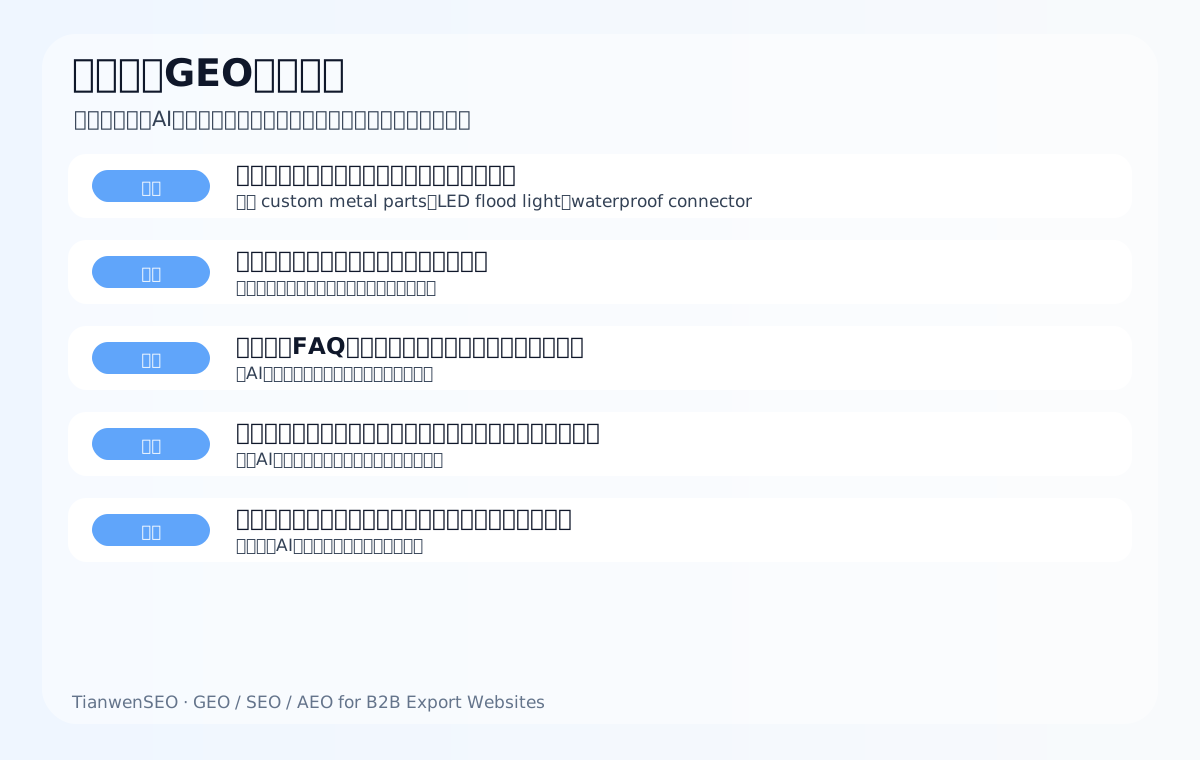
How should GEO content be written: a breakdown of an export product page
Taking waterproof connector as an example, traditional SEO might focus on whether the page title contains terms such as waterproof connector manufacturer, IP67 connector supplier, and M12 waterproof connector, and whether the content covers materials, specifications, and applications. AEO goes further by writing common questions as direct answers, for example “IP67 waterproof connector can resist temporary immersion under defined test conditions, while IP68 is usually used for deeper or longer immersion depending on manufacturer specifications.” GEO then requires that the page can be synthesized by AI into purchasing advice: which rating to use in which environment, which parameters must be confirmed, which certifications to verify, and what information to provide when requesting a quote.
A product page more suited to GEO should not contain only product images and a few promotional lines; it should include modules such as applicable scenarios, a model table, material descriptions, IP rating explanations, cable diameter ranges, operating temperature, installation methods, certification documents, common faults, and an inquiry checklist. Each module should be as specific as possible, avoiding sentences such as “high quality waterproof connector for many industries” that cannot be cited.
| Module | Weak copy | GEO-friendly copy | Why it is better |
|---|---|---|---|
| Application scenarios | Used in many outdoor projects | Suitable for outdoor LED lighting, solar cable connection, marine equipment control boxes when IP rating and cable diameter match project requirements | Includes specific industries, usage conditions, and judgment limits |
| Specifications | Many sizes available | M8/M12/M16 options, 2-8 pins, cable OD range, rated voltage/current, operating temperature | AI and buyers can directly extract parameters |
| Certifications | Certified quality | CE/RoHS available for selected models; test documents should be confirmed before bulk order | Avoids uncontrollable promises while giving a way to verify |
| Inquiry | Contact us for price | Please provide connector type, pin count, cable diameter, quantity, target market and application environment | Lets buyers know what to prepare for the next step |
The overlap between GEO and SEO: which traditional foundations are still mandatory
GEO does not bypass search engines, nor does it write only for AI platforms. Many answer sources of generative systems still come from crawlable web pages, search results, authoritative materials, and clearly structured pages. Therefore, the basic work of traditional SEO is still mandatory, and the more solidly it is done, the easier it is to advance GEO.
- Crawling foundation: important pages must not be blocked by robots, login restrictions, incorrect status codes, or unreadable content.
- Indexing foundation: product pages, category pages, and resource pages should have clear titles, body text, internal links, and sitemap entries.
- Intent matching: one page solves one main purchasing question; do not mix selection, quotation, company introduction, and encyclopedia content together.
- Page experience: readable on mobile, reasonable speed, images with captions, and tables that can be clearly seen on phones.
- Internal link relationships: product pages, category pages, application pages, and resource pages should explain each other rather than exist in isolation.
- Trust signals: company information, certificates, export markets, contact details, product materials, and external materials should stay consistent.
For example, if a cnc machining parts page is not indexed, GEO cannot even be discussed; if the page title says “High Quality Product” and the body text lacks information such as cnc machining, tolerance, surface finish, and materials, both search engines and AI will find it hard to judge the topic; if the page does not link to material selection, surface treatment, tolerance guides, and an inquiry checklist, buyers will also find it hard to continue evaluating.
The difference between GEO and AEO: direct answers and generative synthesis are not the same thing
AEO is often understood as answer engine optimization, with the focus on making the information on a page a clear direct answer. Questions such as “what is IP67,” “what does MOQ mean,” and “how to choose LED flood light beam angle” are suited to concise definitions, steps, FAQs, and tables. GEO leans more toward generative synthesis: AI may not cite just one sentence of yours, but integrate your content with other sources into a recommendation.
Therefore, AEO is more like “writing the answer clearly,” while GEO is more like “getting your facts into the AI’s answer-organization process.” The two do not conflict. Export websites can use AEO writing to improve the extractability of pages, and then use GEO thinking to fill in entity consistency, sources of evidence, product facts, and cross-page relationships.
| Question type | AEO approach | GEO approach | Export example |
|---|---|---|---|
| Definition question | One-sentence definition + supplementary explanation | Keep the definition consistent with brand/product facts | What is IP67 waterproof connector |
| Step question | List the steps and cautions | Connect the steps to product materials and the inquiry path | How to choose LED flood light wattage |
| Comparison question | Use a table to compare differences | Add application limits, purchasing risks, and sources | stainless steel 304 vs 316 for custom parts |
| Supplier question | List selection criteria | Show the company entity, evidence, product range, and industry materials | private label activewear manufacturer selection |
90-day implementation roadmap: how export businesses upgrade from SEO to GEO
Stage 1: do an accessibility and fact inventory within 7 days
In the first week, do not rush to overhaul all pages. First list the most important product pages, category pages, application pages, and resource pages, and check whether they can be accessed normally, whether they are indexed, whether titles are accurate, whether the body text contains core product facts, and whether images and tables can be understood. The point is not perfection but finding the basic problems that block understanding by search engines and AI.
- List 10-30 core English product terms and their corresponding URLs, such as custom metal parts, LED flood light, and packaging machine.
- Check whether each page has a clear H1, product introduction, specifications, applications, FAQ, and contact entry.
- Confirm that no settings block crawling and that important body text does not exist only inside images.
- Record pages in GSC that already have impressions and clicks, and prioritize pages with baseline data.
Stage 2: complete the core page structure within 30 days
In the second stage, begin improving pages. Each core page should at least cover the questions buyers will actually ask: what applications it suits, what scenarios it does not suit, which parameters need to be provided, how to choose a model, what certifications and testing exist, and how to judge samples and lead time. The goal of this stage is not to write more beautiful paragraphs but to turn pages into extractable factual material.
Stage 3: build resource pages and internal connections within 60 days
Product pages solve specific products, while resource pages solve general judgment. For example, a company doing cnc machining parts can build resource pages such as materials guide, surface finish guide, tolerance guide, drawing requirements, and quality inspection checklist. Each resource page should link back to relevant product pages and inquiry pages, so buyers naturally move from learning about a question into preparing for a quote.
Stage 4: review AI answers and inquiries within 90 days
Within 90 days, AI answer review should be brought into content operations. Select 10-20 buyer questions and regularly record in AI search and Google results whether the answer mentions your brand, whether it cites the website, whether it describes things accurately, and whether it directs buyers to the right pages. At the same time, compare with GSC, GA4, and the inquiry table to see whether page upgrades bring better visit paths and inquiry quality.
Examples of English export product terms: different keywords should map to different pages
A common problem on many export websites is cramming all English product terms into a single page. In the traditional SEO era this already easily caused intent confusion, and in GEO scenarios the problem is even more obvious: AI cannot tell whether you supply a certain product, explain a certain question, or provide a certain industry solution. A better approach is to assign pages according to query intent.
| English query | Buyer intent | Recommended page type | What the page must answer |
|---|---|---|---|
| custom metal parts | Looking for custom metal parts supply capability | Product/capability page | Materials, processes, tolerances, surface treatment, drawing requirements |
| LED flood light for warehouse | Looking for warehouse lighting solutions | Application page | Wattage, beam angle, installation height, certifications, energy consumption |
| packaging machine for powder | Looking for powder packaging equipment | Application/category page | Material properties, packaging speed, precision, cleaning and maintenance |
| medical probe manufacturer | Looking for a medical probe supplier | Product/trust page | Materials, cleanliness requirements, certifications, quality control |
| ceramic dinnerware wholesale | Looking for tableware wholesale and customization | Category/purchasing page | Materials, patterns, packaging, MOQ, target market |
| industrial valve supplier | Looking for an industrial valve supplier | Category/solution page | Medium, pressure, temperature, connection method, standards |
The benefit of doing this is that every page has a clear task. Product pages handle supply capability, application pages handle scenario judgment, resource pages handle professional explanation, FAQs handle purchasing questions, and the contact page handles the next step. AI systems find it easier to understand page roles, and buyers find it easier to locate the information they need.
GEO page writing framework: start from the purchasing question, not from terminology
Export GEO pages can be written in the order of “question — judgment — evidence — next step.” First answer the question buyers care about most, then give judgment criteria, then provide verifiable evidence, and finally tell them how to continue. This order is better suited to search and AI answers than starting with a company introduction.
| Module | What to write | Cautions | Example |
|---|---|---|---|
| Above-the-fold answer | Answer the core question in 150-220 words | Do not build up too long; do not discuss only concepts | What GEO is and why export businesses need it |
| Decision table | Put different choices into a table | Use dimensions buyers can understand | IP rating, materials, application scenarios, risks |
| Action steps | From checking to editing to reviewing | Steps must be executable | Export query terms from GSC, map pages, add FAQ |
| Evidence materials | Cite standards, specifications, tests, official statements | Avoid promises that cannot be verified | Certification documents, test items, product parameters |
| Review metrics | Search, AI answers, inquiries, and sales feedback | Do not look only at traffic | Whether AI describes the product range correctly, whether inquiries are more specific |
How to judge whether a page is GEO-friendly
To judge whether a page is GEO-friendly, you do not need to buy complex tools first. The checklist below can be used for a manual audit. Go through every core product page, category page, and resource page, and the problems will basically become clear.
| Check item | Passing standard | Failing sign | How to fix |
|---|---|---|---|
| Page role | At a glance, you know whether it is a product, category, application, or resource page | The page tries to cover everything | Split intents and clarify the page task |
| Fact density | Has specifications, materials, certifications, applications, limits | Only adjectives and advertising lines | Add specific parameters and judgment boundaries |
| Extractable structure | Has definitions, tables, FAQs, steps | The whole page is stacked long paragraphs | Rewrite into short paragraphs and structured modules |
| Entity consistency | Company name, brand, product lines, and contact details are consistent | Different pages use inconsistent wording | Unify naming and key information |
| Internal link relationships | Can link to product, resource, and inquiry pages | Isolated pages | Add entries to related pages |
| Review data | Can be mapped to GSC queries, GA4 paths, and inquiries | Cannot measure results | Build a page-level record table |
How GSC, GA4, inquiries, and AI answers should be viewed together
The biggest taboo in GEO review is looking at only one metric. A brand appearing once in AI answers does not mean business value; rising GSC clicks do not mean inquiry quality has improved; an increase in inquiries may also come from ads or trade shows. Export businesses should look at four types of data together: GSC for search demand, GA4 for visit paths, the inquiry table for business results, and AI answer records for whether brand and product facts are expressed correctly.
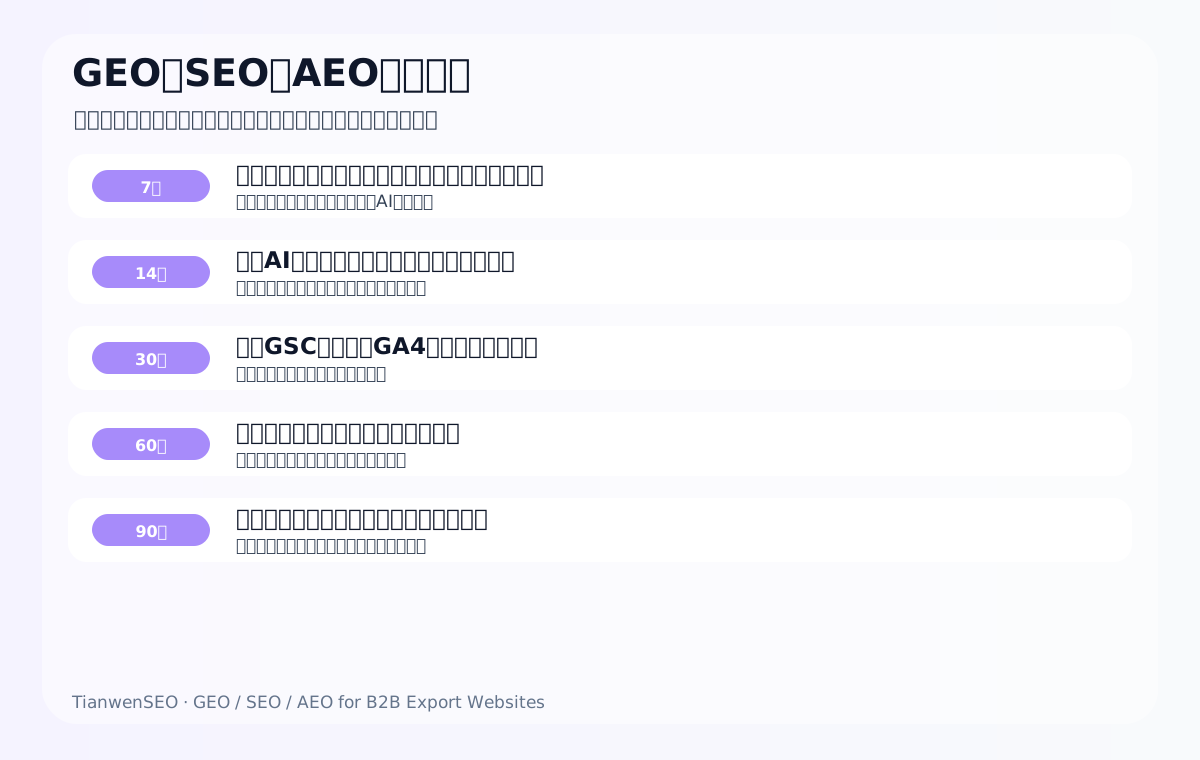
| Data source | What to look at | How to judge | Next step |
|---|---|---|---|
| GSC | Query terms, pages, clicks, impressions, CTR | Whether product terms land on the correct pages | Improve titles, FAQ, internal links, and page intent |
| GA4 | Entry pages, paths, dwell time, conversion events | Whether buyers continue to view product and contact pages | Optimize page entries and inquiry paths |
| Inquiry table | Source, product, country, clarity of requirements | Whether inquiries are more specific and closer to a quote | Add inquiry checklists and product materials |
| AI answer records | Whether the brand is mentioned, whether it is cited, whether it is accurate | Whether AI describes products and capabilities incorrectly | Add entity materials, FAQ, and evidence pages |
| Sales feedback | Frequently asked customer questions, misunderstandings, reasons for loss | Whether pages explain key concerns in advance | Turn sales questions into resource pages and FAQ |
Export businesses at different stages have different GEO priorities
New site: build the SEO foundation first
If the website has just launched and indexing, product pages, English content, and inquiry paths are still incomplete, it is not advisable to chase complex GEO monitoring right away. A new site should first ensure that core pages can be crawled and indexed, that product term pages are clear, and that product images, parameters, certifications, contact details, and basic FAQ are complete. Without these, AI answers will find it hard to cite anything.
Sites with traffic but few inquiries: check page intent and conversion paths
If GSC has impressions and clicks but inquiries are few, the problem may not be GEO but whether the pages solve buyers’ questions. For example, if an LED flood light page gets traffic but buyers cannot find beam angle, warranty, certification, installation height, or shipping packaging information, they will leave. At this stage, use AEO and GEO thinking to add Q&A, tables, and selection modules.
Sites that already have brand search: add entity consistency and sources of evidence
If the brand already has search volume, the GEO focus should be on brand entity consistency, company materials, certificate pages, industry materials, and external sources. AI systems need to judge “who this brand is, what it sells, and whether it is trustworthy.” Inconsistent company names, brand names, product lines, addresses, and contact details across pages increase the risk of misinterpretation.
Sites with a lot of content but unclear results: consolidate and review
If the website already has a large number of articles but rankings, traffic, and inquiries have not improved noticeably, the problem may be scattered intents, duplicate content, pages competing for the same keywords, or a lack of business paths. At this point, do not continue blindly adding articles; instead, organize pages by product line and purchasing intent, keep valuable content, merge overlapping content, and concentrate key questions on stronger pages.
How evidence should be placed in GEO content
AI answers prefer materials that are verifiable, consistently expressed, and clearly contextualized. Export websites can divide evidence into four categories: product evidence, company evidence, industry evidence, and business evidence. Evidence is not for showing off but for reducing the uncertainty of buyers and AI systems.
| Evidence type | What to include | Suitable pages | Cautions |
|---|---|---|---|
| Product evidence | Specification tables, materials, test items, images, application limits | Product pages, resource pages | Do not write absolute claims that cannot be verified |
| Company evidence | Factory capability, equipment range, certifications, export markets | About Us, capability pages | Keep names and information consistent |
| Industry evidence | Standard explanations, selection methods, installation and maintenance | Guide pages, FAQ pages | Cite sources clearly and do not exaggerate |
| Business evidence | Inquiry process, sample lead time, packaging methods, quality inspection | Contact page, purchasing guide | Give judgment ranges and do not promise uncontrollable results |
For example, pages related to medical probe manufacturer should clearly explain material compatibility, cleanliness requirements, testing processes, and the regulatory requirements that customers in applicable markets need to confirm, rather than simply saying “medical grade quality.” Such expression is both more professional and better suited to being cited by AI as “what information a supplier needs to confirm.”
GEO frequently asked questions
What is GEO?
GEO is Generative Engine Optimization, a set of optimization methods that make website content, brand entities, product facts, and evidence materials easier for generative AI search to understand, cite, and synthesize.
Will GEO replace SEO?
No. SEO remains the foundation of crawling, indexing, ranking, and clicks. GEO adds understanding, citation, entity consistency, and answer accuracy within AI answers on top of SEO.
What is the difference between GEO and AEO?
AEO emphasizes writing content as extractable direct answers; GEO emphasizes whether generative AI can correctly use your brand, products, and evidence when synthesizing multiple sources.
Should export businesses do GEO or SEO first?
If the website foundation is weak, build the SEO base first; if indexing and product pages already exist, then add AEO structure and GEO evidence. It is best to advance all three in the order of foundation, answers, and citation capability.
Is GEO about using AI to write articles?
No. AI writing is only an auxiliary method; the core of GEO is clear facts, extractable structure, entity consistency, credible evidence, and a closed review loop.
Which export pages are most suitable for GEO?
Core product pages, category pages, application pages, resource pages, FAQ pages, and purchasing guides are most suitable, because they can answer buyers’ actual questions.
How should product pages be changed to be more GEO-friendly?
Complete the specifications, materials, certifications, applications, limits, selection tables, FAQ, inquiry checklist, and links to related materials, so that both AI and buyers can extract information.
How is GEO performance measured?
You can look at whether AI answers mention the brand, whether they cite the website, and whether the answers are accurate, while combining GSC queries, GA4 paths, inquiry sources, and sales feedback.
What should I do if AI does not cite my website?
First check crawling, indexing, page facts, citable structure, brand entities, and external materials; do not just change titles or pile up articles.
How long does GEO take to show changes?
It varies widely by site. Generally, you can use 30 days to look at indexing and answer baselines, and 60-90 days to judge direction by combining search, visits, and inquiries.
Can export websites promise AI recommendations?
No. AI answers are affected by platform, query, sources, and timing; you should not promise definite recommendations, but can only improve the chance of being understood and cited through content and evidence.
Do GEO articles need to be very long?
Technical guides and resource pages that should be long need depth, while contact pages and navigation pages that are not suited to long content should not be padded with words. The key is complete answers, specific facts, and clear structure.
Is GEO suitable for B2B factories or trading companies?
It suits both. Factories should focus on showing production capability and technical boundaries, while trading companies should focus on showing product selection, supply chain, quality inspection, delivery, and market experience.
Does GEO require structured data?
Structured data helps, but it cannot replace factual body content. Page body text, tables, FAQ, image captions, and internal links are equally important.
Can a company without an English team do GEO?
You can start with core English product terms, specification tables, FAQ, and inquiry checklists, gradually build English resource pages, and then review search and inquiry feedback.
Conclusion: the essence of GEO is to make an export website a more reliable source of material
GEO, SEO, and AEO are not three mutually exclusive slogans. For export businesses, SEO solves being discovered, AEO solves being directly answered, and GEO solves being correctly understood and cited by generative AI. The truly effective approach is not chasing concepts but making product pages, category pages, application pages, resource pages, and inquiry paths clearer.
If your website can clearly answer buyers’ questions, use tables to explain product differences, use resource pages to explain standards and selection, keep the company entity, product lines, certificates, and contact details consistent, and then continuously review with GSC, GA4, inquiries, and AI answer records, then it is not only better suited to traditional Google SEO but also to the age of AI search. GEO is not a shortcut; it is a higher demand on content quality, product facts, and business closed loops.
Continue reading this set of GEO materials
If you are systematically learning about GEO and AI search visibility, it is advisable to continue with the articles below. First understand the concepts, then look at diagnosis, monitoring, content structure, and the boundaries of cooperation.
- What is AEO: why answer engine optimization is more than writing FAQ, and what export websites should do
- What kind of blog posts are more likely to be mentioned by ChatGPT: how to change export website content topics and structure in 2026
- Where to start with AI search optimization: should export websites build a query set first or change content first?
- How to do GEO: what to change first, from page structure to citation probability
- What is Schema structured data: which types should export websites add for SEO and AI search
- How to build B2B export AI search visibility: a guide to getting inquiry terms and solution terms into AI answers
{
“@context”: “https://schema.org”,
“@type”: “FAQPage”,
“mainEntity”: [
{
“@type”: “Question”,
“name”: “What is GEO?”,
“acceptedAnswer”: {
“@type”: “Answer”,
“text”: “GEO is Generative Engine Optimization, a set of optimization methods that make website content, brand entities, product facts, and evidence materials easier for generative AI search to understand, cite, and synthesize.”
}
},
{
“@type”: “Question”,
“name”: “Will GEO replace SEO?”,
“acceptedAnswer”: {
“@type”: “Answer”,
“text”: “No. SEO remains the foundation of crawling, indexing, ranking, and clicks. GEO adds understanding, citation, entity consistency, and answer accuracy within AI answers on top of SEO.”
}
},
{
“@type”: “Question”,
“name”: “What is the difference between GEO and AEO?”,
“acceptedAnswer”: {
“@type”: “Answer”,
“text”: “AEO emphasizes writing content as extractable direct answers; GEO emphasizes whether generative AI can correctly use your brand, products, and evidence when synthesizing multiple sources.”
}
},
{
“@type”: “Question”,
“name”: “Should export businesses do GEO or SEO first?”,
“acceptedAnswer”: {
“@type”: “Answer”,
“text”: “If the website foundation is weak, build the SEO base first; if indexing and product pages already exist, then add AEO structure and GEO evidence. It is best to advance all three in the order of foundation, answers, and citation capability.”
}
},
{
“@type”: “Question”,
“name”: “Is GEO about using AI to write articles?”,
“acceptedAnswer”: {
“@type”: “Answer”,
“text”: “No. AI writing is only an auxiliary method; the core of GEO is clear facts, extractable structure, entity consistency, credible evidence, and a closed review loop.”
}
}
]
}
This page is machine-translated from the Simplified Chinese version and awaiting human review. It has not yet been proofread.