AEO (Answer Engine Optimization) is not about adding a few more FAQs at the bottom of a page, nor is it a promise that AI will recommend a particular brand every time. It is about organizing website content into a structure that answer engines can more easily discover, understand, cite, and accurately restate. For Chinese export manufacturers, factories, and trading companies, the core of AEO is giving answer-based search experiences such as ChatGPT, Google AI Overviews, Perplexity, and Gemini the chance to obtain clear, credible, and quotable product facts and materials from the official website when they answer procurement questions.
If you sell custom metal parts, LED flood light, packaging machine, medical probe, cnc machining parts, ceramic dinnerware, waterproof connector, industrial valve supplier, private label activewear manufacturer, AEO should not revolve around abstract marketing concepts. It should revolve around the questions overseas buyers actually ask: how to choose, what scenario it suits, what certificates are required, what the specifications are, how to request a quote, whether customization is possible, and where to find the datasheet.
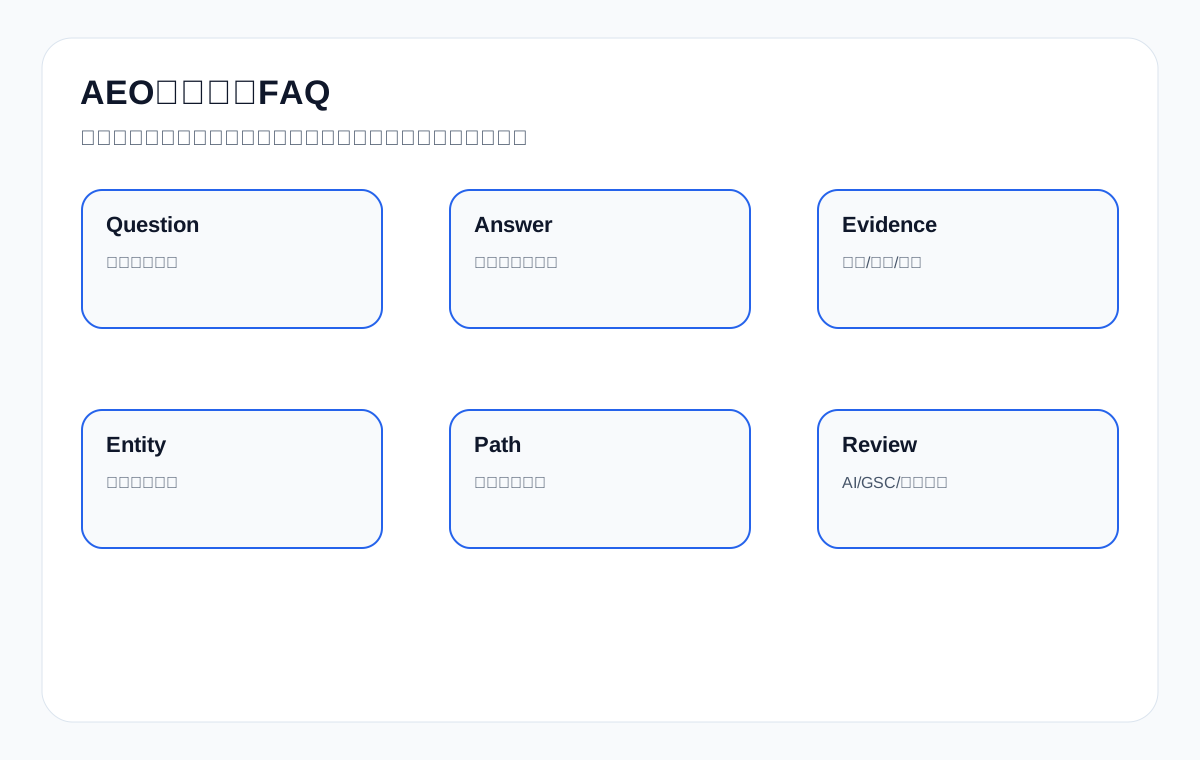
Official evidence boundaries: AEO is not just writing FAQs, and it is not the name of an official ranking system
The term AEO is best used as an execution method.
It reminds us that a page must not only be crawlable by search engines, but also able to answer foreign trade procurement questions directly. However, it is not the name of a ranking system that Google has separately announced, and writing an FAQ does not by itself mean answer engine optimization is complete.
For foreign trade websites, a more reliable approach is to break AEO down into several reviewable fields: whether the page is crawlable, whether the answer is clear, whether the facts are verifiable, whether the structured data is genuine, and whether Search Console and GA4 allow continuous observation.
Mapping table of official documentation and AEO execution boundaries
| Official documentation | AEO actions it can support | What it cannot prove |
|---|---|---|
| Google Search Central: SEO Starter Guide | A page must first be crawlable, understandable, and presentable to search engines, and its title, body, links, and image information must serve real users. | It cannot prove that simply switching to a Q&A format will earn a page answer-type display. |
| Google Search Central: Featured snippets | Answer paragraphs, steps, tables, and clear context help search systems understand the direct answers on a page. | It cannot promise that a given paragraph will become a featured snippet or any other answer display. |
| Google Search Central: FAQPage structured data | FAQ structured data is suitable for marking genuinely visible Q&A content on a page, and it must comply with scope and quality requirements. | It cannot turn FAQPage markup into a universal switch for AEO. |
| Google Search Central: Structured data general guidelines | Structured data must match the visible content of the page; it must not mark information users cannot see or that is untrue. | Schema cannot make up for missing facts in the body copy. |
| Google Search Central: AI features and your website | AI features still rely on search systems understanding page content, so a site must remain accessible, indexable, and clear. | It cannot promise that a page will enter AI Overview or any other AI display. |
| Search Console Help: Performance report | You can observe search performance fields such as queries, pages, clicks, impressions, CTR, and average position. | It cannot by itself prove that an AI platform cited an answer from the official website. |
| Google Analytics Help: About events | You can observe on-site behavioral events such as forms, buttons, email, and WhatsApp. | It cannot attribute a single on-site event directly to AEO. |
| OpenAI Platform: Bots | You can check robots and logs to avoid key answer pages being restricted unintentionally. | It cannot prove that ChatGPT will definitely display that page’s content. |
| Bing Webmaster Blog: AI Performance | If visible in your account, you can observe the impressions, citations, and clicks reported by Bing AI Performance. | It cannot represent all answer engines, nor replace manual sampling. |
AEO page acceptance checklist: FAQ is only one piece
| Module | Passing standard | Failing signal |
|---|---|---|
| Direct answer paragraph | The early part of the page answers the core question in short sentences before expanding into reasons, steps, and decision criteria. | The opening only lays out concepts, and readers still do not know the answer after three screens. |
| Procurement scenario | Questions come from real foreign trade procurement, such as specifications, MOQ, certification, lead time, packaging, after-sales service, and target industries. | Only vague “advantages” and “solutions” are written, with no procurement action. |
| Factual evidence | Specifications, certificates, test methods, product images, case conditions, and service boundaries can be reviewed. | Only “good quality” and “rich experience” are written, with no verifiable information. |
| Answer structure | Definitions, comparison tables, step lists, FAQs, risk notes, and next-step links together form an answer system. | Only FAQs are piled up, and every question is very short. |
| Structured data | Markup such as FAQPage, Product, and Article matches the visible content on the page. | The schema is packed, but the body copy has no corresponding content. |
| Review records | A fixed query set, platforms, dates, answer screenshots, cited pages, and subsequent change records. | A single screenshot is taken and AEO is declared a success. |
How to phrase AEO conclusions when there are no GSC signals
New sites or new pages often do not yet have Search Console row data.
At this stage, AEO conclusions should be written as “foundation completed” and “monitoring baseline established.” You cannot write that keywords have already improved, nor that an answer engine has steadily adopted official website content.
| Current evidence | Conclusions you can write | Conclusions you cannot write |
|---|---|---|
| The page has been given a direct answer paragraph and a procurement question set | The page is better suited to answering the target procurement questions. | Answer engines will definitely adopt this page. |
| FAQs and structured data have been checked | The visible Q&A on the page matches the marked-up content. | FAQ markup will definitely produce answer displays. |
| GSC has no query/page row data yet | There is not yet an analyzable sample of search performance; continued observation is needed. | The ranking of a certain keyword has already improved. |
| GA4 events have been configured | Inquiry buttons, forms, and contact clicks can be observed going forward. | Current inquiries definitely come from AEO. |
| AI/answer sampling has been set up | Answer changes can be recorded against a fixed query set. | One sampling represents long-term performance. |
So the point of AEO is not the “number of Q&As.” It is more like a set of page expression disciplines: answer the question first, then provide evidence, then offer the next step.
2. The relationship between AEO and SEO: not a replacement, but an addition
AEO is not a replacement for SEO. SEO makes a page discoverable, crawlable, indexable, and rankable; AEO places more emphasis on whether a page can be directly understood, excerpted, and cited by answer engines. Without a foundation in SEO, AEO also lacks a stable source.
If a foreign trade website has unindexed core product pages, incomplete product materials, inconsistent company entities, and messy internal links, it will be hard to become a reliable answer source even with FAQs added.
AEO should therefore be built on top of SEO fundamentals: crawling, indexing, content, internal links, structured data, entity consistency, and review all need to be done well.
Table of differences between AEO and SEO
| Dimension | SEO focus | AEO focus |
|---|---|---|
| Goal | Search result impressions and clicks | Being understood and cited in answers |
| Content | Satisfying search intent | Directly answering excerptable questions |
| Structure | Titles, internal links, page quality | Definitions, tables, FAQs, evidence |
| Data | GSC rankings and clicks | AI mentions, citations, and accuracy |
| Conversion | From visit to inquiry | From answer to official website verification and inquiry |
3. Why AEO is not just writing FAQs
FAQ is part of AEO, but not all of it. FAQs help answer specific questions, but if product pages lack specifications, resource pages lack evidence, company entities are inconsistent, pages have no internal links, and content is not credible, FAQs can hardly support answer visibility on their own.
Many websites write FAQs as self-questioning entries like “Why choose us” and “Is the quality good,” which are neither close to procurement questions nor suitable for AI citation. Truly valuable FAQs come from GSC, inquiries, sales feedback, materials, and product questions.
AEO requires a complete system: a question bank, answer pages, product facts, documentary evidence, structured data, entity consistency, internal link paths, and review metrics.
Differences between FAQs and a full AEO system
| Item | FAQs only | Complete AEO |
|---|---|---|
| Question source | Written subjectively | GSC, inquiries, sales feedback |
| Answer structure | Short Q&A | Definitions, tables, steps, evidence |
| Page support | An isolated module | Product pages, resource pages, application pages |
| Entity signals | Not addressed | Company, brand, and product consistency |
| Review | No monitoring | AI citations, GSC, inquiry quality |
4. The core object of AEO: natural-language questions and procurement scenarios
Answer engines are closer to natural-language Q&A. Foreign trade companies need to expand keywords into a question bank: how buyers would ask about materials, applications, certificates, specifications, suppliers, MOQ, samples, lead times, and customization capability.
For example, AEO questions for waterproof connector could include: What IP rating is suitable for outdoor LED lighting? How to choose M12 waterproof connector? What information is needed for custom cable assembly quote?
These questions are closer to AI answer scenarios than a single keyword, and closer to real inquiries.
Table of AEO question types for foreign trade
| Question type | Example | Target page |
|---|---|---|
| Definition questions | What is IP67 waterproof connector? | Tutorial/FAQ |
| Selection questions | How to choose LED flood light? | Selection guide |
| Application questions | Which connector is used for marine lighting? | Application page |
| Documentation questions | Where to find packaging machine manual? | Resource page |
| Quotation questions | What information is needed for CNC quote? | Inquiry page |
5. The direct answer paragraph: AEO pages should answer at the start
AEO content should give a direct answer at the beginning. Neither users nor AI should have to scroll for a long time before seeing the conclusion. A direct answer usually uses 2 to 4 sentences to state the definition, the intended audience, the decision criteria, and the next step.
For example: “When choosing LED flood light, foreign trade buyers should first confirm the installation height and lighting area, then look at power, lumens, IP rating, color temperature, heat dissipation, and certification. If it is for a parking lot, also prepare the pole height, illuminance requirements, and target market certification.”
This way of writing is better suited to answer engine comprehension than laying out industry background first.
Structure of a direct answer paragraph
| Element | How to write it | Value |
|---|---|---|
| Definition | State what the topic is | Easy to identify |
| Intended audience | State who it is for | Matches intent |
| Decision criteria | List the core conditions | Excerptable |
| Next step | Link to products or resources | Forms a path |
| Boundaries | State the limitations | Reduces misunderstanding |
6. The evidence layer: specifications, documentation, certificates, and tests matter more than slogans
AEO is not just about writing “answers”; it also requires evidence. Evidence for a foreign trade website includes product specifications, datasheets, manuals, certificates, test reports, application photos, videos, FAQs, and company entity information.
For example, an industrial valve supplier page needs materials, pressure ratings, test standards, and certificates; a ceramic dinnerware page needs safety testing, material descriptions, and packaging information; a custom metal parts page needs materials, tolerances, surface finishes, and inspection methods.
Answers without evidence easily become vague opinions and are not suitable for long-term citation.
AEO evidence layer table
| Evidence | Applicable pages | Role |
|---|---|---|
| Specification table | Product page/resource page | Supports accurate answers |
| Certificates | Resource page/About page | Builds credibility |
| Test reports | Product page/resource page | Proves performance |
| Application photos | Application page/tutorial | Explains scenarios |
| Inquiry checklist | Inquiry page/FAQ | Improves lead quality |
7. Page system: AEO depends on coordination across multiple page types
A single article cannot carry the entire AEO task. Product pages provide product facts, resource pages provide evidence, application pages provide scenarios, tutorial pages explain questions, FAQs answer specific doubts, and inquiry pages collect requirements.
For example, the AEO system for a packaging machine could include: a powder packaging machine product page, a how to choose packaging machine tutorial, a food packaging application page, a manual resource page, an MOQ/installation FAQ, and an inquiry page.
These pages support each other through internal links, so answer engines can more easily see the full context.
AEO page system table
| Page type | AEO role | Foreign trade example |
|---|---|---|
| Product page | Source of product facts | 100W LED flood light |
| Resource page | Source of evidence | datasheet, certificate |
| Application page | Scenario answers | connector for marine lighting |
| Tutorial page | Explanations and steps | how to choose packaging machine |
| FAQ | Specific Q&A | MOQ, sample, custom option |
| Inquiry page | Conversion and document checklist | upload drawing for quote |
8. Structured data: helpful, but not all of AEO
Schema can help machines understand page types and entities, such as Product, Organization, Article, FAQPage, BreadcrumbList, and VideoObject. But structured data cannot replace page content, nor can it mark information that is not visible on the page.
FAQPage is only meaningful when the questions and answers are genuinely visible. Product schema must be based on real product content; do not invent prices, inventory, or ratings. Organization must be consistent with the official website, footer, About page, and external materials.
Structured data is an auxiliary layer of AEO, not a universal switch.
The role of schema in AEO
| Type | Suitable pages | Notes |
|---|---|---|
| Product | Product detail page | Fields must be truthful |
| FAQPage | Visible FAQs | Questions come from real procurement |
| Article | Tutorials and resource descriptions | Clear structure |
| Organization | About page and sitewide | Entity consistency |
| Breadcrumb | Category and product hierarchy | Visible on the page |
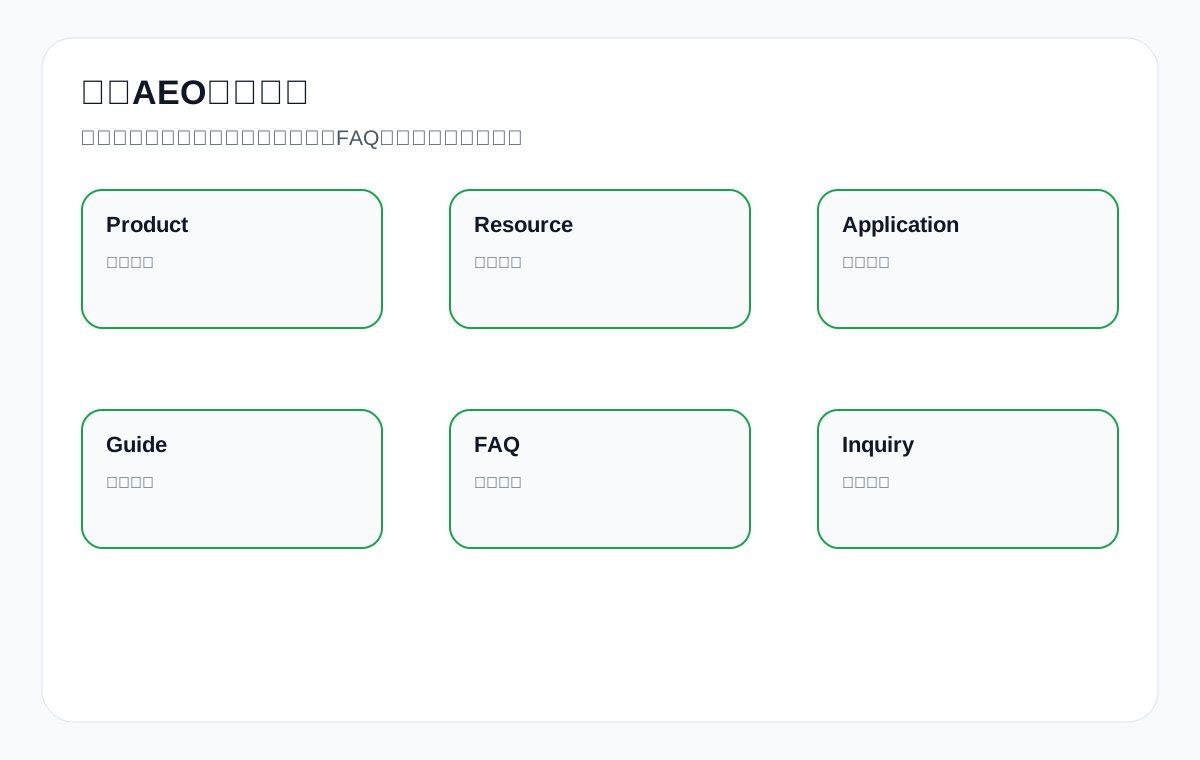
9. Entity consistency: answer engines need to know who you are and what you sell
AEO depends heavily on entity clarity. The company’s English name, brand name, product names, domain, logo, contact information, certificate holder, and external platform profiles should be as consistent as possible. Otherwise, answer engines may be unable to confirm whether different pieces of information belong to the same company.
A common problem for foreign trade companies is that the official website’s English name, the certificate company name, the Alibaba platform name, the LinkedIn name, and the email domain do not match. The About page needs to explain the relationships between entities, and pages, documents, and schema must stay consistent.
Product entities should also be unified; for example, clear relationships should be established among custom metal parts, CNC machining parts, and precision machined components.
Entity consistency checklist
| Entity | What to check | Risk |
|---|---|---|
| Company | English name, logo, address, email | Brand confusion |
| Brand | Relationship between the brand and the company entity | Attribution errors |
| Product | Standard names and aliases | Fragmented query terms |
| Certificates | Holder and product scope | Insufficient trust |
| External materials | Consistency across social media and platforms | Confused AI citations |
10. AEO content writing: use answer blocks, tables, steps, and FAQs together
AEO content is not about turning an article into a Q&A list; it is about giving every important question an answer block, explanation, table, steps, examples, and a next step. Answer blocks are good for excerpting, tables for comparison, steps for operations, and FAQs for supplementary detail.
For example, “how to choose waterproof connector” can start with an answer block, then explain IP rating, pin count, materials, and application environment, use a table to compare IP67/IP68, use steps to explain the information needed for a quote, and use FAQs to answer MOQ and custom cable questions.
This structure is more complete than FAQs alone and better suited to foreign trade procurement decisions.
AEO writing components table
| Component | Role | Example |
|---|---|---|
| Answer block | Direct answer | First 2-4 sentences |
| Table | Comparison and judgment | Specification and application matrix |
| Steps | Operational path | Selection and quotation process |
| Examples | Grounded in product scenarios | LED flood light for parking lot |
| FAQ | Supplement with real questions | MOQ, certificate, sample |
11. AEO topic selection: expand from query terms to question sets
Traditional SEO often starts with keywords, while AEO expands keywords into question sets. One core term may correspond to multiple questions: definition, selection, comparison, application, documentation, risk, and quotation.
For example, packaging machine can be expanded into: What packaging machine is suitable for powder? How to compare vertical and horizontal packaging machines? What information is needed for a packaging machine quote? How to maintain packaging machine? What certificate is needed for food packaging?
Each question must have a target page assigned; not all of them have to be written as blog posts.
Keyword-to-question-set table
| Core term | Question set | Target page |
|---|---|---|
| LED flood light | how to choose / IP rating / parking lot | Tutorial + application + product |
| custom metal parts | tolerance / material / quote drawing | Tutorial + capability + inquiry |
| waterproof connector | IP67 / M12 / marine use | Tutorial + product + application |
| ceramic dinnerware | safety / private label / packaging | Resource + capability + FAQ |
| industrial valve | pressure / material / test report | Product + resource + application |
12. What is the difference between AEO and GEO? Foreign trade companies need not overthink the names
AEO often emphasizes direct answers from answer engines, GEO often emphasizes citations and brand visibility in generative engines, and AI search visibility is a broader term. For foreign trade companies, there is no need to agonize over the names; the key is to build content assets that can be discovered, understood, cited, and reviewed.
Whether it is called AEO, GEO, or AI search visibility, none of them can do without: clear questions, direct answers, real materials, entity consistency, a page system, external signals, and data review.
Do not keep changing direction for the sake of a new buzzword; first make product pages, resource pages, application pages, and FAQs solid.
Comparison of AEO/GEO/AI visibility
| Name | Emphasis | Foreign trade implementation |
|---|---|---|
| AEO | Direct answers and Q&A structure | Answer blocks, FAQ, schema |
| GEO | Citations in generative answers | Resource pages, entities, external signals |
| AI Visibility | Overall visibility | Monitor mentions and accuracy |
| SEO | Search results and clicks | Crawling, indexing, content, internal links |
| Common foundation | Useful content and credible facts | Product materials and inquiry paths |
13. AEO review: don’t just take screenshots — fix the query set
AI answers change with time, region, model, and how the question is asked. AEO review cannot rely on a single screenshot; it needs a fixed query set and regular records of mentions, citations, accuracy, competitors, and official website sources.
The query set should cover product, application, documentation, and quotation questions. For example, waterproof connector can monitor questions such as IP rating, marine lighting, M12, and custom cable quote.
Then combine AI review with GSC, GA4, and inquiry quality to judge whether the content is bringing real improvement.
AEO review table
| Metric | What to look at | Action |
|---|---|---|
| Coverage | Whether questions are covered | Add question pages |
| Citation | Whether the official website is cited | Strengthen resource pages |
| Accuracy | Whether answers are accurate | Correct the facts |
| Competitors | Why competitors appear | Benchmark and fill gaps |
| Inquiry | Whether inquiries are more specific | Adjust content and forms |
14. A 90-day roadmap for AEO projects
The first 30 days are for the question bank and page inventory: identify product lines, procurement questions, existing pages, documentation gaps, and entity consistency. Days 31-60 are for content assets: add answer pages, product pages, resource pages, FAQs, and internal links. Days 61-90 are for monitoring and review: look at AI answers, GSC, GA4, and inquiry quality.
Do not start by only writing FAQs. First confirm which product lines are most worth doing, which pages lack materials the most, and which questions are closest to an inquiry.
After 90 days, use the data to decide on the second batch of product lines and content.
90-day AEO roadmap table
| Period | Focus | Deliverables | Review |
|---|---|---|---|
| Days 0-30 | Question bank and page inventory | Query set, page map, documentation gaps | Current-state baseline |
| Days 31-60 | Content and material development | Answer pages, resource pages, FAQs | Pages and indexing |
| Days 61-90 | AI and business review | Monthly report, second-batch plan | Citations, accuracy, inquiries |
15. Common misconceptions: why AEO gets done too narrowly
Misconception one: equating AEO with FAQs. FAQ is just one module; it cannot replace content and evidence.
Misconception two: focusing only on whether AI mentions the brand and not on whether the answer is accurate. A wrong mention can be more dangerous than no mention.
Misconception three: ignoring SEO fundamentals. If a page cannot be indexed, AEO lacks a source.
Misconception four: writing examples from service industries for foreign trade clients. Foreign trade AEO must be grounded in English product terms and procurement questions.
Misconception five: promising fixed results. AI answers cannot be fully controlled; focus on long-term visibility and accuracy.
Misconception correction table
| Misconception | Consequence | Correction |
|---|---|---|
| Only writing FAQs | Insufficient page support | Add product and resource pages |
| Only looking at mentions | Ignoring inaccurate descriptions | Monitor accuracy |
| Skipping SEO | Unstable sources | Get crawling and indexing right first |
| Examples that don’t fit | Clients cannot relate | Use foreign trade product terms |
| Overpromising | Distorted expectations | Explain risk boundaries |
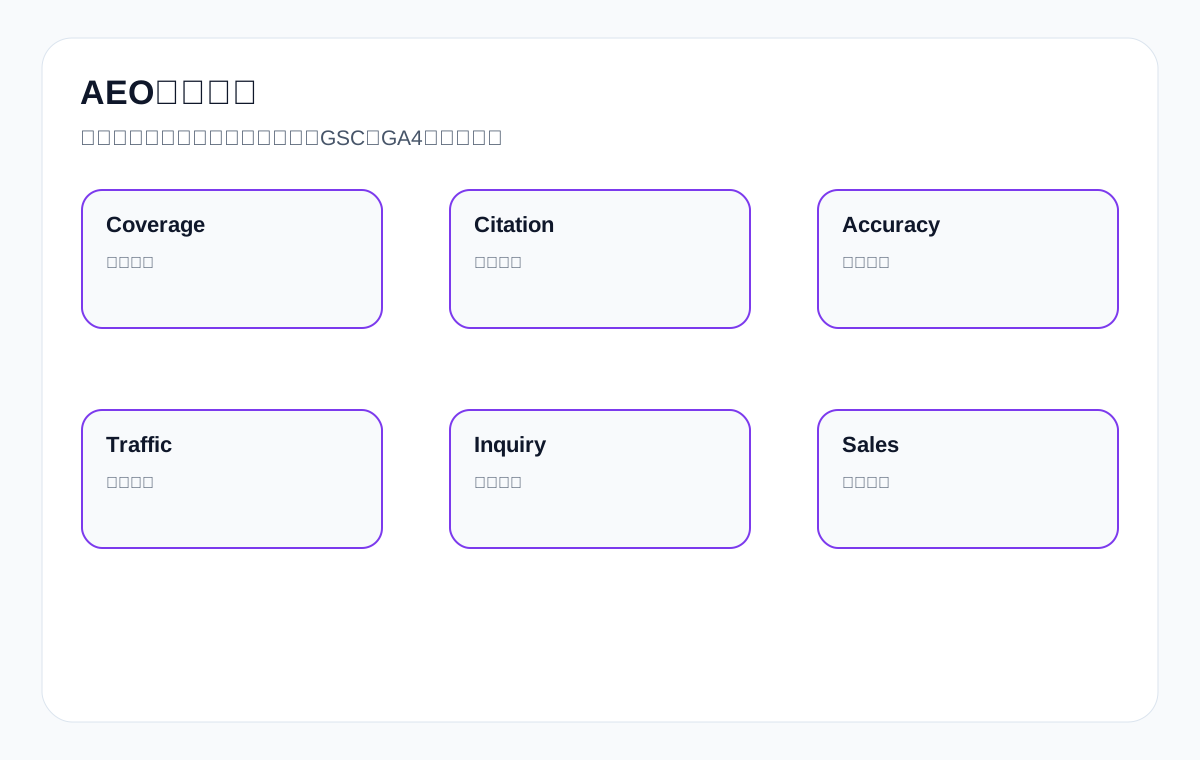
18. AEO case study: how waterproof connector moves from FAQ to an answer system
If a waterproof connector website only writes “Do you support customization, how long is the lead time, how do I request a quote” at the bottom of the page, that is just an FAQ. A real AEO system should start from procurement questions: what IP67 is, how to choose between IP67 and IP68, what scenarios M12 4 pin suits, what to note for marine lighting, and what materials are needed for a custom cable assembly quote.
These questions correspond to different pages: the IP rating explanation can be a tutorial page, M12 4 pin is a product page, marine lighting is an application page, the datasheet is a resource page, and custom cable quote is an inquiry page. The FAQ only gathers common questions as a supplement; it should not carry the entire explanation.
In this way, answer engines can more easily understand the product system from multiple pages, rather than seeing only a few isolated Q&As.
waterproof connector AEO page map
| Procurement question | Target page | Page content |
|---|---|---|
| What is IP67 waterproof connector? | Tutorial page | Definition, standards, application limits |
| M12 4 pin connector specs | Product page | Specifications, images, datasheet |
| Connector for marine lighting | Application page | Salt spray, sealing, recommended products |
| Waterproof connector datasheet | Resource page | Version, applicable models, download |
| Custom cable assembly quote | Inquiry page | Cable length, quantity, application, drawings |
19. AEO case study: how packaging machine builds a closed loop of answers and documentation
Packaging machine procurement questions are usually complex; both AI and buyers need information on materials, packaging formats, speed, precision, certification, installation, and maintenance. Writing only “we provide high-quality packaging machines” has no answer value.
A complete AEO system can include: a how to choose packaging machine tutorial, a powder packaging machine category page, a food packaging application page, a machine manual resource page, a maintenance FAQ, and a request a quote inquiry page. Each page answers one clear question.
Articles and materials should link to each other. Tutorials explain how to choose, product pages give specifications, resource pages give manuals and videos, FAQs answer lead time, installation, and after-sales questions, and the inquiry page collects materials, packaging dimensions, target capacity, and certification requirements.
packaging machine AEO content table
| Content asset | Question answered | Conversion path |
|---|---|---|
| Selection guide | How to choose packaging machine? | Links to equipment categories |
| Material category page | Which machine fits powder? | Links to products and videos |
| Application page | Food packaging requirements? | Links to certificates and inquiry |
| Resource page | Where is the manual? | Download and contact |
| Inquiry page | What info is needed? | Submit requirements |
20. AEO case study: how custom metal parts builds content around drawing-based quoting
The AEO focus for custom metal parts is not writing many industry concepts, but answering buyers’ specific questions before they request a quote from a drawing: how to choose materials, how to specify tolerances, how surface finish affects cost, what drawing formats are needed, and how to judge a supplier’s capability.
Core content can include: a custom metal parts manufacturer capability page, a CNC machining tolerance guide, a surface finish comparison, upload drawing for quote, and an inspection report sample. Each page can be used by AI to answer different questions.
If the content enables customers to prepare materials, quantities, drawings, surface finishes, and tolerances in advance, the inquiries sales receives will also be more specific.
custom metal parts AEO content table
| Question | Page | Key materials |
|---|---|---|
| What tolerance do I need? | Tolerance guide | Tolerance table and cost impact |
| Which material is suitable? | Material guide | 6061, 7075, 304, etc. |
| How to request a quote? | Inquiry page | Drawings, quantity, surface finish |
| How is quality checked? | Inspection resource page | inspection report |
| Can you handle low volume? | Capability page FAQ | Sample and mass production notes |
21. AEO content review checklist: ask these questions before publishing
Every piece of AEO content should be reviewed before publication. Does it answer a real question? Does it have a direct answer at the start? Does it include tables, steps, or checklists? Does it have product facts and documentary evidence? Does it link to related products, materials, and inquiry paths? Does it avoid exaggerated promises? Can it be reviewed?
If an article only explains concepts and has no product scenarios, materials, or next step, it is not suitable as core AEO content. Foreign trade websites should prioritize pages that support procurement decisions.
A review checklist can give content teams, product teams, and sales teams a shared standard.
Pre-publication AEO review table
| Review item | Passing standard | Action if it fails |
|---|---|---|
| Real question | Comes from GSC/inquiries/sales | Choose a new topic |
| Direct answer | Give a clear conclusion at the start | Rewrite the opening |
| Evidence and materials | Specifications, certificates, and materials are visible | Add resource pages |
| Clear structure | Tables, steps, and FAQs are complete | Add structural modules |
| Conversion path | Links to products, materials, and inquiry | Add internal links and CTAs |
22. AEO and content cannibalization: don’t create a new short article for every question
AEO emphasizes answering questions, but that does not mean every small question needs a new short article. If questions belong to the same search intent, they can be merged into a pillar page or an FAQ module. Otherwise, the site will end up with many repetitive short articles, which instead reduces topical clarity.
For example, IP67 waterproof connector, IP68 connector, and waterproof connector for outdoor lighting can form one selection pillar page and several subpages, rather than a dozen short articles competing with each other. The materials, speed, and packaging formats of packaging machine should also be organized by page system.
AEO content governance must consider both citability and page roles, avoiding content cannibalization created just to cover questions.
How to handle AEO questions
| Question type | Handling approach | Reason |
|---|---|---|
| Core big question | Pillar page | Needs a complete answer |
| Detailed specification question | Subpage or FAQ | Avoid breaking it up too finely |
| Product specification question | Product page | Close to procurement |
| Documentation verification question | Resource page | Provides evidence |
| Quote preparation question | Inquiry page/FAQ | Improves lead quality |
23. AEO and internal links: give the answer a next step
Answer engines may provide a summary, but users still need to verify and act. Official website content must offer a next step: view products, download materials, compare specifications, check certificates, submit an inquiry. Internal links are what connect the answer to the business path.
Every piece of AEO content should have at least three types of links: related products or category pages, resource or certificate pages, and inquiry or contact pages. Anchor text should be specific, such as “IP67 waterproof connector datasheet,” rather than “click here.”
Internal links also help search and AI understand page relationships. Isolated answer pages can hardly support long-term visibility.
AEO internal link table
| Content type | Should link to | Purpose |
|---|---|---|
| Selection guide | Category pages, product pages | From answer to product |
| Specification explanations | Product pages, resource pages | Verify specifications |
| Certificate descriptions | Certificate pages, About page | Build trust |
| Application articles | Application products and cases | Scenario conversion |
| Quotation guide | Forms and upload entry points | Collect requirements |
24. AEO metric system: don’t look at a single answer screenshot
AEO review needs a metric system. The most basic metrics include question coverage, brand or product mentions, official website citations, answer accuracy, competitor appearances, changes in GSC query terms, GA4 on-site behavior, material downloads, inquiry quality, and sales feedback.
A single answer screenshot can only serve as a record, not as a conclusion. Answers are affected by model, region, time, phrasing, and retrieval results. A more reliable approach is a fixed query set, a fixed cadence, and fixed record fields, observing trends and types of errors.
Foreign trade companies should also connect AI metrics with business metrics. If AI mentions the brand but there are no visits or inquiries, business value is not necessarily created; if AI does not mention the brand directly, but users enter through a resource page and submit high-quality inquiries, that is also worth attention.
AEO metric system table
| Metric | Description | Foreign trade judgment |
|---|---|---|
| Question coverage | How many questions in the query set are covered by official website content | Completeness of content assets |
| Official website citations | Whether AI cites official website URLs | Credibility of materials |
| Answer accuracy | Whether specifications, applications, and certificates are correct | Factual consistency |
| GSC changes | Whether related question terms are growing | Search understanding |
| GA4 behavior | Whether users download materials or submit inquiries | Path effectiveness |
| Sales feedback | Whether inquiries are more specific | Business value |
25. AEO teamwork: product, sales, content, and technical teams all take part
AEO is not work that content people alone can complete. Product teams provide specifications, materials, certificates, and application limits; sales teams provide real customer questions and inquiry quality; content teams organize the information into answers and pages; technical teams ensure pages are crawlable, structured data is correct, and speed and mobile experience are usable.
Without product materials, content becomes vague; without sales feedback, the question bank drifts from real procurement; without technical support, pages may not be crawled reliably; without review, the team does not know what to change next.
It is advisable to hold a monthly AEO review meeting around the fixed query set, GSC, GA4, inquiries, and sales feedback to decide the next batch of pages. The meeting does not need to be complicated, but it must land on URLs and actions.
AEO team roles table
| Role | Responsibilities | Deliverables |
|---|---|---|
| Product/engineering | Specifications, materials, applicable scope | Product fact sheet |
| Sales | Customer questions, lead quality | Question bank and feedback |
| Content | Answer structure, tables, FAQs | Page drafts and updates |
| Technical | Crawling, schema, speed | Page usability |
| Owner | Priorities and review | Monthly plan |
26. AEO content updates: answers must change with products and markets
AEO content does not end once it is published. Product specifications, certifications, MOQ, lead times, market standards, and customer questions all change. If content is not updated for a long time, AI and users may cite outdated information.
Foreign trade companies should set update cycles for core AEO pages. Product pages and resource pages should be updated in sync when there are new certificates, models, or specifications; FAQs should be updated based on sales questions; application pages should be updated for target markets and customer scenarios; tutorial pages should be updated based on GSC query terms and AI answer errors.
When updating, record the reason for the change and the review date, so you can judge whether the change improved query terms, citation accuracy, and inquiry quality.
AEO update trigger table
| Trigger event | Pages to update | Content to update |
|---|---|---|
| New product launch | Product pages, category pages, FAQs | Specifications, images, materials |
| Certificate changes | Resource pages, product pages | Certification scope and version |
| High-frequency sales questions | FAQs, tutorial pages | Answers and checklists |
| Incorrect AI answers | Relevant answer pages | Definitions and factual explanations |
| Market changes | Application pages, resource pages | Standards and scenarios |
27. Risk boundaries for AEO content: what not to write
AEO content should avoid uncontrollable promises and misleading expressions. Do not promise that AI will definitely cite or recommend you or definitely bring inquiries, and do not exaggerate product capabilities, fabricate certificates or test results, or present unsuitable scenarios as suitable.
Foreign trade companies should pay particular attention to product compliance and application boundaries. Products such as medical probe, ceramic dinnerware, and industrial valve involve materials, safety, and standards, so content must be confirmed by product or compliance staff. Wrong answers can damage trust.
Good AEO content explains applicable conditions, limitations, and information that needs further confirmation, rather than saying “it all works” to every question.
Risky phrasing alternatives table
| Not recommended | Recommended | Reason |
|---|---|---|
| Will definitely be recommended by AI | Strengthens the foundation for being understood and cited | Avoids uncontrollable promises |
| Suitable for all scenarios | Applicability must be confirmed against specifications | Avoids misleading buyers |
| Certificates cover all products | State the scope of the certificate | Compliance accuracy |
| Lead time is absolutely fixed | Lead time depends on quantity and customization requirements | Reflects B2B reality |
| No materials needed | Key specifications are required for a quote | Improves lead quality |
28. Aligning AEO with sales materials: website, PDF, and sales pitch must match
AI and buyers may encounter the official website, PDF catalogs, product datasheets, email replies, and third-party platform materials at the same time. If these materials contradict each other, trust and answer accuracy suffer.
It is advisable to treat the website’s AEO content as the unified source of materials. Sales pitches, PDFs, trade show materials, and social media content should all reference the same product fact sheet. That way, when a customer enters the website from an AI answer and then contacts sales, the information they hear is consistent.
For high-value product lines, an English product fact library can be built, containing standard names, specifications, applications, certificates, FAQs, images, and material links. AEO content, SEO pages, and sales materials all draw from it.
Material alignment table
| Material channel | Content to align | Owner |
|---|---|---|
| Website pages | Product facts and FAQs | Content + product |
| PDF catalogs | Specifications and models | Product + sales |
| Sales emails | MOQ, lead time, material checklist | Sales |
| Third-party platforms | Brand and product names | Operations |
| Certificate materials | Applicable scope and version | Compliance/product |
16. FAQ: Common questions about AEO (Answer Engine Optimization)
What is AEO?
AEO is the practice of making content easier for answer engines to discover, understand, excerpt, and cite, with the focus on directly answering user questions and providing credible evidence.
Is AEO just writing FAQs?
No. FAQ is only one part of AEO; it also requires product facts, resource pages, entity consistency, internal links, structured data, and review.
Which is more important, AEO or SEO?
The two stack. SEO is the foundation, and AEO builds on SEO to make content better suited to answer-based search and AI citation.
Which AEO content should a foreign trade website do first?
Start with selection guides, application pages, resource pages, FAQs, and quote preparation pages for high-value product lines.
Can AEO guarantee that AI cites the official website?
No. What you can control is improving page clarity, credible materials, entity consistency, and monitoring and review.
Is FAQPage schema mandatory?
Visible and genuine FAQs can be considered, but schema cannot replace page content, and you should not mark questions that are not visible.
Does AEO need external signals?
Yes. Official website content is the foundation, and industry materials, trade shows, partners, certificates, and third-party mentions also help credibility.
How do you judge whether AEO is working?
Look at mentions, citations, and accuracy in the fixed query set, then combine them with GSC, GA4, inquiry quality, and sales feedback.
Can old articles be turned into AEO content?
Yes. First confirm the target question and the page role, then add answer blocks, tables, materials, FAQs, and internal links.
Is AEO suitable for B2B foreign trade?
Yes. B2B procurement questions are complex and need clear answers, documentary verification, and inquiry paths even more.
If you can only do one thing first, start with a single high-value product line: organize real procurement questions, add a pillar guide, add product page specifications and resource pages, then use a fixed query set to review whether AI answers become more accurate. This small closed loop is more effective than vaguely revising FAQs across the whole site, and it makes it easier for the team to see real change and keep improving every page, every material entry point, and every effective inquiry path.
17. Conclusion: AEO makes a foreign trade website a credible answer source
AEO is not a standalone trick, nor is it another name for an FAQ module. It requires a foreign trade website to organize product facts, procurement questions, documentary evidence, company entities, page paths, and review metrics so that answer engines and overseas buyers can understand them more accurately.
For Chinese export manufacturers and trading companies, the most worthwhile part of AEO is not chasing concepts but building the official website into an English-language product question and resource library: with clear answers, specification tables, certificate materials, application scenarios, FAQs, and quotation checklists.
When website content can be accurately restated by AI and also guide users smoothly into product, resource, and inquiry paths, AEO is truly serving foreign trade customer acquisition.
Final checklist
| Checklist item | Completion standard |
|---|---|
| Question bank | Comes from English product terms, inquiries, GSC, and sales feedback |
| Answer structure | Direct answer at the start, with tables and steps in the body |
| Evidence layer | Specifications, certificates, datasheets, and manuals are verifiable |
| Page system | Products, resources, applications, tutorials, and FAQs support each other |
| Entity consistency | Company, brand, product, and certificate information is unified |
| Review loop | Look at AI, GSC, GA4, and inquiry quality together |
Continue reading this GEO series
If you are systematically learning about GEO and AI search visibility, the following articles are recommended next. Start with the concepts, then move on to diagnostics, monitoring, content structure, and collaboration boundaries.
- What is AI SEO: How it differs from traditional SEO, GEO, and AEO
- What is GEO: How it differs from SEO and AEO, and what foreign trade websites should do
- Where to start with AI search optimization: Should a foreign trade website build a query set first or revise content first?
- How to do GEO: What to change first, from page structure to citation probability
- What is schema structured data: Which types should foreign trade websites add for SEO and AI search
- How to build B2B foreign trade AI search visibility: A guide to getting inquiry terms and solution terms into AI answers
This page is machine-translated from the Simplified Chinese version and awaiting human review. It has not yet been proofread.