Competitor keyword mining is not about copying the words on a competitor’s website onto your own, and it is not about rushing to write an article the moment you see a keyword with high search volume. For export manufacturers and trading companies, it solves three more practical problems: which English words overseas buyers are actually using to describe the product, which page types are better suited to carry those words, and which content entry points that could bring in inquiries are missing from your own website.
If a factory that makes custom metal parts only fixates on broad terms like “metal parts,” it usually runs into two problems: search volume looks large, but competition on the first page is extremely strong; and even after writing a very long article, it may still not convert into inquiries. Conversely, if you break a competitor’s pages down into more specific terms such as custom aluminum machining parts, stainless steel turned components, precision CNC parts for automotive, and low volume CNC machining supplier, you can see that buyers search by material, process, application industry, purchasing stage, and supplier capability.
This article is not about tool buttons; it is about a process that foreign trade companies can actually put into practice: start from competitor pages, extract English product terms, judge search intent, map page types, assess inquiry value, and then decide whether to update a product page, add a category page, write an industry solution page, or create a new technical article or FAQ.
What problem does competitor keyword mining actually solve?
The surface-level output of competitor keyword mining is a keyword list, but the truly valuable output should be a page action plan. A keyword list only tells you “which keywords exist,” while a page action plan tells you “which page should carry each keyword, what the current page is missing, and what to change next.”
The common problem with foreign trade websites is not a lack of keywords, but the absence of a correspondence between keywords and pages. For example, LED flood light is best carried by a category page or product page; LED flood light for warehouse is better suited to an industry application page; how to choose outdoor LED flood light wattage is better suited to a technical article; and LED flood light manufacturer China may need a product category page, a factory capability page, and an inquiry entry point working together.
| Problem the company sees | The keyword problem behind it | Page action it should become |
|---|---|---|
| Competitors publish many articles, and you do not know what to write | Reading only titles, without breaking down search intent | First group keywords by product terms, application terms, and purchasing question terms |
| The product page exists but gets no organic traffic | The page states only the product name and does not cover specifications, materials, applications, or buyer questions | Add a specification table, application scenarios, FAQ, internal links, and an inquiry entry point |
| The article ranks but brings no inquiries | Informational terms are not connected to commercial terms | Link from the article to product pages, industry pages, and the inquiry page |
| Ad keywords are expensive, and organic traffic is hard to win too | Focusing only on broad terms and ignoring long-tail product terms | Start with low-competition but highly relevant English long-tail terms |
Benchmarking against the Top 1 / authoritative references: what Ahrefs and Semrush get right, and what is still missing
When it comes to competitor keyword mining, the current authoritative content usually comes from tool platforms such as Ahrefs and Semrush. Their strength is data acquisition and gap discovery: you can see the keywords your competitors rank for and you do not, as well as which keywords their pages capture. But this content usually assumes the reader already knows how to turn keywords into a page strategy — and for foreign trade companies, that is precisely the hardest step.
| Benchmark item | What the authoritative reference gets right | What foreign trade companies still lack | How this article strengthens it |
|---|---|---|---|
| Keyword gap | Can find keywords your competitors rank for but your site does not | No idea whether these keywords should be carried by a product page, category page, industry page, or article | Add a page type mapping matrix |
| Search volume and difficulty | Can sort by search volume, KD, and ranking position | In B2B foreign trade, low-volume keywords can still have high inquiry value | Add inquiry intent and execution cost scoring |
| Competitor pages | Can see ranking URLs and traffic pages | No understanding of why a page can serve buyer needs | Break down title, H1, specification table, FAQ, application scenarios, and CTA |
| Content gap | Flags that the site lacks a certain type of topic | Easily misinterpreted as publishing more articles | Turn topics into a renovation plan for product pages, industry pages, and the inquiry page |
So foreign trade companies should not stop at “what keywords do competitors have?” They should keep asking: what buyer task lies behind these keywords? Is the buyer looking for a supplier, checking specifications, comparing prices, verifying certifications, looking for an application solution, or preparing to submit an inquiry? Only when you answer at this level does competitor keyword mining turn into a growth action.
First define three types of competitors: business competitors, search competitors, and content competitors
Many foreign trade companies initially treat offline peers or trade show peers as their only competitors, but in Google Search, the companies actually taking your traffic are not necessarily the same type of business. You need to look at three types of competitors at the same time.
| Competitor type | How to identify | What to mine | Foreign trade example |
|---|---|---|---|
| Business competitor | Similar products, customers, and price ranges | Product terms, process terms, certification terms, factory capability terms | An export factory that also makes cnc machining parts |
| Search competitor | Frequently appears on the first page of Google results for target keywords | Title wording, page type, FAQ, internal link structure | Websites ranking on the first page for waterproof connector supplier |
| Content competitor | Does not necessarily sell the same products, but its content covers buyer questions | Technical articles, selection guides, purchasing questions | Industry media or platform pages that write about how to choose LED flood light |
The three types of competitors should not be lumped together. Business competitors are useful for judging whether your website clearly explains your supply capability; search competitors are useful for judging page structure; content competitors are useful for discovering the questions buyers care about. If you look only at business competitors, you may miss a large number of guide pages and platform pages that are capturing traffic; if you look only at search competitors, you may ignore the supplier capability requirements involved in the real purchasing process.
What materials should foreign trade companies prepare before doing competitor keyword mining?
Preparing materials before you start mining competitors keeps the keyword list from growing more chaotic later. At a minimum, prepare the following information:
- Core product list: English product name, Chinese product name, model, material, process, application industry.
- Key countries or markets: the United States, Germany, the United Kingdom, the Middle East, Southeast Asia, and so on; search terms may differ from market to market.
- Current website URLs: product pages, category pages, industry pages, article pages, and the contact page.
- Existing GSC queries: English terms that already have impressions but low clicks.
- Inquiry quality feedback: which keywords bring inquiries that look like real buyers, and which are just students, job seekers, or low-price requests.
For example, a company that makes packaging machine should not prepare only the single term “packaging machine”; it should also organize product and application branches such as vertical packaging machine, powder packing machine, granule packaging machine, automatic pouch packing machine, and food packaging machine supplier. Only then, when you look at competitors, can you judge whether they cover product categories, industry applications, or purchasing questions.
Reverse-engineer English product terms from competitor pages: do not fixate only on homepage keywords
A competitor’s homepage usually covers the brand, company introduction, and a small number of core product terms, but the truly valuable terms are often hidden in category pages, product detail pages, application pages, FAQs, and technical articles. When mining terms, you should look layer by layer by page type.
| Competitor page type | What to observe | Terms you may extract | Action on your own site |
|---|---|---|---|
| Product category page | Category names, filter conditions, paragraph descriptions | LED flood light, outdoor flood light, industrial flood light | Optimize the category page title, opening paragraph, product list, and FAQ |
| Product detail page | Model, specifications, materials, applications, certifications | IP66 LED flood light, 200W LED flood light, aluminum housing flood light | Add a specification table, application images, specification notes, and an inquiry button |
| Industry application page | Use scenarios, pain points, solutions | LED flood light for warehouse, flood light for sports field | Create or strengthen an industry solution page |
| Technical article | Selection questions, maintenance questions, comparison questions | how to choose LED flood light wattage | Write a technical guide and link internally to the product page |
| FAQ | Pre-purchase concerns, lead time, certifications, MOQ | LED flood light MOQ, LED flood light lead time | Add an FAQ and a question block on the inquiry page |
The point of this process is not to stuff every keyword into one article, but to determine which page should carry each keyword. A mature foreign trade site should let the product page answer “what this product is,” the category page answer “what specifications and series exist,” the industry page answer “what applications it suits,” articles answer “how to choose and how to judge,” and the inquiry page answer “how to submit a requirement.”
Visual module: explanation of the flow chart from competitor pages to inquiry opportunities
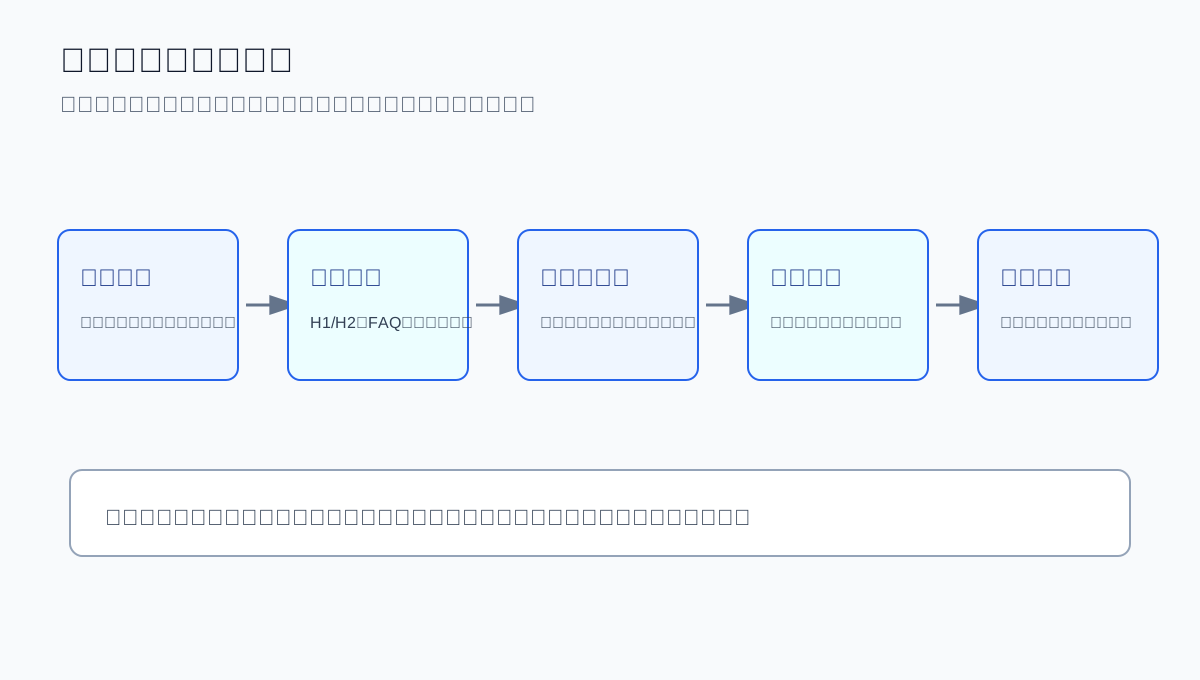
This chart is well placed in the first half of the article, to help readers understand that competitor keyword mining is not a single action but a closed loop running from search results to page optimization to inquiry review.
Reverse-engineer page types from keywords: product pages, category pages, industry solution pages, article pages, FAQ, and inquiry pages
The value of a keyword depends on whether the page carrying it is correct. For example, waterproof connector supplier is closer to supplier selection, so it suits a category page or capability page; waterproof connector pinout is closer to technical documentation, so it suits a technical article; waterproof connector for outdoor lighting is closer to an application scenario, so it suits an industry solution page.
Take industrial valve supplier as an example: the same product can be broken down into different levels such as valve manufacturer, stainless steel valve, high pressure industrial valve, industrial valve for oil and gas, and industrial valve supplier China. They should not all be carried by a single article; instead, they should form a structure spanning product pages, category pages, industry pages, technical articles, and the inquiry page.
Mapping English product terms to page types: where foreign trade sites most often go wrong
Many websites cram every keyword into the blog, and as a result neither the product pages rank nor the blog generates inquiries. The correct approach is to give core product terms to product/category pages, application scenario terms to industry solution pages, purchasing question terms to FAQ or articles, and high-intent supplier terms to the inquiry page.
Take industrial valve supplier as an example: the same product can be broken down into different levels such as valve manufacturer, stainless steel valve, high pressure industrial valve, industrial valve for oil and gas, and industrial valve supplier China. They should not all be carried by a single article; instead, they should form a structure spanning product pages, category pages, industry pages, technical articles, and the inquiry page.
Keyword opportunity scoring: higher search volume does not mean more worth doing
B2B foreign trade keywords cannot be judged by search volume alone. medical probe manufacturer may not have high search volume, but its inquiry value is far higher than the broad medical probe. When scoring, look at relevance, inquiry intent, competitor strength, page gap, and execution cost.
Take industrial valve supplier as an example: the same product can be broken down into different levels such as valve manufacturer, stainless steel valve, high pressure industrial valve, industrial valve for oil and gas, and industrial valve supplier China. They should not all be carried by a single article; instead, they should form a structure spanning product pages, category pages, industry pages, technical articles, and the inquiry page.
When to create a new page, when to update an old page, and when to merge or noindex
If an existing page matches the target keyword’s intent and is merely incomplete, update the old page first; create a new page only when the target keyword corresponds to an independent product series or industry application; if several old articles compete for the same keyword, consider merging them; if a page has no search value and creates duplication, you can noindex or delete it.
Take industrial valve supplier as an example: the same product can be broken down into different levels such as valve manufacturer, stainless steel valve, high pressure industrial valve, industrial valve for oil and gas, and industrial valve supplier China. They should not all be carried by a single article; instead, they should form a structure spanning product pages, category pages, industry pages, technical articles, and the inquiry page.
GSC review: competitor keyword mining does not end when the keyword list is done
After publishing or updating, check changes in GSC queries, page impressions, click-through rate, average position, inquiry entry clicks, and AI answer citations. Without a data review, competitor keyword mining is just a one-off exercise in organizing materials.
Take industrial valve supplier as an example: the same product can be broken down into different levels such as valve manufacturer, stainless steel valve, high pressure industrial valve, industrial valve for oil and gas, and industrial valve supplier China. They should not all be carried by a single article; instead, they should form a structure spanning product pages, category pages, industry pages, technical articles, and the inquiry page.
Common misconceptions: why much competitor keyword mining does not bring inquiries
Common misconceptions include looking only at homepages, looking only at search volume, copying titles only, writing articles for every keyword, ignoring product pages, ignoring differences between country markets, failing to link internally to the inquiry page, and failing to review inquiry quality.
Take industrial valve supplier as an example: the same product can be broken down into different levels such as valve manufacturer, stainless steel valve, high pressure industrial valve, industrial valve for oil and gas, and industrial valve supplier China. They should not all be carried by a single article; instead, they should form a structure spanning product pages, category pages, industry pages, technical articles, and the inquiry page.
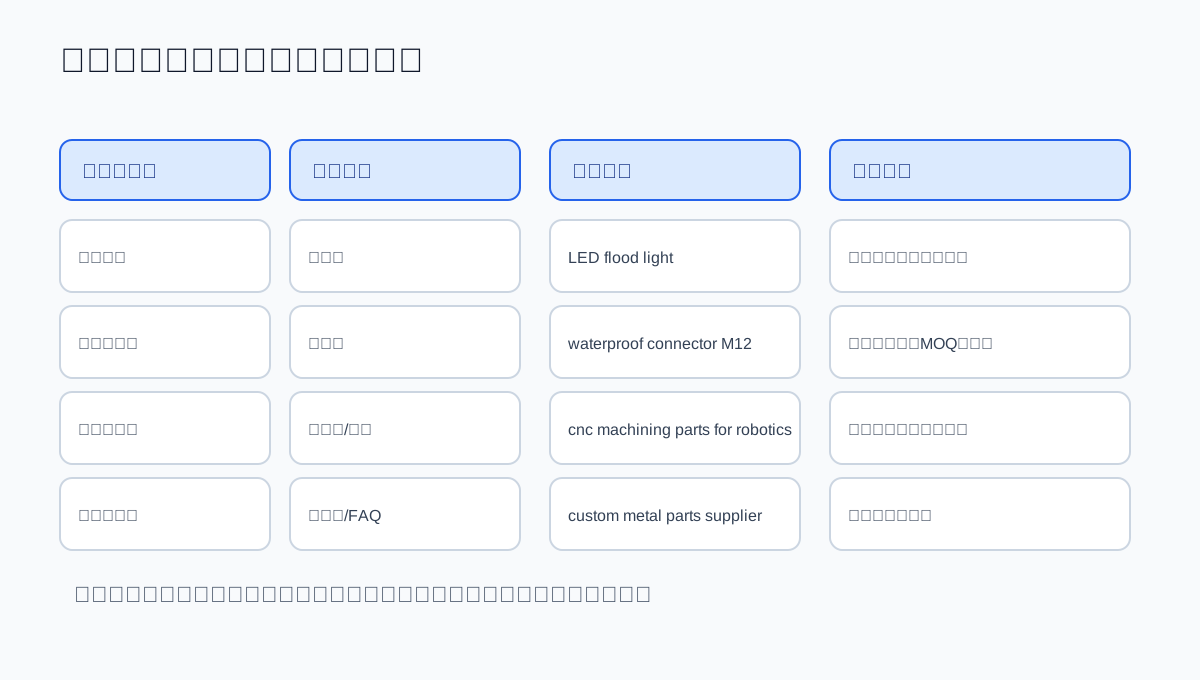
| Keyword type | Example | Recommended page | Reasoning |
|---|---|---|---|
| Core product term | cnc machining parts | Product category page | The buyer wants to see supply scope, materials, processes, and capabilities |
| Material/specification term | stainless steel valve | Category page or product page | The buyer has already entered specific product filtering |
| Application scenario term | LED flood light for warehouse | Industry solution page | The buyer cares about the use scenario and the solution |
| Purchasing question term | packaging machine price | FAQ / article / inquiry page | The buyer is evaluating budget and suppliers |
| Supplier term | waterproof connector supplier | Category page + inquiry page | The buyer is close to the inquiry stage |
Visual module: explanation of the English product term to page type mapping matrix
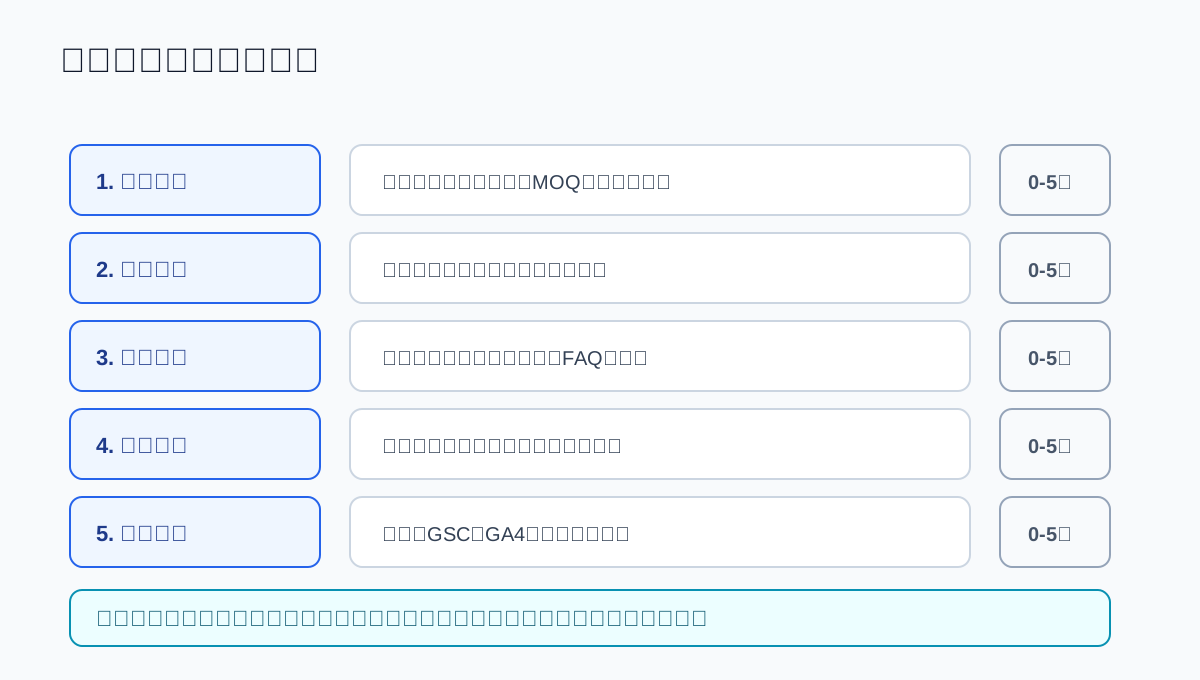
Visual module: explanation of the competitor keyword opportunity scorecard
FAQ: common questions foreign trade companies have about competitor keyword mining
Can competitor keywords be copied directly?
No. Keywords can be used as a reference, but the page structure, product capabilities, market positioning, and inquiry path must be re-evaluated in light of your own website.
Is it worth targeting keywords with low search volume?
It depends on inquiry intent. In B2B foreign trade, many high-value keywords do not have large search volume, but the buyers are more clearly defined.
Do competitors rank well because their articles are longer?
Not necessarily. It may also be because the page type is a better match, the internal links are stronger, the product information is more complete, or the brand signals are clearer.
When tool data and GSC data conflict, which should you trust?
For an existing website, prioritize GSC, because it reflects your site’s real impressions; tools are better suited to discovering external opportunities.
How often should you review?
New pages usually show early impressions after 4 to 8 weeks; at 3 months, look at clicks and query expansion, then combine that with inquiry quality to decide whether to go deeper.
Should you work on product pages or articles first?
If a keyword has clear purchasing intent, prioritize a product page, category page, or industry solution page; if the keyword is a selection or tutorial question, carry it with an article instead.
Can you target keywords competitors have not written about?
Yes, but first confirm that buyers actually search for them; you can validate this using GSC, Google Trends, sales questions, and ad search terms together.
How do you judge whether a keyword can bring inquiries?
Look at whether the keyword contains purchasing signals such as supplier, manufacturer, price, custom, OEM, material, application, MOQ, and lead time, then check whether the page has a clear inquiry entry point.
Conclusion: turn competitor keyword mining into a page growth mechanism
The final output of competitor keyword mining should not be an isolated keyword list, but a reusable page growth mechanism: regularly observe competitor pages, extract English product terms and buyer questions, map them to page types, rank them by inquiry value, update product pages, category pages, industry solution pages, and technical articles, and then review with GSC and inquiry sources. Only in this way does competitor research truly become a long-term search asset for a foreign trade website.
The complete execution process: from 20 competitor pages to one actionable opportunity table
When foreign trade companies actually put this into practice, it is not advisable to start by analyzing hundreds of competitor pages. A more reliable approach is to first choose 5 competitor websites and select 3 to 5 of the most representative pages from each: a homepage, a product category page, a product detail page, an industry application page, and a technical or FAQ page. That yields around 20 pages, which is already enough to judge the page structure and keyword distribution in the market.
- Step 1: Determine the main product line. For example, a company that makes waterproof connectors can start by looking only at waterproof connectors, rather than looking at wiring harnesses, sensors, switches, and cable assemblies at the same time, or the keyword list will spin out of control.
- Step 2: List search competitors. Search Google for terms such as waterproof connector supplier, waterproof connector manufacturer, and IP68 waterproof connector, and record the websites that repeatedly appear on the first page.
- Step 3: Capture page types. Do not look only at competitor homepages; record whether the ranking pages are product pages, category pages, application pages, blog pages, or platform pages.
- Step 4: Extract page terms. Extract keywords from title, H1, H2, product specifications, FAQ, breadcrumbs, image alt text, and internal link anchor text.
- Step 5: Judge the buyer task. For each keyword, note whether the buyer is looking for a product, a supplier, specifications, prices, certifications, or a use scenario.
- Step 6: Map actions for your own site. Finally, turn the keywords into page actions instead of just keeping a keyword list.
| Step | Input materials | Output | Where mistakes happen |
|---|---|---|---|
| Choose competitors | Google first-page results, peers the sales team knows, trade show peers | 5–10 targets for analysis | Choosing only business peers and ignoring content competitors in search results |
| Choose pages | Homepages, category pages, product pages, application pages, article pages | 20–50 page URLs | Looking only at homepages and missing the pages that actually rank |
| Extract terms | Titles, heading tags, body text, FAQ, specification tables, anchor text | English product terms and buyer question terms | Extracting only broad terms and not specifications, materials, or application terms |
| Classify intent | Keywords and ranking pages | Informational, product, supplier, and purchasing question types | Treating every keyword as an article topic |
| Decide actions | Your site’s existing pages and gaps | Update, create, merge, noindex, add internal links | Only publishing new articles and not changing the carrying pages |
Breaking down foreign trade product terms: a keyword set should be split into at least 5 dimensions
Competitor keyword mining cannot stop at a single product name. When foreign trade buyers search, they usually combine the product name with material, specifications, use, purchasing role, country or region, and problem scenario. Covering only the product name makes the page look thin and puts it in competition with a large number of platform pages.
| Dimension | Description | Example terms | Suitable pages |
|---|---|---|---|
| Core product term | The buyer describes the product directly | medical probe, waterproof connector, packaging machine | Product page, category page |
| Material/specification term | The buyer already knows the specific requirement | stainless steel valve, IP68 waterproof connector, 200W LED flood light | Product detail page, category page |
| Process/capability term | The buyer cares about supply capability | CNC machining parts, low volume CNC machining, custom metal parts | Capability page, process page |
| Application scenario term | The buyer looks for a solution by use scenario | LED flood light for warehouse, valve for chemical plant | Industry solution page |
| Purchasing question term | The buyer is making a purchasing judgment | packaging machine price, MOQ for custom metal parts, lead time for CNC parts | FAQ, technical article, inquiry page |
If competitors cover only core product terms and not application scenario terms, the opportunity may lie in an industry solution page; if competitors have many technical articles but thin product pages, the opportunity may lie in rewriting product pages; if competitors have strong category pages but weak FAQs, the opportunity may lie in purchasing question terms and the inquiry page.
How to judge why a competitor page ranks
When you see a competitor page ranking high, do not look only at how many words it contains. What matters more is judging which part of the search task it satisfies. A page may rank well because its title is closer to the intent, because its product specifications are complete, because the page has a clearer category structure, or because its internal links and brand authority are stronger.
| Where to look | What to check | How to turn it into an action on your own site |
|---|---|---|
| Title | Whether it includes product, application, and supplier terms | Adjust the title so the core intent is clearer |
| H1 / opening paragraph | Whether it directly answers the buyer’s question | State the product scope, applicable scenarios, and supply capability in the opening paragraph |
| Specification table | Whether materials, dimensions, certifications, and models are complete | Add a specification table to the product page instead of writing only marketing copy |
| FAQ | Whether it answers MOQ, lead time, customization, certifications, and samples | Add pre-purchase questions to reduce concerns before the inquiry |
| Internal links | Whether articles, categories, products, and the inquiry page are linked together | Add a next-step path to high-intent keyword pages |
| Visual assets | Whether there are product images, structure diagrams, and application images | Add visual modules and diagrams to improve comprehension |
The goal of this step is not “the competitor has it, so I need it too,” but rather judging which module of the competitor page genuinely helps users. If a competitor has 3,000 words but no application scenarios, and your page can add a specification table, scenario images, purchasing questions, and an inquiry path, you have a chance to be more complete in meeting the content task.
Grouping competitor keywords: do not let the keyword list become a trash can
Keywords exported from competitor tools are often very miscellaneous. Without grouping, a common problem appears later: product terms, article terms, question terms, brand terms, and low-value terms are all mixed together, and no one knows what to do next. It is advisable to process them in at least the following 6 groups.
| Group | Criteria | Example | Next step |
|---|---|---|---|
| High-intent product terms | Contains purchasing signals such as supplier, manufacturer, custom, OEM, and price | custom metal parts supplier | Check the product page and inquiry page first |
| Specification/model terms | Contains dimensions, power, ingress protection rating, material, and model | IP68 waterproof connector | Add to category pages and product detail pages |
| Application scenario terms | Contains for + industry/application | LED flood light for warehouse | Create an industry solution page |
| Selection question terms | how to choose, what is, difference between | how to choose packaging machine | Write a technical article and link internally to the product page |
| Price/purchasing process terms | price, cost, MOQ, lead time, sample | packaging machine price | Add an FAQ and pre-inquiry notes |
| Low-value broad terms | Intent is too broad or does not fit the business | machine, parts, light | Do not use as a priority page target |
Opportunity priority scoring: turn subjective judgment into a reviewable table
Competitor keyword mining most easily turns into an argument: sales thinks a keyword is important, operations thinks its search volume is too small, and the boss thinks that if competitors have done it, it should be done. The solution is not to decide on gut feeling, but to put every keyword through the same set of criteria with a scorecard.
| Scoring dimension | 1 point | 3 points | 5 points |
|---|---|---|---|
| Business relevance | Weakly related to the product | Related but not a main product | Directly corresponds to a main product or profit product |
| Inquiry intent | Leans toward learning or general browsing | Has some purchasing intent | Clearly looking for a supplier, price, customization, or samples |
| Competitor strength | The first page is all large platforms and authoritative sites | Includes both platforms and company sites | Company sites can also rank, so the competition is enterable |
| Page gap | Your site already has a strong page | A page exists but is incomplete | Your site completely lacks a page to carry it |
| Execution cost | Requires a lot of photography, development, or materials | Requires organizing materials and changing pages | Materials already exist and it can be done in the short term |
Whether a keyword should be prioritized is not a matter of a single score but of overall judgment. For example, medical probe manufacturer may not have high search volume, but if its business relevance, inquiry intent, and page gap are all high, it may be more worth doing first than the broad medical probe.
How to place visual modules
Combining images with text is not decoration; it makes complex judgments easier to understand. This article recommends at least three images: the first is the competitor keyword mining flow chart, explaining the path from competitor pages to inquiry opportunities; the second is the English product term to page type mapping matrix, explaining that different keywords should be carried by different pages; and the third is the keyword opportunity scorecard, helping the team align on priorities.
If conditions allow later, a fourth image can be added: a competitor page breakdown diagram marking the title, H1, specification table, FAQ, CTA, internal link entry points, and reusable modules. This kind of image is more valuable than ordinary illustrations, because readers can take it and check their own website directly.
Post-publication review metrics: how to know whether this round of mining was useful
After competitor keyword mining is completed, track at least 4 types of metrics. The first is whether GSC queries expand, especially whether more English product terms, specification terms, and application scenario terms appear. The second is whether impressions for target pages grow. The third is whether click-through rate improves, indicating that titles and snippets are closer to search intent. The fourth is whether the inquiry path becomes clearer, for example whether users move from an article to a product page, industry page, or contact page.
| Review metric | What to look at | How to judge |
|---|---|---|
| Query expansion | New English product terms and long-tail terms | Check 4–8 week changes in the GSC page dimension |
| Page impressions | Whether product pages, category pages, and industry pages gain more impressions | Compare data from the same period before and after the update |
| Click-through rate | Whether the title and snippet bring more clicks | Look at CTR and average position changing together |
| Inquiry path | Whether articles guide users to product pages and the contact page | GA4 paths, events, or form sources |
| AI answer citations | Whether AI search mentions the brand or cites the official site | Record the query set and answer sources |
Closing: competitor keyword mining should become a long-term mechanism
A foreign trade website does not finish with one round of competitor analysis. Product lines change, competitors update their pages, Google search results shift, and AI answers change their sources. The truly valuable practice is to review a fixed batch of core product terms and industry scenario terms every quarter: see what new pages competitors have published, which keywords are starting to get impressions, which old pages are beginning to decline, and which inquiry questions keep recurring.
When you turn competitor keyword mining into a long-term mechanism, your website content will no longer be just a pile of articles; it will gradually form a clear structure of product pages, category pages, industry solution pages, technical articles, and inquiry pages. For foreign trade companies, this is the value that competitor keyword mining can truly deliver.
A more detailed foreign trade case: from custom metal parts to a page plan
Suppose a factory’s main business is custom metal parts, and its current website has only one broad product page whose title reads Custom Metal Parts Manufacturer, with body text mainly introducing the company’s equipment and machining capabilities. After analyzing competitors, it turns out that the top-ranking websites do not write about just one broad term; they break metal parts into four layers: material, process, industry, and purchasing questions.
| Competitor keyword found | Buyer intent | Page your site should add | Page focus |
|---|---|---|---|
| custom aluminum parts | Looking for custom aluminum parts | Material category page | Aluminum grades, surface treatment, machining tolerances, application industries |
| CNC machining parts for automotive | Looking for a machining supplier for the automotive industry | Industry solution page | Automotive part types, quality control, materials, inspection process |
| low volume custom metal parts | Low-volume customization needs | Purchasing question page or capability page | MOQ, prototyping lead time, delivery time, quotation material requirements |
| custom metal parts supplier China | Supplier selection | Product page + factory capability page + inquiry page | Equipment, experience, export markets, quality inspection, inquiry form |
This case shows that competitor keyword mining should not conclude merely that “we need to target custom metal parts”; it should produce a page plan: one main product page to carry core terms, several material/process category pages to carry segmented terms, an industry solution page to carry application terms, and FAQ and inquiry pages to carry pre-purchase questions. Only then is there a chance to connect search traffic to the real business.
A more detailed foreign trade case: how to break down LED flood light
Now look at LED flood light. Many companies put all the information on a single product category page: power, color temperature, waterproof rating, application scenarios, installation method, certifications, and the inquiry button are all crammed together. After competitor keyword mining, you usually find that this category can be split into at least three types of pages.
- Category page: carries core terms such as LED flood light, outdoor LED flood light, and industrial LED flood light.
- Application page: carries LED flood light for warehouse, LED flood light for sports field, and LED flood light for parking lot.
- Technical article: carries how to choose LED flood light wattage, IP65 vs IP66 flood light, and LED flood light beam angle.
If competitors already have application pages and you have only a category page, the gap is not “not enough articles” but a missing page type. This judgment is critical, because adding the wrong page wastes time: writing a broad blog post when you should have built an industry solution page; writing a company introduction when you should have added a specification table; piling on more text when you should have optimized the inquiry entry point.
On-site coordination after competitor keyword mining: do not leave pages isolated
Once you have added new pages based on competitor keywords, the next step is not to wait for rankings but to connect them into the site structure. If an industry solution page does not link to the relevant product pages, users finish reading without knowing how to send an inquiry next; if a technical article does not link to a category page, Google has a hard time understanding its relationship to commercial pages; if a product page is not supported by an FAQ and related articles, the page will seem insufficiently deep.
| New page type | Where it should link | Purpose of the link |
|---|---|---|
| Product page | Category page, industry page, FAQ, inquiry page | Let buyers see specifications, scenarios, and the entry point for submitting a requirement |
| Category page | Core product pages, application pages, technical articles | Channel broad demand to more specific pages |
| Industry solution page | Related product pages, case-style explanations, inquiry page | Turn application scenarios into purchasing actions |
| Technical article | Product page, category page, FAQ | Guide informational traffic to commercial carrying pages |
| FAQ page | Product page, contact page, resource download, or inquiry form | Resolve pre-purchase concerns |
How the team should divide the work: what sales, operations, and technical staff each look at
Competitor keyword mining is not a one-person SEO job. For a foreign trade company, it works better to split it across three roles: sales provides real buyer language, operations handles search data and page structure, and technical or site-building staff handle page implementation and fundamentals such as speed, indexing, and structured data.
| Role | What they provide | What they judge | What they output |
|---|---|---|---|
| Sales / business | Buyer inquiries, quotation questions, common specifications, real purchasing language | Which keywords look more like real buyers | Product terms, question terms, and a list of purchasing concerns |
| Operations / SEO | Competitor pages, keyword data, GSC queries, page performance | Which keywords have search opportunities and which pages need additions | Keyword groupings and a page action table |
| Site building / technical | Page structure, speed, indexing, internal links, forms, and tracking | Whether pages can be crawled, understood, and converted | Page changes, visual modules, form and tracking setup |
This division of labor avoids a common problem: operations collects a pile of keywords, but sales says they have no inquiry value; sales knows how customers ask, but the website has no page to carry it; technical staff builds the page, but there is no tracking or review metric. For competitor keyword mining to become a growth action, these three types of information must come together.
Additional FAQ: more questions foreign trade companies ask
How often should competitor keyword mining be done?
For core product lines, once a quarter is recommended. You should also do an ad hoc review when a new product launches, a key market changes, ad costs rise, or new queries appear in GSC. Too low a frequency means missing competitors’ new pages and changes in search demand; too high a frequency makes it easy to fall into constantly looking at data without changing pages.
Can you do this without Ahrefs or Semrush?
Yes. Tools improve efficiency, but they are not the only entry point. You can start with a basic version using Google search results, competitor site navigation, page titles, GSC queries, Google Trends, ad search terms, and sales inquiries. The key is to turn keywords into page actions rather than to swear by any single tool.
Is it still worth referencing competitors when they are large platforms?
It is worth referencing, but you cannot copy it wholesale. Platform pages are usually strong in authority and product quantity; a foreign trade company site should instead learn from their categorization approach, filter conditions, FAQ, and product information structure, and then differentiate with more specific supply capabilities, application scenarios, and inquiry paths.
When several competitor pages rank for the same keyword, which one should you learn from?
First check whether the page types are consistent. If the first page contains platform pages, manufacturer category pages, technical articles, and video results, the keyword has mixed intent and needs to be broken down further. Do not simply imitate the top-ranking page; judge which part of the intent your business is best suited to carry.
Can competitor keywords be used directly in Google Ads?
They can serve as a reference, but ad keywords need stricter screening. Organic search can cover informational and long-tail question terms, while ads should prioritize high-intent terms, supplier terms, product specification terms, and clear purchasing terms, with negative keywords used to control waste.
How do you keep competitor keyword mining from becoming plagiarism?
Do not copy the other side’s titles, structure, or copy. What you need to extract is buyer demand and the page task, then rewrite it in light of your own products, factory capabilities, specifications, certifications, delivery methods, and market positioning. What is truly valuable is differentiated reinforcement, not rewriting competitor content.
Should a keyword be handled with Chinese content or English content?
If the target is overseas buyers, the final carrying page should be in English or the language of the target market. Chinese content can be used for internal team understanding and documenting methodology, but when actually acquiring overseas Google traffic, you need to return to English product terms and English pages.
After competitor keyword mining is complete, which type of page should be changed first?
Prioritize pages that already have impressions, are highly relevant to the product, and are close to the inquiry stage. These are usually core product pages, category pages, industry application pages, and high-intent articles. Do not prioritize high-traffic keywords with no business relevance at all.
Official sources and the boundaries of competitor keyword mining
Competitor keyword mining is good for finding page opportunities, but third-party tool estimates should not be treated as real search performance. In the end, you have to return to Search Console, page intent, and the foreign trade inquiry path.
| Official source | What it is used to judge | Acceptance boundary |
|---|---|---|
| Search Console Performance report | Use your site’s real query/page data to calibrate keyword judgments | Without your own site data, do not write it up as existing demand |
| Google Trends help | Observe changes in keyword region, time, and relative interest | Trends is not a precise search volume tool |
| Google: SEO Starter Guide | Map keywords to titles, body text, and links | The presence of a keyword does not mean the page has value |
| Google: Helpful content | Check whether the content provides information gain | Do not copy the competitor’s structure wholesale |
| GA4 events | Observe inquiry actions after the keyword page | Conversion events cannot replace search impressions |
Low-data period review checklist
| Check item | Fields to record | How to write during a low-data period |
|---|---|---|
| Indexing entry | index/follow, canonical, sitemap, internal links, HTTP status code | Record only the currently accessible state; do not write search result judgments |
| Content evidence | Page role, product or service materials, images, structured data, update date | When materials are insufficient, list the gaps; do not add fabricated cases |
| Search Console | query, page, country, device, date window | If GSC shows zero rows, write zero rows and do not extrapolate rankings or clicks |
| GA4 review | Forms, downloads, email clicks, inquiry entry points, key events | If there are no events, fix data collection first and do not write conversion conclusions |
Continue reading this SEO series
If you are systematically working through SEO for a foreign trade website, it is worth continuing with the articles below. First clarify the relationships among crawling, indexing, content, links, and review, then decide which page to change next.
- How to check Googlebot content accessibility: a guide to rendering, text, links, and resources
- How to judge backlink quality: a guide to relevance, trustworthy sources, and risk control
- How to do content SEO: a guide to search intent, information gain, and indexable content
- How to do keyword research: product terms, search intent, and the page mapping process for foreign trade
- How to choose keyword tools: choose by diagnostic scenario, not by working through a tool checklist
- How to do keyword mapping: a guide to foreign trade keyword mapping, page intent, and fixing internal cannibalization
{
“@context”: “https://schema.org”,
“@type”: “FAQPage”,
“mainEntity”: [
{
“@type”: “Question”,
“name”: “Can competitor keywords be copied directly?”,
“acceptedAnswer”: {
“@type”: “Answer”,
“text”: “No. Keywords can be used as a reference, but the page structure, product capabilities, market positioning, and inquiry path must be re-evaluated in light of your own website.”
}
},
{
“@type”: “Question”,
“name”: “Is it worth targeting keywords with low search volume?”,
“acceptedAnswer”: {
“@type”: “Answer”,
“text”: “It depends on inquiry intent. In B2B foreign trade, many high-value keywords do not have large search volume, but the buyers are more clearly defined.”
}
},
{
“@type”: “Question”,
“name”: “Do competitors rank well because their articles are longer?”,
“acceptedAnswer”: {
“@type”: “Answer”,
“text”: “Not necessarily. It may also be because the page type is a better match, the internal links are stronger, the product information is more complete, or the brand signals are clearer.”
}
},
{
“@type”: “Question”,
“name”: “When tool data and GSC data conflict, which should you trust?”,
“acceptedAnswer”: {
“@type”: “Answer”,
“text”: “For an existing website, prioritize GSC, because it reflects your site’s real impressions; tools are better suited to discovering external opportunities.”
}
},
{
“@type”: “Question”,
“name”: “How often should you review?”,
“acceptedAnswer”: {
“@type”: “Answer”,
“text”: “New pages usually show early impressions after 4 to 8 weeks; at 3 months, look at clicks and query expansion, then combine that with inquiry quality to decide whether to go deeper.”
}
}
]
}
This page is machine-translated from the Simplified Chinese version and awaiting human review. It has not yet been proofread.