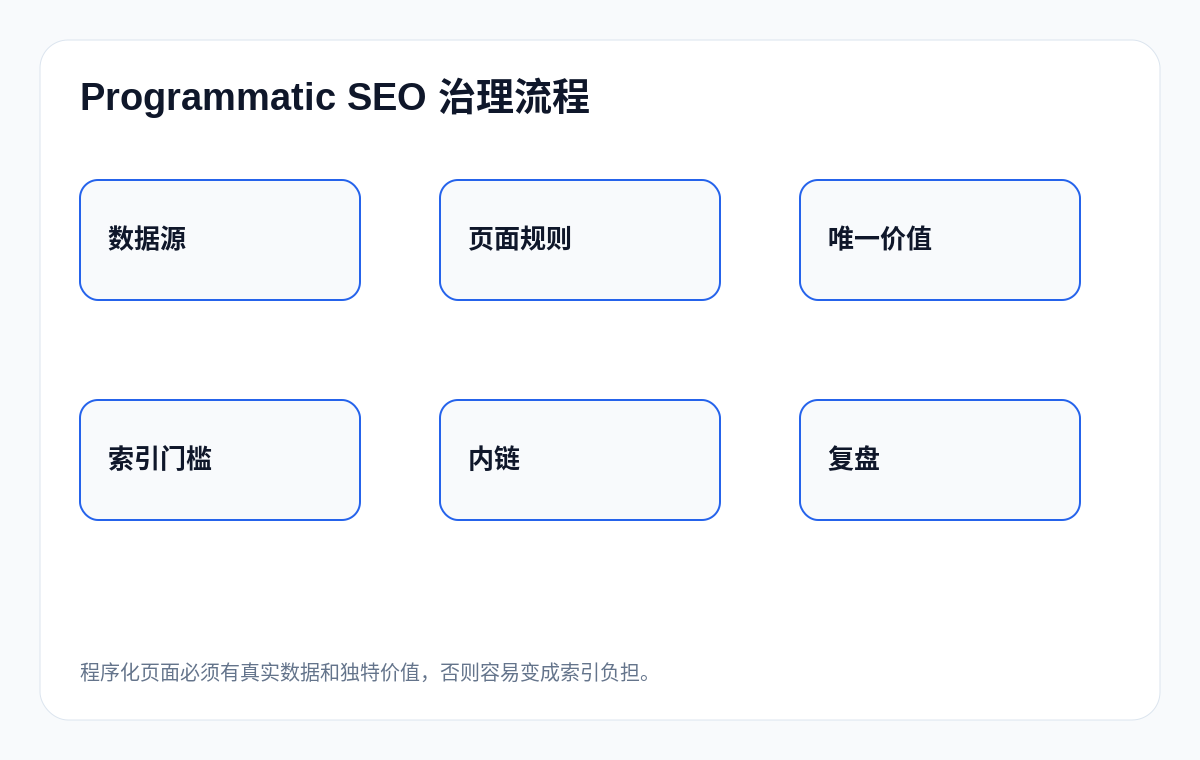
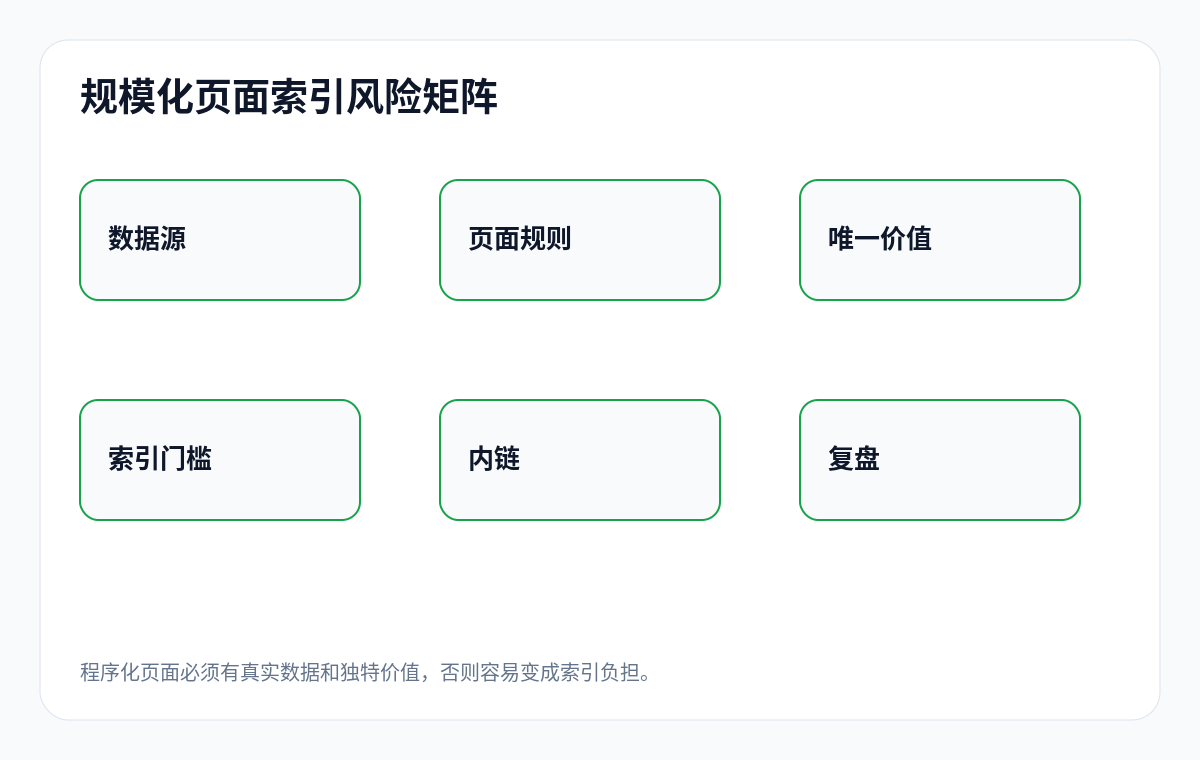
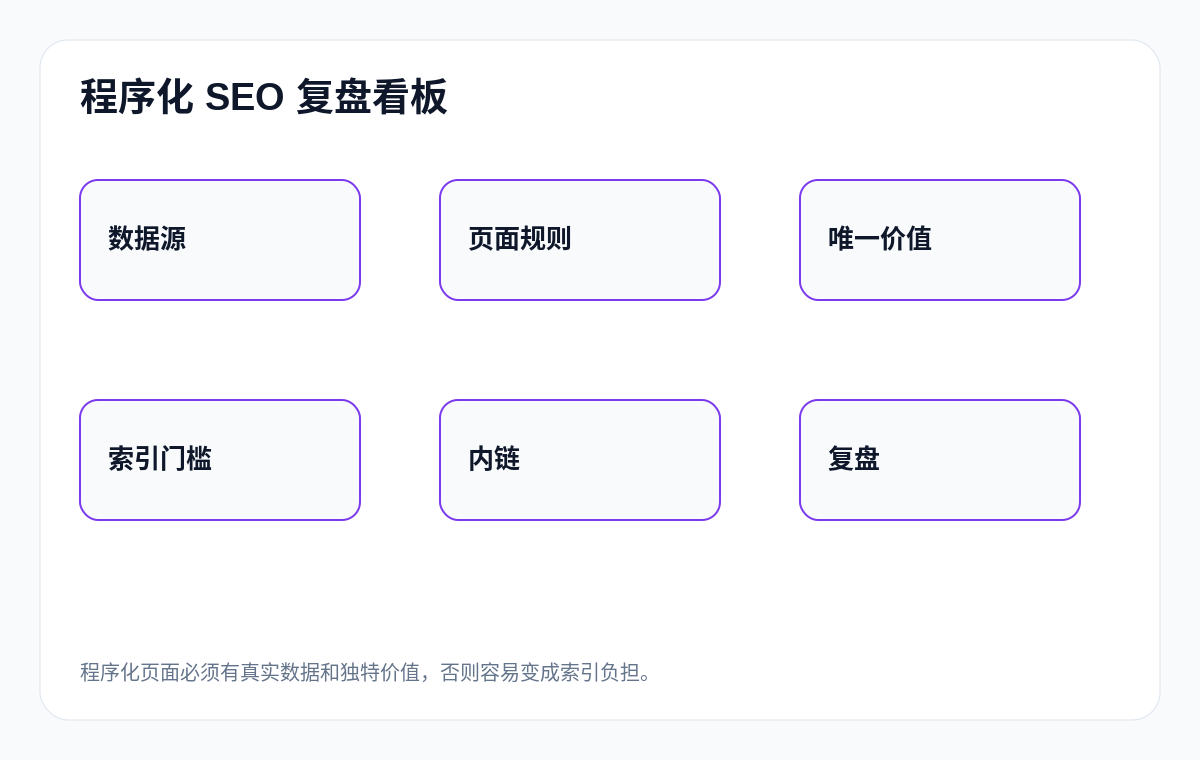
Programmatic SEO is a method for generating searchable pages at scale from structured data and page rules. It is not bulk page duplication, and it is not the random combination of cities, products, and specifications into a large number of pages. For export businesses, Programmatic SEO is only worth doing when every page has real data, unique value, clear search intent, and measurable business value that can be reviewed.
If you sell custom metal parts, LED flood light, packaging machine, medical probe, cnc machining parts, ceramic dinnerware, waterproof connector, industrial valve supplier, private label activewear manufacturer, you may want to build large numbers of material pages, size pages, application pages, regional pages, industry pages, model pages, and comparison pages. But if each page only swaps one word while the content and value stay the same, the result is thin content, index bloat, and wasted crawl budget. This article focuses on how to control page rules, index risk, and export inquiry value.
Step 1: Which export scenarios suit Programmatic SEO
The core question in deciding which export scenarios suit Programmatic SEO is whether a page has independent search intent and unique value. Programmatic SEO should not generate pages just to increase page count, and in particular low-value combinations must not consume index and crawl resources.
For products such as custom metal parts, LED flood light, packaging machine, medical probe, cnc machining parts, ceramic dinnerware, waterproof connector, industrial valve supplier, private label activewear manufacturer, a standalone page is only appropriate when differences in material, specification, application, industry, region, or model actually affect a buyer’s purchasing decision. Otherwise, the content should be merged into a category page, a guide page, or a filtering function.
| Dimension | Risky approach | Correct approach |
|---|---|---|
| Data source | No real data | Use real fields such as product specifications, applications, inventory, certifications, and regional service |
| Page rules | Simple word substitution | Each page type has its own structure and decision table |
| Unique value | Duplicated content | Provide unique specifications, comparisons, FAQs, and case boundaries |
| Index threshold | Index everything | Low-value combinations are noindexed or not generated |
| Internal links | Created in isolation | Link naturally from categories, applications, and guides |
| Review | Track only page count | Track index rate, clicks, inquiries, and lead quality |
Step 2: Why scaled pages carry high risk
The core question in deciding why scaled pages carry high risk is whether a page has independent search intent and unique value. Programmatic SEO should not generate pages just to increase page count, and in particular low-value combinations must not consume index and crawl resources.
For products such as custom metal parts, LED flood light, packaging machine, medical probe, cnc machining parts, ceramic dinnerware, waterproof connector, industrial valve supplier, private label activewear manufacturer, a standalone page is only appropriate when differences in material, specification, application, industry, region, or model actually affect a buyer’s purchasing decision. Otherwise, the content should be merged into a category page, a guide page, or a filtering function.
Step 3: How to judge the data source
The core question in judging the data source is whether a page has independent search intent and unique value. Programmatic SEO should not generate pages just to increase page count, and in particular low-value combinations must not consume index and crawl resources.
For products such as custom metal parts, LED flood light, packaging machine, medical probe, cnc machining parts, ceramic dinnerware, waterproof connector, industrial valve supplier, private label activewear manufacturer, a standalone page is only appropriate when differences in material, specification, application, industry, region, or model actually affect a buyer’s purchasing decision. Otherwise, the content should be merged into a category page, a guide page, or a filtering function.
| Dimension | Risky approach | Correct approach |
|---|---|---|
| Data source | No real data | Use real fields such as product specifications, applications, inventory, certifications, and regional service |
| Page rules | Simple word substitution | Each page type has its own structure and decision table |
| Unique value | Duplicated content | Provide unique specifications, comparisons, FAQs, and case boundaries |
| Index threshold | Index everything | Low-value combinations are noindexed or not generated |
| Internal links | Created in isolation | Link naturally from categories, applications, and guides |
| Review | Track only page count | Track index rate, clicks, inquiries, and lead quality |
Step 4: How to design page rules
The core question in designing page rules is whether a page has independent search intent and unique value. Programmatic SEO should not generate pages just to increase page count, and in particular low-value combinations must not consume index and crawl resources.
For products such as custom metal parts, LED flood light, packaging machine, medical probe, cnc machining parts, ceramic dinnerware, waterproof connector, industrial valve supplier, private label activewear manufacturer, a standalone page is only appropriate when differences in material, specification, application, industry, region, or model actually affect a buyer’s purchasing decision. Otherwise, the content should be merged into a category page, a guide page, or a filtering function.
Step 5: How to set index thresholds
The core question in setting index thresholds is whether a page has independent search intent and unique value. Programmatic SEO should not generate pages just to increase page count, and in particular low-value combinations must not consume index and crawl resources.
For products such as custom metal parts, LED flood light, packaging machine, medical probe, cnc machining parts, ceramic dinnerware, waterproof connector, industrial valve supplier, private label activewear manufacturer, a standalone page is only appropriate when differences in material, specification, application, industry, region, or model actually affect a buyer’s purchasing decision. Otherwise, the content should be merged into a category page, a guide page, or a filtering function.
| Dimension | Risky approach | Correct approach |
|---|---|---|
| Data source | No real data | Use real fields such as product specifications, applications, inventory, certifications, and regional service |
| Page rules | Simple word substitution | Each page type has its own structure and decision table |
| Unique value | Duplicated content | Provide unique specifications, comparisons, FAQs, and case boundaries |
| Index threshold | Index everything | Low-value combinations are noindexed or not generated |
| Internal links | Created in isolation | Link naturally from categories, applications, and guides |
| Review | Track only page count | Track index rate, clicks, inquiries, and lead quality |
Step 6: Which pages should not be generated
The core question in deciding which pages should not be generated is whether a page has independent search intent and unique value. Programmatic SEO should not generate pages just to increase page count, and in particular low-value combinations must not consume index and crawl resources.
For products such as custom metal parts, LED flood light, packaging machine, medical probe, cnc machining parts, ceramic dinnerware, waterproof connector, industrial valve supplier, private label activewear manufacturer, a standalone page is only appropriate when differences in material, specification, application, industry, region, or model actually affect a buyer’s purchasing decision. Otherwise, the content should be merged into a category page, a guide page, or a filtering function.
Step 7: Which pages should be noindexed
The core question in deciding which pages should be noindexed is whether a page has independent search intent and unique value. Programmatic SEO should not generate pages just to increase page count, and in particular low-value combinations must not consume index and crawl resources.
For products such as custom metal parts, LED flood light, packaging machine, medical probe, cnc machining parts, ceramic dinnerware, waterproof connector, industrial valve supplier, private label activewear manufacturer, a standalone page is only appropriate when differences in material, specification, application, industry, region, or model actually affect a buyer’s purchasing decision. Otherwise, the content should be merged into a category page, a guide page, or a filtering function.
| Dimension | Risky approach | Correct approach |
|---|---|---|
| Data source | No real data | Use real fields such as product specifications, applications, inventory, certifications, and regional service |
| Page rules | Simple word substitution | Each page type has its own structure and decision table |
| Unique value | Duplicated content | Provide unique specifications, comparisons, FAQs, and case boundaries |
| Index threshold | Index everything | Low-value combinations are noindexed or not generated |
| Internal links | Created in isolation | Link naturally from categories, applications, and guides |
| Review | Track only page count | Track index rate, clicks, inquiries, and lead quality |
Step 8: How to control parameter combinations
The core question in controlling parameter combinations is whether a page has independent search intent and unique value. Programmatic SEO should not generate pages just to increase page count, and in particular low-value combinations must not consume index and crawl resources.
For products such as custom metal parts, LED flood light, packaging machine, medical probe, cnc machining parts, ceramic dinnerware, waterproof connector, industrial valve supplier, private label activewear manufacturer, a standalone page is only appropriate when differences in material, specification, application, industry, region, or model actually affect a buyer’s purchasing decision. Otherwise, the content should be merged into a category page, a guide page, or a filtering function.
Step 9: How regional pages avoid fake localization
The core question in helping regional pages avoid fake localization is whether a page has independent search intent and unique value. Programmatic SEO should not generate pages just to increase page count, and in particular low-value combinations must not consume index and crawl resources.
For products such as custom metal parts, LED flood light, packaging machine, medical probe, cnc machining parts, ceramic dinnerware, waterproof connector, industrial valve supplier, private label activewear manufacturer, a standalone page is only appropriate when differences in material, specification, application, industry, region, or model actually affect a buyer’s purchasing decision. Otherwise, the content should be merged into a category page, a guide page, or a filtering function.
| Dimension | Risky approach | Correct approach |
|---|---|---|
| Data source | No real data | Use real fields such as product specifications, applications, inventory, certifications, and regional service |
| Page rules | Simple word substitution | Each page type has its own structure and decision table |
| Unique value | Duplicated content | Provide unique specifications, comparisons, FAQs, and case boundaries |
| Index threshold | Index everything | Low-value combinations are noindexed or not generated |
| Internal links | Created in isolation | Link naturally from categories, applications, and guides |
| Review | Track only page count | Track index rate, clicks, inquiries, and lead quality |
Step 10: How to build product application pages
The core question in building product application pages is whether a page has independent search intent and unique value. Programmatic SEO should not generate pages just to increase page count, and in particular low-value combinations must not consume index and crawl resources.
For products such as custom metal parts, LED flood light, packaging machine, medical probe, cnc machining parts, ceramic dinnerware, waterproof connector, industrial valve supplier, private label activewear manufacturer, a standalone page is only appropriate when differences in material, specification, application, industry, region, or model actually affect a buyer’s purchasing decision. Otherwise, the content should be merged into a category page, a guide page, or a filtering function.
Step 11: How to build material and specification pages
The core question in building material and specification pages is whether a page has independent search intent and unique value. Programmatic SEO should not generate pages just to increase page count, and in particular low-value combinations must not consume index and crawl resources.
For products such as custom metal parts, LED flood light, packaging machine, medical probe, cnc machining parts, ceramic dinnerware, waterproof connector, industrial valve supplier, private label activewear manufacturer, a standalone page is only appropriate when differences in material, specification, application, industry, region, or model actually affect a buyer’s purchasing decision. Otherwise, the content should be merged into a category page, a guide page, or a filtering function.
| Dimension | Risky approach | Correct approach |
|---|---|---|
| Data source | No real data | Use real fields such as product specifications, applications, inventory, certifications, and regional service |
| Page rules | Simple word substitution | Each page type has its own structure and decision table |
| Unique value | Duplicated content | Provide unique specifications, comparisons, FAQs, and case boundaries |
| Index threshold | Index everything | Low-value combinations are noindexed or not generated |
| Internal links | Created in isolation | Link naturally from categories, applications, and guides |
| Review | Track only page count | Track index rate, clicks, inquiries, and lead quality |
Step 12: How to build model and replacement pages
The core question in building model and replacement pages is whether a page has independent search intent and unique value. Programmatic SEO should not generate pages just to increase page count, and in particular low-value combinations must not consume index and crawl resources.
For products such as custom metal parts, LED flood light, packaging machine, medical probe, cnc machining parts, ceramic dinnerware, waterproof connector, industrial valve supplier, private label activewear manufacturer, a standalone page is only appropriate when differences in material, specification, application, industry, region, or model actually affect a buyer’s purchasing decision. Otherwise, the content should be merged into a category page, a guide page, or a filtering function.
Step 13: How to build comparison pages
The core question in building comparison pages is whether a page has independent search intent and unique value. Programmatic SEO should not generate pages just to increase page count, and in particular low-value combinations must not consume index and crawl resources.
For products such as custom metal parts, LED flood light, packaging machine, medical probe, cnc machining parts, ceramic dinnerware, waterproof connector, industrial valve supplier, private label activewear manufacturer, a standalone page is only appropriate when differences in material, specification, application, industry, region, or model actually affect a buyer’s purchasing decision. Otherwise, the content should be merged into a category page, a guide page, or a filtering function.
| Dimension | Risky approach | Correct approach |
|---|---|---|
| Data source | No real data | Use real fields such as product specifications, applications, inventory, certifications, and regional service |
| Page rules | Simple word substitution | Each page type has its own structure and decision table |
| Unique value | Duplicated content | Provide unique specifications, comparisons, FAQs, and case boundaries |
| Index threshold | Index everything | Low-value combinations are noindexed or not generated |
| Internal links | Created in isolation | Link naturally from categories, applications, and guides |
| Review | Track only page count | Track index rate, clicks, inquiries, and lead quality |
Step 14: How to design internal links
The core question in designing internal links is whether a page has independent search intent and unique value. Programmatic SEO should not generate pages just to increase page count, and in particular low-value combinations must not consume index and crawl resources.
For products such as custom metal parts, LED flood light, packaging machine, medical probe, cnc machining parts, ceramic dinnerware, waterproof connector, industrial valve supplier, private label activewear manufacturer, a standalone page is only appropriate when differences in material, specification, application, industry, region, or model actually affect a buyer’s purchasing decision. Otherwise, the content should be merged into a category page, a guide page, or a filtering function.
Step 15: How to submit sitemaps
The core question in submitting sitemaps is whether a page has independent search intent and unique value. Programmatic SEO should not generate pages just to increase page count, and in particular low-value combinations must not consume index and crawl resources.
For products such as custom metal parts, LED flood light, packaging machine, medical probe, cnc machining parts, ceramic dinnerware, waterproof connector, industrial valve supplier, private label activewear manufacturer, a standalone page is only appropriate when differences in material, specification, application, industry, region, or model actually affect a buyer’s purchasing decision. Otherwise, the content should be merged into a category page, a guide page, or a filtering function.
| Dimension | Risky approach | Correct approach |
|---|---|---|
| Data source | No real data | Use real fields such as product specifications, applications, inventory, certifications, and regional service |
| Page rules | Simple word substitution | Each page type has its own structure and decision table |
| Unique value | Duplicated content | Provide unique specifications, comparisons, FAQs, and case boundaries |
| Index threshold | Index everything | Low-value combinations are noindexed or not generated |
| Internal links | Created in isolation | Link naturally from categories, applications, and guides |
| Review | Track only page count | Track index rate, clicks, inquiries, and lead quality |
Step 16: How to monitor index rate in GSC
The core question in monitoring index rate in GSC is whether a page has independent search intent and unique value. Programmatic SEO should not generate pages just to increase page count, and in particular low-value combinations must not consume index and crawl resources.
For products such as custom metal parts, LED flood light, packaging machine, medical probe, cnc machining parts, ceramic dinnerware, waterproof connector, industrial valve supplier, private label activewear manufacturer, a standalone page is only appropriate when differences in material, specification, application, industry, region, or model actually affect a buyer’s purchasing decision. Otherwise, the content should be merged into a category page, a guide page, or a filtering function.
Step 17: How to read crawl waste from logs
The core question in reading crawl waste from logs is whether a page has independent search intent and unique value. Programmatic SEO should not generate pages just to increase page count, and in particular low-value combinations must not consume index and crawl resources.
For products such as custom metal parts, LED flood light, packaging machine, medical probe, cnc machining parts, ceramic dinnerware, waterproof connector, industrial valve supplier, private label activewear manufacturer, a standalone page is only appropriate when differences in material, specification, application, industry, region, or model actually affect a buyer’s purchasing decision. Otherwise, the content should be merged into a category page, a guide page, or a filtering function.
| Dimension | Risky approach | Correct approach |
|---|---|---|
| Data source | No real data | Use real fields such as product specifications, applications, inventory, certifications, and regional service |
| Page rules | Simple word substitution | Each page type has its own structure and decision table |
| Unique value | Duplicated content | Provide unique specifications, comparisons, FAQs, and case boundaries |
| Index threshold | Index everything | Low-value combinations are noindexed or not generated |
| Internal links | Created in isolation | Link naturally from categories, applications, and guides |
| Review | Track only page count | Track index rate, clicks, inquiries, and lead quality |
Step 18: How to judge value with GA4 and CRM
The core question in judging value with GA4 and CRM is whether a page has independent search intent and unique value. Programmatic SEO should not generate pages just to increase page count, and in particular low-value combinations must not consume index and crawl resources.
For products such as custom metal parts, LED flood light, packaging machine, medical probe, cnc machining parts, ceramic dinnerware, waterproof connector, industrial valve supplier, private label activewear manufacturer, a standalone page is only appropriate when differences in material, specification, application, industry, region, or model actually affect a buyer’s purchasing decision. Otherwise, the content should be merged into a category page, a guide page, or a filtering function.
Step 19: AI search and structured pages
The core question in AI search and structured pages is whether a page has independent search intent and unique value. Programmatic SEO should not generate pages just to increase page count, and in particular low-value combinations must not consume index and crawl resources.
For products such as custom metal parts, LED flood light, packaging machine, medical probe, cnc machining parts, ceramic dinnerware, waterproof connector, industrial valve supplier, private label activewear manufacturer, a standalone page is only appropriate when differences in material, specification, application, industry, region, or model actually affect a buyer’s purchasing decision. Otherwise, the content should be merged into a category page, a guide page, or a filtering function.
| Dimension | Risky approach | Correct approach |
|---|---|---|
| Data source | No real data | Use real fields such as product specifications, applications, inventory, certifications, and regional service |
| Page rules | Simple word substitution | Each page type has its own structure and decision table |
| Unique value | Duplicated content | Provide unique specifications, comparisons, FAQs, and case boundaries |
| Index threshold | Index everything | Low-value combinations are noindexed or not generated |
| Internal links | Created in isolation | Link naturally from categories, applications, and guides |
| Review | Track only page count | Track index rate, clicks, inquiries, and lead quality |
Step 20: custom metal parts programmatic scenarios
The core question in custom metal parts programmatic scenarios is whether a page has independent search intent and unique value. Programmatic SEO should not generate pages just to increase page count, and in particular low-value combinations must not consume index and crawl resources.
For products such as custom metal parts, LED flood light, packaging machine, medical probe, cnc machining parts, ceramic dinnerware, waterproof connector, industrial valve supplier, private label activewear manufacturer, a standalone page is only appropriate when differences in material, specification, application, industry, region, or model actually affect a buyer’s purchasing decision. Otherwise, the content should be merged into a category page, a guide page, or a filtering function.
Step 21: LED flood light programmatic scenarios
The core question in LED flood light programmatic scenarios is whether a page has independent search intent and unique value. Programmatic SEO should not generate pages just to increase page count, and in particular low-value combinations must not consume index and crawl resources.
For products such as custom metal parts, LED flood light, packaging machine, medical probe, cnc machining parts, ceramic dinnerware, waterproof connector, industrial valve supplier, private label activewear manufacturer, a standalone page is only appropriate when differences in material, specification, application, industry, region, or model actually affect a buyer’s purchasing decision. Otherwise, the content should be merged into a category page, a guide page, or a filtering function.
| Dimension | Risky approach | Correct approach |
|---|---|---|
| Data source | No real data | Use real fields such as product specifications, applications, inventory, certifications, and regional service |
| Page rules | Simple word substitution | Each page type has its own structure and decision table |
| Unique value | Duplicated content | Provide unique specifications, comparisons, FAQs, and case boundaries |
| Index threshold | Index everything | Low-value combinations are noindexed or not generated |
| Internal links | Created in isolation | Link naturally from categories, applications, and guides |
| Review | Track only page count | Track index rate, clicks, inquiries, and lead quality |
Step 22: packaging machine programmatic scenarios
The core question in packaging machine programmatic scenarios is whether a page has independent search intent and unique value. Programmatic SEO should not generate pages just to increase page count, and in particular low-value combinations must not consume index and crawl resources.
For products such as custom metal parts, LED flood light, packaging machine, medical probe, cnc machining parts, ceramic dinnerware, waterproof connector, industrial valve supplier, private label activewear manufacturer, a standalone page is only appropriate when differences in material, specification, application, industry, region, or model actually affect a buyer’s purchasing decision. Otherwise, the content should be merged into a category page, a guide page, or a filtering function.
Step 23: medical probe programmatic scenarios
The core question in medical probe programmatic scenarios is whether a page has independent search intent and unique value. Programmatic SEO should not generate pages just to increase page count, and in particular low-value combinations must not consume index and crawl resources.
For products such as custom metal parts, LED flood light, packaging machine, medical probe, cnc machining parts, ceramic dinnerware, waterproof connector, industrial valve supplier, private label activewear manufacturer, a standalone page is only appropriate when differences in material, specification, application, industry, region, or model actually affect a buyer’s purchasing decision. Otherwise, the content should be merged into a category page, a guide page, or a filtering function.
| Dimension | Risky approach | Correct approach |
|---|---|---|
| Data source | No real data | Use real fields such as product specifications, applications, inventory, certifications, and regional service |
| Page rules | Simple word substitution | Each page type has its own structure and decision table |
| Unique value | Duplicated content | Provide unique specifications, comparisons, FAQs, and case boundaries |
| Index threshold | Index everything | Low-value combinations are noindexed or not generated |
| Internal links | Created in isolation | Link naturally from categories, applications, and guides |
| Review | Track only page count | Track index rate, clicks, inquiries, and lead quality |
Step 24: ceramic dinnerware programmatic scenarios
The core question in ceramic dinnerware programmatic scenarios is whether a page has independent search intent and unique value. Programmatic SEO should not generate pages just to increase page count, and in particular low-value combinations must not consume index and crawl resources.
For products such as custom metal parts, LED flood light, packaging machine, medical probe, cnc machining parts, ceramic dinnerware, waterproof connector, industrial valve supplier, private label activewear manufacturer, a standalone page is only appropriate when differences in material, specification, application, industry, region, or model actually affect a buyer’s purchasing decision. Otherwise, the content should be merged into a category page, a guide page, or a filtering function.
Step 25: waterproof connector programmatic scenarios
The core question in waterproof connector programmatic scenarios is whether a page has independent search intent and unique value. Programmatic SEO should not generate pages just to increase page count, and in particular low-value combinations must not consume index and crawl resources.
For products such as custom metal parts, LED flood light, packaging machine, medical probe, cnc machining parts, ceramic dinnerware, waterproof connector, industrial valve supplier, private label activewear manufacturer, a standalone page is only appropriate when differences in material, specification, application, industry, region, or model actually affect a buyer’s purchasing decision. Otherwise, the content should be merged into a category page, a guide page, or a filtering function.
| Dimension | Risky approach | Correct approach |
|---|---|---|
| Data source | No real data | Use real fields such as product specifications, applications, inventory, certifications, and regional service |
| Page rules | Simple word substitution | Each page type has its own structure and decision table |
| Unique value | Duplicated content | Provide unique specifications, comparisons, FAQs, and case boundaries |
| Index threshold | Index everything | Low-value combinations are noindexed or not generated |
| Internal links | Created in isolation | Link naturally from categories, applications, and guides |
| Review | Track only page count | Track index rate, clicks, inquiries, and lead quality |
Step 26: Pre-launch checklist
The core question in the pre-launch checklist is whether a page has independent search intent and unique value. Programmatic SEO should not generate pages just to increase page count, and in particular low-value combinations must not consume index and crawl resources.
For products such as custom metal parts, LED flood light, packaging machine, medical probe, cnc machining parts, ceramic dinnerware, waterproof connector, industrial valve supplier, private label activewear manufacturer, a standalone page is only appropriate when differences in material, specification, application, industry, region, or model actually affect a buyer’s purchasing decision. Otherwise, the content should be merged into a category page, a guide page, or a filtering function.
Step 27: 90-day review
The core question in the 90-day review is whether a page has independent search intent and unique value. Programmatic SEO should not generate pages just to increase page count, and in particular low-value combinations must not consume index and crawl resources.
For products such as custom metal parts, LED flood light, packaging machine, medical probe, cnc machining parts, ceramic dinnerware, waterproof connector, industrial valve supplier, private label activewear manufacturer, a standalone page is only appropriate when differences in material, specification, application, industry, region, or model actually affect a buyer’s purchasing decision. Otherwise, the content should be merged into a category page, a guide page, or a filtering function.
| Dimension | Risky approach | Correct approach |
|---|---|---|
| Data source | No real data | Use real fields such as product specifications, applications, inventory, certifications, and regional service |
| Page rules | Simple word substitution | Each page type has its own structure and decision table |
| Unique value | Duplicated content | Provide unique specifications, comparisons, FAQs, and case boundaries |
| Index threshold | Index everything | Low-value combinations are noindexed or not generated |
| Internal links | Created in isolation | Link naturally from categories, applications, and guides |
| Review | Track only page count | Track index rate, clicks, inquiries, and lead quality |
Step 28: Common misconceptions
The core question in reviewing common misconceptions is whether a page has independent search intent and unique value. Programmatic SEO should not generate pages just to increase page count, and in particular low-value combinations must not consume index and crawl resources.
For products such as custom metal parts, LED flood light, packaging machine, medical probe, cnc machining parts, ceramic dinnerware, waterproof connector, industrial valve supplier, private label activewear manufacturer, a standalone page is only appropriate when differences in material, specification, application, industry, region, or model actually affect a buyer’s purchasing decision. Otherwise, the content should be merged into a category page, a guide page, or a filtering function.
FAQ: Common questions about Programmatic SEO
Does Programmatic SEO mean automatically generating a large number of pages?
No. It means generating pages with unique value from real data and clear rules, not simply swapping words in bulk.
Is Programmatic SEO suitable for export websites?
It suits some scenarios, such as material, application, model, regional service, and product specification pages, but index quality must be controlled.
Should every combination page be indexed?
No. Combination pages with low search value, duplicated content, or no business value should be noindexed, consolidated, or not generated at all.
How do programmatic pages avoid thin content?
Give every page unique data, a decision table, FAQs, application scenarios, image captions, and links to related products.
Does Programmatic SEO carry risk?
Yes. Low-quality content at scale can cause index bloat, wasted crawl budget, and content quality problems.
How should Programmatic SEO be reviewed?
Look at index rate, GSC queries, crawl logs, GA4 behavior, inquiry sources, and CRM lead quality.
Will AI search cite programmatic pages?
Only pages with clear structure, real data, and the ability to answer specific questions have a better chance of being understood and cited.
Conclusion: Programmatic SEO is about the quality threshold
Programmatic SEO is valuable for export businesses, but only if every page helps a buyer complete a decision. Whether you sell custom metal parts, LED flood light, packaging machine, medical probe, cnc machining parts, ceramic dinnerware, waterproof connector, industrial valve supplier, private label activewear manufacturer, you should first set the data source, page rules, index threshold, and review metrics, and only then decide whether to generate pages at scale.
Official references and the quality boundary of Programmatic SEO
The risk of Programmatic SEO is low-quality pages at scale. Export websites can scale their page structure, but every page needs independent facts, a real use case, an indexable entry point, and a clear quality threshold.
| Official source | What it is used to judge | Acceptance boundary |
|---|---|---|
| Google: Spam policies | Check for scaled low-quality content, doorway pages, and content abuse risk | Generating pages in bulk cannot bypass quality requirements |
| Google: Helpful content | Confirm whether a page has independent user value | A template change is not information gain |
| Google: Consolidate duplicate URLs | Handle similar parameter pages and duplicate pages | canonical cannot rescue every thin page |
| Google: Sitemaps overview | Submit in batches and observe URL discovery | Submitting more does not equal indexing more |
| Search Console Performance report | Observe real search performance by page group | Do not write growth conclusions during a low-data period |
Low-data period review table
| Check item | Fields to record | How to write during a low-data period |
|---|---|---|
| Index entry point | index/follow, canonical, sitemap, internal links, HTTP status code | Record only the current accessible state, not a judgment about search results |
| Content evidence | Page role, product or service materials, images, structured data, update date | List gaps when materials are insufficient; do not add invented cases |
| Search Console | query, page, country, device, date window | If GSC shows zero rows, write zero rows; do not extrapolate rankings or clicks |
| GA4 review | Forms, downloads, email clicks, inquiry entry points, key events | If events are missing, fix collection first; do not write conversion conclusions |
Continue reading this SEO collection
If you are working through export website SEO systematically, it helps to continue with the articles below. Start by clarifying how crawling, indexing, content, links, and review relate to one another, then decide which page to change next.
- How to do Enterprise SEO: A guide to crawling, structure, permissions, and team governance for large export websites
- How to do International Ecommerce SEO: A guide to multilingual, multi-currency, and cross-border category page optimization
- How Google crawls, indexes, and ranks: A diagnostic guide for export websites from indexing to inquiries
- How search engines work: A guide to crawling, indexing, ranking, and export website diagnostics
- Technical SEO audit checklist: A diagnostic guide to crawling, indexing, structure, and inquiry paths for export websites
- Sitemap technical guide: Sitemap submission, index diagnostics, and troubleshooting common errors
{
“@context”: “https://schema.org”,
“@type”: “FAQPage”,
“mainEntity”: [
{
“@type”: “Question”,
“name”: “Does Programmatic SEO mean automatically generating a large number of pages?”,
“acceptedAnswer”: {
“@type”: “Answer”,
“text”: “No. It means generating pages with unique value from real data and clear rules, not simply swapping words in bulk.”
}
},
{
“@type”: “Question”,
“name”: “Is Programmatic SEO suitable for export websites?”,
“acceptedAnswer”: {
“@type”: “Answer”,
“text”: “It suits some scenarios, such as material, application, model, regional service, and product specification pages, but index quality must be controlled.”
}
},
{
“@type”: “Question”,
“name”: “Should every combination page be indexed?”,
“acceptedAnswer”: {
“@type”: “Answer”,
“text”: “No. Combination pages with low search value, duplicated content, or no business value should be noindexed, consolidated, or not generated at all.”
}
},
{
“@type”: “Question”,
“name”: “How do programmatic pages avoid thin content?”,
“acceptedAnswer”: {
“@type”: “Answer”,
“text”: “Give every page unique data, a decision table, FAQs, application scenarios, image captions, and links to related products.”
}
},
{
“@type”: “Question”,
“name”: “Does Programmatic SEO carry risk?”,
“acceptedAnswer”: {
“@type”: “Answer”,
“text”: “Yes. Low-quality content at scale can cause index bloat, wasted crawl budget, and content quality problems.”
}
}
]
}
This page is machine-translated from the Simplified Chinese version and awaiting human review. It has not yet been proofread.